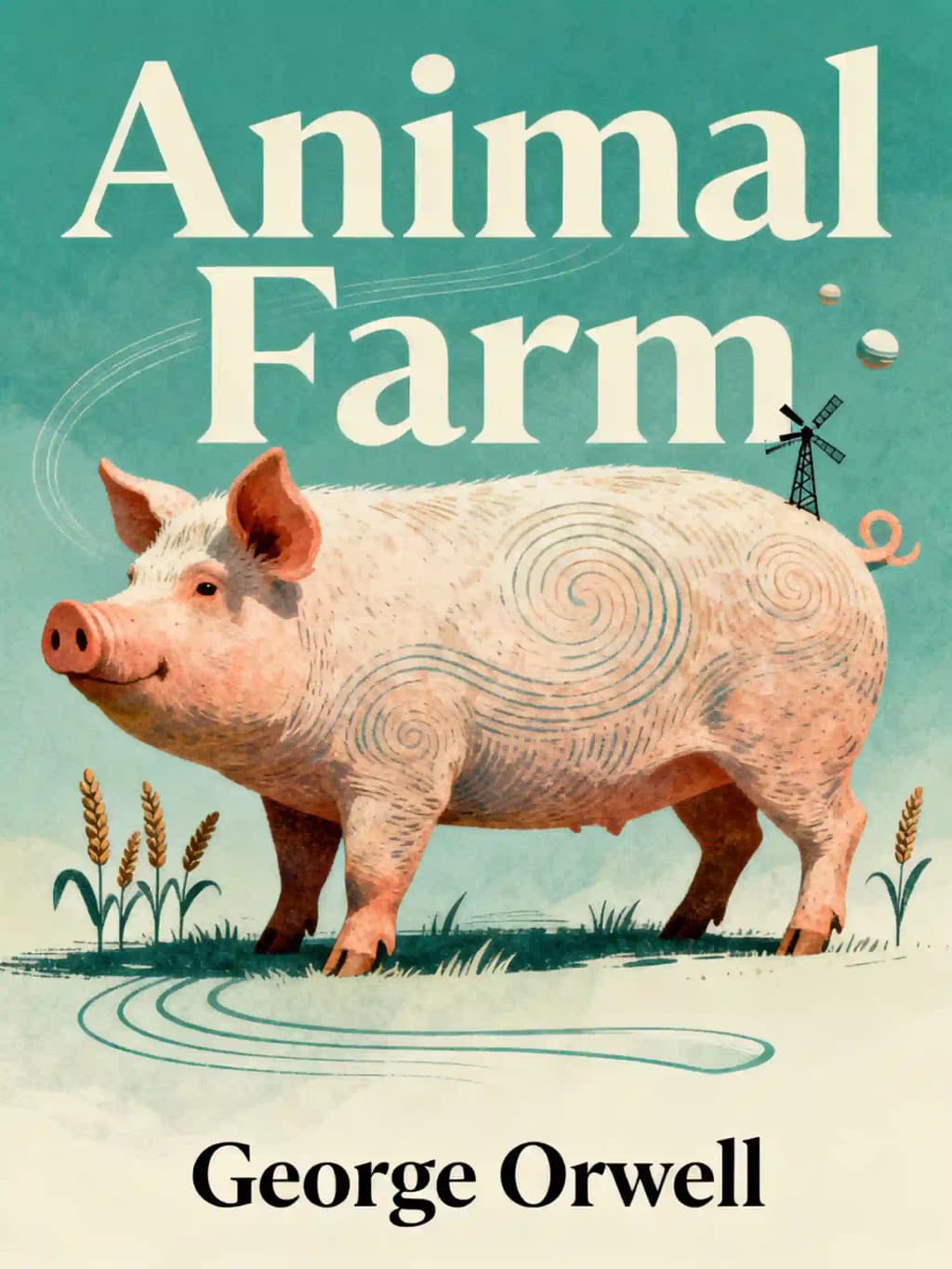
Animal Farm
Panoramica di Animal Farm
Orwell's allegorical masterpiece exposes totalitarianism through rebellious farm animals. Banned in Stalin's USSR, its chilling warning "some animals are more equal than others" resonates across generations. What makes this political satire, written during WWII, still frighteningly relevant in today's power dynamics?

Temi chiave in Animal Farm
- revolutionary corruption
- totalitarian propaganda
- class stratification
- language manipulation
- power dynamics
Citazioni da Animal Farm
Four legs good, two legs bad.
Man is the only creature that consumes without producing.
Beasts of England, beasts of Ireland, / Beasts of every land and clime, / Hearken to my joyful tidings / Of the golden future time.
The creatures outside looked from pig to man, and from man to pig, and from pig to man again; but already it was impossible to say which was which.
Personaggi di Animal Farm
- SnowballA vivacious and inventive pig and leader
- Old MajorA prize-winning boar who inspires the rebellion
- BoxerA loyal and hardworking cart-horse
- SquealerA brilliant talker and persuasive pig
Sull'autore
Sull'autore di Animal Farm
George Orwell (1903–1950), born Eric Arthur Blair, was a renowned English novelist, essayist, and political critic best known for his allegorical masterpiece Animal Farm.
A sharp observer of authoritarianism and social injustice, Orwell fused his experiences as a colonial policeman in Burma, a soldier in the Spanish Civil War, and a BBC journalist into works that dissect power dynamics and ideological manipulation.
Animal Farm (1945), a satirical fable about revolutionary betrayal, cemented his reputation as a visionary critic of totalitarianism, alongside his dystopian novel Nineteen Eighty-Four. His nonfiction classics—including The Road to Wigan Pier and Homage to Catalonia—blend investigative rigor with moral clarity, reflecting his lifelong commitment to democratic socialism.
Translated into over 70 languages and adapted into multiple films, Animal Farm remains a global literary touchstone, routinely taught in schools and cited in political discourse. Orwell’s astute warnings about propaganda, censorship, and thought control continue to resonate in modern culture, with the term "Orwellian" enduring as shorthand for oppressive governance.
Scarica il riassunto di Animal Farm
Ottieni il riassunto di Animal Farm in formato PDF o EPUB gratuito. Stampalo o leggilo offline quando vuoi.
FAQ su questo libro
Animal Farm is a political allegory about farm animals who overthrow their human owner, envisioning an equal society, only to see their revolution corrupted by power-hungry pigs. The story parallels the Russian Revolution, tracing how ideals of freedom devolve into tyranny as the pigs adopt human vices and oppressive tactics.
This book suits readers interested in political satire, historical allegories, or critiques of authoritarianism. Students, educators, and fans of classic literature will appreciate its layered symbolism and exploration of power dynamics.
Yes—it’s a timeless critique of totalitarianism and propaganda, distilled into a concise, accessible narrative. Its themes of corruption and manipulation remain relevant, making it essential for understanding political systems and human nature.
The Seven Commandments are rules created by the animals to enforce equality, such as “All animals are equal.” Over time, the pigs revise them (e.g., “No animal shall drink alcohol to excess”) to justify their exploitation, symbolizing the erosion of revolutionary ideals.
The windmill represents progress, propaganda, and flawed ambition. Initially a symbol of collective effort, it becomes a tool for the pigs to manipulate the animals, reflecting how authoritarian regimes co-opt projects to consolidate power.
Orwell employs symbols like the barn (shifting power structures), whiskey (corruption), and the dogs (state violence). These elements critique the Soviet Union’s betrayal of socialist ideals and the manipulation of language and fear.
- Napoleon: Joseph Stalin, using fear and propaganda.
- Snowball: Leon Trotsky, exiled for opposing Stalin.
- Boxer: The loyal working class, exploited despite dedication.
- Squealer: State-controlled media spreading lies.
This revised commandment exposes the pigs’ hypocrisy, highlighting how elites twist language to justify inequality. It underscores Orwell’s warning about the corrupting influence of power.
The novel’s themes—media manipulation, eroding truths, and unchecked authority—resonate in debates about misinformation and political polarization. Its critique of power structures remains a cautionary tale for contemporary governance.
Some argue it oversimplifies historical events or lacks nuanced character development. However, its strength lies in its allegorical clarity, making complex political concepts accessible.
Both critique totalitarianism, but Animal Farm uses allegory to dissect revolution’s failures, while 1984 explores dystopian surveillance. Orwell’s focus on language as a tool of control unites them.
- Question authority and propaganda.
- Vigilance is necessary to protect democratic ideals.
- Power corrupts when left unchecked.
These lessons apply to personal, professional, and societal contexts.
As political divisions and misinformation proliferate, the novel’s warnings about manipulated narratives, eroded freedoms, and charismatic authoritarianism offer urgent insights for maintaining accountable governance.
- 1984 (George Orwell): Dystopian control.
- Lord of the Flies (William Golding): Societal breakdown.
- Brave New World (Aldous Huxley): Technological tyranny.
Each explores power dynamics and human nature.