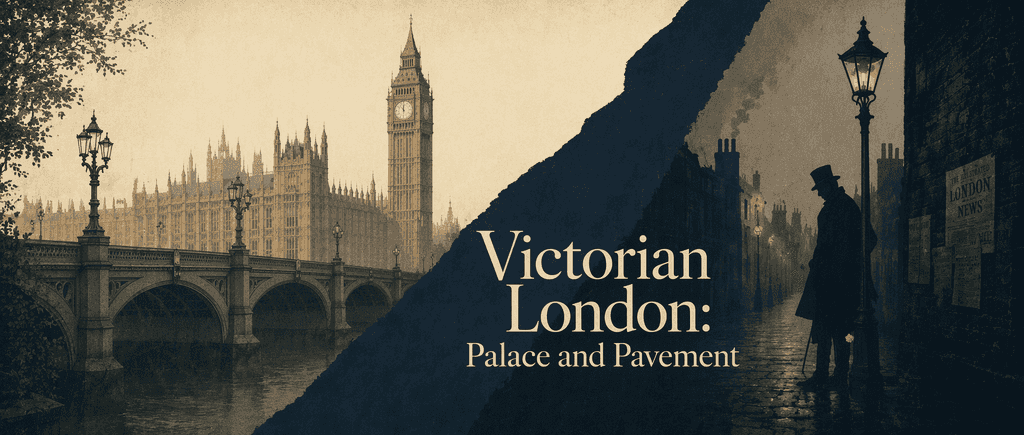
Dickens' masterpiece chronicles revolution-torn London and Paris, featuring history's most quoted opening line. With over 160 years of cultural impact, this haunting tale of sacrifice and redemption remains a literary cornerstone that still shapes how we understand social upheaval today.
Charles John Huffam Dickens (1812–1870) was a renowned Victorian novelist and social critic. He is the author of A Tale of Two Cities, a seminal work of historical fiction that intertwines themes of revolution, sacrifice, and redemption.
Born in Portsmouth, England, Dickens drew from his early experiences of poverty and his father’s imprisonment for debt. These early hardships fueled his lifelong advocacy for social reform and empathy for the marginalized.
Dickens was known for serialized storytelling and cliffhanger narratives. He pioneered literary techniques that captivated 19th-century readers. His expansive catalog includes classics like Great Expectations, Oliver Twist, and Bleak House, each critiquing systemic injustice through vivid characters and intricate plots.
A Tale of Two Cities remains a cornerstone of English literature, lauded for its exploration of duality during the French Revolution. Translated into over 30 languages and adapted into numerous films and plays, the novel has sold over 200 million copies worldwide, cementing Dickens’s legacy as a master storyteller whose works continue to resonate across generations.
A Tale of Two Cities explores the turmoil of the French Revolution through interconnected lives in London and Paris. Central themes include sacrifice, resurrection, and societal injustice, following characters like Charles Darnay, a renounced aristocrat; Sydney Carton, a self-sacrificing lawyer; and Lucie Manette, whose love binds them. The novel contrasts personal redemption with the chaos of political upheaval.
Fans of historical fiction, classic literature enthusiasts, and readers interested in moral dilemmas should read this book. Its gripping portrayal of revolution, complex characters like Carton and Madame Defarge, and themes of sacrifice make it ideal for students and those exploring 19th-century societal critiques. Dickens’ vivid prose and iconic opening line also appeal to lovers of literary craftsmanship.
Yes. As a cornerstone of English literature, it offers timeless insights into human resilience and societal conflict. Its iconic opening line, rich symbolism, and unforgettable characters—notably Sydney Carton’s redemption arc—make it a compelling read. Critics praise its exploration of duality and sacrifice, cementing its relevance for modern audiences.
The opening line uses antithesis to contrast the extremes of pre-revolutionary Europe, highlighting societal inequalities and foreshadowing chaos. Dickens underscores the duality of human experience—hope and despair, wealth and poverty—setting the stage for the novel’s exploration of conflict and redemption.
Carton transforms from a disillusioned alcoholic to a selfless hero. Initially cynical, his unrequited love for Lucie inspires him to sacrifice his life for Darnay, symbolizing spiritual rebirth. His final act, declaring “It is a far, far better thing I do,” epitomizes redemption and the novel’s theme of resurrection.
Dickens drew from the French Revolution (1789–1799), particularly the Storming of the Bastille and Reign of Terror. The novel critiques aristocratic oppression (e.g., Marquis Evrémonde’s cruelty) and revolutionary excesses, reflecting Dickens’ concerns about social inequality and violence in his own era.
Key figures include:
Their intertwined fates drive the narrative’s exploration of justice and mercy.
Themes include:
Social injustice is critiqued through the aristocracy’s brutality and the revolution’s bloody retribution, while love and solidarity emerge as redemptive forces.
Dickens depicts the revolution as both a justified revolt against oppression and a descent into chaos. Scenes like the Marquis’ murder and the guillotine’s “sharp female called La Guillotine” illustrate the cost of unchecked vengeance, critiquing both aristocratic corruption and revolutionary extremism.
Sacrifice drives the narrative: Carton dies for Darnay, Lucie nurtures her broken father, and Darnay risks his life to save Gabelle. These acts underscore themes of love and moral redemption, contrasting the destructive sacrifices of the revolution.
Through the Evrémondes’ exploitation of peasants and the Defarges’ vengeful uprising, Dickens condemns systemic oppression. The novel warns against dehumanization on both sides, advocating for empathy over retribution.
Some critics argue the plot relies on coincidences (e.g., Carton and Darnay’s resemblance) and melodrama. Others note underdeveloped female characters beyond Lucie and Madame Defarge. Despite this, its emotional depth and thematic complexity remain widely praised.
Senti il libro attraverso la voce dell'autore
Trasforma la conoscenza in spunti coinvolgenti e ricchi di esempi
Cattura le idee chiave in un lampo per un apprendimento veloce
Goditi il libro in modo divertente e coinvolgente
The authorities display a fatal inability to read the warning signs.
England too has its 'dear old institutions' of pillories.
Lucie's devotion gradually restores her father to his former self.
The courtroom is packed with spectators showing 'Ogreish' interest.
The trauma of his imprisonment remains a shadow over his life.
Scomponi le idee chiave di A Tale of Two Cities in punti facili da capire per comprendere come i team innovativi creano, collaborano e crescono.
Vivi A Tale of Two Cities attraverso narrazioni vivide che trasformano le lezioni di innovazione in momenti che ricorderai e applicherai.
Chiedi qualsiasi cosa, scegli il tuo stile di apprendimento e co-crea intuizioni che risuonano davvero con te.

Creato da alumni della Columbia University a San Francisco
"Instead of endless scrolling, I just hit play on BeFreed. It saves me so much time."
"I never knew where to start with nonfiction—BeFreed’s book lists turned into podcasts gave me a clear path."
"Perfect balance between learning and entertainment. Finished ‘Thinking, Fast and Slow’ on my commute this week."
"Crazy how much I learned while walking the dog. BeFreed = small habits → big gains."
"Reading used to feel like a chore. Now it’s just part of my lifestyle."
"Feels effortless compared to reading. I’ve finished 6 books this month already."
"BeFreed turned my guilty doomscrolling into something that feels productive and inspiring."
"BeFreed turned my commute into learning time. 20-min podcasts are perfect for finishing books I never had time for."
"BeFreed replaced my podcast queue. Imagine Spotify for books — that’s it. 🙌"
"It is great for me to learn something from the book without reading it."
"The themed book list podcasts help me connect ideas across authors—like a guided audio journey."
"Makes me feel smarter every time before going to work"
Creato da alumni della Columbia University a San Francisco

Ottieni il riassunto di A Tale of Two Cities in formato PDF o EPUB gratuito. Stampalo o leggilo offline quando vuoi.
What does it mean to live in a world tearing itself apart? In 1775, London and Paris stood as twin reflections of dysfunction-both magnificent and rotting from within. England's king and queen ruled with "large jaws and plain faces," while France's monarchs bore "large jaws and fair faces." This mockingly similar description reveals a shared blindness: both regimes convinced themselves things were "settled forever," even as warning signs flashed everywhere. London's streets crawled with armed robbers who terrorized even the Lord Mayor in broad daylight. Paris aristocrats required three servants just to prepare morning chocolate-one to pour, one to stir, one to present. Meanwhile, a nobleman's carriage struck and killed a child, and the Marquis tossed a gold coin as compensation for the "inconvenience" before driving away. A woman stood watching, knitting silently, her eyes never leaving him. Her name was Madame Defarge, and she was recording everything. This wasn't just inequality-it was a powder keg awaiting a spark.
Dr. Alexandre Manette emerged from the Bastille after eighteen years as a ghost-white-haired, broken, reduced to mechanically making shoes. He had forgotten even his own name, responding only to "One Hundred and Five, North Tower"-his cell number. His daughter Lucie found him this way, and with her "golden thread" of devotion, slowly wove him back into life. He established a medical practice in London, earning respect for his scientific knowledge. Yet he kept that old shoemaker's bench, and when stress overwhelmed him, he reverted-pacing his room at night as if still imprisoned, hands working with dreadful skill at cobbling. After Lucie's wedding, he suffered a complete regression lasting nine days. His resurrection was never complete; trauma shadowed him always. Yet his journey from living death to renewed purpose embodied hope-that even the most damaged soul might find restoration through love.
Charles Darnay stood trial for treason in London's Old Bailey, the crowd showing "Ogreish" interest in his potential execution. The case turned when his defense revealed Sydney Carton, a dissolute lawyer, bore a striking resemblance to the accused - undermining witness identification. These identical men established a crucial doppelganger motif. Darnay possessed principle and purpose; Carton described himself as "a disappointed drudge" who cared for no man on earth. He worked as Stryver's "jackal," performing the real intellectual labor while his colleague reclined "like a lion." Late nights found Carton laboring over documents in solitary misery, towels soaked in cold water wrapped around his head. Yet beneath his cynical exterior burned profound love. Confessing his feelings to Lucie while acknowledging his unworthiness, he admitted she had kindled him, "heap of ashes that I am, into fire." His words proved prophetic: "There is a man who would give his life, to keep a life you love beside you." Their physical resemblance suggested identity isn't fixed - that transformation remains possible even for the most fallen.
Revolution erupted with the Bastille's fall after four fierce hours. Defarge discovered "A.M." scratched in "One Hundred and Five, North Tower"-evidence of Dr. Manette's imprisonment. Outside, Saint Antoine demanded the governor's head. Madame Defarge placed her foot upon his neck and "hewed off his head." This transformation showed how oppression breeds its own brutal mirror. The revolution spread like wildfire. Four figures converged on the Marquis's chateau, setting it ablaze. Within a hundred miles, officials hung from street lamps. The wine-shop became revolutionary headquarters, where Madame Defarge presided. Before her sat defaced coins-"as much defaced and beaten out of their original impress as the small coinage of humanity from whose ragged pockets they had come." Even the Carmagnole dance transformed into something ghastly as dancers spun, clutched, and struck at one another-a terrible sight of warped humanity.
At the revolution's center stood Madame Defarge, whose knitting encoded names of the condemned. She embodied justified grievance transformed into implacable hatred-a "tigress" carrying pistol and dagger. "It would be easier for the weakest poltroon that lives to erase himself from existence," she declared, "than to erase one letter of his name or crimes from the knitted register of Madame Defarge." Her fury stemmed from personal tragedy: "That sister of the mortally wounded boy was my sister, that husband was my sister's husband, that unborn child was their child." Her vengeance consumed the entire Evremonde line, including Darnay despite his rejection of his heritage. When her husband mentioned the Marquis's compassionate wife, she retorted, "Tell the Wind and Fire where to stop; not me!" Her death came not from aristocratic enemies but in struggle with Miss Pross-love's protection triumphing over hatred's destruction when the pistol discharged.
Sydney Carton's transformation from cynical drunkard to sacrificial hero completed the novel's exploration of resurrection. Having lived a wasted life, he found redemption in giving it meaning. His plan unfolded with precision: drugging Darnay unconscious and exchanging places with him in the cell. A young seamstress recognized the substitution, asking to hold his hand for courage - a moment of human connection that affirmed his sacrifice's value. As Carton approached the guillotine, the words "I am the resurrection and the life" echoed in his mind. Walking by the river earlier, he had watched an eddy turning purposelessly until absorbed by the stream - "Like me," he thought. Now his purposeless life found meaning in its end. His final imagined thoughts transcended circumstances: "It is a far, far better thing that I do, than I have ever done; it is a far, far better rest that I go to than I have ever known." Through sacrifice, the dissolute lawyer achieved a nobility that eluded him in life, his wasted existence redeemed through one selfless act.
Throughout the story, Lucie listened to "echoing footsteps of years"-a metaphor for time's march and revolution's approaching storm. These footsteps began gently, growing increasingly ominous. When Lucie's young son died uttering "I am called, and I must go!" the echoes transformed, blending with "the rustling of an Angel's wings." As revolution erupted, distant sounds became "an awful sound, as of a great storm in France with a dreadful sea rising." The novel's final image returns to these footsteps, transformed through Carton's sacrifice. His prophetic vision presents a beautiful city rising from ashes, the Darnay family finding peace, their son named Sydney becoming "a famous man in France." This transformation reflects the central theme: individual acts of love and sacrifice possess power to redeem even the darkest historical circumstances. While hatred drove Madame Defarge's methodical vengeance, love motivated Carton's ultimate sacrifice. The "golden thread" of human connection proved ultimately stronger than the knitted register of condemnation. In a world perpetually torn between its best and worst impulses, redemption remains possible even at life's end-a single act of selfless love can transform a wasted life into something profound that resonates through generations.