Capitolo 1
Transforming Workplaces: When Development Becomes the Bottom Line
Have you ever wondered why most people seem to be living double lives at work? They're doing their official job while simultaneously performing an unpaid "second job" - hiding weaknesses, managing impressions, and playing politics. This hidden drain of energy and resources represents perhaps the single biggest loss organizations suffer daily. What if there was a way to eliminate this waste by creating a workplace where people could bring their whole, imperfect selves to work?
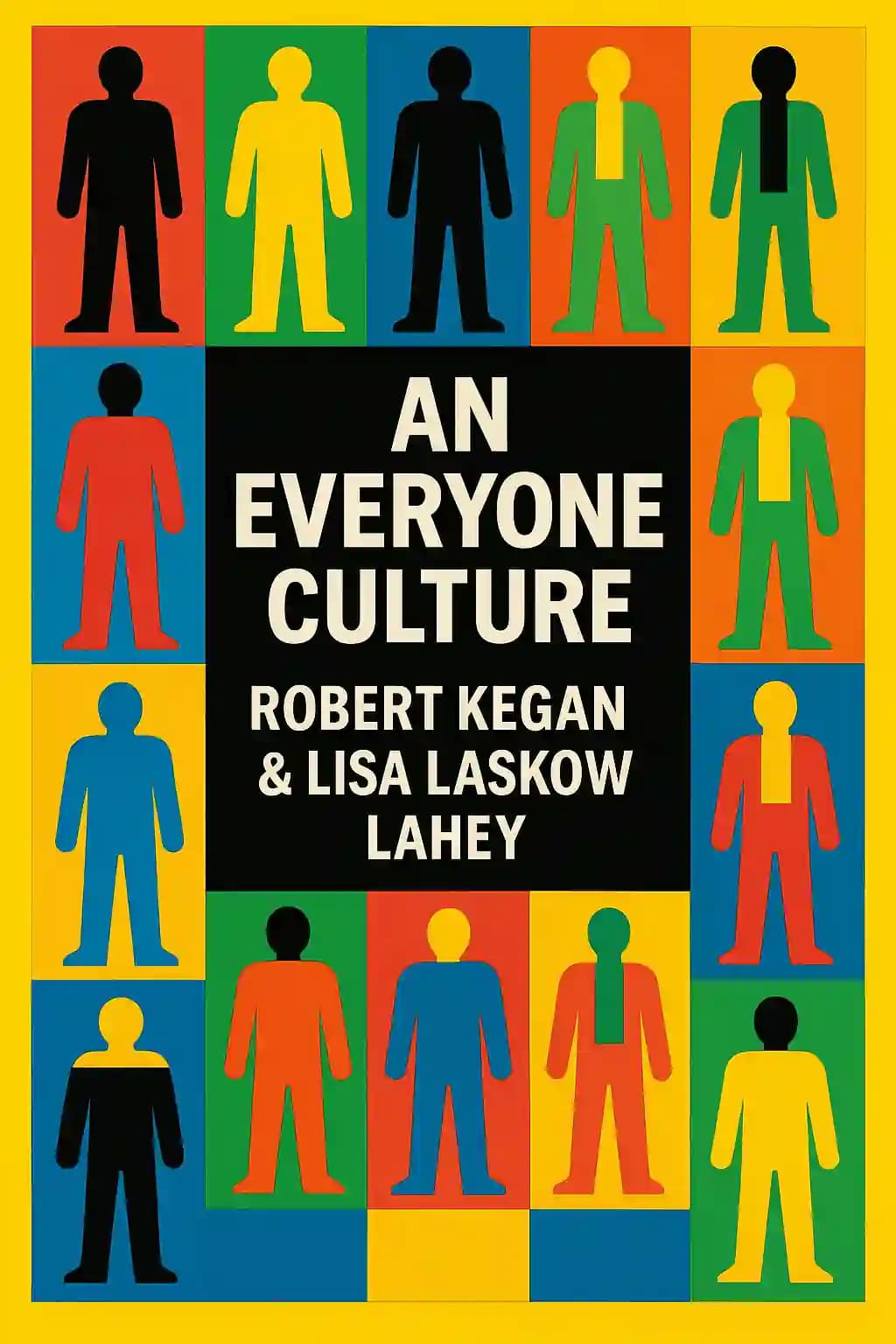
In "An Everyone Culture," Harvard professors Robert Kegan and Lisa Lahey introduce us to a revolutionary organizational model they call the Deliberately Developmental Organization (DDO). These companies have created environments where personal growth and business performance aren't competing priorities but are fundamentally integrated. The book has become required reading at companies like Google and Microsoft, with LinkedIn founder Reid Hoffman calling it "essential for anyone looking to create a more robust organization in today's rapidly changing environment." What makes this approach so powerful is that it taps into what research shows is the single biggest cause of burnout - not overload, but working too long without experiencing personal development.
Capitolo 2
The Revolutionary Concept of Deliberately Developmental Organizations
Imagine a workplace where revealing your weaknesses is celebrated rather than punished. Where feedback flows freely across hierarchical boundaries. Where everyone - from entry-level employees to CEOs - is actively working on overcoming their limitations. This is the reality in Deliberately Developmental Organizations.
DDOs operate on a fundamentally different premise than conventional companies. Rather than treating development as something "extra" that happens outside regular work through occasional training programs or executive coaching, they weave development into the very fabric of daily operations. The organization itself becomes an incubator of capability.
This approach addresses a critical mismatch in today's workplace. Research shows that approximately 58% of adults haven't reached the level of mental complexity needed for today's increasingly volatile, uncertain, complex, and ambiguous business environment. Traditional organizations are asking for capabilities that most workers don't yet possess - and then failing to provide environments where those capabilities can develop.
DDOs solve this problem by creating cultures that are both safe enough and demanding enough that everyone stops hiding their limitations and instead works on overcoming them. The results are remarkable: increased profitability, improved retention, faster promotion tracks, more honest communication, better error detection, and solutions to seemingly intractable problems.
What's most striking about these organizations is how they've transformed the traditional work-reward equation. Beyond conventional incomes like paychecks and benefits, they provide what might be called "new incomes": personal satisfaction, meaningfulness, and happiness. But not happiness defined as mere pleasure or positive emotions - rather, happiness as a process of human flourishing that embraces growth through challenge, which may include pain and suffering.
Capitolo 3
Inside Three Groundbreaking Organizations
The book centers on three companies that exemplify the DDO approach, though they operate in entirely different industries: Bridgewater Associates (the world's largest hedge fund), Decurion Corporation (which runs movie theaters and real estate), and Next Jump (an e-commerce technology company).
At Next Jump, new employees begin with a three-week Personal Leadership Boot Camp that immediately identifies their "backhands" - character weaknesses that need development. Using a tennis metaphor, everyone must work on both their natural strengths (forehand) and areas of discomfort (backhand). Most people's deeper limitations fall into being either overly confident ("arrogant") or overly humble ("insecure"). Everyone knows each other's backhands and works on them daily.
The company operates on the equation "Better Me + Better You = Better Us." Better Me represents constant self-improvement, with employees directly confronting limitations. Better You focuses on deriving meaning through helping others. Better Us is the ultimate outcome - sustained happiness through personal growth and helping others. Remarkably, Next Jump weighs revenue contributions and cultural contributions equally (50/50) in salary reviews, creating a workplace where meaningful work is prioritized alongside financial success.
At Decurion Corporation, meetings begin by "aligning intentions" - acknowledging that participants are about to practice something difficult that might trigger fear or vulnerability. The company challenges conventional wisdom about which industries can foster meaningful personal growth. Even cinema crew members working in retail service roles experience the same rich psychological development as knowledge workers in other settings.
During fast-paced operations between movie showings, ArcLight teams gather for ten-minute "pulse-check huddles" that exemplify how personal development and business improvement happen simultaneously. These huddles operate on multiple developmental levels: teams discuss immediate operational improvements, crew members practice giving direct feedback to peers, and managers provide meta-feedback on how effectively feedback was delivered.
Bridgewater Associates operates with radical transparency - every meeting is recorded and available to all employees. There are no closed-door conversations; everything becomes "historical record of what is true." The company embraces the equation "Pain + Reflection = Progress" and even provides a "Pain Button" app for employees to record negative emotions at work, triggering follow-up conversations to explore underlying causes.
The Dot Collector app enables continuous feedback where everyone rates others with thumbs-up/down assessments and specific comments about actions. These accumulated "dots" create what Bridgewater calls "a pointillist picture of a person" over time, helping identify developmental needs. No one is exempt - even the CEO receives frank feedback about leadership skills.
Capitolo 4
The Science Behind Adult Development
What gives DDOs their power is a deep understanding of how adults continue to develop throughout their lives. For decades, experts believed mental development fundamentally ended by our twenties. However, research over the past forty years has revealed that mental complexity continues to increase throughout adulthood.
This development doesn't unfold continuously but occurs in plateaus with periods of stability and change. Three distinct plateaus in adult mental complexity have been identified: the socialized mind, the self-authoring mind, and the self-transforming mind.
The socialized mind is shaped by the expectations and judgments of others, particularly those in authority. People at this level send information strongly influenced by what they believe others want to hear, often withholding crucial information to please leaders or avoid causing shame - the classic "groupthink" phenomenon.
The self-authoring mind filters information based on what serves their personal agenda or mission. When sending information, they communicate what others need to hear to further their design. When receiving information, they prioritize what fits their plan and filter out what seems irrelevant.
The self-transforming mind possesses a filter but isn't fused with it. People at this level can stand back from their own filter and examine it, valuing yet remaining wary of any single stance or agenda. When receiving information, they place higher priority on data that may reveal limits in their current design.
Research supports that higher mental complexity correlates with better performance. A study of twenty-one CEOs of large, successful companies found a clear upward slope showing that increased mental complexity correlates with greater work competence across multiple leadership dimensions.
Capitolo 5
The Three Dimensions of a DDO
DDOs can be understood through three dimensions: edge (developmental aspirations), groove (developmental practices), and home (developmental communities).
The edge represents the developmental aspirations that orient people toward their growing edge. DDOs operate on four fundamental principles in this dimension: adults can grow, weakness is a potential asset, the organization runs on developmental principles, and the bottom line is all one thing (profitability and human development are inseparable).
The groove encompasses developmental practices and tools that enable growth. DDOs embrace four key principles here: destabilization can be constructive, minding the gaps between what we say and do is essential work, the time scale is set for growth rather than closure, and the interior life is part of what is manageable.
Home refers to the developmental communities that provoke and hold vulnerability. Four principles guide this dimension: rank does not have its usual privileges, everyone does people development, everyone needs a crew (a group that both exposes blind spots and supports growth), and everyone builds the culture.
What makes DDOs remarkable is how they create "pan-developmental" cultures that support people regardless of their developmental stage. This is the fullest meaning of an "everyone culture" - not just that all employees receive developmental support, but that the culture works developmentally wherever you may be in your journey.
Capitolo 6
The Business Case for Development
Are DDOs serious businesses or merely indulgent experiments? The evidence is clear: Bridgewater has made more money for investors than any other hedge fund in history; Decurion's theaters have the highest gross per screen in North America; and Next Jump has been called "the most successful company you've never heard of" by INC Magazine.
When challenged about Next Jump's dramatic improvements - leaping from 30% to 100% annual growth and reducing turnover from 40% to single digits - leaders explain these changes came directly from their DDO commitment. Despite engineers receiving weekly job solicitations with higher pay, turnover plummeted because employees value the "internal income" of personal growth over external financial rewards.
At Bridgewater, CEO Greg Jensen states unequivocally: "We do not think of our culture as a 'contributor' to our business success; we do not think of it as a 'factor.' We think of it as, literally, the cause of our success." Their exceptional performance during the 2008 financial crisis - earning 9.4% for investors when markets were crashing - stems from the same source as their culture: "deep, independent thinking and debate about what is true."
Decurion approaches business through the lens of integrity - making whole what is typically divided. Their axiom that "pursuing human development and profitability emerges as one thing" isn't just philosophy but practical business strategy. This approach creates value in unexpected ways, from pairing leaders with contrasting styles to mixing unlikely partners at every level.
To truly understand a DDO's business value, consider what doesn't happen there compared to ordinary organizations. Two corrosive dynamics plague most companies: employees wasting enormous energy doing the "second job" of hiding weaknesses and managing impressions, and the trust-destroying practice of speaking negatively about colleagues behind their backs. DDOs eliminate both, allowing companies to operate at full efficiency rather than the typical 60%.
Capitolo 7
Uncovering Your Own Blind Spots
One of the most powerful tools DDOs use is the Immunity to Change (ITC) exercise, which helps individuals identify their personal "backhand" - the unconscious limitations preventing their growth. This systematic approach reveals the hidden barriers that keep us stuck in old patterns, even when we sincerely want to change.
The process begins by identifying a meaningful improvement goal - something that would make you more effective in your current role or help you contribute more to your organization. This goal should be specific, actionable, and genuinely important to you. For instance, rather than setting a vague goal like "become a better leader," you might target "give more direct feedback to team members" or "delegate more effectively to develop others."
Next, you create a fearless inventory of behaviors that work against your improvement goal, including both actions you take and things you fail to do. This requires brutal honesty. For example, if your goal is to delegate more, you might list behaviors like: checking and correcting others' work before it's finished, taking back tasks when they're not done exactly as you would do them, or failing to provide clear instructions and context when assigning work.
The third step involves identifying the fears that emerge when you imagine doing the opposite of your undermining behaviors. These fears reveal hidden competing commitments - unconscious ways you protect yourself from vulnerability. For example, someone with a goal of being more collaborative might have a hidden commitment to avoiding situations where their competence might be questioned. A manager wanting to delegate more might discover a competing commitment to maintaining control or protecting their reputation for excellence.
The final step is identifying the core beliefs sustaining your immune system - what the authors call "big assumptions." These are foundational beliefs we treat as absolute truths about ourselves and the world. Common examples include "If I'm not perfect, I'm worthless," "Showing vulnerability means I'm weak," or "I can't trust others to maintain my standards." By naming these assumptions, we can question whether they're actually 100% true, diminishing their power over us and opening paths to change.
The ITC process often reveals surprising connections between our stated goals and our unconscious resistance. For instance, a leader who wants to be more strategic might discover that their constant involvement in operational details isn't just a bad habit, but a protection against the fear of being seen as disconnected or losing control. Understanding these connections allows us to address the root causes of our resistance rather than just battling symptoms.
Capitolo 8
Creating Your Own DDO
The journey toward becoming a DDO begins with creating "home" - a supportive environment for vulnerability and learning. This environment must be intentionally cultivated through consistent actions and visible commitment from leadership at all levels. While there's no single right approach, leaders with formal authority play a crucial role as champions and participants, visibly demonstrating the openness required. They must model vulnerability by sharing their own development challenges, admitting mistakes, and actively participating in learning discussions.
Creating a DDO requires working simultaneously in multiple dimensions - engaging "head, heart, and hand." The head element involves bringing your interior life into work, examining thoughts, feelings and underlying assumptions that may limit your potential. This includes regular reflection practices, such as journaling, meditation, or structured feedback sessions. Leaders must create dedicated time and space for employees to explore their mental models, biases, and growth edges.
The heart element ensures this invitation comes with good intentions and compassion, not as a control mechanism to extract more from workers. This requires building psychological safety through consistent actions that demonstrate care and support. Examples include celebrating learning from failures, providing emotional support during challenging projects, and acknowledging the whole person beyond their work role. Organizations must actively work to separate development conversations from performance evaluations to maintain trust.
The hand element provides reliable, repeatable practices, structures and tools that rebuild the culture daily. These might include regular learning forums, peer coaching circles, structured reflection time, and development-focused team meetings. Organizations should establish clear protocols for giving and receiving feedback, conducting after-action reviews, and facilitating group learning discussions.
Establishing shared norms, agreements, or "rules of the road" oriented to development is essential. These agreements should address questions like: "What conditions do we need to provide for interior work?" and "How can we support both self-development and colleagues' development?" The agreements should be co-created with employees and regularly revisited to ensure they remain relevant and effective. Specific examples might include agreements about confidentiality, respectful challenging of assumptions, and commitment to regular development practices.
Organizations should expect continuous violations of these agreements and deploy practices that convert violations into learning opportunities. This requires creating safe spaces for discussing breakdowns, establishing clear processes for addressing violations constructively, and viewing mistakes as valuable data about where the system needs strengthening. Regular review sessions can help teams identify patterns in agreement violations and develop more effective support structures.
Capitolo 9
A New Way of Being at Work
While the past fifty years have seen extraordinary changes in how we handle information and data, our approach to human development at work hasn't experienced a similar revolution. The DDOs profiled demonstrate that organizations and workers can become each other's greatest resources for flourishing. Traditional workplace models often separate personal growth from professional development, treating them as distinct domains that rarely intersect. However, DDOs have discovered that integrating these aspects creates powerful synergies.
Though some might argue that vulnerability at work contradicts human nature, the real people showcased have been successfully practicing these approaches for years. These organizations have created environments where people can bring their whole selves to work - not just their strengths but also their limitations, fears, and aspirations. This includes openly discussing challenges, admitting mistakes, seeking feedback, and sharing personal growth goals. For example, at Bridgewater Associates, employees regularly record meetings and review them together, analyzing not just the content but also their communication patterns and emotional responses.
In a world increasingly characterized by volatility, uncertainty, complexity, and ambiguity (VUCA), the DDO may represent our best hope for creating organizations that can meet these challenges while simultaneously helping people become the best versions of themselves. These organizations have developed specific practices to thrive in uncertainty: regular feedback loops, transparent decision-making processes, and continuous learning opportunities embedded in daily work. Companies like Decurion Corporation demonstrate how this approach leads to both business innovation and personal transformation, with employees regularly taking on stretch assignments that push their developmental edges.
By integrating personal development with business operations, these pioneering organizations have discovered that the path to extraordinary business results runs directly through the growth and flourishing of every individual. This integration manifests in various ways: structured reflection sessions after project completions, peer coaching programs, regular developmental conversations, and the intentional design of work processes to surface learning opportunities. The result is a workplace where business challenges become catalysts for personal growth, and individual development directly contributes to organizational success.
These organizations have also found that this approach creates remarkable resilience and adaptability. When employees are practiced in vulnerability, self-reflection, and continuous learning, they're better equipped to handle change and uncertainty. They've developed internal capabilities to process complexity, navigate ambiguity, and maintain effectiveness even in rapidly shifting circumstances.
Capitolo 10
The Courage to Transform
What makes DDOs truly remarkable isn't just their practices but the courage they demonstrate in challenging fundamental assumptions about how work should be organized. These organizations boldly question decades-old management philosophies and workplace conventions that have separated professional advancement from personal growth. They reject the notion that we must leave our personal growth at the door when we enter the workplace, recognizing instead that human development and business success are intrinsically linked.
These organizations demonstrate remarkable courage in several ways. First, they're willing to invest significant resources in developmental practices when many competitors focus solely on immediate productivity. Second, they maintain their commitment to development even during challenging economic times when other companies typically cut such "non-essential" programs. Third, they embrace transparency and vulnerability at all levels of the organization, including senior leadership.
They've created environments where people can experience what the authors call "well-held vulnerability" - the rare feeling of being simultaneously far from your most put-together self yet still valued and included. This state is achieved through carefully designed practices: regular feedback sessions where mistakes are viewed as learning opportunities, structured reflection periods that encourage personal insight, and collaborative problem-solving sessions where everyone's perspective is valued regardless of their position. These practices create psychological safety while pushing people to grow beyond their comfort zones.
The impact of this approach extends far beyond individual growth. DDOs consistently report higher employee engagement, lower turnover, and stronger innovation metrics compared to their industry peers. They've proven that creating space for human development actually enhances business performance rather than detracting from it. Companies like Bridgewater Associates and Next Jump have demonstrated that prioritizing personal growth alongside professional development can lead to remarkable business outcomes.
The question isn't whether DDOs can succeed - they clearly can. The evidence is mounting through case studies, financial results, and employee satisfaction metrics. The real question is whether more organizations will have the courage to follow their lead, transforming not just how we work but who we become through our work. This requires leaders willing to challenge conventional wisdom, embrace vulnerability, and commit to long-term developmental practices even when facing short-term pressures.
As the workplace continues to evolve in the twenty-first century, the DDO model offers a compelling vision of what might be possible when we make development not just something we do, but who we are. This model becomes increasingly relevant as younger generations enter the workforce seeking meaning and growth in their work lives, and as organizations face complex challenges requiring continuous learning and adaptation.
Capitolo 11
The Path Forward: From Surviving to Flourishing
The DDO approach represents a fundamental shift from seeing work as something we endure to something through which we flourish. By creating cultures where personal growth and business performance are integrated, these organizations have discovered a powerful truth: that human beings have an innate desire to develop, to become more than they currently are.
What these organizations demonstrate is that when we create environments that support this natural development - that make it safe to be vulnerable, that provide continuous feedback and challenge, that treat limitations as opportunities rather than liabilities - we unlock extraordinary potential in both individuals and organizations.
The journey isn't easy. It requires courage, commitment, and a willingness to challenge deeply held assumptions about how work should be organized. But for those willing to make the journey, the rewards are profound: workplaces where people can bring their whole selves, where business success and personal growth reinforce each other, and where everyone has the opportunity to become the best version of themselves.
In a world of increasing complexity and change, this may be our most promising path forward - not just for creating more successful businesses, but for creating more fulfilling lives.