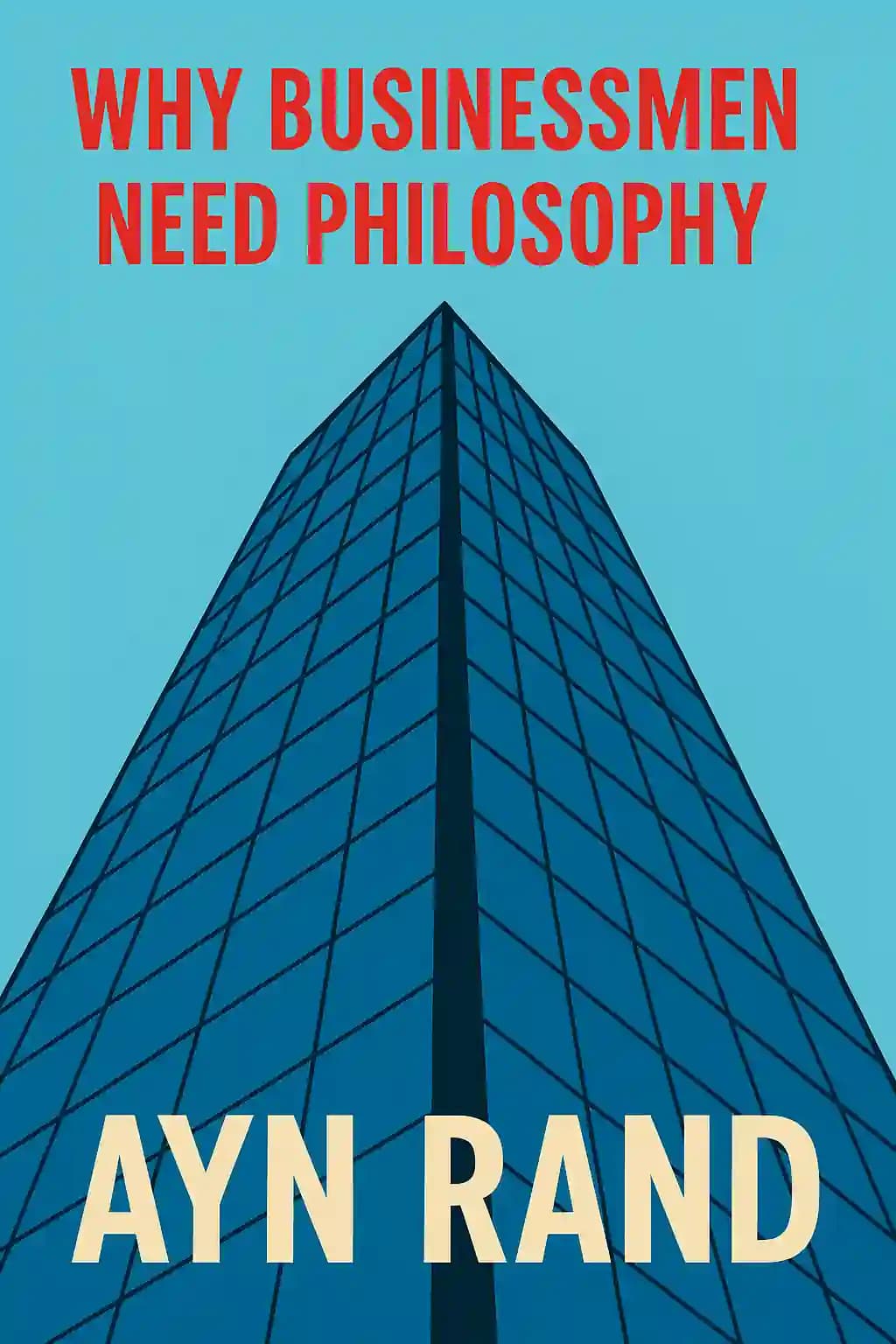
Why businessmen need philosophy
Overview of Why businessmen need philosophy
In "Why Businessmen Need Philosophy," Ayn Rand defends capitalism's moral foundation. Former BB&T CEO John Allison's introduction underscores its relevance for leaders seeking ethical clarity. What if the philosophical principles rejected by academia are actually essential for business success?

Key Themes in Why businessmen need philosophy
- moral defense of capitalism
- wealth as intellectual product
- altruism versus profit
- entrepreneurial mind
- philosophical foundations of business
Quotes from Why businessmen need philosophy
Wealth creation begins not with physical resources or labor but with human thought.
Selfishness has been universally condemned while self-sacrifice has been praised as the highest virtue.
Profit-seeking isn't merely tolerated but celebrated as a moral achievement.
The businessman epitomizes the productive mind in action.
The businessman who creates valuable products is actively virtuous.
Characters in Why businessmen need philosophy
- Ayn RandAuthor and philosopher who defends capitalism
- Leonard PeikoffEssayist who discusses the productive mind
- John AllisonFormer BB&T CEO and proponent of the book's ideas
About the Author
About the Author of Why businessmen need philosophy
Ayn Rand (1905–1982), born Alissa Rosenbaum in St. Petersburg, Russia, was a philosopher, novelist, and influential advocate of Objectivism, a philosophy centered on rational self-interest and individualism.
Her essay collection Why Businessmen Need Philosophy distills her ideas on capitalism, reason, and moral clarity, reflecting her belief that philosophy is essential to practical decision-making. Rand’s works, including bestsellers Atlas Shrugged and The Fountainhead, blend fiction with philosophical discourse, critiquing collectivism and championing entrepreneurial freedom.
A refugee from Soviet Russia, her anti-communist stance and defense of laissez-faire capitalism stemmed from firsthand experiences with totalitarianism. Her nonfiction works, such as The Virtue of Selfishness and Capitalism: The Unknown Ideal, further systematize her ideas, which have influenced libertarian thought and business leaders worldwide. Atlas Shrugged alone has sold over 10 million copies, cementing Rand’s legacy as one of the 20th century’s most provocative thinkers.
Download Summary of Why businessmen need philosophy
Get the Why businessmen need philosophy summary as a free PDF or EPUB. Print it or read offline anytime.
FAQs About This Book
Why Businessmen Need Philosophy is a collection of essays defending capitalism through Ayn Rand’s Objectivist philosophy. It argues that business leaders need philosophical principles to justify profit-driven enterprise, counter anti-capitalist rhetoric, and embrace rational self-interest as moral. Key themes include the spiritual value of creation, critiques of altruism, and capitalism’s role in human flourishing.
This book targets business professionals, entrepreneurs, and free-market advocates seeking intellectual tools to defend capitalism. It’s also valuable for readers interested in Ayn Rand’s ethics, Objectivism’s application to business, or philosophical critiques of collectivism. The essays blend theory with practical advice for navigating ideological challenges.
Yes, for those seeking a moral defense of capitalism. The book offers rare essays by Rand and Objectivist thinkers like Harry Binswanger, linking philosophy to real-world business decisions. It provides frameworks to reject guilt over profit-seeking and address accusations of corporate greed.
- Rational self-interest: Profit-seeking aligns with moral virtue when rooted in voluntary exchange.
- Critique of altruism: Sacrificing self-interest for others stifles innovation and justifies overregulation.
- Philosophy as foundational: Business decisions implicitly rely on ethical and epistemological principles.
- Capitalism’s moral superiority: Free markets reward creativity, benefiting society through mutual trade.
Rand portrays businessmen as heroic creators who transform ideas into tangible goods, driving progress. Their pursuit of profit is a spiritual endeavor, reflecting reason, productivity, and self-esteem. This contrasts with societal views of business as purely materialistic.
Harry Binswanger’s essay argues philosophy acts as the “ultimate CEO” by providing a coherent worldview for strategic decisions. Just as CEOs set corporate vision, philosophy addresses fundamental questions about reality, ethics, and human potential, guiding long-term business success.
The essays reframe “greed” as virtuous self-interest, emphasizing that ethical profit requires creating value for others. Rand’s philosophy rejects altruism as immoral, asserting that guilt-free ambition drives innovation and societal wealth.
- Use moral arguments to justify free markets (e.g., mutual benefit in trade).
- Reject altruistic framing in policy debates.
- Emphasize business’s role in solving problems (e.g., healthcare, technology).
Altruism is labeled destructive because it demands self-sacrifice, discourages innovation, and enables collectivist policies. The book argues that equating morality with sacrifice undermines capitalism’s ethical foundation and empowers anti-business rhetoric.
Both works defend capitalism through Rand’s Objectivist lens. Atlas Shrugged’s fictional entrepreneurs mirror the essays’ real-world arguments, illustrating how philosophical principles shape economic systems and individual achievement.
The book remains pertinent amid debates over corporate responsibility, ESG criteria, and wealth inequality. Its defense of profit-driven innovation offers counterarguments to modern critiques of capitalism, particularly in tech and global markets.
Critics argue Rand’s rejection of altruism oversimplifies morality and ignores systemic inequities. Some view the essays as overly dogmatic, dismissing valid concerns about corporate power or environmental impacts.