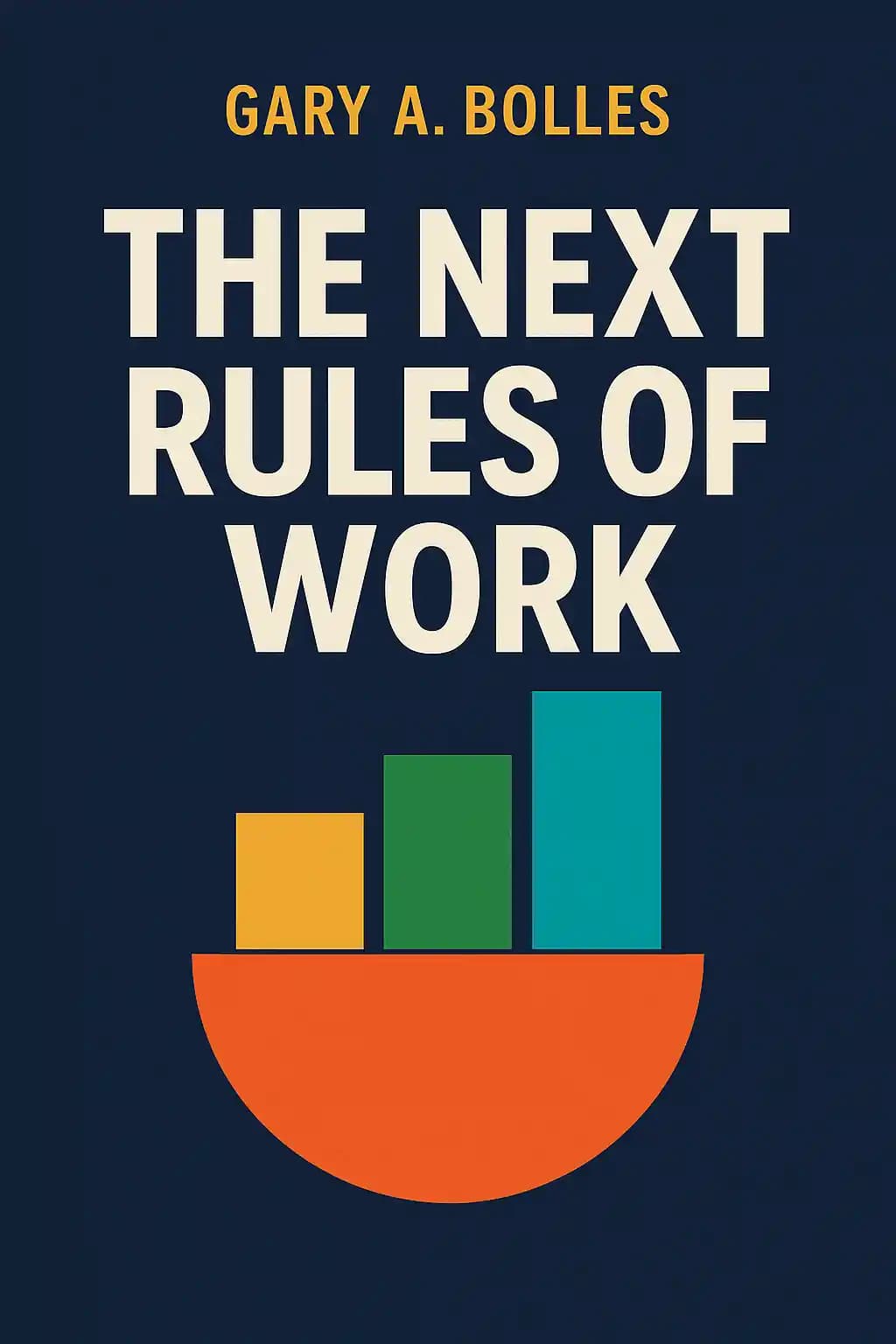
Next Rules of Work
The Mindset, Skillset and Toolset to Lead Your Organization Through Uncertainty
Overview of Next Rules of Work
In a world where robots may reshape employment, Gary Bolles offers a human-centered roadmap for thriving amid technological disruption. What if the key to future success isn't fighting change, but developing an entirely new mindset? Amazon and Google already embrace these principles.

Key Themes in Next Rules of Work
- technological disruption
- human-centric workplace
- skills-based economy
- adaptive leadership
- future of automation
Quotes from Next Rules of Work
Workers were viewed as human “assets” or “resources.”
Robots and software don't take jobs—humans give them away.
The fundamental challenge isn't technology but the pace of change.
Characters in Next Rules of Work
- Gary A. BollesAuthor and expert on the future of work
- Frederick Winslow TaylorCreator of scientific management principles
- Henri FayolDeveloper of hierarchical management principles
- Shoshana ZuboffAuthor who predicted tech-driven work scenarios
About the Author
About the Author of Next Rules of Work
Gary A. Bolles, author of The Next Rules of Work: The mindset, skillset, and toolset to lead your organization through uncertainty, is a globally recognized authority on the future of work and organizational leadership. A seasoned strategist and adjunct Chair for the Future of Work at Singularity University, Bolles combines decades of experience advising startups, Fortune 500 companies, and governments with insights from his pioneering LinkedIn Learning courses, which have educated over 1 million professionals worldwide.
His work focuses on equipping leaders and teams to thrive in an era of exponential technological change, drawing from his roles as co-founder of career-transition platform eParachute.com and partner at consultancy Charrette LLC.
Bolles’ expertise stems from his interdisciplinary background in tech entrepreneurship, editorial leadership, and career coaching methodologies popularized by his father, Richard Bolles’ seminal What Color Is Your Parachute?. A frequent speaker at global summits and host of the collaborative initiative Global Skills Day, he bridges theoretical frameworks with actionable strategies for workforce transformation. The Next Rules of Work expands on his widely followed LinkedIn newsletter, consolidating proven practices for building agile, human-centric organizations.
Download Summary of Next Rules of Work
Get the Next Rules of Work summary as a free PDF or EPUB. Print it or read offline anytime.
FAQs About This Book
The Next Rules of Work provides a roadmap for navigating uncertainty in the modern workplace, emphasizing mindset shifts, adaptive skills, and digital tools to thrive in a post-pandemic world. Bolles explores strategies for organizations and individuals to embrace exponential change, foster lifelong learning, and build resilience in the digital work economy. Key themes include redefining leadership, leveraging AI, and creating inclusive workplaces.
This book is essential for CEOs, HR leaders, and career changers seeking to future-proof their organizations or careers. It’s also valuable for entrepreneurs, policymakers, and educators addressing workplace disruption. Bolles combines insights for managers redesigning teams and individuals adapting to remote work, gig economies, or AI-driven industries.
Bolles introduces three core frameworks:
- Mindset: Embracing agility and unlearning outdated practices.
- Skillset: Developing hybrid skills like critical thinking and digital literacy.
- Toolset: Leveraging AI, collaboration platforms, and data analytics.
These interconnected frameworks help organizations and workers navigate volatility.
The book positions AI as a collaborative tool for augmenting human capabilities, not replacing jobs. Bolles advocates for upskilling workforces to manage AI integration, automate repetitive tasks, and focus on uniquely human skills like creativity and empathy. He also warns against ethical pitfalls in algorithmic bias.
Bolles emphasizes lifelong learning and portfolio careers, urging readers to treat skills as currency. He provides tactics for career pivots, including networking in digital communities, micro-learning, and using AI-driven job-matching tools. His methods build on What Color Is Your Parachute? principles, updated for the gig economy.
Unlike theoretical takes, Bolles combines actionable strategies with case studies from Silicon Valley and global enterprises. It uniquely balances organizational transformation (e.g., flattening hierarchies) with individual adaptability, bridging macro-trends and personal career tactics.
Notable insights include:
- “Uncertainty is the new normal; resilience is the new skill.”
- “The digital work economy rewards those who learn faster than the machines.”
- “Your competition isn’t automation—it’s someone using automation.”
These encapsulate the book’s focus on proactive adaptation.
Yes. Bolles details four principles for distributed teams: asynchronous communication, outcome-based metrics, AI-enhanced collaboration, and “digital empathy.” He provides templates for virtual onboarding, feedback loops, and preventing burnout in hybrid environments.
Some reviewers note the book prioritizes large organizations over SMEs and lacks granular implementation steps. Others argue its AI optimism downplays job displacement risks. However, its actionable frameworks are widely praised.
Drawing on 30+ years as a Silicon Valley executive and career coach, Bolles blends tech trends (from AI to broadband access) with human-centric strategies. His work at Singularity University and eParachute.com informs the book’s balance of futurism and practicality.
Absolutely. Updated examples address post-pandemic remote work norms, Gen AI tools like ChatGPT, and 2025 labor shortages. Bolles’ “Skills Genome Project” concept aligns with current efforts to standardize competency mapping and micro-credentials.
While Atomic Habits focuses on personal routines and Who Moved My Cheese? uses allegory, Bolles’ work offers systemic solutions for organizational and individual change. It’s ideal for readers seeking actionable steps rather than abstract theories.