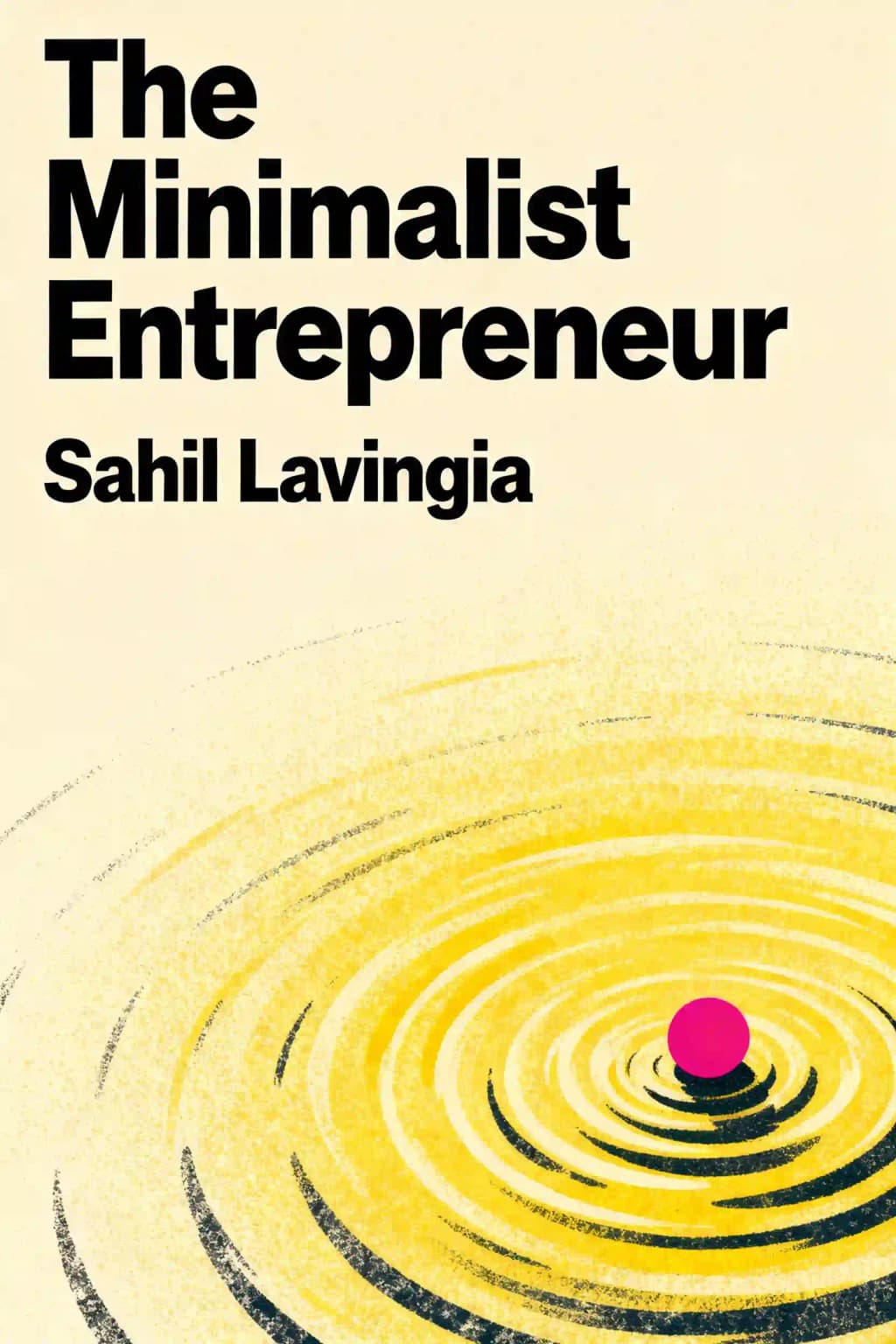
The Minimalist Entrepreneur
How Great Founders Do More with Less
Overview of The Minimalist Entrepreneur
Discover how to build profitable businesses without the VC hype. Sahil Lavingia's counterintuitive approach has earned Derek Sivers' praise as "brilliant" and "must-read." What if success comes from serving a specific community first, not chasing unicorn status?

Key Themes in The Minimalist Entrepreneur
- profitability over growth
- community-first business
- sustainable startup scaling
- bootstrapping strategies
- creator economy monetization
Quotes from The Minimalist Entrepreneur
Start with less.
Build an audience.
Stay small.
Profitability over hypergrowth.
The question isn't whether you can start a business-it's which community you'll serve and which problems you'll solve.
Characters in The Minimalist Entrepreneur
- Sahil LavingiaAuthor and founder of Gumroad
- Peter AskewEntrepreneur who built VidaliaOnions.com
- Pieter LevelsFounder of Nomad List
- Nathan BarryFounder of ConvertKit
- Sol OrwellFounder of Examine.com
About the Author
About the Author of The Minimalist Entrepreneur
Sahil Lavingia is the author of The Minimalist Entrepreneur: How Great Founders Do More with Less. He is also an entrepreneur and the founder of Gumroad, a pioneering platform that empowers creators to sell digital products directly to their audience.
Lavingia is a vocal advocate for sustainable business practices. His book blends his experience scaling Gumroad to $10 million in annual recurring revenue with insights from his angel investments in companies like Figma and Lambda School.
The Minimalist Entrepreneur distills his philosophy of prioritizing profitability and community over hypergrowth, an idea shaped by his widely-read essay “Reflecting on My Failure to Build a Billion-Dollar Company.” Beyond Gumroad, Lavingia shares actionable advice through his newsletter and talks, championing bootstrapped ventures and transparent entrepreneurship.
His platform has facilitated over $356 million in sales for more than 70,000 creators worldwide, solidifying his reputation as a thought leader in the creator economy.
Download Summary of The Minimalist Entrepreneur
Get the The Minimalist Entrepreneur summary as a free PDF or EPUB. Print it or read offline anytime.
FAQs About This Book
The Minimalist Entrepreneur advocates building sustainable, community-driven businesses that prioritize profitability over rapid growth. Sahil Lavingia shares lessons from founding Gumroad, emphasizing starting small, avoiding venture capital reliance, and focusing on manual customer engagement. Key themes include bootstrapping, ethical monetization, and scaling only when necessary. The book challenges Silicon Valley’s “growth at all costs” mentality, offering frameworks for creators and solopreneurs.
Aspiring founders, indie creators, and small business owners seeking alternatives to traditional startup models will benefit most. It’s particularly relevant for those wanting to build businesses without VC funding, creators aiming to monetize digital products, and entrepreneurs prioritizing work-life balance. Sahil’s insights resonate with people disillusioned by hype-driven entrepreneurship.
Yes, for its actionable strategies on sustainable business-building. Readers praise its focus on profitability-first tactics, community-centric marketing, and pragmatic frameworks like “sales as market exploration.” Critics note it’s less applicable to venture-backed startups. The book’s strength lies in real-world examples from Gumroad’s journey and Sahil’s transparent reckoning with failure.
- Start small: Validate ideas through manual sales before scaling
- Community-first: Build businesses alongside customers, not for them
- Profitability > growth: Avoid “toxic growth” via sustainable monetization
- Outsource non-core tasks: Use software instead of premature hiring
- Embrace constraints: Limited resources foster creativity and focus
Sahil advocates “gardening” over “rocket ship” growth—methodically nurturing a business through customer feedback and incremental improvements. He warns against scaling before achieving product-market fit, suggesting entrepreneurs “grow at the pace of their own learning.” The book emphasizes profit reinvestment over external funding and organic marketing via content/SEO.
Some argue the minimalist approach limits market dominance potential and isn’t suited for capital-intensive industries. Others note Sahil’s focus on digital products overlooks physical goods challenges. However, supporters counter that the book intentionally targets solopreneurs and niche markets where slow growth is sustainable.
While both advocate iterative development, Sahil prioritizes profitability from day one over Eric Ries’ “minimum viable product” concept. The Minimalist Entrepreneur rejects growth hacking in favor of community-building and rejects VC funding as a default path. It’s seen as a post-2020 update to lean principles, tailored for the creator economy.
- “Starting a business should be an option for everyone, no matter your background”
- “Money doesn’t solve everything—it just amplifies what’s already working”
- “Sales isn’t persuasion; it’s figuring out what the market wants”
- “Build a business that works even if you stop working”
The book provides frameworks for monetizing skills gradually—Sahil calls it “entrepreneurship as a side effect.” It teaches identifying underserved communities, validating ideas through pre-sales, and building revenue streams before quitting traditional jobs. Case studies show creators transitioning from freelancers to business owners.
Drawing from Gumroad’s near-collapse in 2015, Sahil reframes failure as a necessary teacher. He details how abandoning unicorn ambitions allowed Gumroad to become sustainably profitable. The book argues that public failure builds trust and that “businesses don’t fail—founders give up”.
Sahil’s “outsource everything” philosophy aligns with distributed teams. The book shows how to build global communities using digital tools, manage asynchronous workflows, and leverage platforms like Gumroad for location-independent income. It’s cited as a blueprint for Web3-era decentralized businesses.
While not explicitly about AI, the book’s principles apply to automated businesses. Sahil discusses using software to handle repetitive tasks, allowing founders to focus on high-value work—a concept amplified by modern AI tools. Later editions may expand on his Manifold podcast insights about AI’s role in creative commerce.