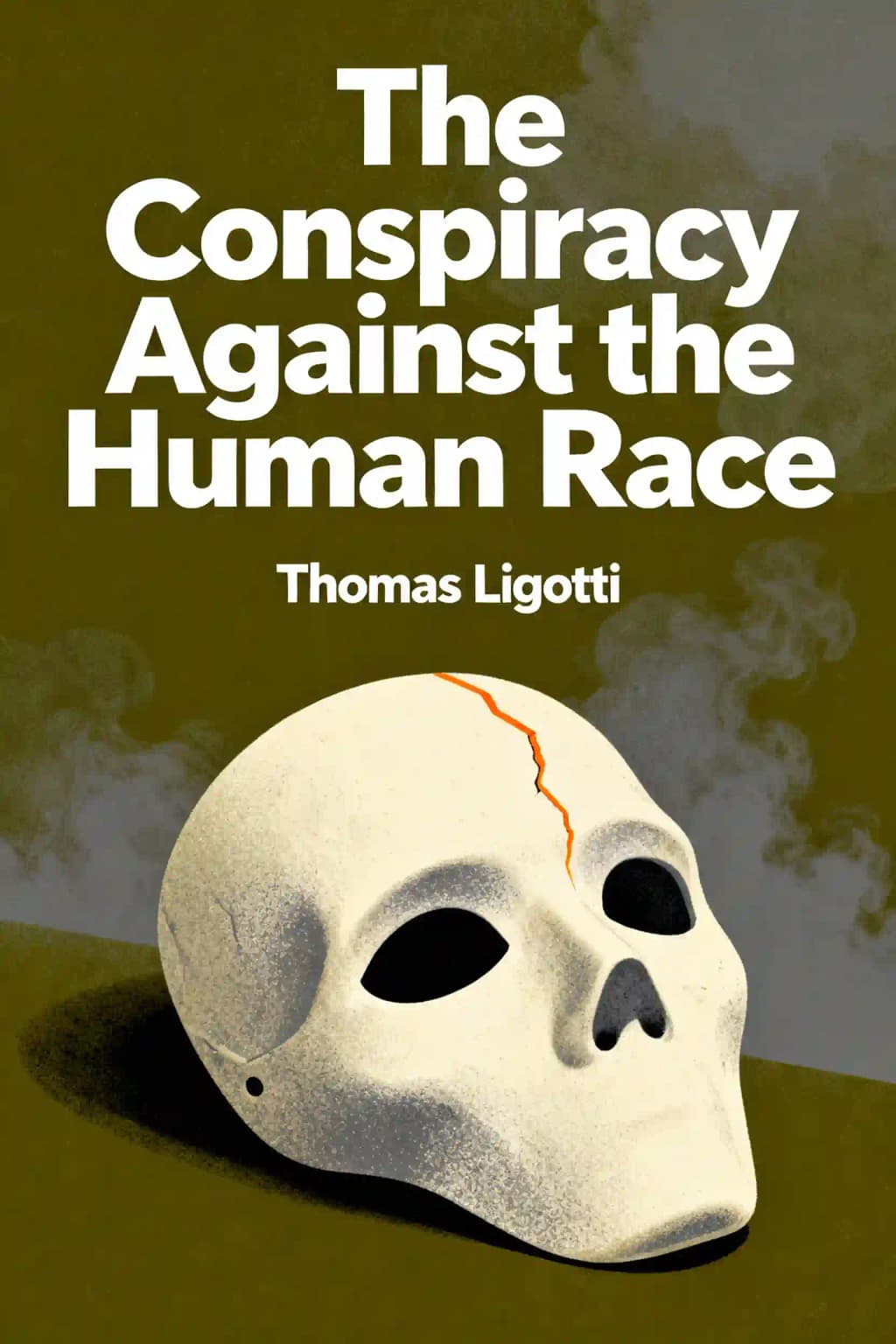
The Conspiracy against the Human Race
A Contrivance of Horror
Overview of The Conspiracy against the Human Race
Ligotti's nihilistic masterpiece that inspired True Detective's Rust Cohle, outsold Ayn Rand, and sparked plagiarism controversy. Can any philosophical work be more terrifying than facing the truth - that consciousness itself might be humanity's greatest cosmic joke?

Key Themes in The Conspiracy against the Human Race
- philosophical pessimism
- existential horror
- human consciousness catastrophe
- metaphysical nihilism
- defense mechanisms against reality
Quotes from The Conspiracy against the Human Race
Human consciousness itself is the ultimate cosmic horror.
Consciousness became our existential catastrophe.
We lost our residence in the universe.
We survive only through self-deception.
People are fundamentally either pessimists or optimists.
Characters in The Conspiracy against the Human Race
- Thomas LigottiAuthor and philosopher of contemporary pessimism
- Peter Wessel ZapffeNorwegian philosopher who studied consciousness
- Rust CohleNihilistic character who channels Ligotti's ideas
- Matthew McConaugheyActor who portrays the character Rust Cohle
About the Author
About the Author of The Conspiracy against the Human Race
Thomas Ligotti is the author of The Conspiracy Against the Human Race and a cult figure in contemporary horror fiction renowned for his philosophical pessimism. Born in 1953, this American writer and lay philosopher explores themes of cosmic dread, nihilism, and existential horror through dense, literary prose.
Ligotti's acclaimed fiction includes Songs of a Dead Dreamer, Teatro Grottesco, and The Nightmare Factory, which won the Bram Stoker Award. His novella My Work Is Not Yet Done delves into corporate horror with a distinctly bleak worldview.
In 2015, Penguin Classics republished his early collections, placing him among only ten living American writers in their catalog alongside literary giants like Thomas Pynchon and Don DeLillo. The Washington Post called Ligotti "the best kept secret in contemporary horror fiction," a reputation enhanced by critical acclaim from The New York Times Book Review and The New Yorker following his Penguin Classics debut.
Download Summary of The Conspiracy against the Human Race
Get the The Conspiracy against the Human Race summary as a free PDF or EPUB. Print it or read offline anytime.
FAQs About This Book
The Conspiracy Against the Human Race by Thomas Ligotti is a 2010 philosophical non-fiction book exploring pessimism, nihilism, and antinatalism. Ligotti argues that consciousness itself is a tragic blunder that causes suffering, and that humanity would be better off not existing. The book examines how people cope with life's meaninglessness through various delusions and distractions, drawing on philosophers like Peter Wessel Zapffe and Emil Cioran to support his dark worldview.
Thomas Ligotti is an American horror fiction author born in 1953, best known for his cosmic horror short stories. In The Conspiracy Against the Human Race, Ligotti ventures into philosophical non-fiction to articulate the pessimistic worldview that permeates his fiction. Having built a cult following through his literary horror collections, Ligotti uses this book to directly examine the philosophical foundations of existence, consciousness, and suffering that inform his dark aesthetic.
The Conspiracy Against the Human Race appeals to readers interested in philosophical pessimism, existential philosophy, and dark intellectual explorations of consciousness. It's ideal for fans of Ligotti's horror fiction seeking to understand his worldview, philosophy students exploring antinatalism and nihilism, and those drawn to thinkers like Schopenhauer, Cioran, and Zapffe. The book requires tolerance for bleak perspectives and dense philosophical arguments about suffering and meaninglessness.
The Conspiracy Against the Human Race is worth reading for those seeking intellectually rigorous examinations of pessimistic philosophy, though it demands comfort with profoundly dark ideas. The book uniquely blends philosophical analysis with literary horror sensibilities, offering insights into consciousness, suffering, and existential dread. However, readers should approach it understanding that Ligotti presents unrelentingly bleak arguments about existence without offering optimistic counterpoints or solutions beyond voluntary extinction.
"Malignantly useless" is Thomas Ligotti's signature phrase in The Conspiracy Against the Human Race, describing the fundamental nature of existence and consciousness. The term captures Ligotti's view that the world is both actively harmful ("malignantly") and devoid of inherent purpose or meaning ("useless"). This phrase encapsulates his argument that consciousness forces awareness of life's horrifying meaninglessness, making existence a cruel condition that serves no beneficial function.
Thomas Ligotti's main argument in The Conspiracy Against the Human Race is that consciousness is a tragic evolutionary mistake that creates inevitable suffering. He contends that being aware of life's meaninglessness and horror forces humans to constantly suppress this knowledge through various psychological mechanisms and cultural distractions. Ligotti concludes that the only true escape from this predicament is either ego death or humanity's voluntary extinction, though he acknowledges neither outcome is likely.
The Conspiracy Against the Human Race draws heavily from Norwegian philosopher Peter Wessel Zapffe's essay "The Last Messiah," Romanian philosopher Emil Cioran, and German philosopher Philipp Mainländer. Ligotti also references Arthur Schopenhauer's concept of "Will" as a puppeteer controlling human actions. These pessimistic thinkers provide the philosophical foundation for Ligotti's arguments about consciousness as tragedy, determinism, suffering as life's fundamental condition, and antinatalism as a logical response to existence.
Thomas Ligotti employs the puppet metaphor in The Conspiracy Against the Human Race in two interconnected ways. First, he describes humans as "meat puppets" with no free will, controlled by Schopenhauer's impersonal "Will" rather than conscious choice, illustrating his deterministic worldview. Second, puppets represent soulless, lifeless entities that create horror through their uncanny resemblance to humans, symbolizing how consciousness makes us aware of our own mechanistic, meaningless nature.
In The Conspiracy Against the Human Race, Thomas Ligotti argues that consciousness is an evolutionary blunder and the root of all human suffering. He describes consciousness as a mystery that forces awareness of existence's horrifying meaninglessness, creating a paradox where humans must constantly distract themselves from this knowledge. Ligotti adopts Zapffe's view that consciousness creates the false notion of self and that humans are "hunks of spoiling flesh on disintegrating bones" forced into self-awareness.
The Conspiracy Against the Human Race faces criticism for its unrelentingly bleak perspective that offers no alternative viewpoints or counterarguments to philosophical pessimism. Critics note that Ligotti's arguments rely on accepting his starting premise that "being alive is not all right," which many readers reject. The book is also challenged for presenting voluntary human extinction as a logical conclusion while simultaneously acknowledging that most humans don't accept pessimistic philosophy, creating a tension in his reasoning.
The Conspiracy Against the Human Race presents antinatalism as a logical conclusion of philosophical pessimism, arguing against bringing new conscious beings into existence. Thomas Ligotti contends that having children represents a futile attempt at genetic immortality that only perpetuates suffering. Drawing on Peter Zapffe's philosophy, Ligotti asserts that humans possess only one genuine right—the right to die—and that creating new life condemns beings to inevitable suffering and death.
Peter Wessel Zapffe's essay "The Last Messiah" provides a foundational framework for The Conspiracy Against the Human Race, particularly his view that human existence is fundamentally tragic. Ligotti adopts Zapffe's concept that consciousness developed through blind evolutionary mutations without purpose, creating beings over-equipped for survival who must cope with existential awareness. Zapffe's ideas about humans possessing only the right to die and consciousness creating false notions of self permeate Ligotti's philosophical arguments throughout the book.