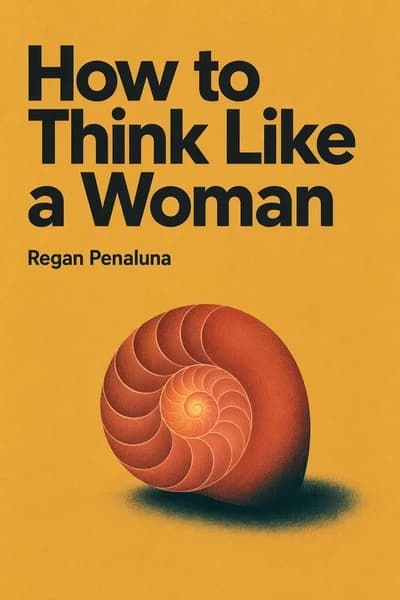
How to Think Like a Woman
Four Women Philosophers Who Taught Me How to Live a Life of the Mind
Overview of How to Think Like a Woman
In "How to Think Like a Woman," Regan Penaluna resurrects four erased female philosophers while challenging philosophy's deep-seated misogyny. Named to Inc.'s Non-Obvious Book Awards, this memoir-meets-critique asks: Why were brilliant women thinkers systematically removed from intellectual history - and what does their erasure cost us?

Key Themes in How to Think Like a Woman
- canonical misogyny
- forgotten female philosophers
- patriarchal academic culture
- intellectual gender equality
- feminist philosophical recovery
Quotes from How to Think Like a Woman
Why haven't women achieved the highest levels of thought?
To be ruled by a woman is the ultimate outrage for a man.
The whole World is a single Lady's Family.
Women were as rational as men but lived as Machins devoid of mind.
Characters in How to Think Like a Woman
- Regan PenalunaAuthor and philosopher sharing her journey
- Mary Astell17th-century philosopher and education advocate
- Damaris CudworthEarly woman philosopher and Lady Masham
- Professor BergGraduate professor who questioned women's thought
- StellaFarmer and Bible study leader who inspired Regan
About the Author
About the Author of How to Think Like a Woman
Regan Penaluna, author of How to Think Like a Woman: Four Women Philosophers Who Taught Me How to Love the Life of the Mind, is an award-winning journalist and philosopher whose work bridges intellectual history, feminism, and memoir. With a PhD in philosophy from Boston University and a master’s in journalism, Penaluna combines rigorous academic insight with accessible storytelling. Her book, a genre-blending exploration of feminist philosophy, interweaves the lives of 17th- and 18th-century thinkers Mary Astell, Damaris Masham, Mary Wollstonecraft, and Catharine Cockburn with her own journey navigating male-dominated philosophical spaces.
A senior nonfiction editor at Guernica and former editor at Nautilus Magazine, Penaluna’s writing has been featured in The Atlantic and praised by scholars like Kate Manne for its “impassioned prose” and cultural relevance.
Her analysis of gender inequality and intellectual erasure is informed by her editorial expertise and academic background, positioning her as a vital voice in contemporary feminist discourse. How to Think Like a Woman has been acclaimed as a “must-read” for its unflinching critique of philosophy’s historic marginalization of women, earning endorsements from leading thinkers and media outlets globally.
Download Summary of How to Think Like a Woman
Get the How to Think Like a Woman summary as a free PDF or EPUB. Print it or read offline anytime.
FAQs About This Book
How to Think Like a Woman by Regan Penaluna combines memoir, biography, and feminist critique to explore the lives of four overlooked 17th- and 18th-century women philosophers—Mary Wollstonecraft, Damaris Masham, Catharine Cockburn, and Margaret Cavendish. It examines their contributions to philosophy while critiquing systemic sexism in academia and the erasure of women’s intellectual labor.
This book appeals to readers interested in feminist philosophy, women’s history, and critiques of patriarchal systems. It’s particularly relevant for those exploring gender disparities in academia or seeking alternative histories of philosophy that highlight marginalized voices.
Yes. The book is a New York Times Editors’ Choice and award-winning work praised for its sharp analysis, humor, and blend of personal narrative with historical research. It offers a fresh perspective on philosophy’s gendered biases and celebrates women’s intellectual resilience.
Penaluna focuses on Mary Wollstonecraft (known for A Vindication of the Rights of Woman), Damaris Masham (proto-feminist ethicist), Catharine Cockburn (moral philosopher), and Margaret Cavendish (natural philosopher). Their work challenges the male-dominated canon and redefines philosophical thought through a feminist lens.
The book argues that Western philosophy has systematically excluded women, perpetuating misogynistic narratives that devalue female intellect. Penaluna highlights sexist quotes from canonical male philosophers and contrasts them with the marginalized yet groundbreaking ideas of women thinkers.
Penaluna recounts her struggles in academia, including dismissive attitudes toward women philosophers, harassment, and a marriage that stifled her confidence. These experiences mirror the historical challenges faced by the women she profiles.
Notable quotes include Penaluna’s observation that “patriarchy makes it hard for a woman to think for herself” and her critique of philosophy’s “circular logic” justifying women’s exclusion. The book also resurrects marginalized ideas, like Cavendish’s holistic view of nature.
Penaluna reconstructs an “alternative history” by analyzing fragmented works of women philosophers, arguing their domestic responsibilities and societal constraints limited their output. She emphasizes how their ideas, though suppressed, laid groundwork for feminist thought.
Some may find Penaluna’s blend of memoir and scholarship uneven, while others critique the book’s narrow focus on four figures. However, its unapologetically feminist lens is widely praised for exposing philosophy’s systemic biases.
With a PhD in philosophy and a journalism career, Penaluna merges rigorous research with accessible storytelling. Her academic experiences of sexism and editorial work at Nautilus and Guernica inform the book’s depth and narrative flair.
The book underscores ongoing gender inequities in academia and intellectual spheres. By reviving marginalized voices, it invites readers to rethink philosophy’s legacy and advocate for inclusive scholarship in the 21st century.
Unlike conventional feminist texts, Penaluna intertwines biography, history, and autobiography to critique philosophy’s exclusionary practices. The book’s hybrid structure and focus on lesser-known thinkers offer a novel lens for understanding gendered intellectual labor.