Capitolo 1
Beyond Incremental: The Revolutionary Power of 10x Thinking
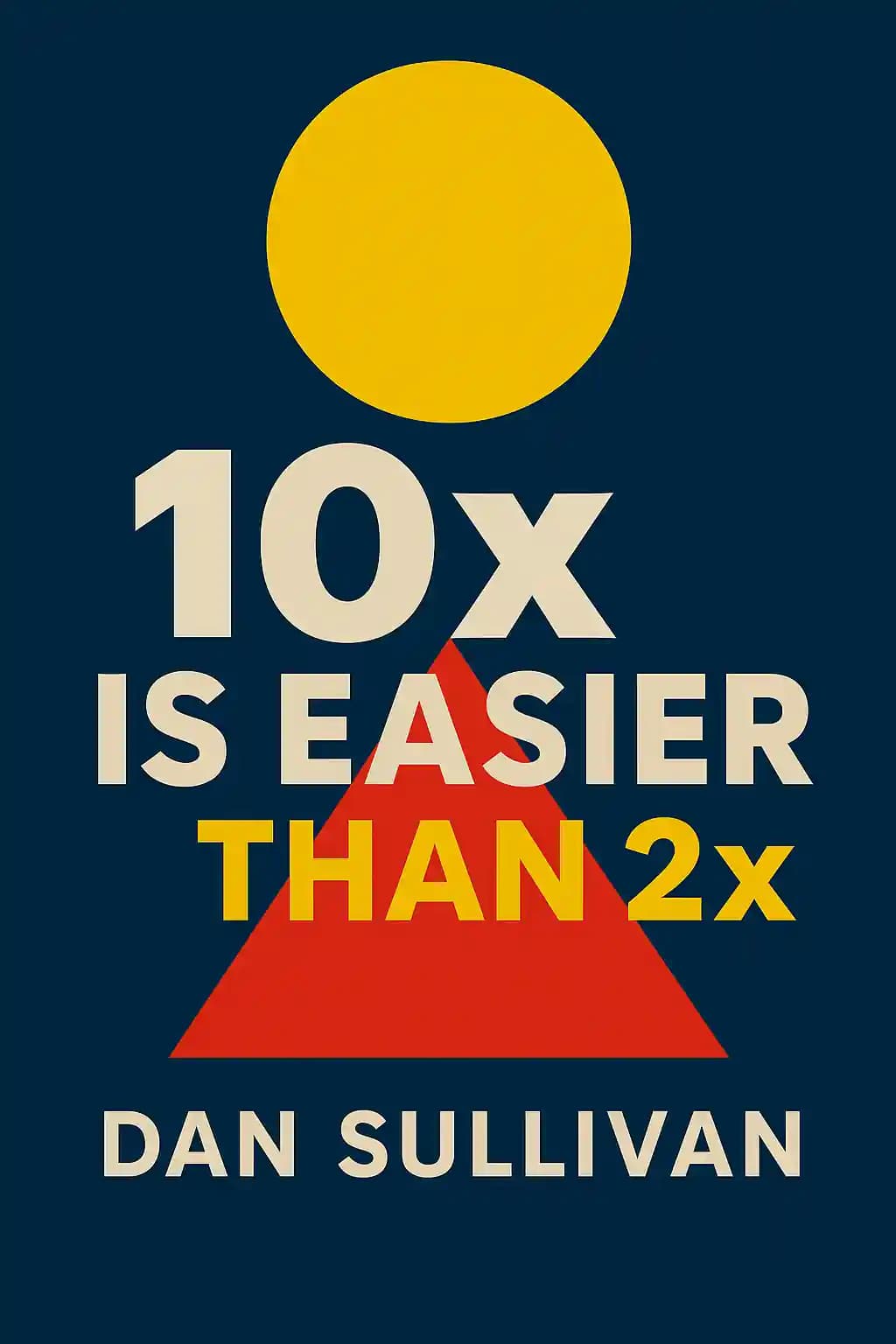
When Dan Sullivan's book "10x Is Easier Than 2x" hit the shelves, it challenged everything we thought we knew about growth and achievement. The book quickly became a favorite among tech entrepreneurs like Peter Diamandis (founder of XPRIZE) and negotiation expert Chris Voss, who called it both "a call to action and roadmap." What makes this book so compelling is its counterintuitive premise: that making something ten times bigger or better is actually simpler than doubling it. In an era where exponential growth is becoming the new normal, Sullivan and co-author Dr. Benjamin Hardy argue that incremental improvement is not just inefficient-it's the harder path. Their approach has transformed countless entrepreneurs, including many who've built nine-figure businesses using these principles. The book's cultural impact extends beyond business circles, influencing how we think about personal growth, time management, and the pursuit of mastery in any field.
Capitolo 2
Why 10x Is Fundamentally Different From 2x
The fundamental difference between 10x and 2x thinking lies in how each approach filters your activities. With 2x thinking, you maintain roughly 80% of your current activities while making minor adjustments to improve efficiency. It's linear growth based on your past-doing more of the same, just harder or faster. This approach feels comfortable because it doesn't require significant change, but it's ultimately exhausting and unsustainable.
In contrast, 10x requires letting go of 80% of your current focus to go all-in on the crucial 20% that delivers the most impact. This creates a qualitative transformation rather than mere incremental improvement. The 80/20 Rule (Pareto Principle) shows that 20% of your activities produce 80% of your results, but you can only identify this critical 20% when you set goals big enough to make the distinction obvious.
Small goals don't require 80/20 thinking because they don't demand significant changes. Only by stretching your goal 10x bigger does it become clear which strategies and behaviors won't work. As Dr. Alan Barnard explains, small goals create paralysis through too many possible paths, while impossible-seeming 10x goals immediately filter out ineffective strategies, leaving only the few approaches that might actually work.
This simplifies decision-making dramatically. With 2x goals, you can maintain most of your current activities, but 10x demands letting go of the majority to focus intensely on what truly matters. This makes 10x paradoxically easier than 2x-it eliminates confusion by making obvious which few paths might actually work.
Dan Sullivan helps entrepreneurs apply this principle by identifying their top 20% of clients that provide 80% of revenue and excitement, then drawing a clear line separating them from the rest. This filtering process, while initially uncomfortable, creates extraordinary clarity and focus.
Capitolo 3
The Continuous 10x Journey: Making Exponential Jumps
Linda McKissack's real estate journey perfectly illustrates the power of 10x thinking and the transformative nature of exponential growth. Starting with just $3,000 in first-year revenue as a part-time agent while in college, Linda transformed her business through strategic jumps that required both courage and foresight. When she made the pivotal decision to hand her thriving company to Brad in 2000, it appeared counterintuitive - "a step back to step way forward." Though this move initially resulted in a significant financial setback, reducing her income by 80%, this calculated investment freed her to focus on her new 20% - developing franchises and expanding her vision beyond local success.
The transition period was challenging and required extraordinary patience. It took three years of relentless effort - teaching classes, making countless calls, and recruiting potential partners - to launch her first franchise in Ohio. During this period, she invested not only her time but also her own income with no immediate return, demonstrating the principle that exponential growth often requires substantial upfront investment. After achieving her first franchise success, Linda systematically refined her approach, creating repeatable systems that made launching franchises across multiple cities increasingly efficient. Her methodology evolved from individual effort to scalable processes, allowing for faster expansion with each new location.
By 2011, Linda's business had grown to the point where she needed to make another pivotal shift. She hired a regional team, transitioning her 20% focus to leadership development and strategic growth. This move represented another exponential jump, as she moved from working in the business to truly working on it, developing leaders who could replicate her success across multiple markets.
Today, her business empire spans two major regions with 28 offices and more than 5,000 agents across three states, generating an impressive $14 billion in annual revenue. Through six successive 10x jumps, Linda evolved from a part-time college student to a successful real estate agent, to a listing specialist, to a franchise developer, and finally to a regional leader. Each evolutionary jump required her to let go of her previous focus and embrace a higher-level opportunity, dramatically increasing her freedom, income (now consistently in the high seven figures), and net worth (approaching nine figures).
As Linda frequently emphasizes in her presentations: "2x was just the launching pad to 10x, where you're now doing something totally different than you were before. Each jump requires you to become a different person with new skills, new thinking, and new capabilities." Her story powerfully demonstrates how 10x thinking isn't simply about doing more of the same - it's about qualitative transformation that fundamentally changes both what you do and who you are as a leader and entrepreneur.
Capitolo 4
Raising Standards: The Foundation of 10x Growth
Chad Willardson's journey from financial advisor trainee to billion-dollar wealth manager demonstrates how continuously raising standards drives extraordinary results. At 24, Chad defied his manager's warnings that no one would trust someone his age with significant investments by committing to only working with clients investing at least $100,000. After six months of rejection and relentless effort, his first client invested $600,000, validating his high standards approach.
This success led him to raise his minimum to $250,000, and by the end of his 18-month training, Chad had $30 million under management-double the program requirement. Within seven years, he managed $280 million and received multi-million dollar recruitment offers from top firms. Recognizing these opportunities as merely 2x growth, Chad made the bold 10x decision to start his own firm focused exclusively on millionaire entrepreneurs.
By continually raising his client minimums-from $1 million to eventually $10 million-Chad transformed his business while working less. Despite managing over $1 billion, he visits his office only 30 days yearly, focusing exclusively on his highest-value contributions. This evolution required shedding his former identity-the cold-caller, the first-in-last-out worker-to embrace a new 10x identity.
The key insight is that raising standards means rejecting 80% of what you currently do to focus on the vital 20%, making quality the priority over quantity. This requires what Dan Sullivan calls the 4C's Formula: Commitment leads to Courage, which builds Capability, ultimately creating Confidence. Each step in this cycle enables you to raise standards further, creating a virtuous cycle of growth.
The rewards for higher quality aren't linear but exponential. Jimmy Donaldson (MrBeast) exemplifies this principle with his YouTube success formula: "It's much easier getting five million views on one video than 100-thousand views on 50 videos." A 10% better video doesn't get 10% more views, but potentially 4x the views.
This explains why massive ambitions are paradoxically easier than modest ones-there's less competition at the top, and solving one $30 million problem is simpler than solving 100 problems at $100,000 each. As Tim Ferriss notes, "The level of competition is fiercest for 'realistic' goals, paradoxically making them the most time and energy-consuming."
Capitolo 5
Embracing Abundance: From Needing to Wanting
When Dan Sullivan hit rock bottom in 1978-getting divorced and going bankrupt on the same day-he experienced a profound awakening about personal responsibility and authentic desire. This crisis became a catalyst for transformation, leading him to develop a revolutionary daily practice of desire documentation. Each morning, he would meticulously write down his genuine wants, not just immediate needs, training his mind to think in terms of possibilities rather than limitations. This practice gradually rewired his thinking from a survival-based mindset to one of creative expansion.
The distinction between living in scarcity versus abundance manifests in every aspect of life. Those operating from wanting play an infinite game where possibilities constantly expand, wealth compounds, and value creation becomes natural and energizing. They see opportunities where others see limitations. In contrast, needers operate in a finite game, constantly reacting to external pressures, seeking security, and viewing resources as limited. This fundamental difference shapes not just financial decisions, but relationships, career choices, and personal growth.
Dan outlines four crucial distinctions that characterize this paradigm shift. First, needing is extrinsically motivated-driven by external pressures, expectations, and societal norms-while wanting emerges from authentic internal desires. Second, needing prioritizes security and safety, leading to risk-averse behavior, while wanting embraces freedom and possibility, encouraging bold action. Third, needing operates from a scarcity mindset where resources are limited and must be protected, while wanting recognizes abundant opportunities for creation and growth. Fourth, needing produces reactive behaviors focused on problem-solving, while wanting generates creative responses that shape new realities.
The power of authentic wanting is exemplified through Brian Armstrong's leadership at Coinbase. When faced with intense social pressure to engage in political activism, Armstrong made the controversial decision to maintain the company's singular focus on creating an open financial system. This choice, though criticized, demonstrated the courage to pursue genuine wants over external expectations. It illustrates how "freedom to" (actively choosing your direction) differs fundamentally from "freedom from" (merely escaping undesirable circumstances).
True freedom emerges from the courage to pursue authentic desires without needing external validation or justification. This requires developing what Dan calls "wanting muscle"-the ability to identify and act on genuine desires even when they conflict with others' expectations or conventional wisdom. The practice involves regular self-reflection, honest assessment of motivations, and the willingness to take full responsibility for one's choices and their consequences.
This mindset transformation is essential for achieving 10x growth because it shifts focus from reactive problem-solving to proactive value creation. When operating from wanting, entrepreneurs naturally think bigger, take bolder actions, and create more innovative solutions. They move from asking "What do I need to do?" to "What do I want to create?" This fundamental shift in perspective unleashes creative potential and opens pathways to exponential growth that remain invisible to those operating from need.
Capitolo 6
Discovering Your Unique Ability: The Core of 10x Growth
Your Unique Ability is the purest expression of yourself-"the David" or the "20 percent" of any 10x jump. It's how you create value that's so specialized no one can compete with you. Professional skateboarder Paul Rodriguez (P-Rod) exemplifies this principle. When Nike approached him in 2005, he insisted on having his own signature shoe-something granted to less than one percent of Nike athletes. Despite Nike's initial reluctance, P-Rod stood firm in his desire, which ultimately led to ten signature shoes that sold millions of pairs.
Those who take their Unique Ability seriously make the biggest 10x leaps because they focus on creating extremely unique value only they can deliver. Most entrepreneurs initially spend less than 20% of their time in their Unique Ability, but as they shift more time to developing it, non-linear jumps follow.
Committing to your Unique Ability requires extreme courage-betting fully on yourself regardless of others' opinions. Though it may seem "natural," pursuing your Unique Ability is intensely challenging yet ultimately liberating. When operating in your Unique Ability, work becomes play, you learn 10x faster, and you continually push boundaries without competition.
Your Unique Ability evolves with each 10x jump, taking you in surprising directions like Michelangelo's progression from drawing to sculpture to architecture. Research shows that viewing your work as a calling-doing what you're meant to do-leads to greater wellbeing and career success. People with a sense of calling often ignore conventional career advice, trusting their inner voice instead.
As Robert Greene explains, mastery requires forging your own unconventional path with self-confidence and self-awareness-the "X factor" that distinguishes true masters. Ultimately, mastery and uniqueness are inseparable.
To develop your Unique Ability: be honest about what you want without justification, expand your vision exponentially, clarify your ideal future self, identify the critical 20% that will drive your 10x jump, and let go of the less important 80%. Your Unique Ability should be defined broadly enough to transcend any specific activity, focusing on your essence rather than a particular skill.
Capitolo 7
Measuring Progress: The Gap and The Gain
A crucial mindset shift that makes letting go of 80 percent of your life not just possible but enjoyable is what Dan Sullivan calls "The Gap and The Gain." The "gap" is measuring yourself against what "could be" or "should be"-an ideal that can never be reached. Like a desert horizon that continuously recedes as you approach it, ideals constantly shift forward. When in the gap, you devalue your present situation and your entire past becomes problematic because it wasn't what it "should have been."
Being in the gap creates an unhealthy need for external validation that can never be satisfied. Even lifetime achievements fail to build self-confidence. While some entrepreneurs rationalize their gap mindset as driving their success, they ultimately pay too heavy a price by missing the joy of the present moment.
Being in the gain doesn't mean abandoning ambitious goals-it means measuring yourself backward against where you were before, not against ideals. This approach builds confidence, creates momentum, and makes 10x growth feel lighter. The gain mindset transforms every experience into learning opportunities, making you antifragile.
Research shows this approach leads to better decision-making, higher performance, and greater self-determination. The emotional signature of the gain is dopamine (happiness, motivation), while the gap produces cortisol (stress, frustration).
Looking back at your past reveals that you've already achieved 10x growth multiple times in your life. By identifying five past 10x jumps, naming them with timelines, clarifying the 20 percent focus and 80 percent you let go of at each level, and reflecting on how each jump developed your Unique Ability, you can learn from your past and clarify your future direction.
Your "fitness function" clarifies what you're optimizing for in life. Whatever you focus on expands, developing finer distinctions and expertise in that area while causing atrophy elsewhere. Your attention filters what you see and eventually determines who you become. The number one goal in life is developing mastery in your Unique Ability, living out your unique purpose at the highest possible level.
Capitolo 8
Transforming Time: Free Days, Focus Days, Buffer Days
Traditional 9-5 workdays are poorly structured for high productivity in our knowledge-based economy. Entrepreneurs who make the fastest 10x jumps escape this bureaucratic model of time, which originated from factory systems of the early 20th century and continues in our education system.
Dan Sullivan introduces a three-part time management system modeled after how performers structure their days. Rather than following the industrial 9-5 model where entrepreneurs are busy but not productive, this system focuses on qualitative, non-linear results: Free Days (rejuvenation days), Focus Days (performance days), and Buffer Days (organization and preparation days).
Recovery must become the first priority for high performers. Dan's assistant Babs blocks out 180 Free Days on his calendar at the beginning of each year before scheduling anything else. Research confirms that recovery is essential for flow and increased performance. LeBron James invests millions in recovery and sleeps 8-12 hours daily, enabling his unprecedented career longevity. Studies show that psychological detachment from work leads to less fatigue, better health, greater marital satisfaction, improved quality of life, and better mental health.
As success and mastery grow, recovery becomes increasingly important because decisions at higher levels have exponentially greater impact. With greater leverage and influence, judgment becomes crucial. Sound thinking requires brain power, time, and mental fermentation-impossible when constantly busy. Studies show only 16% of creative insights occur at work, with most happening during recreation, transportation, or at home.
Taking more free time benefits not just you but your entire team and systems. The hard truth is that you never know how good your team is until you step away-and they'll never discover their potential if you're constantly managing them. Your absence forces them to take ownership and learn to operate independently, creating what Dan calls a "Self-Managing Company."
For true 10x growth, focus on quality over quantity. Limit yourself to just three important objectives each day that align with your Unique Ability. These goals should meet the three flow state preconditions: clear goals, immediate feedback, and challenges beyond your current skill level. When you complete your objectives, completely unplug and psychologically detach from work.
Capitolo 9
Building a Self-Managing Company for 10x Growth
A Self-Managing Company is exactly what it sounds like-a team that manages themselves without your daily involvement. You remain the visionary and leader, but you're no longer the bottleneck involved in managing systems or teams. Instead, you've brought on world-class "Whos" better suited for those roles while you focus on innovation and transformation.
As an entrepreneur, you evolve through four levels: from rugged individual doing everything yourself (Level 1), to applying "Who Not How" as a leader (Level 2), to replacing yourself with better-fit leaders who run your Self-Managing Company (Level 3), freeing you to focus entirely on your Unique Ability and exploring new possibilities (Level 4).
Tim Schmidt's story with USCCA illustrates this journey. In his first decade (1997-2007), Tim barely achieved 2x growth as a controlling micromanager who did everything himself. The next decade saw explosive 10x growth-from $3-4 million to over $250 million-by building a world-class team and letting go of control.
The transition to a Self-Managing Company is simpler than most leaders believe. As Joseph Smith famously said when asked how he governed 20,000 people: "I teach them correct principles, and they govern themselves." This approach is actually the easiest way to lead-you establish clear vision, standards, and culture, then let people govern themselves.
Transformational Leadership creates trust and emotional commitment, leading to organizational citizenship behaviors where team members voluntarily expand their roles beyond basic requirements. Research confirms that when leaders gain trust and commitment, people naturally go above and beyond. To gain trust, you must first give trust-respecting your team's autonomy while providing clear standards.
A self-multiplying team naturally evolves from a self-managing one when you model the importance of Unique Ability. As team members focus on their own 20% sweet spot and eliminate their 80%, they create new roles for others who excel in those areas. This organic expansion happens when everyone continually refines their role around what energizes them.
This approach does come with a calculated risk-when you help people develop their Unique Ability, they become so valuable they could leave. However, few organizations truly embrace Unique Ability, so the risk is worthwhile. The greater danger is not having a compelling enough 10x vision-without it, your best people will leave while those with a 2x mindset who just want a "job" will remain.
Capitolo 10
The Leverage of 10x: Defeating a Thousand Pounds with Four Ounces
As you deepen your Unique Ability, you'll apply less pressure yet produce exponentially greater impact-the Chinese saying "Si liang bo qian jin" (defeat a thousand pounds with four ounces) perfectly captures this leverage. Your skills become "so good they can't be ignored," creating ripple effects far beyond your immediate actions.
The bottleneck is always the 20 percent that yields 80 percent of results. Most businesses fail to grow exponentially because they focus energy on the 80% of activities that don't solve the core bottleneck. To go 10x, you must let go of the 80% and direct all energy toward the 20%-the true constraint preventing goal achievement.
2x thinking means doing the same thing, only more-brute force without transformation. 10x requires an entirely different approach based on a different future vision. The bottleneck has always been yourself. To achieve 10x results, you must embrace your 20 percent, let go of your 80 percent repeatedly, and continually refine your focus to become the most powerful and unique version of yourself.
This means committing to a 10x vision, identifying your Unique Ability, creating a Self-Managing Company, and playing the infinite game rather than remaining stuck in finite thinking. The path to 10x freedom and purpose requires embracing transformation rather than incremental improvement.
In "10x Is Easier Than 2x," we explore how transformational growth happens through commitment to higher consciousness. As you develop your Unique Ability and choose freedom, you'll stop forcing yourself to do things you don't want to do. You'll shift from push to pull motivation, operating from want rather than need.
Like the consultant who charged $50,000 to mark an X on a nuclear plant gauge ($1 for the X, $49,999 for knowing where to put it), your expertise becomes increasingly valuable as you continuously expand your four freedoms: Time, Money, Relationship, and Purpose. This transformation isn't linear but creates an entirely different context and trajectory for your life, giving you greater freedom to cultivate your Unique Ability with a self-managing team continually improving its standards of excellence.