Master negotiator Clive Rich reveals game-changing techniques from his 10 billion deal-making experience with Sony, Apple, and Simon Cowell. Did you know poor negotiation costs UK businesses 17 billion yearly? Transform confrontation into collaboration and unlock win-win outcomes in every conversation.
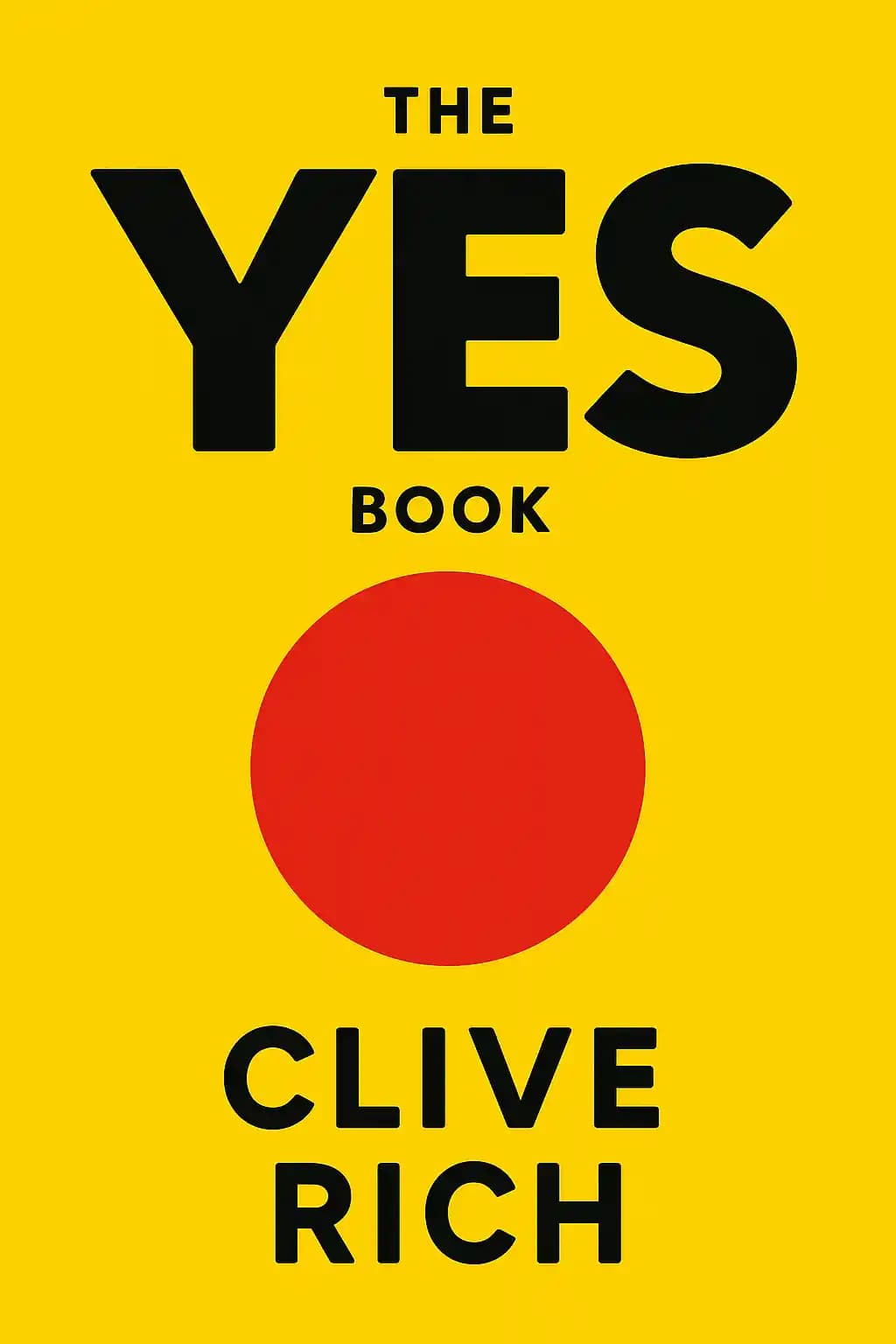
Clive Rich, author of The Yes Book: The Art of Better Negotiation, is a renowned negotiator, mediator, and entertainment lawyer with over 30 years of expertise in brokering high-stakes deals for global brands like Sony, Apple, and the BBC.
A graduate of Lincoln College, Oxford, and the Inns of Court School of Law, Rich combines his legal acumen with practical negotiation strategies in this business and self-help guide, which distills his framework for achieving mutually beneficial outcomes. His career includes negotiating over £10bn in agreements, from Pop Idol’s recording rights to partnerships with Universal and Virgin.
He also designed the negotiation app Close My Deal to democratize deal-making skills. Rich’s other works, including Law for Small Business For Dummies - UK, solidify his authority in legal and entrepreneurial circles.
A Tech London Advocate and seasoned arbitrator, he has been featured in industry talks and corporate training programs worldwide. The Yes Book draws from his billion-dollar negotiations, offering readers actionable insights honed through decades of real-world deal-making.
The Yes Book teaches collaborative negotiation strategies for achieving win-win outcomes in business and life. Clive Rich, a negotiator with over £10 billion in deals, breaks the process into Attitude, Behavior, and Process, emphasizing empathy, adaptability, and structured deal-making. The book highlights how poor negotiation costs businesses £9 million hourly and offers modern frameworks to replace outdated confrontational tactics.
Professionals, entrepreneurs, and anyone seeking to improve negotiation skills will benefit. It’s ideal for leaders handling pay discussions, sales deals, or family compromises. Clive Rich’s insights are particularly valuable for those in high-stakes industries like tech, media, or finance.
Yes, for its actionable strategies like “giving coinage” (trading low-cost concessions) and reframing inner dialogue to boost confidence. Rich’s blend of real-world examples (e.g., deals with Apple, Sony) and tools like the FUSER negotiation style makes it a practical guide for modern collaboration.
Rich cites YouGov data showing UK businesses lose £17 billion annually from ineffective negotiations. He advises avoiding “Confuser” tactics (distorting facts) and “User” behaviors (self-interest) in favor of transparency and shared-value creation.
“Coinage” involves trading concessions that are low-cost to you but high-value to the other party. For example, offering flexible deadlines in exchange for budget adjustments. This builds goodwill and keeps deals moving forward.
Start with low-risk scenarios like bargaining at a farmer’s market. This builds confidence without corporate consequences. Rich also suggests role-playing “worst-case” outcomes to reduce anxiety.
Some readers find the advice overly simplistic for complex negotiations, while others note repetitive examples. However, most praise its focus on collaboration over traditional “win-lose” tactics.
Unlike older models focused on conquest (e.g., The Art of War), Rich emphasizes interdependence. Modern deals, like tech partnerships, require long-term relationships, not one-time victories.
Fusers collaborate to merge agendas, ensuring both sides win. This contrasts with “Losers” (avoiding conflict), “Users” (self-serving), and “Confusers” (manipulative). Rich advocates FUSER tactics for sustainable outcomes.
Use “We” language to align interests (e.g., “How can we structure this to reflect my contributions?”). Prepare “coinage” like taking on extra projects in exchange for a raise, and set a positive climate by acknowledging your employer’s constraints.
It teaches framing requests as mutual gains (e.g., “If I handle chores, could we allocate time for my hobby?”). Techniques like active listening (“You” behavior) and visualizing shared goals reduce conflict in partnerships.
Ressentez le livre à travers la voix de l'auteur
Transformez les connaissances en idées captivantes et riches en exemples
Capturez les idées clés en un éclair pour un apprentissage rapide
Profitez du livre de manière ludique et engageante
Negotiation transforms from confrontation to collaboration.
Our interconnected world demands a collaborative approach.
You have to be totally connected to anyone who touches your brand.
Poor negotiation skills often lead to damaged business relationships.
Fusers believe both parties should benefit from negotiations.
Décomposez les idées clés de Yes Book en points faciles à comprendre pour découvrir comment les équipes innovantes créent, collaborent et grandissent.
Découvrez Yes Book à travers des récits vivants qui transforment les leçons d'innovation en moments mémorables et applicables.
Posez vos questions, choisissez votre style d’apprentissage et co-créez des idées qui vous correspondent vraiment.

Cree par des anciens de Columbia University a San Francisco
"Instead of endless scrolling, I just hit play on BeFreed. It saves me so much time."
"I never knew where to start with nonfiction—BeFreed’s book lists turned into podcasts gave me a clear path."
"Perfect balance between learning and entertainment. Finished ‘Thinking, Fast and Slow’ on my commute this week."
"Crazy how much I learned while walking the dog. BeFreed = small habits → big gains."
"Reading used to feel like a chore. Now it’s just part of my lifestyle."
"Feels effortless compared to reading. I’ve finished 6 books this month already."
"BeFreed turned my guilty doomscrolling into something that feels productive and inspiring."
"BeFreed turned my commute into learning time. 20-min podcasts are perfect for finishing books I never had time for."
"BeFreed replaced my podcast queue. Imagine Spotify for books — that’s it. 🙌"
"It is great for me to learn something from the book without reading it."
"The themed book list podcasts help me connect ideas across authors—like a guided audio journey."
"Makes me feel smarter every time before going to work"
Cree par des anciens de Columbia University a San Francisco

Obtenez le resume de Yes Book en PDF ou EPUB gratuit. Imprimez-le ou lisez-le hors ligne a tout moment.
Picture a business deal where you've crushed the competition, squeezed every dollar from the table, and walked away triumphant. Six months later, that same partner refuses to return your calls. Your "win" just cost you millions in future opportunities. This scenario plays out thousands of times daily in boardrooms worldwide, revealing a fundamental misunderstanding about modern negotiation. We're living through a seismic shift-from negotiation as warfare to negotiation as partnership-and those who haven't noticed are bleeding money and relationships. The world has fundamentally changed. With 5 billion mobile phones connecting us, social media giving voice to billions, and supply chains spanning continents, we're no longer isolated players. We're deeply interdependent. Technology has blurred industry lines so completely that hardware makers, software developers, and content creators now find themselves "in the same boat," forced to row together or sink separately. Meanwhile, economic power has shifted dramatically eastward, with BRICS nations driving nearly half of global growth. This isn't just background noise-it's the new reality where collaboration isn't noble, it's necessary for survival. Here's a staggering truth: the UK alone loses 17 billion annually through poor negotiation-roughly 9 million every working hour. Globally, that number balloons to $500 billion. Yet when executives are asked about improving profitability, better negotiation ranks only sixth in importance, trailing cost-cutting and marketing. This disconnect reveals what we might call the negotiation gap-a chasm between how critical negotiation has become and how little systematic training most people receive.
Fewer than half of business professionals prepare for negotiations-most act on impulse. Companies with structured training outperform peers by 25% in deal closure and achieve 5-10% better terms. Yet only one in three organizations provides systematic training. Your negotiation attitude shapes everything. "Fusers" believe both parties should benefit, staying assertive yet flexible-research shows this "dual concern" approach delivers the best long-term results. "Users" view negotiation as a contest to win at any cost, creating short-term advantages but lasting resentment. "Losers" approach with defeatism, neglecting their interests to satisfy others-this becomes self-fulfilling as they avoid conflict and yield to pressure. "Confusers" operate under mistaken assumptions-believing the pie is fixed, imagining nonexistent conflicts, or overestimating concessions. These cognitive shortcuts make us "cognitive misers," relying on mental simplifications that sabotage optimal outcomes.
Most people underestimate their bargaining power while overestimating their counterpart's. Power rarely distributes 11-0; it's typically 6-5 or 7-4. **Information is power** - market data, financial details, competitor intelligence. A media lawyer settled a songwriter dispute by producing earnings records revealing the true value. **Expertise matters**: specialized knowledge counterbalances other advantages. A career coach secured a $100 reduction on a car service bill by confidently questioning an inflated oil price. **Market power** includes niche strength, momentum, or perceived scarcity. **Scale** provides advantage, though Luxembourg proves tiny nations can thrive through expertise. **Referral power** - deferring decisions to someone absent - prevents hasty concessions. Your **network** of connections provides significant leverage. **Financial strength** offers obvious power, as Manchester City's billion-pound transformation demonstrates. **Existing relationships** create power through prior commitment - people desire consistency with previous actions. **Rules and regulations** on your side provide legal backing. **Authority** from seniority commands respect. Finally, **personal power** - your skill managing attitude, process, and behavior - remains available even when other aces are stacked against you.
Transform negative attitudes through practical confidence-building techniques. Challenge limiting beliefs by questioning generalizations like "I always mess this up" - what evidence actually supports this? These beliefs typically stem from isolated experiences, not patterns. Keep a success journal documenting wins, however small, to counter negative thoughts. Use outcome generation by visualizing success rather than failure. Your unconscious mind doesn't distinguish between imagined and real experiences, so envisioning success programs achievement. Spend 5-10 minutes before negotiations imagining specific details: your confident tone, relaxed body language, the other party nodding, the satisfying agreement moment. Employ "anchors" - triggers that stimulate positive attitudes from past experiences. Recall a powerful moment and access it through a simple trigger like pressing your thumb and forefinger together. Develop pre-negotiation rituals: reviewing materials, breathing exercises, energizing music. Many successful negotiators use power posing - standing confidently for two minutes before meetings - to boost testosterone and reduce stress hormones.
Most negotiators miss that deals follow seven distinct stages. **Preparation** is critical-"if you miss out preparation, then you are preparing to miss out." Consider both failure scenarios and worst-case success outcomes. Elvis Presley's manager sold his master recordings for $5.4 million without considering future royalties-potentially costing hundreds of millions. **Climate setting** establishes atmosphere: attendees, timetable, location, agenda, and authority levels. **Exploring** distinguishes organizational requirements from personal drivers using Maslow's hierarchy-achievement, respect, belonging, reassurance, survival. **Finding coinage** identifies low-cost concessions with high value to them. **Bidding** exchanges offers-ask for what you want without pre-negotiating with yourself. Research shows agreements typically fall closer to first offers than counteroffers. **Bargaining** exchanges counteroffers through progressively smaller concessions-make substantial early concessions showing willingness, then taper. **Close and review** requires recognizing the right moment, then extracting lessons learned.
Behavior focuses on how you negotiate, not just what you negotiate. There are four styles: "I" behaviors advance your agenda through proposals and clear expectations. "You" behaviors address their needs through active listening and open questions. "We" behaviors demonstrate mutual benefits by visualizing positive futures and developing joint solutions. "Parting" behaviors temporarily pause contact through recesses. Match behavior to negotiation stages. During climate-setting, choose based on desired atmosphere. For exploring needs, use "You" behavior. For bidding, use "I" behavior. During bargaining, combine "I" (incentives) with "We" (collaborative problem-solving) to break deadlocks. Adapt to personality types. With visual thinkers, use "The way I see it." With auditory processors, try "Talk to me about that." For kinesthetic types, use "That feels right." When facing tough tactics like threats or ultimatums, make their bad behavior the issue-once exposed, manipulators typically retreat. For "take it or leave it" ultimatums, test firmness with extreme questions. Against salami slicers who request endless small concessions, ask "Is that it?" to force closure.
In our borderless world, negotiation has evolved from occasional skill to daily necessity. The 17 billion lost annually in the UK alone represents damaged relationships, missed opportunities, and the cost of outdated approaches. Mastering negotiation isn't about domination-it's recognizing we're rowing together toward mutual success. When you approach negotiations as a "fuser" rather than a "user," understand your hidden power sources, and systematically apply the seven-stage process, you build lasting partnerships that multiply value over time. The negotiation gap exists because most haven't recognized this shift. They're fighting yesterday's battles with yesterday's weapons. You now have a different framework-one that acknowledges interdependence, leverages behavioral psychology, and creates value rather than merely dividing it. The question isn't whether negotiation matters. The question is whether you'll continue improvising on instinct or approach it systematically, transforming every interaction into opportunity for mutual gain. Because in the New Deal Economy, every conversation is a negotiation, and every negotiation is an opportunity to create something greater together.