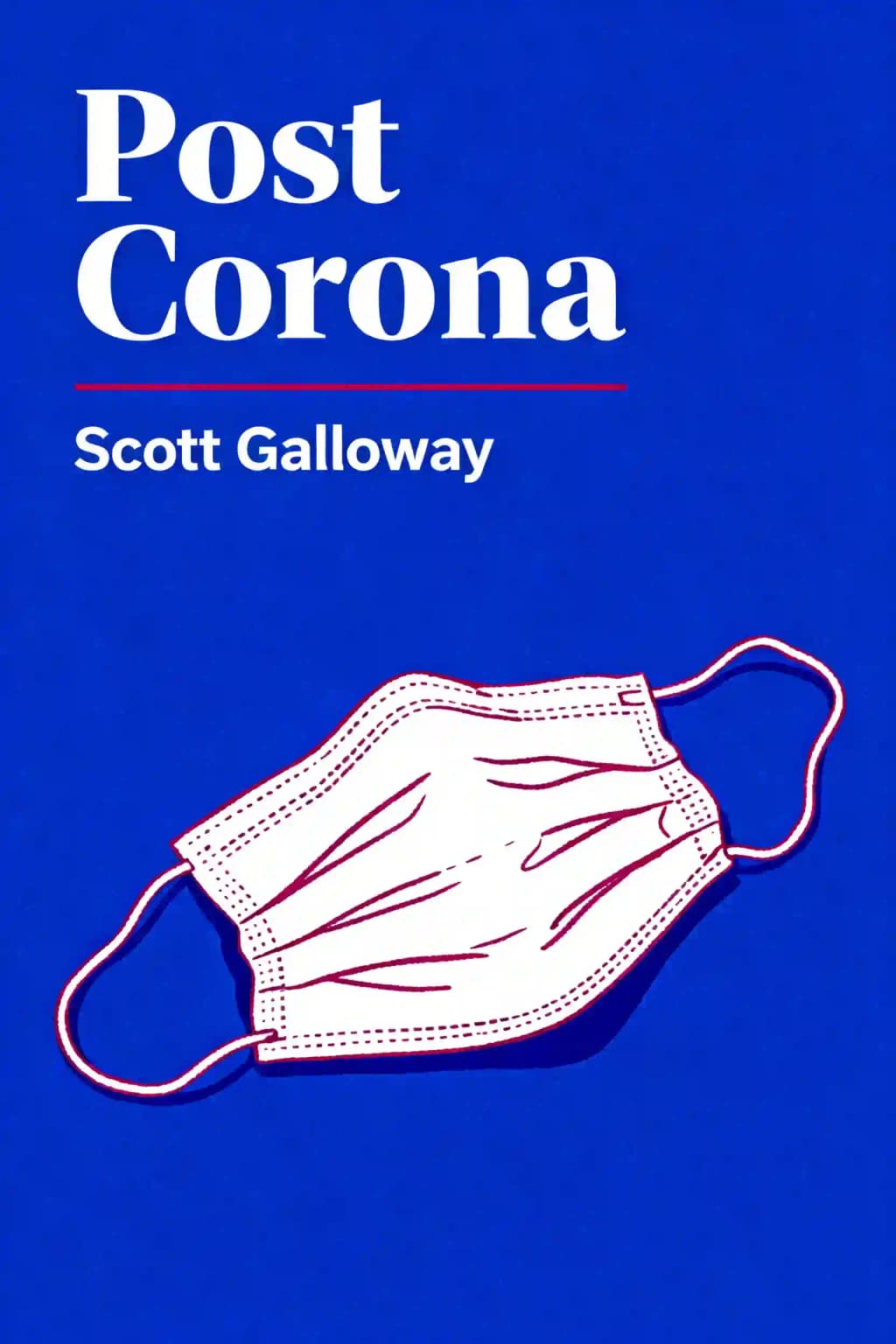
In "Post Corona," NYU professor Scott Galloway reveals how COVID-19 accelerated existing trends, creating winners (tech giants) and losers. This New York Times bestseller, praised by Financial Times as "as good an analysis as you could wish to read," offers a roadmap through our transformed economy.
Scott Galloway, bestselling author of Post Corona and renowned marketing expert, is a clinical professor at NYU’s Stern School of Business and serial entrepreneur.
His book blends economic analysis and business strategy to dissect post-pandemic market shifts, drawing on decades of experience founding companies like L2 (acquired by Gartner) and Section4, a disruptive online education platform. A TED speaker and host of the Prof G and Pivot podcasts, Galloway has penned multiple bestsellers, including The Algebra of Happiness and The Four, which explore success, wealth, and corporate power dynamics.
His work is informed by board roles at The New York Times Company, Urban Outfitters, and Berkeley’s Haas School of Business, as well as his incisive commentary on CNN and in his No Mercy/No Malice newsletter. Galloway’s books, translated into 28 languages, have cemented his reputation as a provocative voice in global business discourse.
Post Corona analyzes how COVID-19 accelerated pre-existing economic and societal trends, cementing the dominance of tech giants like Amazon and Zoom while devastating sectors like hospitality and education. Scott Galloway explores the pandemic’s role in widening inequality, reshaping consumer behavior, and forcing businesses to adapt or perish. The book blends sharp business insights with warnings about declining social mobility and corporate responsibility.
Business leaders, entrepreneurs, policymakers, and anyone interested in understanding tech’s growing influence will find this book essential. It’s particularly relevant for those analyzing post-pandemic economic shifts, digital transformation, or strategies to navigate volatile markets. Galloway’s accessible style also appeals to general readers seeking a macro-level view of societal changes.
Yes—it offers a compelling, data-driven analysis of pandemic-driven disruptions, backed by Galloway’s expertise as a NYU professor and tech entrepreneur. The book’s predictions about tech monopolies, remote work, and economic inequality remain pertinent in 2025, making it a valuable resource for understanding ongoing digital acceleration.
Galloway argues the pandemic turbocharged tech giants’ growth by intensifying reliance on e-commerce (Amazon), remote collaboration (Zoom), and streaming services. He details how these firms leveraged scale and infrastructure to crush competitors, predicting sustained dominance without regulatory intervention.
Higher education, brick-and-mortar retail, and traditional hospitality face existential threats due to outdated models exposed by the crisis. Galloway highlights universities’ declining value proposition without in-person networking and restaurants’ vulnerability to delivery-app economics.
Galloway condemns shareholder primacy and lax antitrust enforcement, arguing they enabled tech monopolies to prioritize profits over societal wellbeing. He advocates for policies to curb corporate power and reinvest in public goods like education and healthcare.
The book emphasizes “the accelerant effect”—how crises amplify winners and losers—and “digital Darwinism,” where companies adapt or die. Case studies contrast agile firms like Peloton with slow-moving incumbents.
While The Four dissects tech giants’ pre-pandemic rise, Post Corona examines their crisis-enabled dominance and broader societal impacts. Both books critique unchecked corporate power but diverge in scope: The Four focuses on corporate strategies; Post Corona addresses systemic policy failures.
He advocates taxing tech monopolies, revitalizing vocational education, and reimagining urban spaces for hybrid work. Galloway also stresses rebuilding trust in institutions through transparency and equitable growth initiatives.
Its themes remain critical amid ongoing debates about AI regulation, remote work evolution, and wealth gaps. The book’s warnings about digital inequality and corporate consolidation have intensified with recent tech layoffs and antitrust lawsuits.
Some argue it overemphasizes tech’s role while underselling healthcare and climate challenges. Others note Galloway’s pro-capitalist solutions contradict his systemic critiques, creating tension between reform and radical change.
Ressentez le livre à travers la voix de l'auteur
Transformez les connaissances en idées captivantes et riches en exemples
Capturez les idées clés en un éclair pour un apprentissage rapide
Profitez du livre de manière ludique et engageante
The pandemic didn’t change the trajectory of trends, but it dramatically accelerated them.
Our national response hasn't inspired confidence.
Your first markdown is your best markdown.
The market's priorities have dramatically shifted.
Décomposez les idées clés de Post Corona en points faciles à comprendre pour découvrir comment les équipes innovantes créent, collaborent et grandissent.
Condensez Post Corona en indices de mémoire rapides mettant en évidence les principes clés de franchise, de travail d'équipe et de résilience créative.

Découvrez Post Corona à travers des récits vivants qui transforment les leçons d'innovation en moments mémorables et applicables.
Posez n'importe quelle question, choisissez la voix et co-créez des idées qui résonnent vraiment avec vous.

Cree par des anciens de Columbia University a San Francisco
"Instead of endless scrolling, I just hit play on BeFreed. It saves me so much time."
"I never knew where to start with nonfiction—BeFreed’s book lists turned into podcasts gave me a clear path."
"Perfect balance between learning and entertainment. Finished ‘Thinking, Fast and Slow’ on my commute this week."
"Crazy how much I learned while walking the dog. BeFreed = small habits → big gains."
"Reading used to feel like a chore. Now it’s just part of my lifestyle."
"Feels effortless compared to reading. I’ve finished 6 books this month already."
"BeFreed turned my guilty doomscrolling into something that feels productive and inspiring."
"BeFreed turned my commute into learning time. 20-min podcasts are perfect for finishing books I never had time for."
"BeFreed replaced my podcast queue. Imagine Spotify for books — that’s it. 🙌"
"It is great for me to learn something from the book without reading it."
"The themed book list podcasts help me connect ideas across authors—like a guided audio journey."
"Makes me feel smarter every time before going to work"
Cree par des anciens de Columbia University a San Francisco

Obtenez le resume de Post Corona en PDF ou EPUB gratuit. Imprimez-le ou lisez-le hors ligne a tout moment.
March 2020 didn't just pause the world-it catapulted us into a future we weren't supposed to reach until 2030. A microscopic virus accomplished what years of innovation, investment, and disruption couldn't: it forced every human system to evolve overnight. E-commerce leaped forward a decade in eight weeks. Telemedicine became mainstream before anyone finished debating its merits. Remote work transformed from a fringe benefit to a default setting. But here's what makes this acceleration so unsettling: it didn't create new trends, it simply revealed what was already inevitable. We've been handed a glimpse of our future, and now we must decide whether to shape it or let it shape us.