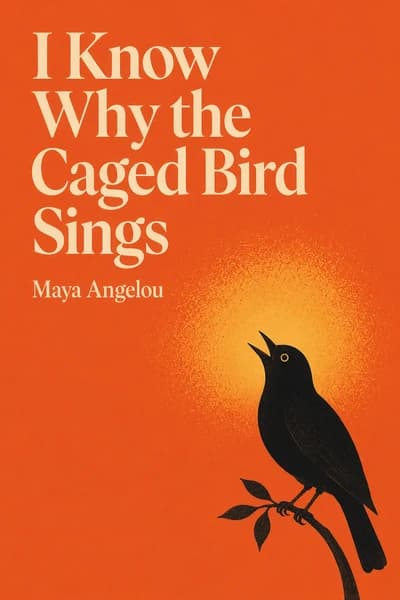
I Know Why the Caged Bird Sings
Overview of I Know Why the Caged Bird Sings
Maya Angelou's groundbreaking autobiography defied publishing stereotypes, becoming a bestseller that sparked Banned Books Week. After reading at Clinton's inauguration, sales surged 500%. James Baldwin helped secure its publication - now a timeless testament to resilience against racism and trauma.

Key Themes in I Know Why the Caged Bird Sings
- racial trauma
- literary salvation
- southern segregation
- female empowerment
- childhood displacement
Quotes from I Know Why the Caged Bird Sings
If growing up is painful for the Southern Black girl, being aware of her displacement is the rust on the razor that threatens the throat.
There is no greater agony than bearing an untold story inside you.
Words mean more than what is set down on paper. It takes the human voice to infuse them with the deeper meaning.
Books become her refuge and salvation, offering escape from the confines of her reality.
Characters in I Know Why the Caged Bird Sings
- Marguerite JohnsonThe protagonist who discovers her voice and power
- BaileyMaya's brother and constant childhood companion
- MommaMaya's grandmother and owner of the General Store
- Uncle WillieMaya's uncle who maintains dignity despite trauma
- Mrs. Bertha FlowersThe mentor who introduces Maya to literature
About the Author
About the Author of I Know Why the Caged Bird Sings
Maya Angelou (1928–2014) was an acclaimed memoirist, poet, and civil rights activist. She authored the groundbreaking autobiography I Know Why the Caged Bird Sings, a seminal work in 20th-century American literature.
Born Marguerite Ann Johnson in St. Louis, Missouri, Angelou drew from her traumatic childhood in the segregated South—including experiences of displacement, racism, and sexual abuse—to craft this raw, resonant exploration of race, identity, and resilience. The first of seven autobiographies, the book earned a National Book Award nomination and became a cultural touchstone, selling over a million copies worldwide and being translated into numerous languages.
A prolific writer, Angelou published poetry collections like Just Give Me a Cool Drink of Water ‘fore I Diiie (Pulitzer Prize-nominated) and later memoirs including Gather Together in My Name and Mom & Me & Mom. Her career spanned civil rights activism as the Northern coordinator for Martin Luther King Jr.’s Southern Christian Leadership Conference, alongside work as a playwright, professor, and influential speaker. I Know Why the Caged Bird Sings remains a foundational text in schools despite censorship challenges, cementing Angelou’s legacy as a voice for marginalized communities.
Download Summary of I Know Why the Caged Bird Sings
Get the I Know Why the Caged Bird Sings summary as a free PDF or EPUB. Print it or read offline anytime.
FAQs About This Book
I Know Why the Caged Bird Sings chronicles Maya Angelou’s childhood (ages 3–17) in the 1930s–1940s American South, exploring themes of racism, identity, and resilience. Abandoned by her parents, Maya navigates trauma, systemic oppression, and self-discovery while living with her grandmother in segregated Arkansas. Key events include her sexual assault, struggles with racial insults, and eventual empowerment through literature and community.
This memoir is ideal for readers interested in civil rights history, autobiographical narratives, or themes of racial identity and personal resilience. Educators, students, and book clubs will value its lyrical prose and exploration of societal inequity. Content warnings apply for depictions of trauma and racism.
Yes. Angelou’s memoir is a seminal work in American literature, acclaimed for its unflinching portrayal of racism and its impact on self-worth. It offers profound insights into overcoming adversity through courage and community, making it a timeless resource for understanding systemic oppression.
- Racism: Systemic discrimination in the segregated South, exemplified by the Ku Klux Klan’s threats and a white dentist’s refusal to treat Maya.
- Identity: Maya’s journey from self-loathing to empowerment, influenced by figures like Mrs. Flowers.
- Resilience: The Black community’s solidarity, such as celebrating Joe Louis’ boxing victory as a collective triumph.
The caged bird represents Black Americans’ confinement under racism and their enduring hope for freedom. Maya’s own struggles—like being silenced after her assault—mirror the bird’s yearning to “sing” despite oppression.
Angelou depicts racism through personal and communal experiences: Maya’s humiliation by a white employer, her grandmother’s degradation by “powhitetrash” girls, and the dehumanizing graduation speech. These moments underscore the psychological toll of segregation.
Books become Maya’s refuge, offering escape and self-expression. After her trauma-induced mutism, Mrs. Flowers reintroduces her to language’s power, reigniting her love for poetry and storytelling.
Maya’s rape and subsequent mutism illustrate the devastation of trauma, while her recovery—aided by community support and literature—highlights healing through empathy and self-expression. The memoir avoids sensationalism, focusing on resilience.
Some critics note graphic depictions of sexual assault and racism, which may distress sensitive readers. However, most praise its candidness and historical significance.
Unlike purely political texts, Angelou blends personal narrative with societal critique, using poetic prose to humanize systemic issues. It complements works like The Autobiography of Malcolm X but stands out for its focus on Black womanhood.
Themes of racial injustice, identity, and resilience remain urgent amid ongoing social equity movements. Maya’s journey mirrors modern struggles for systemic change, making the book a vital tool for discussing intersectional inequality.
- Confronting prejudice: Maya’s defiance against racist systems encourages activism.
- Embracing community: Her growth is fueled by familial and communal support.
- The power of voice: Writing becomes her tool for reclaiming agency.
Angelou’s lyrical prose blends raw honesty with metaphor, transforming personal pain into universal lessons. Her vivid descriptions—like the “ritual insult” by white children—immerse readers in her emotional landscape.
Bailey acts as her protector and confidant, stabilizing her amid instability. Their bond underscores family’s role in surviving trauma, though Bailey’s own struggles later highlight the limits of familial support.
Maya achieves tentative empowerment, becoming a mother at 17. The ending reflects her resilience, blending vulnerability with hope—a testament to overcoming societal and personal barriers.