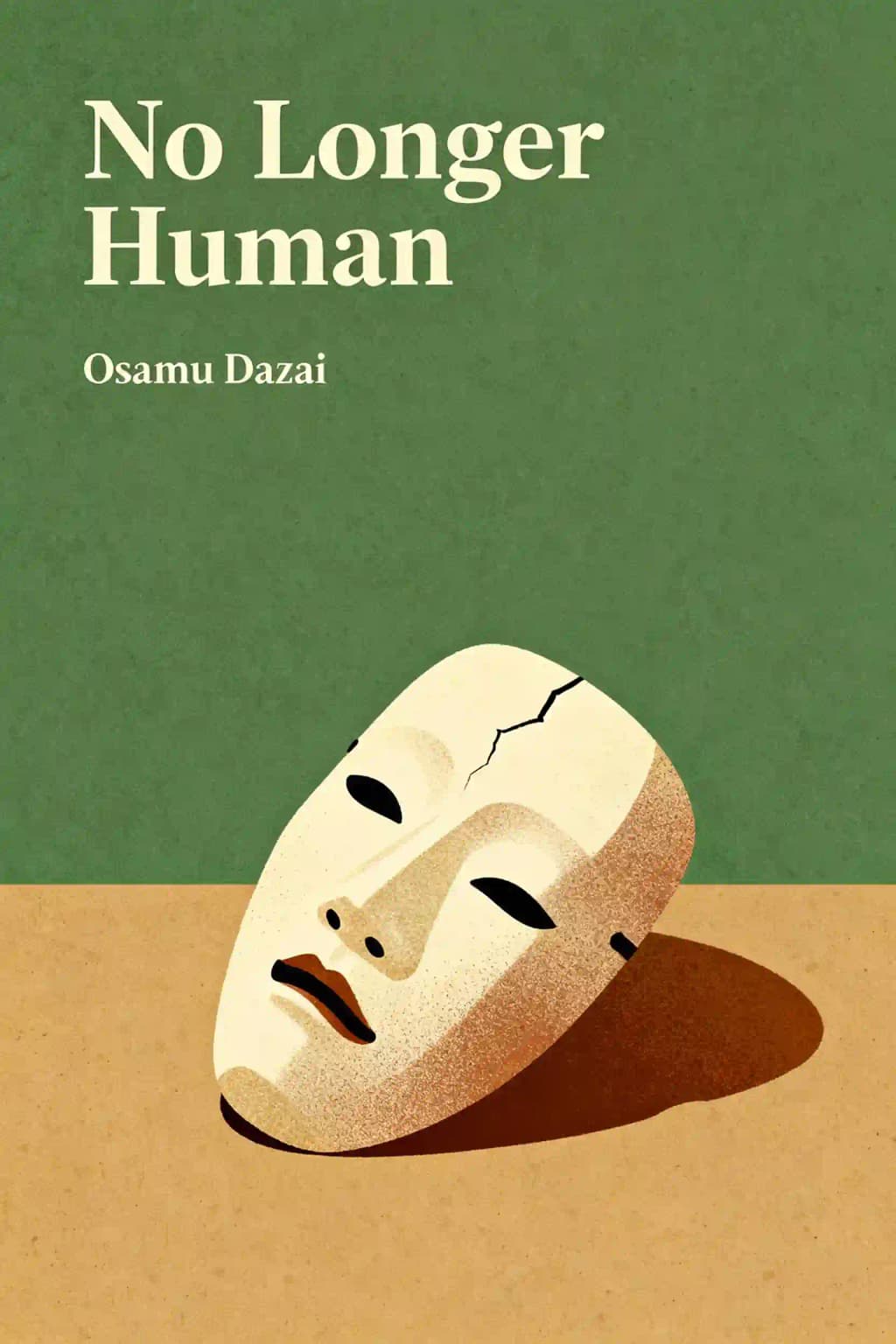
No Longer Human
Confessions of a Faulty Man
Overview of No Longer Human
Published the day its author's body was found after suicide, "No Longer Human" remains Japan's second-bestselling novel - a haunting masterpiece that continues to captivate younger generations with its raw exploration of alienation in a rapidly westernizing society.

Key Themes in No Longer Human
- social performance
- existential alienation
- childhood trauma
- profound shame
- human incomprehensibility
Quotes from No Longer Human
Mine has been a life of much shame.
I succeeded in escaping from being respected.
a wild animal in its true colors.
a picture of a ghost.
entirely unlike the rest.
Characters in No Longer Human
- YozoThe alienated protagonist and narrator
- Osamu DazaiThe author of this semi-autobiographical novel
- Yozo's fatherA wealthy landowner and distant authority figure
- Yozo's motherA figure whose gentle corrections filled Yozo with dread
About the Author
About the Author of No Longer Human
Osamu Dazai, born Shūji Tsushima (1909–1948), was a Japanese novelist and one of the most influential writers of 20th-century Japanese literature, best known for his semi-autobiographical masterpiece No Longer Human.
Published in 1948, this confessional I-novel explores themes of alienation, depression, addiction, and the profound struggle to connect with society—mirroring Dazai's own turbulent life marked by multiple suicide attempts and battles with addiction. His brutally honest portrayal of existential despair and mental health stigma resonated deeply with post-war Japan and continues to captivate global readers today.
Dazai's other acclaimed work, The Setting Sun (1947), achieved such cultural impact that the phrase "people of the setting sun" entered common Japanese dictionaries. Influenced by Dostoevsky and known for his raw emotional depth, Dazai's writing has been translated into more than 60 languages. No Longer Human remains his most popular work internationally and is widely regarded as a modern classic of Japanese literature.
Download Summary of No Longer Human
Get the No Longer Human summary as a free PDF or EPUB. Print it or read offline anytime.
FAQs About This Book
No Longer Human by Osamu Dazai follows Yozo Ōba, a deeply alienated man who struggles to connect with others and feels fundamentally "disqualified" from being human. Through a series of notebooks, the story chronicles his descent into alcoholism, failed relationships, suicide attempts, and drug addiction as he desperately tries to mask his profound fear of human beings. The semi-autobiographical novel explores themes of alienation, shame, and mental anguish in post-war Japan.
Osamu Dazai, born Shūji Tsushima in 1909, was one of Japan's most influential 20th-century writers known for his brutally honest, autobiographical fiction. His tumultuous life—marked by multiple suicide attempts, addiction struggles, and profound alienation—deeply influenced his work and captured the despair of post-war Japan. Dazai's writing style, characterized by confessional first-person narratives and exploration of human fragility, made him a beloved figure in Japanese literature despite his tragic death by suicide in 1948.
No Longer Human is ideal for readers interested in psychological fiction, Japanese literature, and explorations of mental health and alienation. The book resonates particularly with those who've experienced feelings of social disconnection, depression, or the struggle to wear masks in society. Despite its dark themes, Dazai's accessible writing style and relatable portrayal of human vulnerability make it appealing to students and anyone seeking honest examinations of shame, identity, and the human condition.
No Longer Human is considered a masterpiece of modern Japanese literature and remains deeply relevant for its unflinching examination of mental illness and social alienation. The novel's raw emotional honesty and psychological depth offer profound insights into human fragility, making it a powerful reading experience despite its disturbing content. While challenging due to its themes of suicide, addiction, and despair, the book's literary significance and emotional impact make it essential reading for those interested in existential fiction and psychological realism.
The central theme of No Longer Human is profound alienation and the inability to connect authentically with other human beings. Yozo's constant fear of humanity drives him to wear masks and play the clown to hide his true self, ultimately leading him to feel "disqualified as a human being". The novel explores how shame, self-deception, and the inability to trust others can destroy a person's sense of belonging in society and their own humanity.
In No Longer Human, being "disqualified as a human being" represents Yozo's belief that he has fundamentally failed at being human and no longer deserves to participate in society. This phrase emerges after his institutionalization in a psychiatric ward, symbolizing his complete alienation and loss of human connection. It reflects Dazai's exploration of how mental illness, addiction, and social rejection can strip away one's sense of humanity and belonging, leaving only shame and isolation.
Alcoholism in No Longer Human serves as both a coping mechanism and catalyst for Yozo's destruction throughout the narrative. Yozo uses alcohol to numb his fear of other people and temporarily escape his crushing self-awareness, stating he wants to "get so drunk that he can't feel anything". His drinking escalates after traumatic events, particularly after witnessing his wife's assault, ultimately leading to morphine addiction, physical deterioration, and complete social collapse.
Yozo's repeated suicide attempts in No Longer Human reflect his desperate desire to escape human existence rather than solve specific problems. His first attempt with Tsuneko results in her death while he survives, burdening him with additional guilt and alienation. Each subsequent attempt—through drowning, sleeping pills, and contemplated morphine overdose—demonstrates the progressive deepening of his despair and reinforces his feeling of being fundamentally incompatible with life itself.
No Longer Human portrays relationships as sources of both connection and devastating betrayal throughout Yozo's life. His marriage to the innocent Yoshiko offers brief hope for redemption until her rape destroys their relationship and Yozo's fragile trust in human goodness. The novel suggests that Yozo's inability to trust stems from his fear of authenticity—he can neither be genuine himself nor accept others' genuine affection, creating a cycle of failed connections and deeper isolation.
No Longer Human employs a unique framed narrative structure consisting of three notebooks written by protagonist Yozo, bookended by an unnamed narrator's prologue and epilogue. This meta-fictional approach creates distance between the reader and Yozo's confessions while lending authenticity to his account. The notebooks chronicle different periods of Yozo's life from childhood through age 27, creating an autobiographical feel that blurs fiction and reality—a technique characteristic of Dazai's "I-novel" style.
No Longer Human is deeply autobiographical, mirroring Dazai's own struggles with multiple suicide attempts, addiction, and profound alienation. Like Yozo, Dazai was born into a wealthy family, attempted double suicide with a woman (who died while he survived), struggled with alcoholism and drug addiction, and felt fundamentally disconnected from society. The novel was published in 1948, the same year Dazai successfully committed suicide at age 39, making the work a haunting reflection of his inner torment.
No Longer Human is considered one of the most important Japanese novels of the 20th century and has profoundly influenced Japanese literature and culture. The phrase "people of the setting sun," from Dazai's earlier work, entered common usage to describe post-war Japanese disillusionment—a sentiment No Longer Human captures through Yozo's alienation. The novel's exploration of shame and social masks resonates particularly with Japanese readers, and Dazai remains beloved among students for his accessible style and honest portrayal of human weakness.





