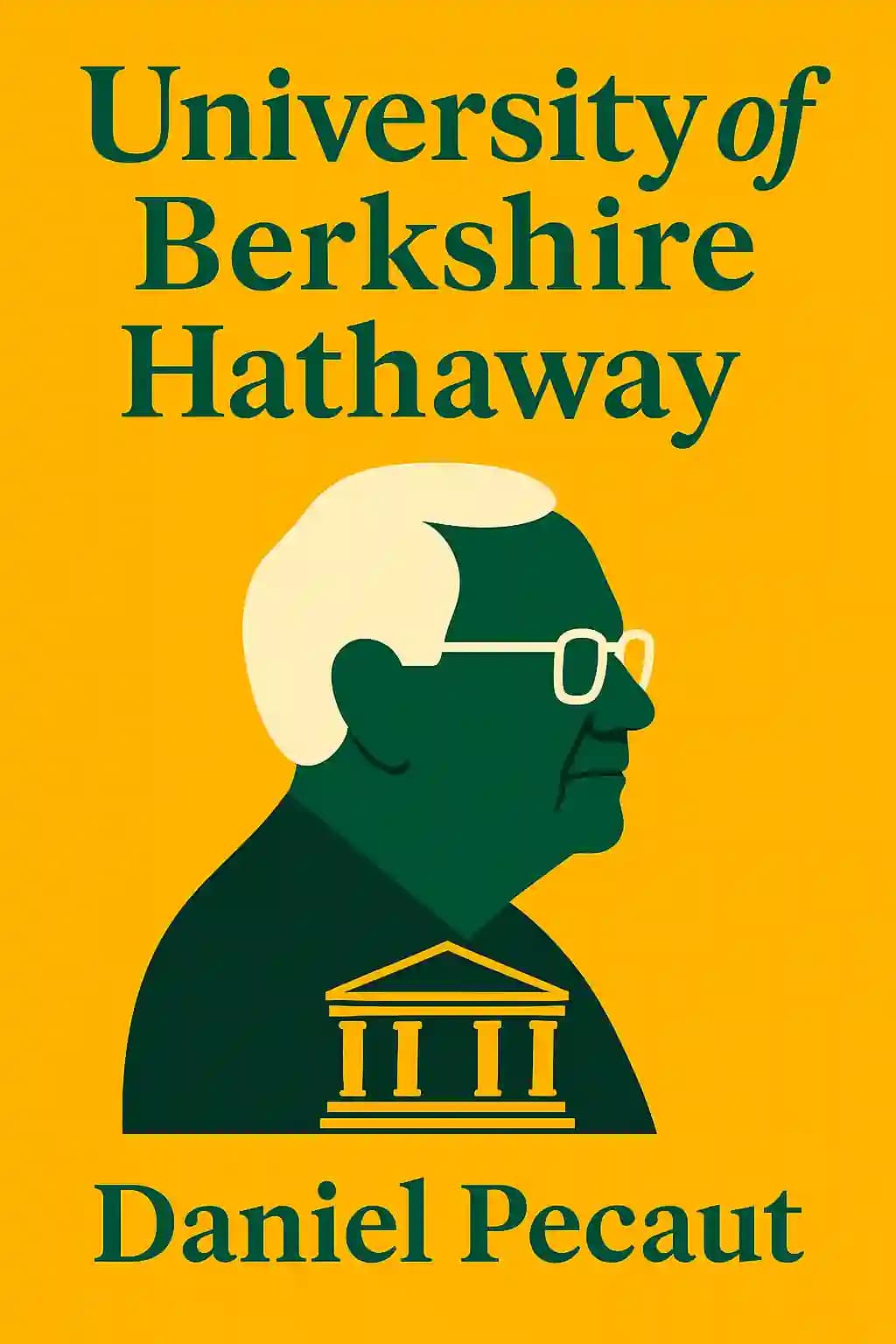
University of Berkshire Hathaway
Overview of University of Berkshire Hathaway
Step inside Warren Buffett's legendary shareholder meetings with this 30-year chronicle that Bill Ackman calls essential reading. Buffett himself autographs this book more than any other - a rare glimpse into the investment philosophy that transformed $10,000 into a $100+ billion empire.

Key Themes in University of Berkshire Hathaway
- value investing principles
- capital allocation strategy
- margin of safety
- economic moat identification
- compounding insurance float
Quotes from University of Berkshire Hathaway
Diversification is a protection against ignorance.
Munger calls diversification 'twaddle' for knowledgeable investors.
Textiles were a dying industry with poor economics.
Successful investing requires the right temperament more than raw intelligence.
Float could be invested, creating a powerful wealth-compounding machine.
Characters in University of Berkshire Hathaway
- Daniel PecautAuthor and investment expert
- Corey WrennCo-author and investment professional
About the Author
About the Author of University of Berkshire Hathaway
Daniel Pecaut, co-author of University of Berkshire Hathaway: 30 Years of Lessons Learned from Warren Buffett & Charlie Munger at the Annual Shareholders Meeting, is a seasoned investment advisor and Harvard-educated expert in value investing. His book, a finance and investing classic, distills three decades of insights from Berkshire Hathaway’s annual meetings, emphasizing long-term wealth-building, market psychology, and ethical leadership.
A frequent contributor to media outlets like the New York Times and Money Magazine, Pecaut combines academic rigor with real-world financial strategy, shaped by his decades analyzing Buffett and Munger’s philosophies.
Pecaut’s other works, including Saving, Spending, Investing, Giving: A Veteran Investment Advisor Reflects on Money, further explore practical wealth management. As CEO of Pecaut Wealth Management, he has advised clients on navigating market cycles since 1986.
University of Berkshire Hathaway has become a trusted resource for investors worldwide, praised for its actionable wisdom and rare access to Buffett’s unfiltered economic outlook. The book’s enduring relevance is underscored by its inclusion in institutional investing curricula and its status as a staple in value-investing literature.
Download Summary of University of Berkshire Hathaway
Get the University of Berkshire Hathaway summary as a free PDF or EPUB. Print it or read offline anytime.
FAQs About This Book
University of Berkshire Hathaway chronicles 30 years of Warren Buffett and Charlie Munger’s insights from Berkshire Hathaway’s annual shareholder meetings. It reveals their investment strategies, focus on intrinsic value, and philosophy on long-term wealth-building, while offering practical wisdom on risk management, market psychology, and life principles.
This book is ideal for investors, business students, and Buffett/Munger enthusiasts seeking firsthand insights into value investing. It’s particularly valuable for those interested in learning how to analyze businesses, manage market volatility, and apply timeless financial principles.
Yes—the book distills decades of Buffett and Munger’s candid advice into actionable lessons, making it a compelling resource for investors. While some sections repeat themes, the depth of firsthand shareholder meeting insights justifies its value for serious learners.
Key strategies include:
- Intrinsic value focus: Buying undervalued businesses with strong fundamentals.
- Long-term holding: Ignoring short-term market noise to compound gains.
- Margin of safety: Purchasing assets well below calculated worth to minimize risk.
- “The market is there to serve you, not instruct you”: Encourages independent thinking over herd mentality.
- “If you can’t value a business, you can’t value a stock”: Emphasizes deep financial analysis before investing.
- “It’s far better to buy a wonderful company at a fair price”: Prioritizes quality over bargain hunting.
Intrinsic value is the discounted future cash flows a business can generate. Buffett and Munger stress calculating this through rigorous analysis of management, competitive advantages, and financial health—not relying on market prices.
The book highlights Berkshire’s insurance-driven “float” strategy, where premiums fund investments. It also advocates for:
- Avoiding debt-fueled speculation.
- Diversifying across industries with durable moats.
- Maintaining liquidity to capitalize on market downturns.
Critics note repetitive themes due to its chronological meeting format and limited critique of Buffett’s missteps (e.g., overestimating newspapers’ viability). However, it remains a top-tier source for understanding Berkshire’s evolution.
Unlike biographies or theoretical guides, this book offers verbatim meeting notes, providing raw access to Buffett/Munger’s thinking. It complements The Essays of Warren Buffett but prioritizes practicality over academic theory.
Daniel Pecaut, a Harvard graduate and 30-year investment strategist, attended Berkshire meetings since 1984. His firm manages over $500M, grounding the book in real-world application of Buffett/Munger principles.
With market volatility and AI disruption, the book’s emphasis on rational decision-making, business durability, and emotional discipline remains critical. Its lessons on capital allocation are timeless for navigating economic uncertainty.
Individual investors learn to:
- Avoid frequent trading and focus on compounding.
- Invest in understandable industries.
- Treat stocks as business ownership stakes, not ticker symbols.





