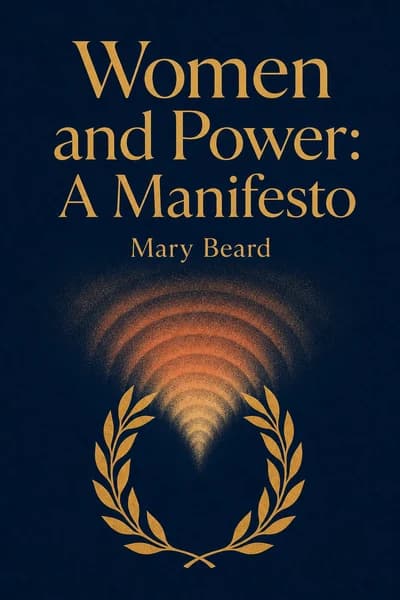
Women and Power
A Manifesto
Overview of Women and Power
In "Women & Power," Cambridge professor Mary Beard exposes how women's voices have been silenced since ancient Greece. Released during #MeToo, this manifesto brilliantly connects Medusa myths to modern politics, challenging us to redefine power rather than force women into male structures.

Key Themes in Women and Power
- classical roots of misogyny
- public speech gender bias
- cultural silencing of women
- masculinity and authoritative discourse
- female exclusion from power
Quotes from Women and Power
Speech will be the business of men, all men, and of me most of all.
Our language still undermines women's public speech through subtle mechanisms.
Sorry, love, you just don't understand.
Women's voices remain niched into speaking only about women's causes.
The silencing continues, echoing across millennia.
Characters in Women and Power
- Mary BeardAuthor, Cambridge professor, and classicist
- TelemachusSon of Odysseus who silences his mother Penelope
- PenelopeWife of Odysseus whose public speech is stifled
- PhilomelaMythological figure silenced by her rapist
About the Author
About the Author of Women and Power
Dame Winifred Mary Beard, acclaimed classicist and bestselling author of Women & Power: A Manifesto, merges her expertise in Ancient Rome with incisive feminist thought to trace misogyny’s roots across millennia.
A professor of classics at Cambridge’s Newnham College and classics editor of the Times Literary Supplement, Beard anchors her analysis of gendered power dynamics in historical parallels, from Homer’s silenced women to modern political figures.
Her acclaimed works, including SPQR: A History of Ancient Rome and Pompeii: The Life of a Roman Town, blend scholarly rigor with public engagement, amplified through her TLS blog “A Don’s Life” and her role in the BBC/PBS series Civilisations.
A trustee of the British Museum and frequent media commentator, Beard has shaped global discourse on antiquity and contemporary gender issues. Women & Power, hailed as a “modern feminist classic” by The Guardian, distills her decades of research into a provocative critique of institutionalized sexism, selling over 500,000 copies and translated into 28 languages.
Download Summary of Women and Power: A Manifesto
Get the Women and Power: A Manifesto summary as a free PDF or EPUB. Print it or read offline anytime.
FAQs About This Book
Women & Power examines the historical roots of misogyny, tracing how Western culture has systematically excluded women from positions of authority since antiquity. Through examples like Penelope’s silencing in Homer’s Odyssey and modern politicians like Hillary Clinton, Beard argues that power structures must be redefined to include women’s voices rather than forcing them into male-defined norms.
This book is essential for feminists, classics enthusiasts, and anyone interested in gender politics. It’s particularly relevant for readers analyzing systemic sexism in leadership, public discourse, or cultural narratives.
Yes. The book’s concise, provocative essays offer a groundbreaking perspective on gender and power, blending historical analysis with modern relevance. It has been hailed as a “modern feminist classic” for its incisive critique of misogyny.
Beard draws parallels between classical examples (e.g., Roman women labeled “androgynes” for speaking publicly) and contemporary issues like online trolling of female leaders. She highlights how assumptions about women’s voices as “shrill” or “untrustworthy” persist across millennia.
- “When it comes to silencing women, Western culture has had thousands of years of practice.”
- “If women aren’t perceived to be within the structure of power, isn’t it power itself we need to redefine?”
These lines encapsulate the book’s critique of systemic exclusion and its call for structural change.
Beard critiques traditional notions of leadership as inherently masculine, arguing that women often face ridicule or marginalization when adopting these roles (e.g., Angela Merkel’s “male-coded” attire). She advocates redefining power as an action (“to power”) rather than a possession.
- Penelope in The Odyssey, silenced by her son Telemachus.
- Medusa, whose beheading symbolizes the punishment of powerful women.
- Philomela, a mythological figure whose tongue was cut out to prevent her from speaking truth.
Beard analyzes incidents like Elizabeth Warren being told to “sit down” during a Senate debate, linking them to ancient patterns of suppressing women’s voices. She argues that female politicians are still judged more harshly for their tone and appearance than male counterparts.
Rather than incremental changes, Beard urges a radical rethinking of power structures. This includes challenging the male-centric definition of leadership and creating systems where women’s contributions are valued without requiring assimilation into patriarchal norms.
Beard reflects on her personal experiences with sexist trolling, connecting digital harassment to historical tactics used to silence women. The book underscores how online abuse reinforces traditional power imbalances.
Some reviewers note the book’s brevity (based on two lectures) leaves less room for detailed solutions. Others desire more intersectional analysis, though Beard’s focus remains on Western classical traditions.
As debates about gender equity persist in politics, workplaces, and online spaces, Beard’s analysis remains critical for understanding enduring biases. Its insights apply to ongoing struggles for representation and equitable leadership.