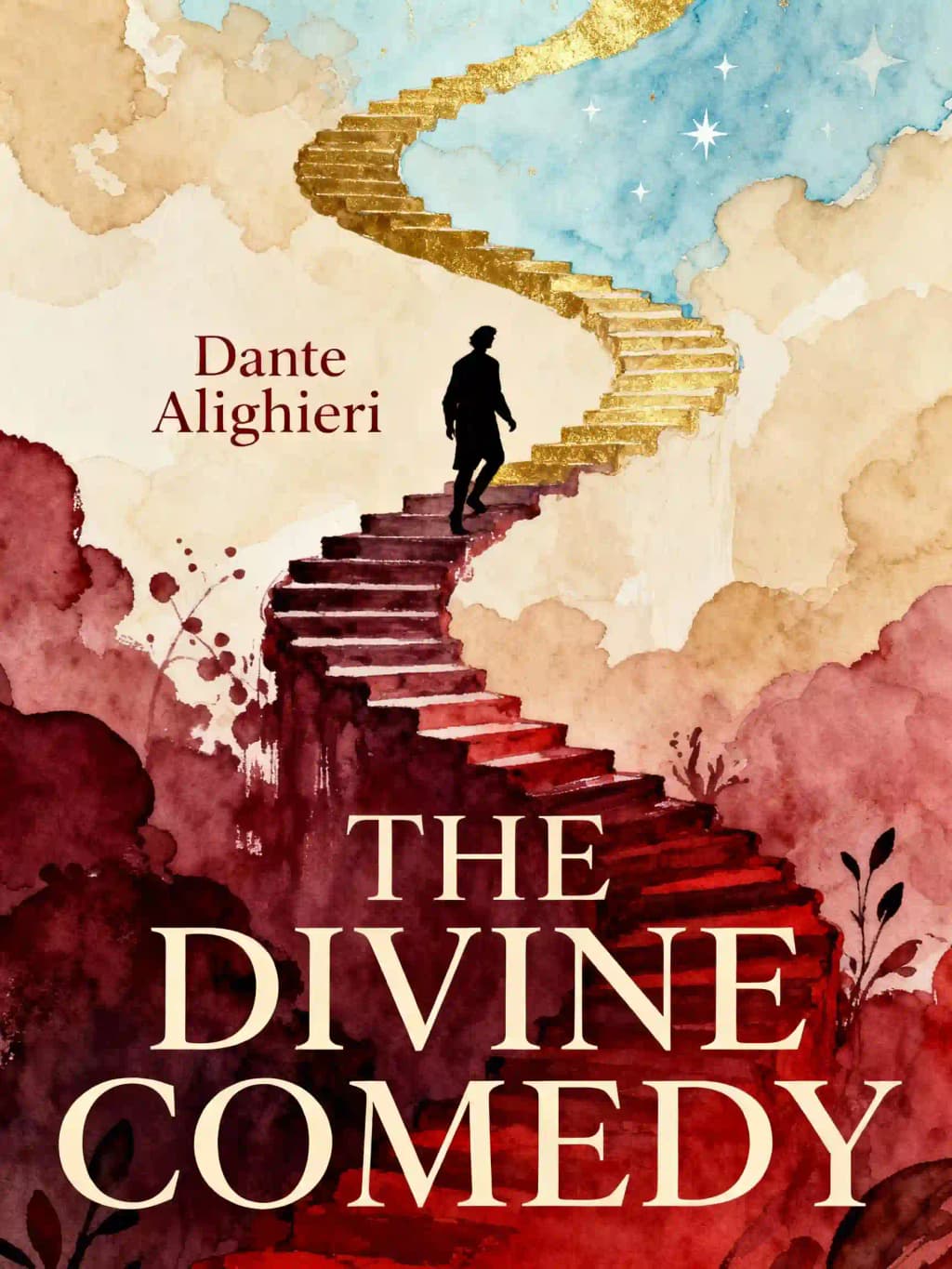
The Divine Comedy
Overview of The Divine Comedy
Dante's epic journey through Hell, Purgatory, and Paradise revolutionized Western literature. T.S. Eliot and James Joyce drew inspiration from this masterpiece that boldly placed corrupt politicians in Hell. What forbidden political commentary lies within this 100-canto spiritual odyssey?

Key Themes in The Divine Comedy
- spiritual redemption
- moral justice
- allegorical journey
- human condition
- theological architecture
Quotes from The Divine Comedy
Midway upon the journey of our life I found myself within a forest dark, For the straightforward pathway had been lost.
There is no greater sorrow than to recall a happy time in wretchedness.
Abandon all hope, ye who enter here!
Your avarice afflicts the world, trampling the good and raising up the wicked.
Characters in The Divine Comedy
- Dante AlighieriThe protagonist and narrator on a spiritual quest
- VirgilAncient Roman poet and Dante's guide through Hell
- BeatriceDante's deceased beloved and symbol of revelation
- FrancescaA damned soul punished for her adulterous passion
- SatanThe figure at the bottom of Hell punishing traitors
About the Author
About the Author of The Divine Comedy
Dante Alighieri (1265–1321), the visionary Italian poet and philosopher behind The Divine Comedy, is celebrated as the father of modern Italian literature. This epic poem, structured into Inferno, Purgatorio, and Paradiso, explores themes of morality, sin, redemption, and the Christian afterlife through a vivid allegorical journey.
Born in Florence, Dante’s political exile in 1302 profoundly influenced his writing, infusing the work with critiques of corruption and a yearning for spiritual and societal renewal. A pioneer of vernacular literature, he elevated the Florentine dialect to a literary language, cementing his legacy as Italy’s national poet.
His earlier work, La Vita Nuova (The New Life), intertwines poetry and prose to chronicle his idealized love for Beatrice Portinari, who later guides him in The Divine Comedy. Recognized for inventing terza rima, Dante’s innovative verse structure shaped European poetry.
Translated into over 50 languages, The Divine Comedy remains a cornerstone of Western literature, inspiring countless adaptations in art, literature, and theology.
Download Summary of The Divine Comedy
Get the The Divine Comedy summary as a free PDF or EPUB. Print it or read offline anytime.
FAQs About This Book
The Divine Comedy traces Dante’s allegorical journey through Hell (Inferno), Purgatory (Purgatorio), and Heaven (Paradiso), guided by Virgil and Beatrice. Written in the 14th century, it explores themes of sin, redemption, and divine justice, framed within medieval Christian theology. The poem’s three-part structure reflects Dante’s progression from spiritual darkness to enlightenment, blending personal exile with universal human struggles.
This epic is essential for literature students, medieval history enthusiasts, and readers exploring Christian allegory. Its layered symbolism appeals to philosophers analyzing morality, poets studying the terza rima form, and historians examining Florentine politics. Those interested in Dante’s revolutionary use of Italian (over Latin) will find it linguistically groundbreaking.
Yes. As a cornerstone of Western literature, it offers timeless insights into human nature, sin, and salvation. Its inventive imagery (like Hell’s nine circles) influenced art and theology for centuries. While challenging, modern translations and annotations make its exploration of love, exile, and divine justice accessible.
Dante’s Purgatorio features seven terraces corresponding to the seven deadly sins: Pride, Envy, Wrath, Sloth, Avarice, Gluttony, and Lust. Penitents climb each terrace to purge sins through counteracting virtues—e.g., pride is healed by humility. Each level ends with an angel erasing one of seven “P” marks from Dante’s forehead.
Written during Dante’s 1302 exile from Florence, the poem allegorizes his political downfall and quest for meaning. Characters like Pope Boniface VIII in Inferno reflect his critiques of corruption. Beatrice’s guidance symbolizes divine grace transcending earthly turmoil, offering hope amid personal and societal crises.
Dante chose vernacular Italian to reach broader audiences, democratizing literature beyond scholarly Latin. This decision revolutionized Western writing, establishing Italian as a literary language. The terza rima structure (ABA rhyme scheme) further showcased Italian’s musicality.
Beatrice represents divine love, theological wisdom, and spiritual revelation. As Dante’s guide in Paradiso, she embodies grace leading souls to God. Her role contrasts with Virgil’s human reason, illustrating the limits of philosophy without faith.
The leopard, lion, and she-wolf blocking Dante’s path symbolize lust, pride, and greed—core sins trapping humanity in spiritual darkness. Their appearance in Canto 1 establishes the poem’s moral framework, motivating Dante’s journey toward redemption.
Dante’s Hell mirrors medieval Earth-centric models: a conical pit with nine circles, descending to Satan frozen at Earth’s core. Purgatory is a mountain with terraces; Paradise ascends through celestial spheres to the Empyrean, reflecting Aristotelian-Ptolemaic cosmology fused with Christian theology.
Some modern critics argue its rigid moral hierarchy reflects medieval dogma, particularly harsh judgments on figures like Cleopatra (lust) and Muhammad (schism). Others note limited female voices beyond Beatrice. However, its psychological depth and inventive allegory are widely praised.
The poem’s exploration of human flaws, resilience, and ethical choices resonates in discussions about power, justice, and personal growth. Phrases like “Abandon all hope” (Inferno Canto 3) remain cultural touchstones, while its structure influences genres from fantasy to psychological literature.
Unlike Homer’s focus on physical journeys, Dante emphasizes spiritual transformation. Both use supernatural guides (Virgil vs. Athena) and explore morality, but Dante’s Christian framework and autobiographical elements create a more introspective, allegorical narrative. The terza rima also contrasts with Homeric hexameter.