Capítulo 1
The Art of Looking: How Images Shape Our Reality
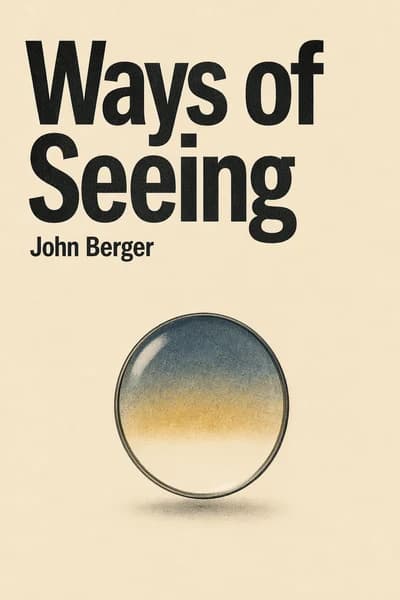
Have you ever considered how the way we see affects what we understand? John Berger's groundbreaking work challenges us to reconsider our relationship with images in a world increasingly dominated by visual media. Since its publication in 1972, "Ways of Seeing" has become required reading in art schools worldwide, praised by critics as "one of the most influential books on art in any language." Originally developed as a BBC television series, Berger's revolutionary approach democratized art criticism by stripping away pretension and speaking directly to everyday viewers. The book remains astonishingly relevant today, with its insights on visual culture continuing to influence everyone from Susan Sontag to contemporary TikTok creators analyzing visual media. Even Beyonce and Jay-Z paid homage to Berger's concepts in their "Apeshit" music video filmed in the Louvre. In a world where we consume thousands of images daily, Berger's fundamental question remains vital: are we truly seeing, or merely looking?
Capítulo 2
Seeing Comes Before Words: The Politics of Vision
Seeing precedes language in human development and consciousness. Before a child can form words or understand speech, they actively recognize and distinguish visual elements in their world - faces, objects, movements, and spatial relationships. This fundamental primacy of vision establishes our initial place in the surrounding environment. While we may later explain and interpret with words, we remain constantly enveloped by and responding to what we see. The relationship between seeing and knowing is never settled, always in flux, creating a dynamic interplay between perception and understanding.
Our vision is not merely passive reception but actively selective engagement. We only see what we choose to look at, consciously and unconsciously positioning ourselves in relation to it. Our eyes move constantly, making thousands of micro-adjustments per minute, establishing what we might call a "circle of vision" that places us at its center. This selective vision shapes our understanding of space, distance, and relationship. Yet simultaneously, we're aware that we ourselves can be seen, making us part of the visible world. This reciprocity of vision - seeing and being seen - is more fundamental than verbal dialogue and shapes our social interactions from infancy.
Every image, from cave paintings to digital photographs, is human-made and embodies a particular way of seeing. Even photographs, which appear to be mechanical reproductions of reality, reflect the photographer's selection from infinite possibilities - choice of subject, angle, timing, framing, and light. Images were first created to conjure absent appearances - to make visible what was no longer present, whether deceased ancestors, distant landscapes, or fleeting moments. Eventually, they evolved beyond mere representation to become records of how someone had seen something, capturing not just appearances but perspectives.
When presented as art, images become laden with cultural assumptions about beauty, truth, genius, civilization, form, status, and taste. These assumptions, often unconsciously absorbed, mystify rather than clarify the past, frequently serving privileged minorities who manipulate historical interpretation to justify their social position. Consider Frans Hals' portraits of the Governors and Governesses of an Alms House - painted in 1664 when Hals himself was destitute and dependent on charity from these very administrators. Traditional art historians typically avoid acknowledging this profound social tension, instead discussing "harmonious fusion" and "unforgettable contrast" in purely formal terms of composition and technique.
What makes these paintings particularly powerful is that we recognize the complex social relations they depict. The confrontation matters deeply: a destitute painter examining wealthy administrators through the eyes of a pauper who must remain technically objective while capturing their likenesses. This is the real drama - an "unforgettable contrast" indeed between power and dependency, artist and patron, observer and observed. Mystification in art criticism often explains away what might otherwise be evident to viewers, replacing lived experience and social reality with disinterested "art appreciation" that ignores crucial contexts of creation and power dynamics.
Capítulo 3
Reproduction: The Democratization and Transformation of Art
In our age of mechanical reproduction, a painting's meaning has become transmittable information that can be utilized or ignored as needed. Digital technology and mass printing have fundamentally transformed how we experience art, from museum postcards to social media shares. Reproduction transforms images in multiple ways - isolating details, changing scales, altering colors, and making paintings available as material for others' arguments. A Rembrandt self-portrait viewed on a phone screen becomes something entirely different from its original form in Amsterdam's Rijksmuseum.
Unlike film, which unfolds in time with irreversible arguments, paintings present all elements simultaneously in a fixed space. While cinema forces viewers through a predetermined sequence, a painting allows the spectator to examine each element at their own pace and in their preferred order. However, the painting's simultaneity maintains its own authority through composition and visual relationships, qualifying any conclusions we might draw. The way our eyes move between Vermeer's carefully placed elements, for instance, creates meaning regardless of viewing order.
Words and context placed around reproductions fundamentally alter how we perceive images. Van Gogh's "Wheatfield with Crows" becomes an illustration of suicide when captioned as his final work, though this interpretation oversimplifies both the painting and the artist's life. Museum placards, art history texts, and social media captions all shape how we understand artworks. Reproductions compete with all other information in our visual environment - from advertisements to news images - their meaning constantly shifted by what appears beside them, their authority distributed across countless contexts.
Though reproducible art could theoretically democratize access, breaking down barriers between high culture and mass audience, reproductions are often used to reinforce existing power structures. They bolster illusions that nothing has changed - that art's traditional authority still justifies social hierarchies and inequality. The concept of "National Cultural Heritage" frequently exploits art to glorify current social systems rather than challenging them, as seen in how nations brand themselves through their artistic traditions.
Some individuals engage with reproductions more personally and democratically - creating mood boards, Pinterest collections, or personal galleries where fine art mingles with postcards, family photos, and magazine clippings. In these contexts, all images belong to the same visual language and express personal experience rather than institutional authority. Original paintings maintain their value through their physical presence - their silence and stillness permeating the material itself, closing the temporal and spatial distance between creation and viewing.
The fundamental question in our age of endless reproduction becomes: to whom does art's meaning truly belong? Does it belong to those who actively apply it to their lived experiences, or to specialized "relic specialists" who claim exclusive interpretive authority? Modern reproduction has irreversibly destroyed art's traditional authority, removing images from their privileged preserves. They now surround us like language, having entered mainstream life without their former aura of power. Yet used thoughtfully, this new democratic language of images could confer new power to define experiences where traditional words fail, creating new forms of visual literacy and meaning-making accessible to all.
Capítulo 4
The Female Image: Women as Objects of Vision
A woman's social presence differs fundamentally from a man's. While a man's presence depends on the promise of power he embodies - whether moral, physical, economic, or sexual - always directed outward toward what he can do to or for others, a woman's presence expresses her attitude toward herself and defines what can be done to her.
From childhood, women are taught to survey themselves continually. Walking across a room or weeping at a father's death, she simultaneously envisions herself performing these actions. This creates two distinct elements in her identity: the surveyor and the surveyed. This self-surveillance exists because how she appears to others, particularly men, determines her life's "success." Her sense of being is supplanted by awareness of how she's appreciated by another.
Men survey women before treating them, so women must internalize this process to gain some control over it. The surveyor part of herself treats the surveyed part as a demonstration of how her whole self wishes to be treated. Every woman's action, regardless of its purpose, is read as indicating how she would like others to treat her.
To simplify: men act and women appear. Men look at women. Women watch themselves being looked at. This determines not only relations between men and women but also women's relationship to themselves. The surveyor within a woman is male; the surveyed is female. She turns herself into an object of vision: a sight.
In European oil painting, women were the principal recurring subject in the category of the nude. Through these paintings, we can discover the criteria by which women have been seen and judged as sights. The first nudes depicted Adam and Eve, where nakedness was created in the mind of the beholder after eating the apple. In Renaissance art, the moment of shame became central, but directed toward the spectator rather than between the couple. Later, shame transformed into display.
Capítulo 5
Nakedness Versus Nudity: The Politics of the Body
There exists a fundamental distinction between nakedness and nudity in European tradition. To be naked is simply to be oneself without clothes, whereas nudity is a form of art, a way of seeing that the painting achieves.
To be naked is to be oneself; to be nude is to be seen naked by others yet not recognized for oneself. A naked body must be seen as an object to become a nude. Nakedness reveals itself honestly, while nudity is placed on display. The nude is condemned to never truly being naked - nudity becomes a form of dress.
In European oil paintings of nudes, the principal protagonist is never painted - he is the presumed male spectator. Everything is addressed to him; the figures have assumed their nudity for his gaze. The women's bodies are arranged to display themselves to this viewer, not for their own sexuality but to appeal to his. Women's sexual passion is minimized so the spectator may feel he monopolizes such passion.
Among the hundreds of thousands of nudes in European painting, perhaps a hundred exceptional works break from this tradition. These are not nudes but paintings of loved women who happen to be naked. In these rare cases, the painter's personal vision of the particular woman is so powerful that it makes no allowance for the spectator. The painter has included her will and intentions in the very structure of the image, in the expression of her body and face.
In reality, nakedness serves a sexual function beyond the encumbrance of clothes. The sight of the other naked delivers a confirmation and provokes relief - they are a woman or man like any other. We're overwhelmed by the familiar sexual mechanism's simplicity. In this revelation lies the warm, friendly anonymity of nakedness - at the moment of nakedness first perceived, an element of necessary banality enters. This banality grounds us in reality while simultaneously offering the possibility of shared subjectivity in sex.
Capítulo 6
Oil Painting as Celebration of Possession
Oil paintings often depict things that are buyable in reality. Placing a painted thing on canvas resembles buying it for your house - when you buy a painting, you also buy the look of what it represents. This connection between possessing and the way of seeing in oil painting is typically ignored by art historians but noted by anthropologist Levi-Strauss, who identified the "avid and ambitious desire to take possession of the object" as a distinctive feature of Western civilization's art.
Though oil paint technique existed since ancient times, oil painting as an art form emerged in the early fifteenth century in Northern Europe, fully establishing its norms by the sixteenth century. The period of traditional oil painting lasted roughly from 1500 to 1900, when its way of seeing was undermined by Impressionism, overthrown by Cubism, and replaced by photography.
What distinguishes oil painting from other forms is its remarkable ability to render tangibility - texture, lustre, solidity. It defines reality as that which can be touched. Though two-dimensional, its illusionism surpasses sculpture by suggesting objects with color, texture and temperature filling space. Oil painting served the ideological interests of the ruling classes, expressing a worldview determined by new attitudes toward property and exchange.
Various genres of oil painting emerged that didn't exist in other traditions. While medieval painters used gold-leaf, oil paintings themselves became demonstrations of what gold or money could buy. Still life paintings of food confirmed the owner's wealth and habitual style of living. Animal paintings emphasized livestock pedigree as proof of value and owner status. Paintings of buildings showed them not as ideal architecture but as features of landed property.
Even landscape painting, which seems least connected to property, reflects proprietary attitudes. In Gainsborough's "Mr and Mrs Andrews," the subjects' proprietary stance toward their surroundings is visible in their expressions. While they may have been engaged in "philosophic enjoyment of uncorrupted Nature," this doesn't preclude them from simultaneously being proud landowners - indeed, private land ownership was typically the precondition for such philosophical enjoyment.
Capítulo 7
Masters Against the Tradition: The Struggle for Artistic Truth
The essential character of oil painting has been obscured by misreading the relationship between its tradition and masters. Exceptional artists like Rembrandt, Vermeer, Poussin, Chardin, Goya, and Turner broke free of traditional norms, producing work opposed to its values, yet are paradoxically acclaimed as the tradition's supreme representatives. These artists didn't merely excel within the established framework - they actively challenged and transformed it.
From this tradition emerged a stereotype of "the great artist" as a man consumed by struggle - against material circumstances, incomprehension, and himself. He's imagined as Jacob wrestling with an Angel, from Michelangelo to Van Gogh. This romantic vision of the tortured genius became deeply embedded in Western culture, appearing in literature, drama, and popular imagination. In no other culture has the artist been viewed this way - Chinese masters were seen as achieving harmony with nature, while medieval artists were viewed as skilled craftsmen. Each time a painter grew dissatisfied with painting's limited role as a celebration of property and status, he inevitably struggled with the very language of his art as understood by tradition.
Rembrandt's self-portraits provide a compelling illustration of this struggle. In his 1634 portrait with Saskia, painted in the year of his marriage, he uses traditional methods for traditional purposes - creating an advertisement for his own good fortune, prestige and wealth. Though his style may be recognizable, it remains heartless, conforming to social expectations and market demands. In contrast, his later self-portraits, particularly those from the 1660s, turn the tradition against itself, wresting its language away from conventional uses. As an old man, he expresses the question of existence itself, using a medium traditionally developed to exclude such questions. The deep psychological insight and unflinching honesty of these later works stand in stark contrast to the superficial glamour of his earlier self-representations.
The tradition contains a fundamental contradiction between exceptional masterpieces and average works, with the difference being not just technical skill but moral and artistic integrity. Average works were often produced cynically, with market demands outweighing artistic values. Artists would frequently compromise their vision to satisfy patrons or meet commercial expectations. This explains the unusually large gap between masterpieces and mediocre works in this tradition - a disparity larger than in other artistic traditions where commercial pressures were less dominant.
Religious and metaphysical themes often appear hypocritical in oil painting because the medium's materialistic nature contradicts spiritual content. This is particularly evident in paintings of Mary Magdalene where her supposed renunciation of worldly pleasures is undermined by her sensual depiction as a "takeable and desirable woman." Similar contradictions appear in paintings of saints and martyrs, where the rich materiality of oil paint and the emphasis on physical beauty often overshadow spiritual messages. Artists like El Greco and Georges de La Tour attempted to resolve this contradiction by developing techniques that subordinated oil paint's natural tendencies to spiritual expression, but they remained exceptions in a tradition that generally celebrated material wealth and physical beauty.
Capítulo 8
Publicity: The Last Form of Oil Painting
In our modern cities, we encounter hundreds, if not thousands, of publicity images daily - a concentration of visual messages unprecedented in human history. These images materialize everywhere: on billboards towering above highways, in magazines glossy with promise, on screens both tiny and massive, in subway stations, and even on the sides of buildings. They belong to the fleeting moment; we see them as we turn pages, round street corners, scroll through social media, or while waiting for commercial breaks to end. Though constantly renewed and updated with the latest trends and technologies, they paradoxically never speak of the present - they reference an idealized past and invariably promise a better future.
Publicity isn't merely a collection of competing messages but rather a sophisticated visual language making a single, seductive proposal: transform your life by buying something more. This promised "more" - whether it's a newer car, a more effective skincare routine, or the latest technological gadget - will supposedly make us richer and more fulfilled, even as we become materially poorer by spending. Publicity achieves its persuasive power through showing us people who appear transformed and enviable - for the state of being envied constitutes glamour, and publicity has mastered the art of manufacturing this glamour through careful staging, lighting, and digital enhancement.
Publicity frequently appropriates and quotes works of art from the past, sometimes openly pastiching well-known paintings like Da Vinci's Last Supper or Botticelli's Venus. Art serves publicity in two distinct but complementary ways: as a sign of affluence (suggesting belonging to the good life) and as cultural authority (lending dignity, wisdom, and legitimacy to commercial messages). Publicity has understood the tradition of oil painting more thoroughly than most art historians, expertly grasping the psychological relationship between artwork and spectator-owner to persuade and flatter the spectator-buyer.
The continuity between oil painting and publicity extends far beyond specific quotations to their shared visual language and symbolic vocabulary. They speak in the same voice about the same things - using similar gestures, romantic naturalistic settings, Mediterranean landscapes, stereotypical poses (particularly for women), luxury materials, and sophisticated perspective techniques. Publicity depends heavily on this inherited visual language because it represents the culture of consumer society, propagating through images society's belief in itself and its values.
Despite sharing this visual language, publicity functions fundamentally differently from oil painting. While traditional paintings showed what owners already possessed and enjoyed, consolidating their sense of worth and status, publicity deliberately makes spectators dissatisfied with their present lives, offering improved alternatives through purchase. Oil painting historically addressed those who profited from market systems; modern publicity addresses those who constitute the market - workers who must be transformed into consumers. Publicity works upon anxiety and insecurity - the deeply rooted fear that without money and the things it can buy, you will become invisible, irrelevant, nothing. This transformation of art's purpose from celebration to inducement marks a profound shift in visual culture's social function.
Capítulo 9
The Endless Deferral of Happiness
Modern publicity increasingly uses sexuality to sell products, implying that buying power equals sexual desirability. Unlike oil painting's present tense, publicity speaks only in future tense - "with this you will become desirable" - yet this future is endlessly deferred. Publicity remains credible because its truthfulness is judged by the relevance of its fantasies to the spectator-buyer's daydreams, not by fulfilled promises.
The gap between what publicity offers and what it promises corresponds to the gap between what spectator-buyers feel themselves to be and what they wish to be. Instead of bridging this gap through action, it's filled with glamorous daydreams. The passive worker becomes the active consumer in imagination.
Publicity also functions as a substitute for democracy, turning consumer choice into a replacement for political choice, masking what is undemocratic in society. It creates a philosophical system explaining everything on its own terms, presenting the world as a setting for the good life - a world that smiles and offers itself to us, where sophistication means living beyond conflict.
Publicity is essentially eventless, extending just as far as nothing else is happening. Real events happen only to strangers - whether tragic like in Bangladesh or nearby in Derry or Birmingham. Publicity excludes the present, eliminating all becoming and development, making experience impossible within it. Everything happens outside it.
Though enormously influential politically, publicity recognizes nothing except the power to acquire. All human faculties are made subsidiary to this power, all hopes simplified into the magical yet repeatable promise offered in every purchase. No other satisfaction can be envisaged within capitalism's culture.
Publicity is both the life of this culture - without it capitalism couldn't survive - and simultaneously its dream. Capitalism survives by forcing the exploited majority to define their interests as narrowly as possible, once achieved through deprivation but now through imposing false standards of desirability. In this way, the language of images that began with oil painting has come full circle, still speaking of possession and status, but now addressing everyone rather than just the privileged few.