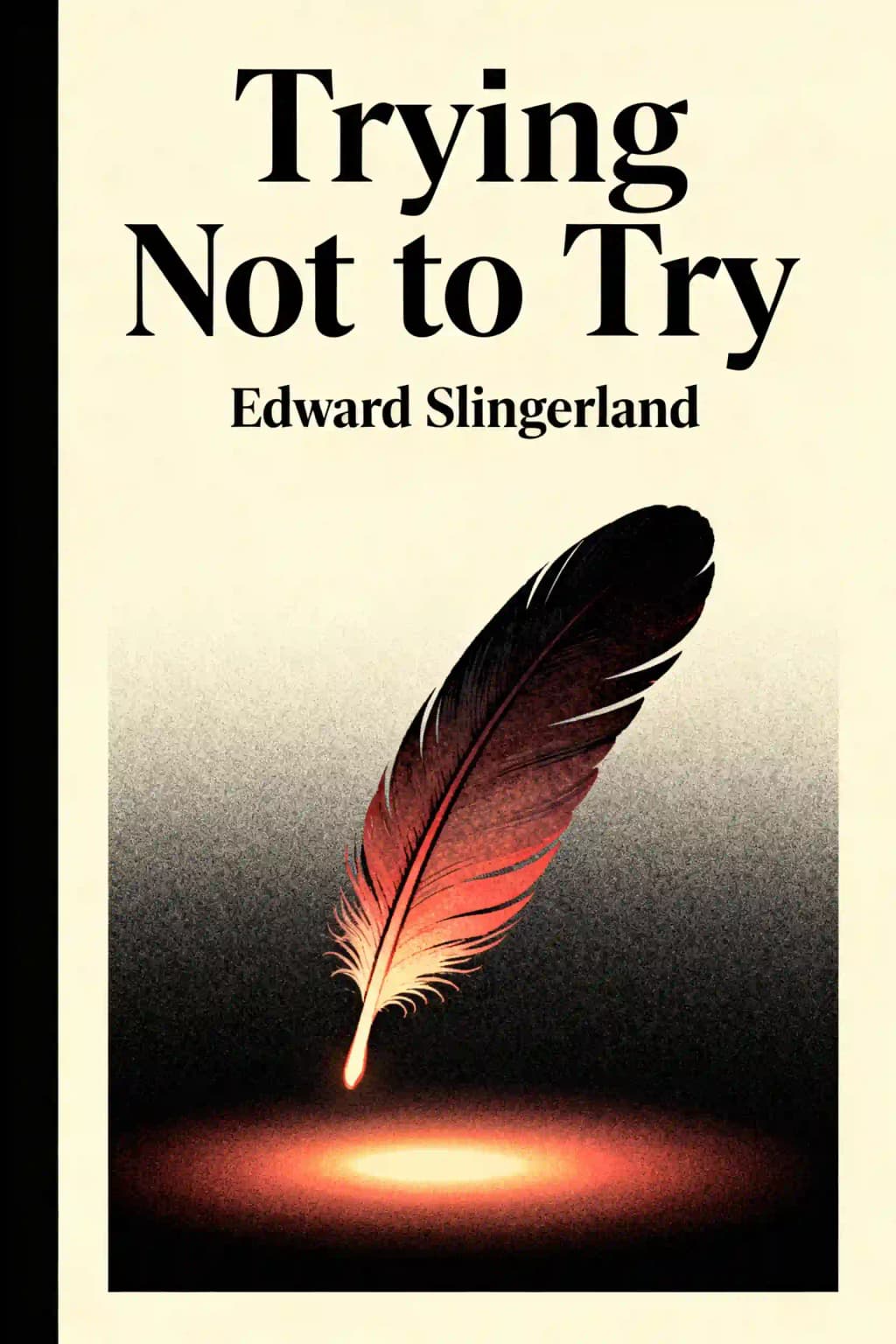
Trying Not to Try
The Ancient Art of Effortlessness and the Surprising Power of Spontaneity
Resumen de Trying Not to Try
Discover the ancient Chinese art of "wu-wei" - effortless action that paradoxically requires intense effort. Tim Ferriss champions this counterintuitive approach where trying harder backfires. What if your greatest achievements come when you stop obsessively pursuing them?
Temas clave en Trying Not to Try
- wu-wei philosophy
- spontaneous action
- cognitive science of flow
- charismatic virtue
- adaptive unconscious
Citas de Trying Not to Try
True mastery isn't about exerting more control, but about learning when to let go.
Spontaneous behavior is inherently difficult to fake.
Trying too hard to be attractive often makes you unattractive.
True influence comes from authentic being rather than calculated doing.
Personajes en Trying Not to Try
- Edward SlingerlandAuthor and scholar of Chinese philosophy
- Butcher DingParable figure who masters effortless ox carving
- Lord WenhuiRuler who observes and learns from Butcher Ding
- Woodcarver QingArtisan who creates bell stands through meditation
Sobre el Autor
Sobre el autor de Trying Not to Try
Edward Slingerland, Distinguished University Scholar and Professor of Philosophy at the University of British Columbia, is the bestselling author of Trying Not to Try: Ancient China, Modern Science, and the Power of Spontaneity. A renowned expert in early Chinese thought and cognitive science, Slingerland bridges ancient philosophy with modern psychology to explore themes of effortless action (wu-wei), decision-making, and human flourishing.
His academic background includes appointments in Philosophy, Psychology, and Asian Studies, along with a groundbreaking translation of Confucius’ Analects.
Slingerland’s work has been featured on high-profile platforms like The Joe Rogan Experience and in his widely praised book Drunk: How We Sipped, Danced, and Stumbled Our Way to Civilization, which examines alcohol’s role in human cultural evolution. A Fellow of the Royal Society of Canada, his research integrates humanities and science, earning accolades such as the American Academy of Religion’s "Best First Book" award. Trying Not to Try has been translated into over 15 languages and remains a staple in discussions of mindfulness and performance psychology.
Descargar resumen de Trying Not to Try
Obtén el resumen de Trying Not to Try como PDF o EPUB gratis. Imprímelo o léelo sin conexión en cualquier momento.
Preguntas Frecuentes Sobre Este Libro
Trying Not to Try explores the ancient Chinese philosophy of wu-wei (“effortless action”) and de (“charismatic power”), blending Eastern thought with modern neuroscience and psychology. Slingerland argues that spontaneity, not rigid effort, unlocks peak performance and fulfillment, using examples from art, leadership, and daily life. The book contrasts Confucian and Taoist approaches to achieving this state.
This book suits readers interested in Eastern philosophy, self-improvement, or the science of flow states. Leaders, artists, and professionals seeking balanced productivity will find actionable insights. Critics note it’s dense at times, so patience with academic tangents is advised.
Yes—for its synthesis of philosophy and science on spontaneity. While some find its historical deep dives dry, the core thesis on “hot cognition” (intuitive action) vs. overthinking offers fresh perspectives on creativity and decision-making. Highlights include practical advice for modern burnout.
Wu-wei is a state of effortless action where skill and intuition align seamlessly. Slingerland illustrates it through musicians “in the zone” or athletes reacting instinctively. It’s not passive but a harmonious flow between mind, body, and task—central to art, leadership, and relationships.
De is the magnetic charisma or virtue cultivated through wu-wei. Slingerland describes it as a persuasive power that arises when actions are unforced—think leaders who inspire loyalty without coercion or artists whose work feels universally resonant.
Confucianism stresses disciplined practice to internalize virtue (e.g., ritual mastery), while Taoism advocates “unlearning” societal norms to reconnect with raw instinct. Slingerland uses this tension to explore whether spontaneity is earned or innate.
Some reviewers find the academic tone repetitive and less actionable than hoped. Others praise its intellectual rigor but note it’s best read in bursts, not as a step-by-step guide.
- Incubate ideas: Take walks or garden to let solutions emerge subconsciously.
- Embrace “hot cognition”: Trust gut feelings in decisions.
- Balance effort: Avoid over-planning to leave room for spontaneity.
Slingerland argues overthinking stifles creativity and social ease. He cites studies showing excessive analysis weakens intuition, advocating for “cold” rational thought only when necessary (e.g., complex math).
- “We’re made for doing, not thinking.”
- “Success does not always come from thinking more rigorously or striving harder.”
These encapsulate the book’s case for trusting embodied wisdom over forced effort.
While mindfulness focuses on present-moment awareness, wu-wei emphasizes unselfconscious action. Slingerland links both to reduced cognitive overload but distinguishes wu-wei as goal-directed flow, not passive observation.
The book critiques modern glorification of hustle, arguing burnout stems from over-reliance on “cold” rationality. Its Taoist-inspired solutions—like strategic disengagement—offer alternatives to constant striving.
Fans of Burkeman’s Four Thousand Weeks (on time management) or Watts’ Zen philosophy will recognize themes of surrender and anti-hustle. Slingerland adds historical depth and cognitive science frameworks.