Capítulo 1
When Smart People Make Bad Decisions
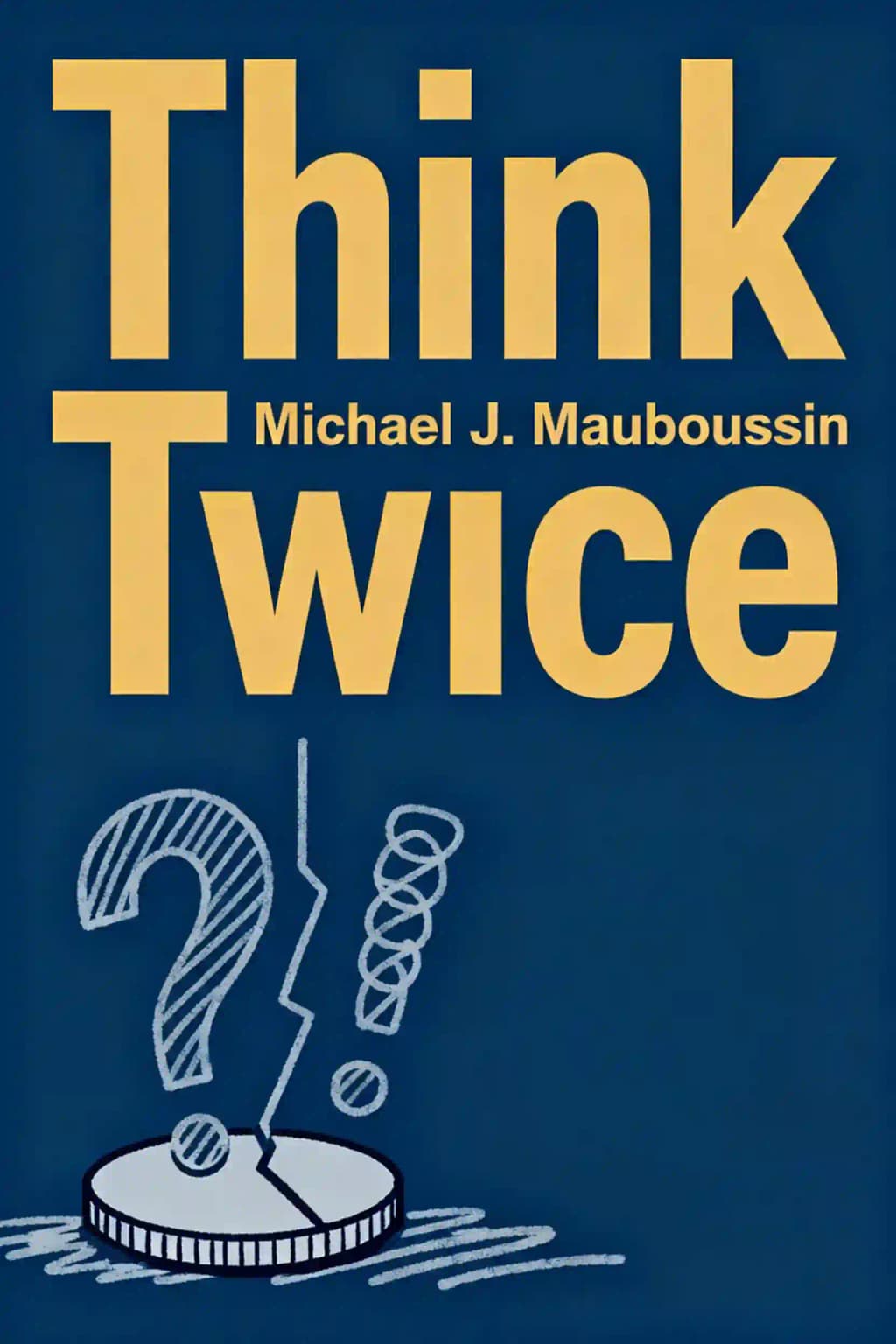
Have you ever wondered why brilliant people sometimes make catastrophic mistakes? In December 2008, Stephen Greenspan, an expert on gullibility, published his book on the subject-only to discover days later that he'd lost 30% of his retirement savings to Bernard Madoff's $60 billion Ponzi scheme. This ironic twist highlights a universal truth: intelligence doesn't guarantee good decision-making. "Think Twice" has become a modern classic in decision science, praised by luminaries like Daniel Kahneman and embraced by executives at companies from Google to Goldman Sachs. Michael Mauboussin, with his unique background spanning Wall Street and academia, delivers a rare combination of practical wisdom and scientific insight that has made this book required reading at top business schools worldwide. Its enduring popularity stems from a simple premise: by understanding common decision traps, we can dramatically improve our choices in business and life.
Capítulo 2
The Power of the Outside View
We naturally approach decisions from the inside view-focusing on our unique circumstances and capabilities-but this perspective leads to systematic errors. Three powerful illusions drive this tendency: the illusion of superiority (85% of high school students rate themselves above median in getting along with others), the illusion of optimism (college students consistently judge themselves more likely to have good experiences than peers), and the illusion of control (lottery participants value tickets they choose at $9 versus $2 for assigned tickets with identical odds).
These illusions explain why corporate executives pursue mergers despite evidence that acquiring companies' stock prices drop roughly two-thirds of the time. Consider Dow Chemical's acquisition of Rohm and Haas, which CEO Andrew Liveris described as "a high-quality beachfront property" despite paying a steep 74% premium. Dow's stock immediately dropped 4% as investors recognized that synergies couldn't possibly justify the premium paid.
Our preference for compelling stories over statistical evidence creates similar problems in healthcare. In one study, nearly 80% of subjects selected a treatment with only 30% effectiveness when paired with a success story, while less than 40% chose a treatment with 90% effectiveness when paired with a failure story. This explains why patients often pursue unproven alternative treatments based on anecdotal success stories rather than evidence-based medicine.
The planning fallacy further demonstrates our poor self-assessment. When college students predicted they had a 50% chance of finishing projects by a certain date, only 13% actually met that deadline. Even when they were 99% certain they would finish by a particular date, only 45% actually did so. As Harvard psychologist Daniel Gilbert notes, despite the "impressive power of this simple technique," people rarely use the outside view because most think of themselves as different and better than others.
To effectively incorporate the outside view, follow four steps: First, select an appropriate reference class that's statistically significant yet relevant to your situation. Second, assess the distribution of outcomes in your reference class. Third, make a prediction based on reference class data, recognizing your forecast will likely be too optimistic. Finally, assess your prediction's reliability and adjust accordingly. The less predictable the domain, the more you should adjust toward the statistical mean.
Capítulo 3
Breaking Free from Tunnel Vision
How can something as irrelevant as your phone number influence important decisions? When Columbia Business School students were asked to estimate Manhattan's doctor population after writing down the last four digits of their phone numbers, those with lower-ending digits guessed an average of 16,531 doctors, while those with higher-ending digits estimated 29,143-a 75% difference. This demonstrates the anchoring-and-adjustment heuristic, where we start with an arbitrary reference point and make insufficient adjustments from it.
This exemplifies a broader decision-making error: tunnel vision, or insufficient consideration of alternatives. Our mental models-simplified representations of reality-trade detail for speed but often fail in today's complex world. When stakes are high, we must slow down and consider the full range of possible outcomes.
Our tunnel vision worsens because we stop adjusting our thinking once we reach a value that seems plausible. Real estate agents given identical information about a house but different listing prices appraised the house at substantially different values, yet less than 20% acknowledged using the listing price in their assessment, showing how unconscious this bias truly is.
The representativeness heuristic causes us to rush to conclusions based on mental categories, neglecting alternatives. A doctor once declared "about zero" chance of heart problems for a fit forest ranger with chest pains who returned the next day with a heart attack. Similarly, the availability heuristic leads us to judge frequency based on what's readily available in memory, causing a doctor to misdiagnose aspirin toxicity as viral pneumonia because of a recent pneumonia outbreak.
Our brains are wired to see patterns and extrapolate them inappropriately. Neuroscientist Scott Huettel found that after seeing just two identical symbols in a row, our brains automatically expect a third, even when we know the sequence is random. This pattern-recognition evolved because "in a natural environment, almost all patterns are predictive," but these relationships don't necessarily hold in our technological world.
Cognitive dissonance creates mental discomfort when we hold contradictory ideas, leading us to rationalize our actions rather than change them. The confirmation bias compounds this problem as we seek information confirming prior beliefs while ignoring contradictory evidence. Brain scans reveal partisans' brains actively reinforce existing beliefs while dismissing contradictory information.
To avoid tunnel vision, explicitly consider alternatives, seek dissent, keep track of previous decisions, avoid making decisions during emotional extremes, and understand incentives-both financial and non-financial ones like reputation or fairness.
Capítulo 4
When Experts Fall Short
Accurately forecasting sales is critical for retailers-especially consumer electronics companies like Best Buy, where holiday sales drive profits and inventory depreciates rapidly. When author James Surowiecki suggested that crowds could outpredict their experts, executives were skeptical. But when they tested the theory by asking hundreds of employees to forecast gift-card sales, the crowd's prediction was 99.5% accurate while the official forecast missed by five percentage points.
This led Best Buy to invest in TagTrade, a prediction market where thousands of employees make tens of thousands of trades on topics from customer satisfaction to store openings. The market has outperformed experts most of the time, providing management with valuable insights they wouldn't otherwise have had.
Wine appreciation seems subjective and mysterious to most people, requiring expert sommeliers to guide selections. Yet economist Orley Ashenfelter created a simple regression equation that predicts Bordeaux wine quality based solely on weather data. Despite scorn from wine experts, Ashenfelter's equation has proven remarkably accurate, especially for judging young wines.
As networks harness collective wisdom and computing power grows, experts are being squeezed out of their traditional roles, particularly in prediction. The key is understanding what type of problem you're facing. For rules-based problems with limited outcomes, experts initially add value by identifying patterns and creating algorithms, but computers ultimately perform better. For probabilistic problems with wide-ranging outcomes-like economic forecasts or oil price predictions-collectives outperform individual experts.
Netflix's recommendation algorithm Cinematch demonstrates the superiority of mathematical models over human experts. This example illustrates a well-documented finding in social sciences: mathematical models consistently outperform expert judgment. Philip Tetlock's exhaustive study of expert predictions found "it is impossible to find any domain in which humans clearly outperformed crude extrapolation algorithms."
The success of prediction markets over expert forecasts demonstrates our second decision mistake: relying on experts instead of collective wisdom. Scott Page's diversity prediction theorem explains this phenomenon mathematically:
Collective error = average individual error - prediction diversity
This theorem reveals that a diverse crowd will always predict more accurately than the average person in the crowd. Three conditions must exist for crowds to predict well: diversity (reducing collective error), aggregation (ensuring all information is considered), and incentives (encouraging participation from those with genuine insights).
Nearly half of Fortune 1000 executives rely on intuition for decision-making, despite its inconsistent reliability. Intuition only works well in stable environments with clear feedback and linear cause-effect relationships. Most alleged experts fail to engage in true deliberate practice-specific activities designed to improve performance with repeatable tasks and high-quality feedback-and therefore don't develop reliable intuition.
Capítulo 5
The Hidden Power of Context
Gregory Berns's fMRI study revealed surprising insights about conformity. When subjects conformed to incorrect group answers about 3D rotation tasks, brain scans showed activity in visual perception areas rather than judgment centers, suggesting that group influence literally changes how we perceive reality. As Berns put it, "seeing is believing what the group tells you to believe."
Meanwhile, subjects who resisted group pressure showed increased activity in the amygdala, the brain's fear center, indicating that standing alone is physiologically stressful. This helps explain why people often conform to group opinions despite clear evidence to the contrary.
Our circumstances influence our decisions far more than we realize, often subconsciously. This explains why we tend to commit the "fundamental attribution error"-attributing others' behavior to their character while explaining our own actions through situational factors.
Our environment shapes our decisions in ways we don't recognize. In a supermarket study, playing French accordion music led to French wines representing 77% of sales, while German music shifted purchases to 73% German wines. Yet 86% of customers denied the music influenced their choice.
This "priming" effect-where environmental cues unconsciously activate knowledge structures-extends beyond music. Research shows exposure to elderly-related words makes people walk slower, cleaning scents promote tidier behavior, and background images of clouds or coins influence sofa preferences.
How choices are presented dramatically influences decisions. In organ donation, neighboring Germany and Austria have vastly different consent rates (12% versus nearly 100%) simply because Germany requires opting in while Austria requires opting out. This default effect saves lives, as donation rates are significantly higher in opt-out countries.
We often make decisions based on immediate emotional reactions rather than impartial analysis of outcomes. This "affect" principle reveals that how we feel about something strongly influences our decisions, often beyond our awareness. When outcomes lack emotional significance, we tend to overweight probabilities-rating a system that saves 98% of 150 lives higher than one saving all 150 lives. Conversely, with emotionally vivid outcomes like lottery jackpots, we become insensitive to probabilities.
Situations shape behavior far more powerfully than most Westerners acknowledge. Milgram's famous obedience experiments showed ordinary people would administer seemingly lethal shocks under authority's influence. Similarly, Zimbardo's Stanford Prison Experiment demonstrated how quickly volunteers adopted their randomly assigned roles as prisoners or guards, with guards becoming increasingly abusive until the experiment was terminated after just five days.
Inertia powerfully shapes decisions as individuals and organizations perpetuate practices long after their usefulness expires. Campbell Soup Company's annual fall tomato soup promotion-originally created to move harvest-time inventory surpluses-continued for eighty years after year-round tomato sourcing eliminated its purpose.
Capítulo 6
The Complexity Challenge
Honey bees demonstrate remarkable collective intelligence despite individual limitations. When a hive needs a new home, scout bees independently evaluate potential sites, returning to perform waggle dances whose duration indicates site quality. The decision happens not through central coordination but through a race to reach a quorum of fifteen scouts at a potential site, almost always resulting in selection of the optimal location.
This swarm intelligence illustrates how complex adaptive systems function: heterogeneous agents following simple rules create emergent structures with properties distinct from individual components. As Stanford biologist Deborah Gordon notes, "Ants aren't smart, ant colonies are." This phenomenon challenges our intuitive desire to understand systems by analyzing their parts.
Complex adaptive systems consist of heterogeneous agents with evolving decision rules who interact to create emergent structures with properties distinct from the underlying agents. Nobel Prize winner Philip Anderson captured this in his essay "More Is Different," explaining that "at each level of complexity entirely new properties appear" that cannot be understood through simple extrapolation of individual components.
This creates a fundamental decision-making challenge: humans instinctively seek simple cause-effect relationships, but complex systems conceal these links. This mistake appears in financial markets where investors fixate on earnings reports while economists demonstrate that collective market behavior follows cash flow. Executives compound this error by forgoing value-creating investments to meet earnings targets, listening to individual advisers rather than market wisdom.
Yellowstone National Park demonstrates how interventions in complex systems produce cascading unintended consequences. When the U.S. Cavalry took over park management in 1886, they prioritized rebuilding depleted game populations. Their success with elk created an ecological disaster as the booming population overgrazed vegetation, causing soil erosion and decimating aspen trees. This reduced beaver populations, whose dams had maintained stream health and trout spawning grounds.
When 60% of elk died in the winter of 1919-1920, managers wrongly blamed predators rather than food scarcity, leading to systematic elimination of wolves, mountain lions, and coyotes. This intervention only worsened the boom-bust cycles, creating what Alston Chase called a "terrible ratchet" where "each mistake made the park worse off and no mistake could be corrected."
Organizations frequently make the mistake of hiring stars without considering the systems that enabled their success. Harvard researchers tracking acclaimed equity analysts found that "when a company hires a star, the star's performance plunges, there is a sharp decline in the functioning of the group or team the person works with, and the company's market value falls." This happens because employers underestimate the importance of firm reputation, resources, relationships, and familiarity with processes that supported the star's previous success.
Capítulo 7
When Context Trumps Strategy
How do behaviors that work in one context fail in another? Frank Sulloway's controversial book "Born to Rebel" claimed birth order fundamentally shapes personality, with firstborns being ambitious and conventional while later-borns are venturesome and open-minded. Despite initial acclaim, scientists challenged his selective use of evidence. The truth lies in context: birth order effects are real within families-older children alternate between dominating and nurturing younger siblings-but these roles don't extend outside the family environment.
Theory building progresses through three crucial stages: observation (measuring phenomena), classification (organizing into categories), and definition (describing relationships between categories and outcomes). Initially, theories rely on attributes and correlations, but they improve as researchers test predictions against real data and reshape theories to reflect circumstances (when it works) and causes (why it works).
Many management theories remain primitive-like early aviators attaching feathers to wings-because consultants observe successes, identify common attributes, and wrongly claim these attributes universally lead to success. Truly effective theories, like Bernoulli's airfoil principle for flight, explain causation rather than just correlation, allowing practitioners to tailor choices to specific situations.
Boeing's 787 Dreamliner project illustrates the danger of embracing a strategy without understanding when it works. Though outsourcing had succeeded for companies like Apple and Dell, Boeing's attempt to have suppliers both design and build airplane sections (rather than just build to Boeing's specifications) proved disastrous. The plane fell significantly behind schedule as suppliers failed to deliver functional sections. What Boeing received was thirty thousand pieces requiring assembly instead of the planned twelve hundred components.
The Colonel Blotto game-where players secretly distribute resources across multiple battlefields-reveals crucial insights about competitive strategy. By varying the game's parameters (resource asymmetry and number of battlefields), we learn when underdogs can win and why sometimes no "best" team exists. With few battlefields, the resource-rich player has a decisive advantage. However, as dimensions increase, outcomes become less predictable, explaining why baseball sees more upsets than tennis.
Stock market predictors like the Super Bowl Indicator (80% accuracy) and bizarre correlations like Bangladesh butter production with S&P 500 performance (75% correlation) highlight our dangerous tendency to confuse correlation with causation. Three essential conditions must exist for true causation: X must precede Y, a functional relationship must exist between variables, and no third factor Z can be causing both X and Y.
The Norse inhabitants of Greenland perished after four centuries due to fatal inflexibility. They stubbornly maintained Norwegian practices that depleted Greenland's scarce resources and refused to learn survival techniques from the native Inuit, literally starving amid abundant food sources they wouldn't utilize.
Capítulo 8
When Small Changes Create Massive Shifts
London's Millennium Bridge opened in 2000 with great fanfare-a sleek, contemporary structure spanning the Thames that cost 20 million and met all engineering standards. Yet just two days after its royal dedication, the bridge was closed for retrofitting due to an embarrassing wobble.
When crowds of pedestrians crossed the bridge, it began swaying laterally up to seven centimeters side-to-side, forcing people to synchronize their walking patterns to maintain balance. Though the bridge remained structurally sound, the unexpected motion-described as "rather like being on a boat"-created an unsettling experience that engineers hadn't anticipated despite their careful calculations for vertical forces.
Complex systems maintain balance through both negative and positive feedback mechanisms. Negative feedback stabilizes systems (like arbitrage in markets or thermostats in homes), while positive feedback amplifies changes (like schools of fish moving in unison or fashion trends spreading).
Phase transitions are moments when small incremental changes trigger dramatic systemic shifts. Philip Ball calls this the "grand ah-whoom"-like water suddenly freezing into ice. These critical thresholds exist in both physical and social systems.
The Millennium Bridge wobble resulted from such a phase transition. Individual pedestrians exert small sideways forces that normally cancel out. But when the bridge lacked sufficient lateral dampeners, slight swaying forced people to widen their steps, creating greater sideways force and more swaying-a positive feedback loop that synchronized crowd behavior. Tests showed the bridge could handle 156 people safely, but adding just 10 more triggered the dramatic wobble-revealing the existence of invisible vulnerability points in complex systems.
While many natural phenomena like human heights cluster predictably around averages, other systems follow power law distributions with extreme outliers. City populations illustrate this: New York has 8 million inhabitants while the smallest American towns have around 50 people-a 150,000-to-1 ratio compared to the mere 5-to-1 ratio between tallest and shortest humans.
Nassim Taleb calls these extreme outcomes "black swans"-consequential outlier events that we rationalize after they occur. These events emerge from positive feedback at critical points, explaining why they continually surprise us despite their predictable existence in certain systems.
The wisdom of crowds depends on three conditions: diversity of opinions, aggregation of information, and proper incentives. When diversity fails-which happens gradually until reaching a critical threshold-collective intelligence collapses. Blake LeBaron's agent-based stock market model demonstrates this perfectly: market prices can continue rising even as trading strategy diversity falls, creating invisible vulnerability until a small demand reduction triggers a crash.
When dealing with systems prone to phase transitions, study the distribution of outcomes in your system, watch for "ah-whoom" moments when system actors coordinate their behavior, be skeptical of forecasters, and mitigate downside risk while capturing upside potential.
Capítulo 9
Distinguishing Between Skill and Luck
After the New York Yankees won only four of their first twelve games in 2005, owner George Steinbrenner expressed bitter disappointment with his highest-paid team's performance. The Yankees eventually tied for first place in their division-not because of the Boss's tongue-lashing, but due to a combination of skill and luck.
Francis Galton, Charles Darwin's cousin and a Victorian polymath, discovered reversion to the mean through empirical study. Initially investigating whether genius was inherited, he noticed that while children of geniuses were above average, they were closer to the mean than their parents.
Galton gathered height data from 400 parents and over 900 grown children, combining mothers' and fathers' heights into "mid-parent stature." He discovered that tall parents tend to have tall children, but these children's heights are closer to the average. Similarly, short parents have short children who are taller than their parents.
Galton's crucial insight was that while reversion occurs between generations, the overall distribution of heights remains stable over time. This paradoxical combination of change and stability is key to understanding reversion to the mean-things become more average individually while the distribution remains unchanged collectively.
In many human endeavors, outcomes combine skill and luck in varying proportions. Activities range from pure chance (slot machines) to mostly skill (chess), but even when skill remains constant, luck fluctuates. Any system combining skill and luck will revert to the mean over time. Daniel Kahneman captured this with his formulas: "Success = Some talent + luck" and "Great success = Some talent + a lot of luck."
Ignoring reversion to the mean leads to three types of mistakes. First is thinking you're special, exemplified by CEOs who believe mean reversion doesn't apply to their companies. The investment world demonstrates this error when retirement plans hire managers with recent strong performance and fire those with poor results-only to see the fired managers subsequently outperform those hired.
Horace Secrist's 1933 book "The Triumph of Mediocrity in Business" exemplifies the second mistake associated with reversion to the mean-misinterpreting data. His extensive work showed how corporate performance metrics revert to the mean, which he interpreted as mediocrity prevailing in business.
Harold Hotelling, an economist and statistician, criticized Secrist's conclusion, noting the diagrams merely proved "ratios have a tendency to wander about." When examining return on invested capital (ROIC) data over a decade, the distribution remains remarkably stable from beginning to end, despite individual companies moving within it.
The halo effect, first described by psychologist Edward Thorndike in the 1920s, is our tendency to make specific inferences based on general impressions. Phil Rosenzweig demonstrated how this pervades business thinking. We observe successful companies, attribute qualities like "visionary leadership" or "motivated employees" to them, then recommend others adopt these attributes. When performance inevitably reverts to the mean, these same attributes are suddenly labeled as flaws, though nothing fundamental changed.
Capítulo 10
Improving Your Decision Processes
How can you immediately improve your decision-making? While most daily decisions don't require deep analysis, high-stakes situations demand careful consideration to avoid suboptimal choices. The key is to prepare, recognize potential mistakes, and apply better decision-making approaches.
First, raise your awareness by identifying common decision-making errors in everyday information streams. By recognizing poor thinking in others, you'll better flag potential mistakes when facing them yourself. Remain circumspect as events unfold, recognizing that hindsight bias often makes commentators claim they predicted outcomes they didn't.
Second, put yourself in others' shoes. Embrace the outside view by considering reference classes of similar situations others have experienced. Recognize the power of situations over individual character when evaluating others' choices. Remember that your actions will trigger reactions, sometimes unpredictable ones, especially in complex adaptive systems.
When evaluating outcomes in business, investing, and sports, properly sorting skill from luck is essential. In luck-dominated domains, anticipate reversion to the mean-extreme outcomes will likely be followed by more average results. The greater the role of luck, the more data needed to separate skill from randomness. When offering criticism, focus exclusively on the skill component, as it's the only part someone can control.
Timely, accurate feedback is crucial for improving decision-making and developing expertise. However, feedback quality varies widely across domains-weather forecasters receive quick, precise feedback, while business strategists face delayed, ambiguous results.
A decision-making journal provides an inexpensive yet powerful tool for improvement. By recording decisions, reasoning, expected outcomes, and your physical and mental state, you create two benefits: First, you can audit decisions by preventing after-the-fact explanations; second, you can identify patterns between your state of mind and decision quality.
When facing tough decisions, a checklist helps identify what you might overlook. Studies show remarkable results-in one medical study, death rates dropped by half and complications fell by one-third when surgeons used checklists. A good checklist balances being general enough for varying conditions yet specific enough to guide action-ideally fitting on one or two pages.
Unlike a postmortem that analyzes a decision after the outcome is known, a premortem assumes you're in the future and your decision has failed. You then identify plausible reasons for that failure before making the decision. Research shows premortems help people identify more potential problems than other techniques and encourage open exchange since no one has yet invested in the decision.
While cause and effect are clear in most day-to-day decisions, systems with many interacting parts often have unclear causal links. As Warren Buffett noted, "Virtually all surprises are unpleasant," making worst-case scenario analysis vital yet often overlooked during prosperous times. Resist simplifying complex systems-financial disasters frequently stem from models failing to capture the full range of possible outcomes in complex markets.
Despite decision-making's obvious importance, few people practice it systematically. By recognizing common mistakes, preparing your mind, understanding context, and applying the right techniques, you can make better decisions and avoid the traps that ensnare even the smartest among us.