Capítulo 1
When Crowds Become Wise: The Surprising Intelligence of Collective Judgment
In 1906, a remarkable discovery shook the foundations of how we understand collective intelligence. Francis Galton, an 85-year-old British scientist with a deep skepticism about the capabilities of ordinary people, visited a country fair where he encountered a weight-judging competition featuring a fat ox. Eight hundred diverse people paid sixpence to guess the dressed weight of the animal. To Galton's astonishment, when he analyzed the 787 legible guesses, the crowd's average was 1,197 pounds-just one pound off the actual weight of 1,198 pounds.
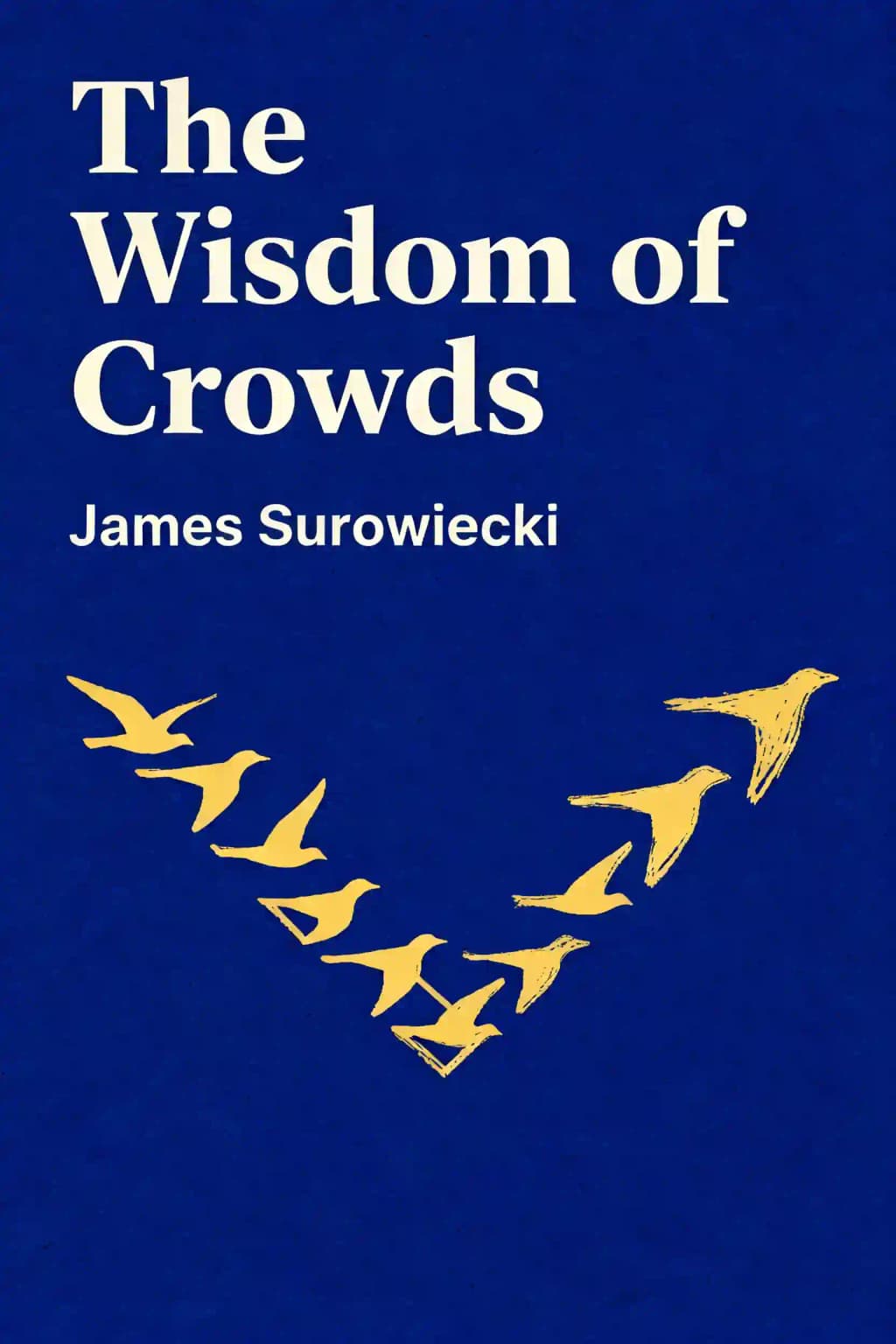
This unexpected result revealed something profound: under the right circumstances, groups can be remarkably intelligent, often smarter than the smartest individuals within them. James Surowiecki's "The Wisdom of Crowds" has become a modern classic, influencing fields from business to politics. Since its publication in 2004, the book has been embraced by tech companies like Google, whose search algorithms embody its principles, and has fundamentally changed how organizations approach problem-solving. Even Barack Obama cited the book during his presidential campaign when discussing his decision-making philosophy. What makes this concept so powerful is that it challenges our cultural reverence for individual genius while offering a practical framework for harnessing our collective intelligence.
Capítulo 2
The Fundamental Principles of Collective Wisdom
The wisdom of crowds manifests throughout our world-from Google's search algorithms to prediction markets for elections to the stock market's functioning. Even though we're all "boundedly rational" with limited information and imperfect judgment, our collective intelligence, properly aggregated, can achieve excellence.
This phenomenon was scientifically demonstrated through numerous experiments between the 1920s and 1950s. Hazel Knight had students estimate room temperature, achieving remarkable accuracy with a group average of 72.4 degrees versus the actual 72 degrees. Kate Gordon's experiments with weight-ranking and buckshot-pile ordering showed group estimates achieving 94-94.5% accuracy. In the classic jelly-beans-in-jar experiment, the group estimate of 871 beans came remarkably close to the actual 850, with only one individual out of fifty-six performing better.
Two key insights emerge: First, these experiments typically aggregated individual judgments without group discussion. Second, while some individuals occasionally outperform the group, no individuals consistently do so across multiple trials. The most reliable approach is simply consulting the group each time.
Throughout the book, Surowiecki focuses on three kinds of problems that collective intelligence can solve:
1. Cognition problems - questions with definitive solutions or where some answers are clearly better than others, like "Who will win the Super Bowl?" or "Where should we build this swimming pool?"
2. Coordination problems - challenges requiring group members to coordinate their behavior with each other, such as buyers and sellers finding fair prices, or drivers navigating traffic safely.
3. Cooperation problems - situations where self-interested individuals must work together despite incentives not to participate, like paying taxes or addressing pollution.
For crowds to demonstrate wisdom, four key conditions must be met: diversity of opinion (each person having some private information), independence (opinions not determined by others), decentralization (ability to specialize and use local knowledge), and aggregation (a mechanism to convert private judgments into collective decisions). When these conditions are satisfied, a group's judgment becomes remarkably accurate because individual errors cancel each other out, leaving the information intact.
Capítulo 3
The Power of Diversity in Decision-Making
The wisdom of crowds extends to remarkable search capabilities and predicting uncertain events. In May 1968, when the submarine Scorpion disappeared, Naval officer John Craven demonstrated collective intelligence's power in solving complex problems. Instead of relying on a few top experts, Craven assembled diverse specialists including mathematicians, submarine experts, and salvage men. Rather than having them collaborate directly, he asked each to bet on various scenarios about the submarine's fate.
Using Bayes's theorem, Craven combined these individual judgments into a collective estimate of the Scorpion's location-a spot no individual had specifically identified. Five months later, the navy found the submarine just 220 yards from the group's predicted location. Despite having minimal evidence about why or how the submarine sank, the group collectively possessed knowledge that no individual member had.
When the Challenger space shuttle exploded in 1986, the stock market demonstrated similar collective wisdom. Within minutes, investors began selling shares of the four contractors involved in the launch. While Lockheed, Martin Marietta, and Rockwell stocks fell 3-6%, Morton Thiokol's plummeted nearly 12% by day's end. The market had effectively identified Thiokol as the responsible party-despite no public information pointing to them. Six months later, the Presidential Commission confirmed the market's verdict: Thiokol's O-ring seals had indeed caused the disaster.
Diversity in decision-making is valuable because it brings different perspectives and skills. Computer simulations show that groups with cognitive diversity often outperform groups composed only of "smart" individuals. This challenges the overvaluation of expertise, noting that expert knowledge is "spectacularly narrow" and expert forecasters typically underperform compared to diverse groups. Studies show that between 1984 and 1999, almost 90 percent of mutual-fund managers underperformed market indices, and experts' judgments are neither consistent with other experts nor internally consistent. Experts routinely overestimate the likelihood that they're right, with the only well-calibrated forecasters being bridge players and weathermen.
Capítulo 4
Independence: The Critical Element for Wise Crowds
While crowds often make wise decisions, they can also make terrible ones. The key difference lies in independence-when people make decisions based on others' choices rather than their own judgment, collective wisdom breaks down through what economists call "information cascades." These cascades occur when individuals begin to ignore their own knowledge and instead follow the crowd, creating a dangerous domino effect of potentially misguided decisions.
Information cascades aren't entirely flawed-in experiments, cascading groups choose correctly about 80% of the time. However, their sequential nature creates significant problems. When early decisions are wrong, the entire group can be led astray, regardless of how many people follow. In the landmark study by Hung and Plott, they modified their marble-drawing experiment to reward collective accuracy rather than individual correctness. The results were striking - participants relied more on private information and less on others' choices, dramatically improving group decisions. This demonstrated that when people are incentivized to think independently rather than conform, the wisdom of crowds becomes more reliable.
The concept of information cascades provides fascinating insights into real-world decision-making patterns. During India's Green Revolution, wheat farmers in uniform regions could rely on neighbors' results because growing conditions were similar across farms. In contrast, rice farmers in varied conditions needed to experiment themselves before adopting new crops because what worked in one microclimate might fail in another. This pattern reveals that cascades are less likely with important decisions where personal stakes are high, which naturally improves group wisdom. Similar patterns appear in other contexts, from investment decisions to technology adoption.
Independence is crucial because it prevents the dangerous phenomenon of groupthink, where social pressure and desire for harmony lead to irrational decision-making. When everyone in a group starts thinking alike, they reinforce each other's existing beliefs rather than challenging them, creating an echo chamber that can amplify errors. This explains why diverse groups often make better decisions than homogeneous ones-even when the homogeneous group consists entirely of experts. For example, studies of corporate boards show that those with greater diversity in background, expertise, and perspective consistently outperform more homogeneous boards in both decision quality and financial performance.
The power of independence extends beyond formal decision-making settings. In prediction markets, where participants bet on future events, accuracy is highest when traders act on their own analysis rather than following market trends. Similarly, scientific breakthroughs often come from researchers who maintain intellectual independence and challenge conventional wisdom. Diversity isn't just about fairness or representation; it's about creating conditions where independent thinking can flourish, leading to better collective outcomes.
Capítulo 5
Decentralization: Harnessing Local Knowledge
The Policy Analysis Market (PAM), a controversial intelligence-gathering tool proposed by the Pentagon in 2003, exemplified the power of decentralized information gathering. The project aimed to create a specialized market focused on geopolitical events in the Middle East, designed to generate intelligence that traditional methods might overlook. Unlike classified internal intelligence markets, PAM would have been open to the public, including traders, academics, and regional experts. This public accessibility drew fierce criticism from Senators Ron Wyden and Byron Dorgan, who labeled it "harebrained" and "offensive," leading to the project's eventual cancellation.
The market's public nature, contrary to critics' concerns, represented its greatest strength. PAM could have gathered valuable insights from diverse sources - local businesspeople, regional scholars, expatriates, and others with unique perspectives on Middle Eastern affairs. By creating financial incentives for accurate predictions, the market would have encouraged participants to share information they might otherwise keep private. This mechanism would have helped break down institutional barriers by incentivizing honest evaluations free from bureaucratic hierarchies or political pressures that often plague traditional intelligence gathering.
Critics fundamentally misunderstood PAM's purpose, presenting it as a replacement for traditional intelligence rather than a complementary tool. The moral objection that betting on potential catastrophes was "offensive" overlooked the reality that government analysts already evaluate these exact scenarios daily - they simply receive fixed salaries instead of market-based compensation. This criticism also ignored parallel examples in the private sector, such as life insurance companies that essentially "bet" on mortality rates, or commodity futures markets that trade on natural disasters' impacts. Markets effectively harness self-interest for collective benefit, and if PAM could have enhanced national security, refusing to implement it might have represented the greater moral failure.
Decentralization's effectiveness stems from its ability to tap into local knowledge that centralized systems inevitably miss. Vernon Smith's groundbreaking experiments in experimental economics demonstrated that while markets rarely meet theoretical conditions for perfect efficiency, they consistently produce near-optimal results even with imperfect human participants. His research revealed that "naive, unsophisticated agents" can successfully coordinate complex activities to achieve mutually beneficial outcomes without fully understanding the broader system. Individual traders might not comprehend the entire market mechanism, but collectively they rapidly discover efficient solutions through price signals and feedback loops. This insight applies beyond traditional markets to various forms of decentralized decision-making, from prediction markets to open-source software development.
The PAM example illustrates how decentralized systems can potentially outperform traditional hierarchical structures in gathering and processing complex information. By creating appropriate incentives and allowing diverse participants to act on their unique knowledge, such systems can reveal insights that would remain hidden in more centralized approaches. This principle extends beyond intelligence gathering to areas like scientific research, technological innovation, and public policy development.
Capítulo 6
Trust and Cooperation in Modern Society
Strong reciprocators represent a crucial force in society - individuals who actively enforce fairness norms even at personal cost. These aren't simply altruists, but rather sophisticated social actors who reject unfair exchanges based on an innate sense of justice. Their actions, while sometimes individually irrational, create powerful ripple effects that benefit the broader group. In economic experiments like the ultimatum game, their willingness to punish unfairness leads to more equitable outcomes. This behavior extends to real-world scenarios, where organizations like the NYSE have been forced to reconsider executive compensation practices due to public pressure from stakeholders demanding fairness.
The fundamental mystery of cooperation continues to intrigue researchers - why do humans cooperate at all? While collective cooperation clearly benefits society as a whole, individual rationality often suggests defection would be more profitable. Robert Axelrod's groundbreaking work proposed that cooperation emerges naturally from repeated interactions - what he termed the "shadow of the future." This theory suggests we stay honest because others can punish noncooperation in future encounters. The threat of reputation damage and future sanctions creates a powerful incentive for cooperative behavior.
However, this explanation falls short when examining cooperation with strangers - a defining feature of modern society. We regularly engage in prosocial behavior with people we'll never meet again: donating to distant causes, conducting business with unknown parties on digital platforms, sharing resources on peer-to-peer networks, and leaving tips at restaurants in foreign cities. This suggests that a society's health might be better measured by how its members treat strangers rather than how they treat friends and family.
The Quakers of 18th-century Britain provide a compelling historical example of how trust and commercial success become mutually reinforcing. Initially forced to trade primarily within their religious community due to discrimination, Quakers developed business practices that emphasized absolute honesty, meticulous record-keeping, and innovations like fixed pricing - a radical departure from the haggling that dominated commerce. Their reputation for trustworthiness became so valuable that non-Quakers actively sought them as business partners, recognizing that their prosperity stemmed directly from their unwavering commitment to ethical behavior.
While recent corporate scandals might suggest that modern capitalism rewards selfishness and deceit, a broader historical view reveals that capitalism's evolution has actually trended toward greater trust and transparency. This transformation occurred not because capitalists suddenly became more virtuous, but because the economic benefits of trustworthiness proved overwhelming. Complex modern economies simply cannot function without widespread confidence in everyday transactions - the costs of constantly verifying every exchange would be prohibitive.
The true innovation of modern capitalism lies in its ability to make trust impersonal. Rather than limiting business to personal relationships or ethnic networks, it developed institutions and systems enabling reliable transactions between complete strangers. This impersonality, often criticized as capitalism's cold heart, actually became its greatest strength - allowing economic activity to expand far beyond traditional boundaries of family, tribe, or religious group. The result has been unprecedented economic growth and social cooperation on a global scale.
Capítulo 7
When Coordination Fails: The Traffic Problem
In 2002, downtown London suffered perpetual traffic jams with 250,000 vehicles competing with a million public transportation commuters on narrow streets. The average speed crawled below ten miles per hour. Mayor Ken Livingstone implemented a 5 congestion charge for driving downtown, installing cameras to enforce it. The plan aimed to raise 180 million annually for public transportation while cutting congestion by 20%.
The principle behind congestion pricing, championed by economist William Vickrey, treats road space as a scarce resource that should be properly priced. By charging for road use, drivers make different choices about when and how to travel based on how much their trip is worth to them. Despite resistance, especially in America where drivers hate paying tolls, London's plan reduced traffic by nearly 20% and increased car speeds by 40%.
The fundamental physics of traffic shows how free-flowing highways gradually descend into stop-and-go jams as volume increases. Bottlenecks, even small ones like a single slow-moving vehicle, create lane-changing behavior that reduces overall capacity. Unlike birds in a flock, drivers struggle to coordinate their movements due to limited information and diverse driving styles. Computer simulations by Mitch Resnick demonstrated how variable speeds and reaction times inevitably produce traffic jams.
A more promising approach comes from physicist Dirk Helbing's concept of "coherent flow," where cars move as a unified "solid block" at optimal pace. This requires preventing constant speed changes and smoothing highway entry flow. Helbing and colleagues showed that driver-assistance systems with radar and sensors could dramatically reduce stop-and-go traffic even if only 10-20% of vehicles used them. Additionally, intelligent on-ramp stoplights that time entry based on actual traffic conditions rather than fixed intervals could help traffic achieve coherent flow, ultimately shortening travel times for everyone.
Capítulo 8
The Wisdom and Madness of Markets
At its core, the stock market's function is predicting how much cash companies will generate in the future-an enormously complex task. For Pfizer's $280 billion valuation to be accurate, it must generate that much free cash over the next two decades. This requires forecasting countless variables: drug development success, regulatory changes, management decisions, competitive landscape, and global economic shifts.
The difficulty of this task should temper our expectations of market efficiency. As economist Fischer Black suggested, markets might be considered efficient even if stock prices were only within 50-200% of their "true" values. While this range seems wide, the crucial comparison is "Inaccurate compared to what?" The market consistently provides better answers than individuals can, evidenced by how few investors consistently outperform it.
Most investors-including professional money managers-find shorting stocks unappealing due to its greater risks, unlimited potential losses, and emotional toll. As Jim Chanos of short fund Kynikos explains, shorting requires enduring constant negative reinforcement: "Wall Street and the news and ten thousand public-relations departments" telling you you're wrong. This psychological burden helps explain why only 2 percent of NYSE shares are typically shorted. The lack of short selling is problematic because it limits diversity of opinion in markets. While rising stock prices seem intuitively good, they're only beneficial if they accurately reflect value-as Enron's inflated stock price demonstrated.
Bubbles and crashes exemplify collective decision making gone wrong. During bubbles, the conditions that make crowds intelligent-independence, diversity, and private judgment-vanish entirely. While small sector-specific bubbles are common, truly devastating are those rare moments when seemingly all investors succumb to the "madness of crowds," like the South Sea Bubble, Japan's 1980s real estate market, or the 1990s tech bubble.
Unlike financial markets, you don't see bubbles in the real economy where televisions and haircuts are bought and sold. Prices there don't swing wildly, and rising prices typically decrease rather than increase consumer interest. The crucial difference is what you're buying: with stocks, you purchase both future earnings and the right to resell to someone else-ideally to someone with a more optimistic view who'll pay more than you did. This creates a fundamental difference in decision-making: when buying an apple, you independently determine its value to you without much concern for others' opinions. With stocks, your decision often depends on what you think others believe the stock is worth-what Keynes called the "beauty contest" model.
Capítulo 9
Democracy: The Ultimate Test of Collective Wisdom
Political scientist James Fishkin created "deliberative polling" to address the limitations of traditional polling. In January 2003, 343 Americans gathered in Philadelphia for a weekend of structured political debate on foreign policy issues. Participants received balanced briefing materials, deliberated in moderated small groups, questioned experts, and were polled before and after to measure how their opinions evolved.
Fishkin's project reflects a deep faith in informed debate and ordinary citizens' capacity for self-governance. He envisions deliberative polling becoming a regular supplement to traditional polls, arguing they better reflect what voters truly think. His more ambitious proposal with Yale law professor Bruce Ackerman is "Deliberation Day"-a national holiday two weeks before major elections where voters would gather in neighborhood groups to discuss campaign issues.
The fundamental disagreement between critics like Judge Richard Posner and deliberative democrats isn't about specific policies but about democracy's purpose. Is democracy valuable because it gives people a sense of control over their lives? Because individuals have the right to self-governance? Or because democracy actually makes intelligent decisions and uncovers truth?
Americans display shocking ignorance about political facts-half didn't know about recent tax cuts, many thought the Soviet Union belonged to NATO during the Cold War, and most vastly overestimate foreign aid spending. However, representative democracy doesn't require voters to understand policy details. It creates a cognitive division of labor where politicians specialize in governance while citizens monitor outcomes.
Democracy works when decisions affecting people's lives receive scrutiny. Competition makes politicians accountable by ensuring punishment for poor decisions. The technocratic alternative-rule by experts-fails because elites have their own ideological biases and smaller decision-making bodies produce less reliable answers. Political decisions involve values and trade-offs about society's direction, where experts hold no special advantage over average voters.
Democracy's true value lies not in solving cognition problems but in addressing fundamental cooperation and coordination challenges: How do we live together for mutual benefit? Democracy teaches compromise through the experience of not always getting what you want, seeing opponents win, and accepting it because you believe your core values remain protected and you'll have future opportunities. The democratic process itself, rather than its specific decisions, demonstrates collective wisdom by embodying the social contract's foundation of compromise and peaceful change.
Capítulo 10
Rethinking Leadership in the Age of Collective Intelligence
The most common question Surowiecki receives asks whether a random group can truly outperform experts on complex questions. This misses the point-The Wisdom of Crowds isn't about defending laypeople against experts but rather challenging our excessive faith in individual decision-makers. Expertise remains valuable, and including well-informed people improves a group's judgment.
Two problems plague reliance on individual experts: First, genuine decision-making prodigies are extraordinarily difficult to identify. Second, even brilliant experts have biases and blind spots that lead to mistakes they don't recognize. Expert judgments are poorly calibrated-there's little correlation between an expert's confidence and their accuracy. By casting a wider net, we improve our chances of finding unknown information while minimizing the impact of individual errors.
The most profound challenge of collective wisdom is how it confronts our deeply held assumptions about leadership and authority-particularly the notion that power must ultimately reside in a single decision-maker. While this is sometimes true, collective judgments can be equally effective and authoritative. At racetracks, crowds collectively determine odds that are both intelligent and accepted as final by all participants. Similarly, financial markets make consequential collective decisions daily.
Despite the evidence for collective wisdom, we remain deeply skeptical of it. Even Surowiecki admits that when conducting public demonstrations of crowd wisdom-from jelly bean counting in Times Square to weight-guessing contests-he still experienced flashes of doubt before each experiment that the crowd might fail. Yet they never did-the collective guesses consistently proved accurate, outperforming most individual estimates even with small groups tackling seemingly impossible challenges.
This persistent skepticism illustrates how deeply counterintuitive the wisdom of crowds remains. Most people instinctively believe that well-informed individuals will be overwhelmed by the poorly informed, making group decisions worse than even average individual judgments. Despite our occasional lip service to "no one of us knows more than all of us," we more readily believe Tommy Lee Jones's Men in Black character: "A person is smart. People are dumb."
The wisdom of crowds challenges us to reconsider not just how we make decisions, but how we structure our organizations, markets, and democracies. By understanding the conditions that make crowds wise-diversity, independence, decentralization, and aggregation-we can design better systems that harness our collective intelligence rather than falling victim to our collective folly.