Capítulo 1
When Reason Takes a Holiday: The Paradox of Human Irrationality
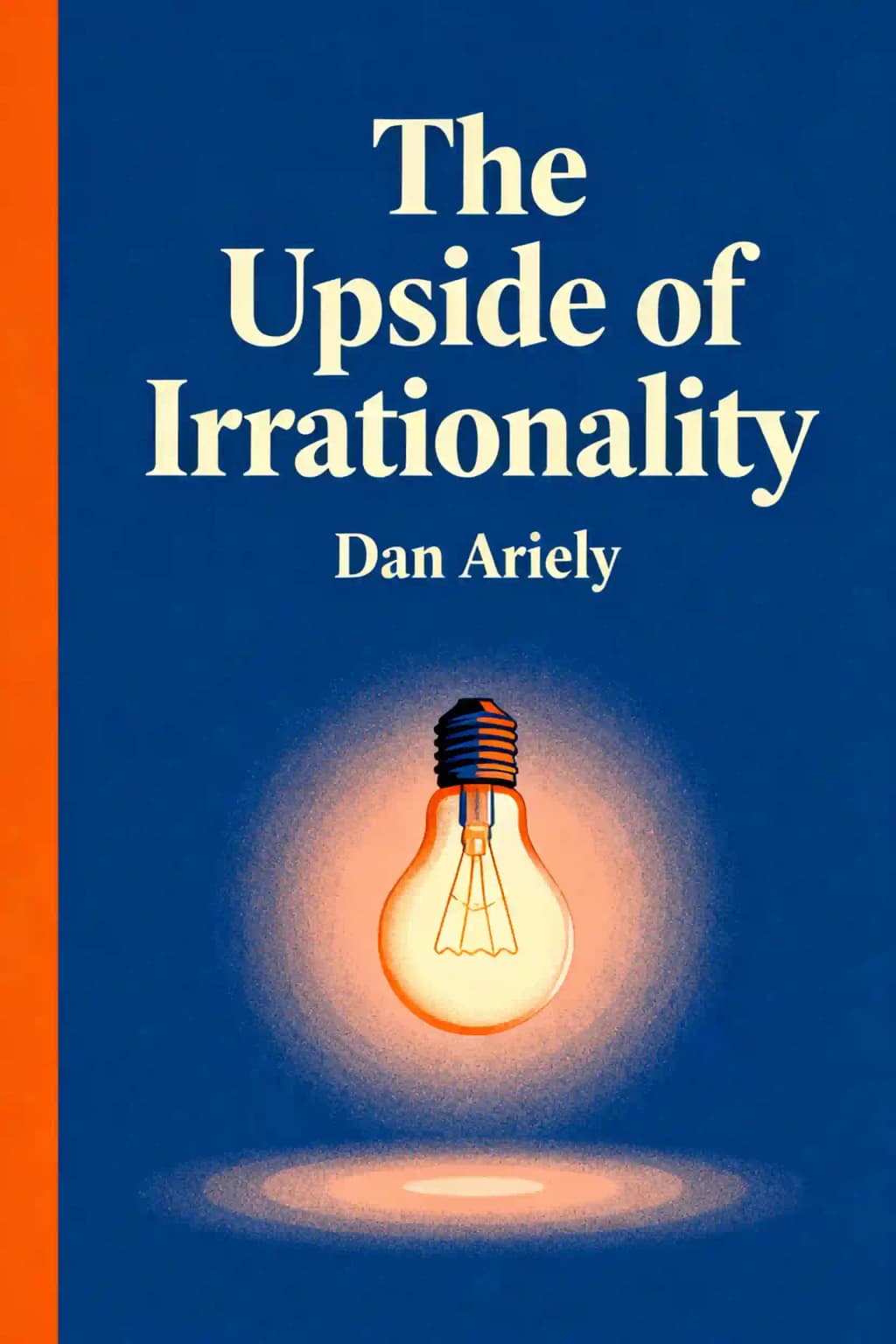
In a world where we pride ourselves on logic and reason, Dan Ariely's "The Upside of Irrationality" arrives as a fascinating revelation of our deeply irrational nature. This isn't just another dry psychology book-it's a journey through the hidden forces that drive our decisions in ways we rarely recognize. The book has achieved cult status among Silicon Valley executives and behavioral economists alike, with figures like Malcolm Gladwell calling it "breathtakingly original." What makes Ariely's work particularly compelling is how he weaves his personal experience-surviving severe burns over 70% of his body as a teenager-into his scientific exploration of human behavior. This transformative experience gave him a unique perspective on adaptation, pain, and decision-making that informs his research in profound ways. Through clever experiments and engaging storytelling, Ariely shows us not just how irrational we are, but how we might harness these tendencies to build better lives, businesses, and societies.
Capítulo 2
When More Money Leads to Worse Performance
Picture yourself as a laboratory rat navigating a maze, motivated by electric shocks of varying intensity. Psychologists Robert Yerkes and John Dodson discovered something counterintuitive: while mild shocks improved learning, high-intensity shocks actually impaired performance as rats became paralyzed with fear. This inverse-U relationship between motivation and performance challenges our fundamental assumptions about incentives-particularly the notion that bigger rewards always yield better results.
To test whether this pattern applies to humans, my colleagues and I conducted experiments in rural India where we could offer truly substantial bonuses-up to five months' salary-without breaking our research budget. We asked participants to perform various cognitive tasks requiring creativity, memory, and problem-solving under different bonus conditions: small (one day's pay), medium (two weeks' pay), or very large (five months' pay).
The results were striking. Those offered the enormous bonuses performed worst of all-achieving good performance less than a third as often as the other groups. The pressure of potentially earning five months' salary created so much stress that participants "choked," much like the rats in Yerkes and Dodson's experiment. Initially, we even amplified this effect by pre-paying participants and making them return money for poor performance, leveraging loss aversion to create even stronger incentives. This approach failed spectacularly when our second participant simply ran away with our funds!
To determine if there were limits to this effect, we conducted follow-up experiments at MIT comparing cognitive tasks (simple math problems) with purely mechanical ones (keyboard clicking). For mechanical tasks, higher bonuses did improve performance. However, once even basic thinking was required, larger incentives became counterproductive-suggesting that executive bonuses might actually impair the complex decision-making they're meant to enhance.
When I presented these findings to investment bankers in New York before the 2008 financial crisis, they insisted they were different-that they performed better under pressure. Yet when we studied NBA "clutch players" who supposedly excel in high-pressure situations, we found they didn't actually improve under pressure; they simply took more shots, with the same percentage of success as in normal play.
The implications are profound: while we shouldn't stop paying people for their work, massive bonuses might be creating counterproductive stress rather than improving performance. For critical tasks requiring concentration and cognitive skill, we might prefer professionals in a "flow state"-fully engaged and focused-rather than distracted by thoughts of their potential windfall.
Capítulo 3
Finding Meaning in the Labor We Do
On a flight from California, I sat beside a professional-looking man who asked what I do for work-a question that typically comes early in conversations with strangers. This focus on occupation reveals how central work is to our identity and self-worth. But what happens when our work feels meaningless?
In 2005, a former student named David visited my MIT office with a troubling story. Working at a prestigious New York investment bank, he'd spent ten weeks creating an elaborate presentation for a merger, only to learn the deal had been canceled. His boss praised his effort, but David was devastated that his work would never serve any purpose. He posed a thought experiment: "Imagine creating PowerPoint slides that someone immediately deletes, despite being well-paid with great benefits. How happy would you be?"
This conversation sparked my interest in what gives work meaning beyond a paycheck. Surprisingly, I found inspiration in my pet parrot Jean Paul, who preferred working for her food rather than eating it freely. This exemplifies "contrafreeloading," a concept discovered by psychologist Glen Jensen in the 1960s. His experiments showed that when given a choice, 44% of rats chose to work for more than half their food rather than eat freely available pellets. Subsequent studies confirmed this pattern across many species-only cats consistently choose the lazy option. This contradicts standard economic theory that organisms always minimize effort while maximizing rewards.
To explore how meaningfulness affects work motivation, we designed an experiment using Lego Bionicles. Participants in a "meaningful" condition built robots that were stored away after completion, while those in a "Sisyphean" condition watched as their completed robots were immediately disassembled before their eyes. Both groups were paid on the same diminishing scale.
The results were dramatic: those in the meaningful condition built an average of 10.6 robots and earned $14.40, while those in the Sisyphean condition built only 7.2 robots and earned $11.52. Most tellingly, in the meaningful condition, participants who loved Legos built more robots, showing their passion drove their effort. In the Sisyphean condition, this correlation disappeared-meaningless conditions killed their internal joy.
We then tried another approach using a letter-finding task with three conditions: acknowledged (experimenters reviewed work with participants' names), ignored (work placed on stack without review), and shredded (work immediately destroyed). Surprisingly, the ignored group performed almost identically to the shredded group-revealing that managers can demotivate employees simply by ignoring their work, nearly as devastating as destroying it outright.
These findings connect to Adam Smith's concept of division of labor, which creates efficiency but can strip meaning from work. As Karl Marx noted in his concept of "alienation of labor," workers separated from the goals and process of production lose identity and meaning. While Smith's efficiency principles worked well for simple production, today's knowledge economy requires imagination and engagement, making Marx's concerns about alienation increasingly relevant.
Capítulo 4
The IKEA Effect: Why We Love What We Build
Every time I walk into IKEA, my mind fills with home improvement ideas. On one such trip, I purchased a modern Swedish toy chest for our family room. Despite the frustrating assembly process with unclear instructions, I felt an unusual attachment to this piece of furniture once completed. I even imagined it was fonder of me than my other furniture was.
This pride of creation runs deep in human beings. When instant cake mixes were introduced in the 1940s, they initially failed because they were too simple, requiring only water. Once Pillsbury required adding eggs and other ingredients, sales took off. This "egg theory" demonstrated that people need to feel some ownership in what they create. Sandra Lee's "70/30 Semi-Homemade Philosophy" perfectly captures this balance-using 70% ready-made products with 30% "fresh creative touches" allows people to feel ownership while saving time.
To test this "IKEA effect," we conducted experiments using origami. Participants who created origami frogs valued their creations at around 23 cents, while non-creators valued the same amateur creations at just 5 cents. However, when non-creators evaluated professionally-made origami, they bid 27 cents-close to what creators bid on their own work. This revealed creators have substantial bias, seeing their amateur work as nearly equal to expert craftsmanship.
The manufacturing world has evolved from Henry Ford's "any color so long as it's black" to today's highly customizable products. Websites like Converse.com allow customers to design their own shoes. While conventional wisdom might suggest that ideal customization would require minimal effort, such efficiency would actually eliminate the benefits of the IKEA effect. By investing thought and effort in creation, we develop a deeper attachment to the final product.
We not only overvalue our own creations but are largely unaware of this tendency, mistakenly believing others share our high opinion. Like parents who think everyone finds their children as adorable as they do, creators assume others value their work equally. This explains why we're surprised when others don't appreciate our creations as much as we do.
While effort increases our attachment to our creations, completion is equally crucial. Those who successfully completed difficult origami valued their creations most highly, while those who struggled but failed valued their work least. This demonstrates that effort only increases affection when it leads to completion; unsuccessful effort actually diminishes our attachment to the product.
These findings challenge the simple economic model that views effort as undesirable stress to be avoided. While we often outsource assembly, gardening, or cooking for convenience, we may be sacrificing the deep enjoyment that comes from personal investment. Though IKEA furniture may frustrate us during assembly, the completed bookcase becomes a source of pride and higher long-term satisfaction precisely because we invested our own sweat in its creation.
Capítulo 5
The Not-Invented-Here Bias: Why We Reject Good Ideas
From time to time, I present research findings to executives hoping they'll implement these ideas in their companies. During one such meeting with banking executives, I suggested ways they might help consumers save money. Despite presenting solid data, they seemed uninterested. I wondered if their lack of enthusiasm stemmed from the fact that the idea wasn't theirs-a phenomenon I call the "Not-Invented-Here" bias.
To test whether people become attached to ideas they create (similar to the IKEA effect with physical objects), we conducted experiments through John Tierney's New York Times blog. Participants either created solutions to problems or evaluated solutions we developed. Those who created their own solutions rated them as more practical and promising than our solutions and were willing to invest more time and money in them.
To rule out the possibility that their ideas were objectively better, we designed a clever follow-up experiment where participants "created" solutions using our pre-selected words, ensuring they'd arrive at the same solutions we had developed. Even when merely rearranging jumbled words to form our exact solution, participants valued "their" ideas more highly than identical ideas presented as ours.
Thomas Edison exemplifies this bias in the extreme. His obsession with direct current (DC) electricity blinded him to the superior alternating current (AC) developed by Tesla. Despite AC's ability to power industrial machines and illuminate over greater distances, Edison dismissed it as "splendid, but utterly impractical." To discredit AC, Edison launched a fear campaign, electrocuting stray animals and secretly funding the development of the electric chair. His demonstrations culminated in the gruesome execution of William Kemmler, who was slowly cooked alive. Despite Edison's efforts, AC eventually prevailed.
The Not-Invented-Here bias extends beyond individuals to entire organizations. Companies develop cultures around their own beliefs, processes, and products, often rejecting external ideas. The proliferation of acronyms within industries serves as a marker of this insularity-they confer insider knowledge while keeping outside ideas at bay. Sony exemplifies this problem, having missed opportunities in MP3 players and flat-screen TVs because of their rejection of outside innovations.
Understanding this tendency has both positive and negative implications. On the positive side, knowing how ownership and pride motivate can help inspire greater commitment. Simple actions like adding inspection tags with names or having children grow vegetables can increase engagement and satisfaction. However, this tendency can also be manipulated or lead us to become fixated on our own ideas and reject better alternatives. The challenge is maximizing the benefits of our creative attachment while minimizing its downsides.
Capítulo 6
The Primal Power of Revenge
Revenge is one of humanity's deepest instincts, as illustrated in Dumas' "The Count of Monte Cristo." Though revenge can lead to terrible consequences, its threat serves as an effective enforcement mechanism supporting social cooperation. The fear of vengeance-even at great personal cost to the avenger-can deter potential wrongdoers.
Research reveals the biological underpinnings of our revenge instinct. In a modified Trust Game experiment, Swiss researchers found that participants often sacrificed their own money to punish those who betrayed their trust. Brain scans showed increased activity in the striatum-associated with reward processing-suggesting punishment actually produces pleasure-like responses.
Similar behavior exists in other primates. German researchers found that chimps would pull a "revenge rope" collapsing a food table if another chimp hoarded food unfairly. The enraged chimps would become "screeching black furballs" when treated unjustly. This similarity between humans and chimps suggests that revenge plays a fundamental role in maintaining social order across species.
The 2008 financial crisis triggered widespread public desire for revenge against bankers. As financial institutions collapsed and received government bailouts, citizens felt betrayed by those they'd trusted with their savings and retirement funds. Despite massive government intervention, public trust remained shattered-further eroded by the bailout legislation's unrelated tax cuts, outrageous Wall Street bonuses, and the financial industry's quick return to business as usual.
My own frustrating experience with Audi inspired research on consumer revenge. When my new car suddenly lost power at 70 mph on the Massachusetts Turnpike, I narrowly avoided disaster. Calling customer service, I was met with indifference-"I am sorry about your inconvenience," the representative sniffed, as if my near-death experience was a minor nuisance. Despite multiple calls to various supervisors, Audi took minimal responsibility. While I understood mechanical failures happen, it was their callous customer service that truly infuriated me.
This led to experiments with colleague Ayelet Gneezy on consumer revenge. We created a scenario where an experimenter interrupted his instructions with a brief 12-second phone call about pizza plans. To measure revenge, we deliberately gave participants too much money to see if they would return it. While 45% returned the extra cash in the control condition, only 14% did so after experiencing the phone interruption-showing how even a minor annoyance could significantly increase vengeful behavior.
Most troublingly, we found that when seeking revenge, people don't distinguish between punishing the actual offender or an innocent party-they simply want someone to pay. This has serious implications for businesses that rely on outsourcing while providing poor customer service.
Fortunately, our research also revealed that a simple apology ("I'm sorry, I shouldn't have answered that call") completely counteracted the effects of the annoyance. People returned the extra money at the same rate as those who weren't annoyed at all. We also found that increasing the time between the offense and the opportunity for revenge reduced vengeful feelings.
Despite its downsides, revenge can sometimes be constructive. Many success stories are built on the motivation for revenge, particularly among entrepreneurs whose self-worth is tied to their work. When Cornelius Vanderbilt returned from vacation to find his associates had sold his steamship company to themselves, he declared "I'll ruin you" and started a rival company that quickly succeeded. Similarly, after Jeffrey Katzenberg was fired from Disney, he co-founded DreamWorks SKG and released Shrek-a film that parodied Disney's fairy tales and featured a villain resembling his former boss.
Capítulo 7
The Remarkable Power of Adaptation
Adaptation is one of our most remarkable human capabilities. Our visual system demonstrates this perfectly: we can function across a vast spectrum of light intensities and quickly adjust when moving between them. After the initial shock of walking from a dark theater into bright sunshine, our eyes adjust and soon we barely notice the light intensity.
This adaptive ability extends to smells, textures, temperatures, and background noises. We initially notice these sensations strongly but gradually pay less attention until they become almost unnoticeable. This serves as an important novelty filter, allowing us to focus our limited attention on meaningful changes while ignoring the constant, unimportant ones.
Through my research with Professor Hanan Frenk, who also suffered severe injuries, we discovered that people with serious injuries developed significantly higher pain thresholds and tolerance. Testing participants at a veterans' club, we found severely injured individuals could withstand hot water for nearly 60 seconds compared to just 27 seconds for those with mild injuries. This adaptation wasn't temporary-it lasted years after the original trauma.
Hedonic adaptation describes how we emotionally level out over time-both positive and negative perceptions fade. Just as we stop noticing the gleaming hardwood floors or garish kitchen cabinets in a new home after a few weeks, we adapt to most life changes. Studies show that even life-altering events like becoming paraplegic or winning the lottery result in happiness levels that eventually return surprisingly close to baseline. We're remarkably poor at predicting this adaptation, consistently overestimating how long both positive and negative emotions will last.
This inability to anticipate adaptation drives the "hedonic treadmill"-our endless pursuit of new possessions that provide only temporary happiness. When a new car's excitement wears off after a few months, we seek the next purchase that promises lasting happiness. This cycle keeps us perpetually chasing new possessions without recognizing how quickly we'll adapt to them.
To manage hedonic adaptation, we must understand when to embrace it and when to disrupt it. Contrary to intuition, research shows that interrupting pleasurable experiences actually enhances overall enjoyment by preventing adaptation, while breaking up unpleasant experiences makes them worse by resetting adaptation. For pleasurable experiences like hot tubs, getting out briefly can enhance the joy of returning.
The key insight is to slow down pleasure-buying a couch and television months apart rather than simultaneously maximizes happiness, while making multiple cutbacks at once minimizes suffering. We can also increase happiness by investing in transient experiences (like travel) rather than constant ones (like furniture), introducing unpredictability into our routines, avoiding comparisons with others who have what we don't, and understanding our individual adaptation patterns.
Capítulo 8
Finding Love in an Imperfect Market
The chapter begins with the author's powerful account of confronting his severely burned body in a mirror for the first time. After seeing his charred face, bent legs, and twisted body, he struggles to reconcile this new appearance with his former self-image as an attractive teenager. This physical transformation forces him to question his place in the social hierarchy, particularly in the dating market. He wonders if he must "settle" for someone with similar disabilities, or if someone might someday overlook his scars.
Though he initially tries to separate mind from body-resolving to ignore his physical needs and live in a mental world-this approach fails when his teenage hormones reawaken during a sponge bath from an attractive nurse. This experience teaches him he must find mind-body harmony rather than separation.
His personal situation evolves into a broader interest in how people select romantic partners, introducing the concept of "assortative mating"-the tendency of people to pair with others of similar attractiveness. The author questions how aesthetically challenged individuals adapt to their position in the social hierarchy, presenting three possibilities: they might alter their perception of beauty, prioritize non-physical attributes like humor or kindness, or fail to adapt at all.
To investigate this question, the author and colleagues design studies using the HOT or NOT website and speed dating. Their findings reveal that while people generally agree on standards of beauty regardless of their own attractiveness, less attractive individuals adapt by placing greater importance on non-physical attributes when selecting partners. In their custom speed dating experiment, participants rated potential partners on physical attractiveness, intelligence, humor, kindness, confidence, and extroversion. The results confirmed that aesthetically challenged individuals place less emphasis on physical appearance and more on other qualities when selecting partners.
The author reflects on his personal struggle with sudden change in his "market value" after his injury. Unlike most people who gradually adapt to their physical limitations from childhood, he faced an abrupt transition from his previous self-image. He agonized over how his scars would affect his romantic future, realizing his position in the assortative mating hierarchy had plummeted overnight.
However, while serving on a committee in graduate school, he met Sumi, an amazing woman who appreciated his sense of humor and eventually saw him as a romantic partner. Fifteen years and two children later, he recognizes how fortunate he is that women typically place less emphasis on physical appearance than men do. He concludes that Stephen Stills's song "Love the One You're With" contains profound truth-not about infidelity, but about our human capacity to discover and love the characteristics of our partners beyond physical appearance.
Capítulo 9
The Empathy Gap: Why One Death Matters More Than a Million
Why do we respond emotionally to one person's suffering but remain unmoved by mass tragedies? I explore this paradox through the story of Baby Jessica, whose 1987 rescue from a well captivated America and generated over $700,000 in donations, while genocides claiming hundreds of thousands of lives receive comparatively little attention. As Joseph Stalin grimly noted, "One man's death is a tragedy, but a million deaths is a statistic."
Research demonstrates we donate significantly more money when presented with an identifiable victim rather than statistical suffering. In an experiment, participants gave twice as much to help "Rokia," a seven-year-old girl from Mali with a photo and personal story, compared to those presented with general statistics about hunger affecting millions. This "identifiable victim effect" explains why charities use individual stories to trigger our empathy and open our wallets.
Three psychological factors explain why we help individual victims but ignore mass suffering. First, "closeness"-we respond more to those physically or emotionally near us than to distant strangers. Second, "vividness"-detailed, sensory descriptions of suffering trigger our emotions more than vague statistics. Third, the "drop-in-the-bucket effect"-we're discouraged from helping when we believe our contribution can't meaningfully solve a massive problem.
When we try to think more rationally about helping others, we actually become less generous. In an experiment, participants primed to think mathematically gave equally small amounts to both individual victims and statistical causes, while those primed emotionally gave generously to individuals. Most disturbing was that presenting both emotional stories and statistics together reduced donations compared to emotional appeals alone. This suggests that calculation suppresses our compassion-we literally cannot feel deeply while thinking statistically.
Our emotional biases lead to irrational allocation of resources. We'll spend $48,000 rescuing an adorable dog at sea or $80,000 rehabilitating a single oil-covered otter, while neglecting more efficient ways to help humans. Data shows an inverse relationship between victims and donations-as the number of sufferers increases, donations decrease. Climate change represents the perfect storm of psychological barriers: it's distant, invisible, gradual, and subject to the drop-in-the-bucket effect where individual actions seem futile.
To overcome these limitations, we should reframe massive tragedies by focusing on individual stories-imagining a specific little girl who dreams of becoming a doctor or a grandmother struggling to raise her deceased daughter's child. We can also leverage emotional biases positively, as when Michael J. Fox's face becomes associated with Parkinson's research. By understanding our emotional limitations, we might make more reasonable decisions about whom to help beyond just "those trapped in a well."
Capítulo 10
The Long Shadow of Fleeting Emotions
Our emotions are fleeting, but when we act impulsively on them, the consequences can linger. When emotions-especially anger-get the best of us, we often wake up later asking, "What was I thinking?" Though we comfort ourselves that we won't repeat such mistakes, the reality is more complex. Even after emotions fade, their effects can persist through what I call "self-herding"-using our past decisions as guides for future behavior, even when those initial decisions were emotionally driven.
While emotions typically seem to disappear without affecting our general decision-making approach, Eduardo Andrade and I wondered if their effects could persist long after the feelings fade. When something puts you in a good mood-like your team winning-you might impulsively buy flowers for your mother-in-law. A month later, with those emotions gone, you might repeat the behavior simply because you remember doing it before. This "self-herding" occurs because we look to our past actions as guides, assuming they were reasonable.
In the ultimatum game, people's emotional reactions to unfair offers are so predictable that most senders offer equitable splits around $12:$8 rather than unfair ones like $19:$1. Brain imaging confirms that unfair offers activate the anterior insula-associated with negative emotions-with stronger activation correlating to higher rejection rates.
We explored how emotions create long-term decision patterns through "self-herding" in two possible ways: specific self-herding (mindlessly repeating exact past actions) or general self-herding (using past actions to inform our character and preferences more broadly). Our findings confirmed that general self-herding was at work-our emotion-influenced decisions become reference points for future choices even in different contexts, creating lasting behavioral patterns long after the emotions have faded.
While we rarely find gender differences in basic decision-making, our more complex ultimatum game revealed interesting distinctions. Men were about 50% more likely than women to accept unfair offers across both emotional conditions. When given alternative options, women in the angry condition predominantly chose the equal $3:$3 split (teaching fairness by example), while angry men opted for the vengeful $0:$3 option (punishing the sender at personal cost).
The key lesson is that emotions easily influence our decisions, even when completely irrelevant to the choice at hand. More critically, these emotional effects outlast the feelings themselves, creating long-term decision patterns through self-herding. This is especially evident in romantic relationships, where emotional cascades can permanently alter communication patterns. One simple test for compatibility is canoeing together-since it lacks established social protocols, it reveals how couples handle stress and unexpected challenges. Before committing to relationships, we should observe our joint behavior in unfamiliar environments and watch for deteriorating patterns.




![[PDF] Toward a Theory of Behavioral Operations - Harvard Business School](/_next/image?url=https%3A%2F%2Fd1y2du6z1jfm9e.cloudfront.net%2Fassets%2Fpodcast%2Fblue.png&w=1024&q=50)