Capítulo 1
Meetings: The Hidden Productivity Killer We Love to Hate
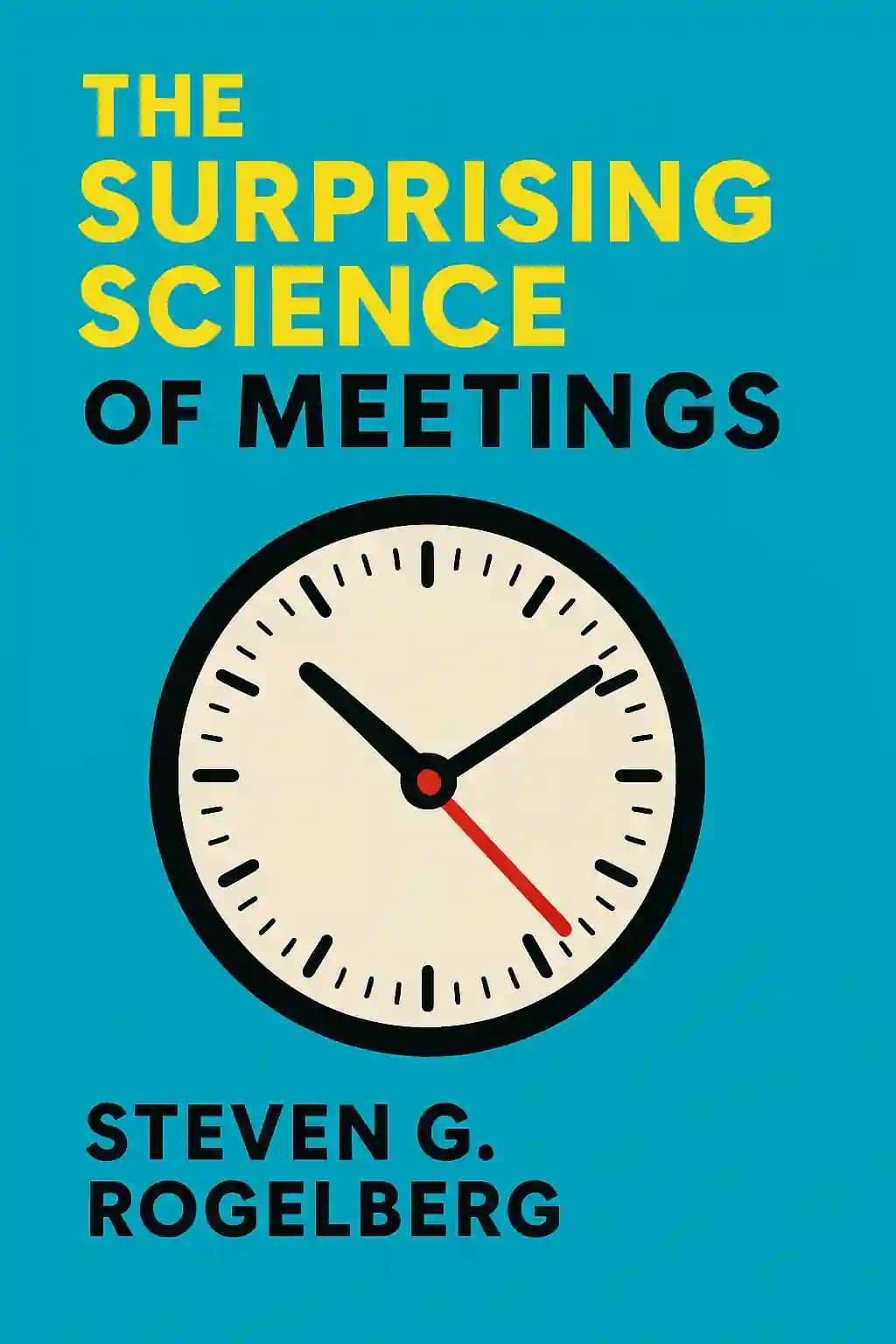
Imagine walking into your office on Monday morning to discover that all your meetings for the week have been canceled. Would you feel relieved or concerned? For most professionals, the answer is a complicated mix of both. In America alone, a staggering 55 million meetings occur daily, consuming approximately $1.4 trillion annually-roughly 8.2% of the 2014 GDP. Even more troubling, an estimated $250 billion of that is completely wasted on ineffective gatherings. The Surprising Science of Meetings by Steven G. Rogelberg has been hailed as a game-changer by organizational leaders worldwide, with Adam Grant calling it "the most important book on meetings ever written." Drawing on fifteen years of groundbreaking research across hundreds of organizations, Rogelberg doesn't just identify what's wrong with our meetings-he provides evidence-based solutions that can transform them from energy-draining obligations into productive, engaging experiences that benefit both organizational outcomes and individual careers.
Capítulo 2
The Meeting Epidemic: More Time, Less Productivity
The scale of meetings in modern organizations is truly staggering. Since 1976, the number of daily workplace meetings in the United States has skyrocketed from 11 million to approximately 55 million. Non-managers attend about eight meetings weekly, while managers participate in twelve, with executives spending 56-60% of their working hours in meetings. For many CEOs, the burden is even heavier-university chancellors average seven meetings totaling nearly five hours daily, while nonprofit executives often spend six and a half hours in meetings, many of which are simply preparing for other meetings.
This proliferation reflects shifting organizational values emphasizing inclusion, empowerment, teamwork, and flatter hierarchies. But the financial impact is enormous. Beyond the $1.4 trillion annual cost, individual companies like Xerox spend over $100 million yearly just on meeting time. These figures actually underestimate the true cost by excluding facilities, equipment, opportunity costs, and the psychological toll of bad meetings.
The frustrating reality is that most organizations simply accept poor meetings as inevitable. While surveys about meeting effectiveness vary widely-some showing 50-70% considered wasteful, others indicating most meetings are somewhat productive-the truth likely falls somewhere in between. Meetings are generally negative experiences, but with some valuable interactions mixed in, often tied to leaders who excel at running them.
What matters most is your organization's specific return on meeting investment. Using a Meeting Quality Assessment tool, you can calculate a "Wasted Meeting Time Index" by evaluating five key areas: meeting design, time dynamics, interpersonal dynamics, discussion dynamics, and post-meeting activities. Scores between 0-20% indicate productive meetings (above typical), 21-40% suggest hit-or-miss meetings with considerable waste (sadly typical), and scores above 41% indicate meetings needing substantial improvement.
Capítulo 3
The Meeting Paradox: Necessary Evil or Untapped Opportunity?
Meetings are easy targets for ridicule. We've all heard the sarcastic quips: "A meeting is an event where minutes are taken and hours are wasted," or "Meetings are indispensable when you don't want to accomplish anything." Management guru Peter Drucker even suggested meetings were symptoms of bad organization. But contrary to popular belief, eliminating meetings isn't the solution. Schedules with too few meetings actually create substantial risks.
Meetings serve vital organizational functions. They provide employees with essential information, inclusion, support, voice, and community. They help people connect in human ways, building relationships and networks. Meetings efficiently bring together ideas and opinions, helping everyone perform better through coordination and cooperation. They help make sense of organizational challenges and ambiguities, foster commitment to goals, and bring individuals together as a coherent whole.
Research actually shows that employees want meetings as part of their ideal workday. The solution isn't eliminating meetings but making them better through evidence-based practices derived from meeting science-the systematic study of what happens before, during, and after meetings.
Meeting science employs various complementary approaches including field surveys, longitudinal studies, and laboratory experiments. Field surveys collect data from managers and employees about meetings and job attitudes, while laboratory studies manipulate meeting conditions to test specific variables like standing versus sitting meetings or emotional contagion among participants.
As Andy Grove of Intel noted, allowing poorly conducted meetings is like permitting theft of valuable time from fellow managers. Rather than accepting bad meetings as inevitable, we need to apply scientific insights to transform them into productive experiences.
Capítulo 4
The Leadership Blind Spot: Why Your Meetings Are Worse Than You Think
Perhaps the most troubling discovery in meeting science is that most leaders dramatically overestimate their meeting facilitation skills. This inflated self-perception creates a significant barrier to improvement-after all, why fix something you don't believe is broken?
Without adequate assessment of meetings and leadership, these problems persist unchecked. Research by Green Peak Partners and Cornell found that high self-awareness was an exceptional predictor of executive success, as self-aware leaders do better at hiring and leveraging talent around them.
To overcome this blind spot, leaders must regularly evaluate their meetings through surveys and feedback. Consider the example of an RSC Bio Solutions CEO who implemented daily fifteen-minute huddles with his commercial team, then assessed their effectiveness through a simple survey measuring usefulness and communication effectiveness. The survey revealed high satisfaction but also identified opportunities for improvement around focus and conciseness. Rather than immediately reducing frequency as some suggested, the CEO first implemented changes: creating additional discussion prompts, rotating leadership responsibilities, and setting clearer expectations.
The ideal meeting leader embodies servant leadership principles, prioritizing others' needs over self-promotion. Unlike egocentric "leader-first" approaches focused on power accumulation, servant leaders share power and find satisfaction when others prosper. This leadership style, practiced at successful companies like SAS, Whole Foods, and Starbucks, aligns with Adam Grant's research on "givers" who assist others without expecting reciprocation.
Servant-leader meeting facilitators recognize their responsibility to make meetings valuable for everyone, not just themselves. They carefully design meetings, create psychologically safe environments, and sometimes strategically limit their own contributions to encourage fuller participation. One leader restricted himself to just one or two sentences in certain meetings to prevent prematurely influencing discussions, resulting in richer, more inclusive conversations.
Effective servant leaders excel at time management, active listening, conflict management, ensuring participation, and building consensus. They take pride in being excellent stewards of others' time, recognizing this approach leads to success for all involved. Research confirms that helping others is one of the most robust predictors of life satisfaction.
Capítulo 5
Breaking the Time Trap: Rethinking Meeting Duration
Cultural norms deeply influence how we conduct meetings, including the ubiquitous sixty-minute meeting length that has become standard across vastly different meeting purposes and contexts. This standardization ignores a fundamental principle known as Parkinson's law-work expands to fill the time available.
First described in a 1955 essay in The Economist, Parkinson's law has been consistently confirmed by research across various populations, from college students to NASA scientists. When given excess time, people expend less effort and feel less urgency. This principle applies directly to meetings-if scheduled for sixty minutes, they generally take the full hour regardless of necessity.
Meeting leaders should thoughtfully determine how much time is actually needed based on goals, attendees, and past meeting analysis. Scheduling unusual meeting lengths (like forty-eight minutes) can increase attention and reduce tardiness. Research supports reducing estimated meeting times by 5-10%, as the Yerkes-Dodson law shows that moderate stress improves performance.
Google popularized the fifty/twenty-five rule (shortening hour meetings to fifty minutes and half-hour meetings to twenty-five), which provides transition time between meetings and reduces the 50% late-start rate that research shows leads to meeting frustration and decreased quality.
Ten or fifteen-minute meetings, common in high-stakes environments like hospitals and emergency services, are gaining popularity in corporate settings. Companies like Percolate have made fifteen minutes their default meeting length, while former Yahoo CEO Marissa Mayer famously scheduled ten-minute meetings that forced tight focus and allowed her to be highly responsive to employee needs.
The "huddle"-a brief team gathering typically lasting 10-15 minutes-has been adopted by organizations from Apple to Zappos to the Obama White House. These daily team gatherings follow a consistent structure: same time, same place, perfect attendance (in person or remote), standing up when possible. Huddles typically address four key areas through focused questions: accomplishments and wins, daily priorities, key metrics, and obstacles. These brief meetings promote unity, coordination, accountability, problem-solving, and cross-team communication.
While huddles are small time investments with big returns, two hazards must be avoided: creating more meeting time (instead, huddles should replace longer meetings) and not honoring the end time. Running over schedule breaks an implicit contract with attendees, causing stress and frustration. Many organizations take ending on time seriously-Google uses visible countdown timers, O3 World's "Roombot" technology dims lights as meetings near their end, while Tripping.com and Buddytruk use humorous penalties for running over.
Capítulo 6
Beyond the Agenda: Strategic Meeting Design
Throughout history, traveling "merchants" have sold quick fixes promising to solve complex problems without requiring deep thought or hard work. Similarly, most meeting advice books and articles tout agendas as a cure-all solution. Unfortunately, relying on meeting agendas alone is exactly this kind of ineffective quick fix.
Research shows agendas are minor predictors of meeting effectiveness, with some studies finding no positive relationship between written agendas and meeting quality. Many organizations simply recycle the same agenda from meeting to meeting, changing only the date. To be truly effective, agendas need strategic thought and preparation beyond just their existence.
An agenda should be treated as an event plan, with careful consideration given to details, flow, and experience. With meetings often costing $1,000-$3,000 in attendee time and salaries, they warrant the same preparation as client meetings. As a meeting leader, you're a steward of others' time, so prepare internal meetings with the same focus as client events.
Meetings should primarily address issues requiring genuine interaction and engagement, not just updates that could be handled through memos or webinars. Effective meetings should focus on interaction-requiring topics such as identifying risks and challenges, discussing key metrics, evaluating processes, solving important problems, celebrating victories, forecasting, and coordinating efforts.
Beyond these leader-identified topics, agenda items should also come from attendees themselves. As Andy Grove noted, "The most important criterion governing matters to be talked about is that they be issues that preoccupy and nag the subordinate." Research shows that when employees have "voice" in work activities, they feel greater commitment and engagement.
The order of agenda items significantly impacts meeting success. Research by Littlepage and Poole found that items early in the agenda receive disproportionate time and attention, regardless of importance. Therefore, simply listing items in the order received is counterproductive. Instead, rank agenda items by strategic importance, considering both immediate and long-term issues. Items with related content should be placed near each other to create a better "story."
While meeting leaders maintain ultimate responsibility, strategically sharing leadership through agenda item "owners" increases accountability and follow-through. These owners facilitate discussion of their items and handle related post-meeting actions. Research confirms that publicly attaching names to tasks improves accountability. Apple formalized this practice with "DRIs" (directly responsible individuals) for agenda items.
The final crucial step in agenda creation is determining not just what to cover but how to address each item. Meeting leaders should consider which tools and techniques best fit each agenda item based on the people involved, tasks at hand, history, and potential challenges.
Capítulo 7
The Attendance Dilemma: Finding the Right Size and Mix
Large, "bloated" meetings are common in organizations, with over 50% containing at least two unnecessary attendees. This happens due to inclusivity concerns, failure to analyze who's truly needed, and fear of political repercussions from excluding people. Despite theoretical benefits of more perspectives, research shows that large meetings are counterproductive.
Bain & Company data shows each person over seven reduces decision effectiveness by approximately 10%. Another study found larger teams report poorer group experiences and more counterproductive behaviors including interpersonal aggression and resource misuse. Large meetings face coordination challenges and suffer from "social loafing"-the tendency to reduce effort when working collectively. In Ringelmann's tug-of-war experiments, individuals in dyads performed at 93% capacity, while those in eight-person groups dropped to 49%.
Companies employ various approaches to limit meeting size. Percolate has a "no spectators" rule, while Apple follows Steve Jobs's intolerance of large meetings. Google advocates for no more than ten attendees, and Amazon uses the "two-pizza rule." Research suggests seven or fewer is ideal for decision-making, eight to twelve works with skilled facilitation, and fewer than fifteen is best for idea generation.
While people complain about too many meetings, exclusion from meetings often creates feelings of marginalization and diminished organizational self-worth. Meeting leaders face a dilemma: large meetings lead to dysfunction, but excluding people can burn bridges.
Five techniques help reduce meeting size while maintaining inclusion: (1) splitting agenda items into multiple smaller meetings; (2) using timed agendas where people enter and exit at specific times; (3) gathering input from non-attendees beforehand; (4) sharing detailed meeting notes with secondary stakeholders; and (5) assigning "representative voices" to speak for specific groups. Research shows people with explicit roles (like representing others) take their responsibilities more seriously.
Excluding unnecessary attendees gives the gift of time to both those who don't attend and those who do, reducing frustration and saving company resources. However, since people dislike exclusion more than meetings themselves, using these techniques allows leaders to manage meeting size strategically without risking feelings of isolation.
Capítulo 8
Breaking Habits: The Power of Meeting Environment
Humans are creatures of habit, with research showing roughly 45% of daily behaviors are repeated in the same location. This extends to meetings, where leaders engage in habitual behaviors-same time, same place, same seating arrangements. Breaking these patterns can create new energy and dynamics.
Where you sit directly affects your meeting experience-influencing who you speak with, how much you participate, and even leadership dynamics. Research shows seating location affects communication flow and who we're likely to disagree with. People in "privileged" positions at the head or foot of the table typically communicate most, while those sitting adjacent are less likely to disagree with each other.
Meeting leaders should encourage seating fluidity to prevent stagnation and promote different communication patterns. Simple solutions include shuffling name placards or changing meeting locations. Another technique is the "empty chair"-a physical cue representing customers or absent stakeholders, helping attendees consider alternative perspectives.
Walking meetings, designed for 2-4 people, have been embraced by leaders like Steve Jobs, Mark Zuckerberg, and Barack Obama. Research supports this practice: walking not only provides health benefits but increases energy, focus, and engagement. Stanford researchers found walking, especially outdoors, significantly boosts creativity-over 80% of participants were more creative walking than sitting.
Walking meetings enhance communication by reducing multitasking, breaking down formalities, and encouraging more authentic conversation. They work best with small groups, minimal technology needs, and proper planning. The route should be relatively quiet and circular, with participants informed in advance to wear appropriate footwear.
Standing meetings offer another alternative to traditional seated formats. Research shows standing meetings were 34% shorter than sitting meetings while maintaining the same quality, with participants reporting greater satisfaction. Studies from Washington University found standing meetings produced better collaboration, less possessiveness of ideas, more openness to others' suggestions, and higher engagement levels.
These techniques are tools to energize meetings, promote focus, and improve the overall experience. They should be used sparingly, as overuse creates just another habit. Leveraging different approaches for different meeting goals is best practice. As William Cowper noted, "variety's the very spice of life that gives it all its flavor."
Capítulo 9
The Silence Solution: Rethinking Meeting Participation
Despite extensive preparation and talent, many corporate product failures like New Coke or McDonald's Arch Deluxe share a common problem: critical information never surfaced during decision-making meetings. The solution might be counterintuitive: less talking and more silence.
Despite the hope that meetings will generate synergistic outcomes exceeding what could be achieved through one-on-one conversations, research shows this only happens 10-15% of the time. The key challenge is that attendees often fail to share unique, critical information, instead focusing on common knowledge that everyone already knows.
Studies by Stasser and Titus demonstrate that groups typically base decisions on shared information rather than surfacing unique insights that could lead to optimal solutions. This happens because sharing common knowledge earns social approval, while unique perspectives may challenge the group's thinking.
Brainwriting leverages strategic silence to generate and prioritize ideas more effectively than traditional brainstorming. Research shows brainwriting groups produce 20% more ideas and 42% more original ideas than traditional brainstorming. The process involves attendees silently writing ideas in response to a prompt, with contributions remaining anonymous. This approach eliminates production blocking (where only one person can speak at a time), reduces fear of social humiliation, and ensures all attendees must participate rather than hiding behind others' contributions.
In simplified brainwriting with voting, attendees silently respond to a prompt tied to the meeting goal, with each idea on a separate sheet. A facilitator then sorts similar ideas into conceptual "buckets," which can be discussed or prioritized through voting. The entire process is inclusive, engaging, time-effective (often taking just one-third the time of traditional brainstorming), and free from conformity pressures.
Another technique is silent reading of proposals during meetings. Amazon's Jeff Bezos pioneered this approach to evaluate ideas on their merits rather than presentation skills or social pressure. Meeting participants read thoroughly written proposals during the meeting itself-not in advance-ensuring everyone has done the preparation work. The silent reading period (10-30 minutes) is followed by vigorous discussion.
Effective meeting leaders recognize they're orchestrating an experience when bringing people together. Most default to the conventional "simultaneous verbal interaction technique" (SVIT), but alternatives like brainwriting and silent reading represent essential options for different meeting goals. As Will Rogers said, "Never miss a good chance to shut up."
Capítulo 10
Mastering Remote Meetings: Overcoming the Distance Challenge
Remote audio-only meetings present unique challenges that require different approaches. Despite technological advances, phone-based meetings remain common as people are often away from their desks. Paradoxically, employees dislike these meetings' effectiveness but prefer attending remotely to regain control through multitasking.
This creates a perfect environment for social loafing-people reduce effort when anonymous, making minimal contributions while doing other work. Even motivated participants struggle with interruptions, communication flow problems, and misinterpretations without visual cues. Background noise and poor connections further undermine effectiveness.
To improve remote meetings, first try encouraging video participation (WebEx, Google Hangout, Skype) to add visual cues that counteract communication problems and social loafing. When video isn't possible, additional facilitation techniques become necessary before, during, and after the meeting.
Before remote meetings: Consider "banning" the mute button to discourage multitasking by asking participants to find quiet spaces; open the conference line early so participants can check connections before the official start time; and choose agenda items carefully, recognizing that meaningful discussion is harder without visual cues.
During remote meetings: Use people's names frequently to maintain engagement and actively manage conversation flow. Draw remote attendees in by calling on them directly and keep a tally to ensure everyone contributes. Direct questions to specific individuals, especially remote participants when others are together in person. Have instant messaging available for attendees to signal when they want to speak.
For larger remote teams, more substantive structural intervention becomes necessary. Keep phone meetings brief (around fifteen minutes) for communicating information and early-stage brainstorming. For decision-making, create small subteams (3-4 people) who discuss problems separately and select representatives. These representatives then meet with the leader to make final decisions-similar to representative democracy.
Another effective approach is "using the intervals"-working between short meetings. First, hold a brief meeting (15 minutes) to outline a problem. Then use collaborative tools like Google Docs for asynchronous brainstorming. After a set period, have someone condense the document, then ask team members to vote on the best ideas. Hold a follow-up meeting (20 minutes) to discuss finalists, then conduct a final vote via online survey.
Remote, audio-only meetings are the most difficult type to run effectively. However, they can work well if these techniques are applied. Many of these techniques-particularly using meeting intervals-can also be applied to improve in-person meetings.
Capítulo 11
Transforming Meeting Culture: A Practical Framework
Meetings are a foundational organizational characteristic that should never be accepted as poor by default. In the US alone, over a trillion dollars is spent on meetings annually, yet they're treated carelessly with little evaluation or drive to improve. Small positive changes-even improving just one meeting weekly-can lead to significant organizational gains and improved employee health and engagement.
Taking just 5-15 minutes to visualize a meeting's flow, key needs, and challenges dramatically improves chances of success. Leaders can engage in a "premortem" exercise, imagining the meeting has failed and working backward to identify potential problems.
Meeting decisions about time, agenda, attendees, and context should be purposeful rather than habitual. Remember Parkinson's law: work expands to fill the time allotted. Consider using odd meeting lengths or start times, or follow Google's approach of scheduling 50-55 minute meetings instead of full hours.
A leader's mindset fundamentally shapes meeting success. The servant-leader approach focuses on making meetings valuable for all attendees rather than using meetings to demonstrate power or control. This mindset drives leaders to actively manage meeting dynamics: engaging all participants, asking meaningful questions, modeling active listening, drawing out input, directing traffic, and handling conflict.
Since meetings often feel like interruptions, leaders should create positive energy from the start through music, enthusiastic greetings, or offering snacks. Begin with a purposeful opening statement and remind attendees of "meeting values."
To maintain engagement, discourage multitasking and consider limiting device use. Keep meetings fresh by incorporating variety through clicker quizzes, role playing, partner discussions, and stretching breaks.
Most leaders overestimate their meeting facilitation skills. Pay attention to warning signs: attendees checking phones, engaging in side conversations, reluctance to disagree, or your own domination of the discussion. Periodically evaluate your regular meetings through quick surveys asking what to stop, start, and continue doing.
The solution to poor meetings isn't elimination but improvement. Meetings serve crucial purposes: building interpersonal connections, combining diverse perspectives, creating shared understanding, fostering commitment to broader goals, and bringing individuals together as a resilient whole.
Approach meeting improvement as an experimental process: try new approaches, reflect on results, and continue learning. This not only enhances your meetings but demonstrates your willingness to innovate and take reasonable risks, helping build a culture of innovation. Your example may inspire others to improve their meetings, gradually transforming the organization's meeting culture.