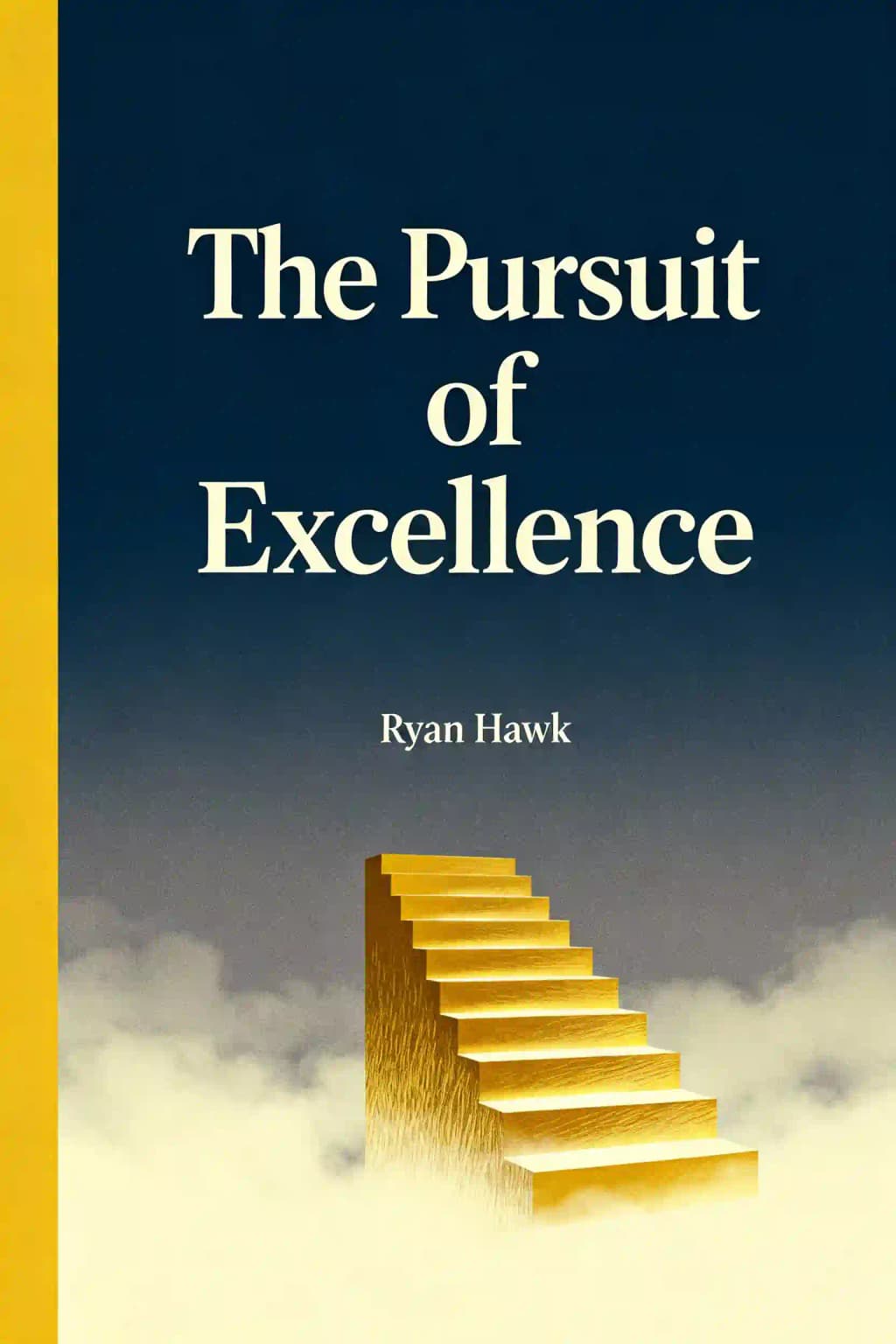
In "The Pursuit of Excellence," podcast legend Ryan Hawk distills wisdom from hundreds of world-class achievers, revealing why excellence trumps success. What separates top performers? Not talent - but uncommon behaviors anyone can adopt. The secret? Excellence isn't a destination; it's a lifelong journey.
Ryan Hawk is the bestselling author of The Pursuit of Excellence and a renowned leadership authority. He combines decades of corporate experience with insights from interviewing over 600 global leaders on his Apple-acclaimed podcast, The Learning Leader Show.
Specializing in management strategies and personal growth, Hawk’s work bridges boardroom principles with athletic discipline, informed by his dual career as a former professional quarterback and VP of Sales at a multibillion-dollar corporation.
His previous books, Welcome to Management (Forbes’ “Best Leadership Book of 2020”) and the USA Today bestseller The Score That Matters, establish his reputation for transforming high performers into visionary leaders. Hawk regularly advises Fortune 500 companies and professional sports teams (NFL, NBA) while hosting one of LinkedIn’s top-rated business podcasts, downloaded in 150 countries. The Pursuit of Excellence sold out its first printing in eight hours and remains a cornerstone text in leadership development programs worldwide.
The Pursuit of Excellence distills insights from 600+ interviews with high achievers into actionable strategies for personal and professional growth. It emphasizes lifelong learning, disciplined habits, and a growth mindset to transcend fleeting success. Key themes include setting daily mini-goals, cultivating transformational relationships, and embracing challenges as opportunities for gradual improvement.
This book is ideal for professionals, leaders, and anyone committed to self-improvement. It’s particularly valuable for those seeking practical frameworks to build resilience, foster mentorship networks, and align daily actions with long-term purpose. Entrepreneurs, managers, and athletes will find its focus on incremental progress and adaptability especially relevant.
Ryan Hawk identifies three pillars: purpose mindset (focusing on controllable actions), growth mindset (embracing challenges), and environment design (curating supportive networks and routines). These principles prioritize continuous self-auditing, deliberate practice, and learning from mentors to sustain excellence over time.
Excellence is framed as a lifelong journey of self-comparison—asking, “Will I be better tomorrow than today?” It’s not about outperforming others but committing to daily incremental gains in intentionality, habits, and purpose-driven actions. Hawk stresses that excellence requires resilience and a refusal to settle for mediocrity.
Transformational relationships are critical. Hawk advocates building a “trusted group of advisors” for mentorship, accountability, and diverse perspectives. These connections accelerate growth by providing feedback, modeling success, and fostering collaborative environments where challenges become shared learning opportunities.
Unlike generic success guides, Hawk’s work blends actionable habits with philosophical depth. It avoids quick fixes, instead offering a systemic approach to excellence through curated routines, environment design, and perpetual learning. The book draws directly from 600+ expert interviews, making it a data-driven roadmap.
Yes. The book provides tools to navigate change, such as reframing challenges as growth opportunities and leveraging mentors for guidance. Hawk’s emphasis on adaptability and purpose-aligned goals helps readers approach career shifts with strategic clarity and resilience.
These steps create a sustainable cycle of improvement.
Some may find its focus on gradual progress overly demanding, as it requires long-term discipline rather than offering rapid solutions. Additionally, while the interview-based insights are valuable, readers seeking highly structured templates might desire more step-by-step frameworks.
Hawk redefines failure as a necessary teacher. By adopting a growth mindset, readers learn to extract lessons from setbacks, adjust strategies, and persist. The book emphasizes that excellence isn’t immunity to failure but the resolve to keep improving despite it.
These quotes encapsulate the book’s ethos: self-focused progress and relentless commitment to small, daily advancements.
It builds on themes from Welcome to Management, delving deeper into personal mastery rather than team leadership. While his earlier book focuses on transitioning to leadership roles, this one offers a universal framework for sustained individual excellence.
Siente el libro a través de la voz del autor
Convierte el conocimiento en ideas atractivas y llenas de ejemplos
Captura ideas clave en un instante para un aprendizaje rápido
Disfruta el libro de una manera divertida y atractiva
Excellence is not a destination; it is a continuous journey.
Success is fleeting; excellence is enduring.
To give anything less than your best is to sacrifice the gift.
Desglosa las ideas clave de Pursuit of Excellence en puntos fáciles de entender para comprender cómo los equipos innovadores crean, colaboran y crecen.
Experimenta Pursuit of Excellence a través de narraciones vívidas que convierten las lecciones de innovación en momentos que recordarás y aplicarás.
Pregunta cualquier cosa, elige tu estilo de aprendizaje y co-crea ideas que realmente resuenen contigo.

Creado por exalumnos de la Universidad de Columbia en San Francisco
"Instead of endless scrolling, I just hit play on BeFreed. It saves me so much time."
"I never knew where to start with nonfiction—BeFreed’s book lists turned into podcasts gave me a clear path."
"Perfect balance between learning and entertainment. Finished ‘Thinking, Fast and Slow’ on my commute this week."
"Crazy how much I learned while walking the dog. BeFreed = small habits → big gains."
"Reading used to feel like a chore. Now it’s just part of my lifestyle."
"Feels effortless compared to reading. I’ve finished 6 books this month already."
"BeFreed turned my guilty doomscrolling into something that feels productive and inspiring."
"BeFreed turned my commute into learning time. 20-min podcasts are perfect for finishing books I never had time for."
"BeFreed replaced my podcast queue. Imagine Spotify for books — that’s it. 🙌"
"It is great for me to learn something from the book without reading it."
"The themed book list podcasts help me connect ideas across authors—like a guided audio journey."
"Makes me feel smarter every time before going to work"
Creado por exalumnos de la Universidad de Columbia en San Francisco

Obtén el resumen de Pursuit of Excellence como PDF o EPUB gratis. Imprímelo o léelo sin conexión en cualquier momento.
Think about the last time you achieved something big-a promotion, a personal record, a milestone you'd been chasing. How long did that feeling last? A week? A day? Maybe just a few hours before you started looking toward the next goal? Here's the uncomfortable truth: success is a moving target that never stays still. You hit one benchmark, and immediately the goalposts shift. Someone else achieves more, or you realize your accomplishment wasn't quite what you imagined. This endless chase is what happens when we confuse success with excellence. The difference is profound. Success measures you against others-it's about being better than the competition, climbing higher on the ladder, accumulating more wins. Excellence asks a fundamentally different question: "Am I better today than I was yesterday?" It's the difference between running someone else's race and running your own. Legendary runner Steve Prefontaine understood this deeply. He didn't race to beat other runners; he raced to discover his limits. To him, giving anything less than his absolute best was "sacrificing the gift" of his potential. Excellence isn't about being the best in the world-it's about becoming the best version of yourself, repeatedly pushing beyond what you thought possible. This is what makes excellence an infinite game with no finish line, only continuous growth.
We've been sold a romantic lie: follow your passion, and success will follow. The truth is more empowering-excellence comes from finding something you're reasonably good at, then applying relentless effort to become great. Passion doesn't lead to mastery; mastery creates passion. Consider Ryan Serhant, a struggling actor when the 2008 crisis hit. He conducted a brutal self-audit, asking friends how they described him. The feedback stung: he couldn't make eye contact, he lacked confidence. Using this painful truth as fuel, Serhant built New York City's top real estate team, selling $1.45 billion in 2019. His mantra: "Expansion. Always, in all ways." He didn't discover his passion for real estate-he built it through mastery. This reflects Carol Dweck's growth mindset: viewing abilities as starting points, not fixed traits. Even Steve Jobs reversed his position on iPhone apps after initially refusing outside developers. Excellence demands surrounding yourself with people who push you toward growth-what Brent Beshore calls transformational relationships that fundamentally change you.
Eliud Kipchoge holds the world marathon record at 2:01:39. Despite humble beginnings in rural Kenya, he became the greatest marathoner through four principles: discipline equals freedom, mindset training matters as much as physical training, teamwork amplifies individual effort, and process trumps outcomes. While the world marvels at his finishing times, Kipchoge obsesses over daily preparation-the unglamorous work nobody sees. Baseball superstar Mike Trout, with three MVP awards and a $426.5 million contract, values one metric above all: running to first base in 3.9 to 4.0 seconds every single time. "When you think about me, I hope you'll think about 3.9 and 4 flat," he says. It's about doing fundamentals right, consistently, even when nobody's watching. The 2016 Olympic swimming rematch between Michael Phelps and Chad le Clos illustrated this perfectly. As they waited to compete, le Clos kept glancing sideways at Phelps, while Phelps stared straight ahead. That divided attention cost le Clos fourth place while Phelps reclaimed gold. When adversity strikes, we need our own "fishing pole"-something concrete to hold onto while everything else swirls around us.
The four-minute mile seemed impossible until Roger Bannister ran it in 3:59.4 in 1954. Within 46 days, another runner broke his record. Within a year, three more shattered the barrier. The limitation was psychological - once someone proved it possible, the barrier dissolved. Breaking through requires confronting brutal reality while maintaining faith. Navy Commander James Stockdale survived 90 months as a POW in the Hanoi Hilton. When asked who didn't make it out, he replied, "The optimists. They died of a broken heart." This paradox - unwavering faith alongside harsh reality - is essential for excellence. Alison Levine, who completed the Adventure Grand Slam despite Raynaud's disease, teaches that you don't need to be the best to reach the summit. You just need to be relentless about putting one foot in front of the other. Unrealistic expectations kill more dreams than lack of ability. Excellence requires understanding that meaningful achievement takes longer than we imagine, then committing anyway.
Howard Thurman offered counterintuitive advice: "Don't ask what the world needs. Ask what makes you come alive, and go do it." This isn't selfish - it's about finding sustainable fuel for the long journey. Jerry Seinfeld explained that exceptional achievement comes not from willpower but from love - "a bottomless pool of energy" that sustains hard work. When you love your craft, preparation feels like privilege, not drudgery. Todd Henry's mantra "Die empty" recognizes that "the most valuable land in the world is the graveyard," where unwritten novels and unlaunched businesses are buried with their creators. This urgency isn't frantic activity - it's purposeful movement toward who you're capable of becoming. Michelle Obama challenges "What do you want to be when you grow up?" as fundamentally flawed because it suggests an endpoint. Her journey through multiple careers demonstrates that excellence requires constant evolution. NBA player J.J. Redick captures this: "You've never arrived. You're always becoming." Rather than using doubters as motivation, embrace supporters and work to prove them right. Self-discovery requires action followed by reflection - you learn who you are through doing, not just thinking.
True humility means recognizing you're one person with one perspective in a vast world. When Coach Ron Ullery needed to coach offensive line with zero experience, he called Cincinnati Bengals coach Jim McNally. Despite recovering from surgery with a full leg cast, McNally spent four hours teaching him every fundamental-the most beneficial learning experience in Ullery's 45-year career. Maria Konnikova, a bestselling author and PhD psychologist, decided to learn professional poker. She identified Erik Seidel-the "Silent Assassin" with over $37.7 million in earnings-as her ideal mentor. Within three years, she transformed from complete novice to tournament winner with over $300,000 in earnings. The lesson? Be optimistic, specific, and justifiable when seeking mentors. The Dunning-Kruger effect shows how people with lower ability overestimate their competence. To avoid this trap: surround yourself with truth-tellers, pause before snap decisions, remain coachable, and don't fear saying "I don't know." The 360-degree review gathers feedback from people above, beside, and below you-but you must take action on it, or trust erodes. Former Amgen CEO Kevin Sharer experienced a breakthrough when IBM's Sam Palmisano taught him to listen solely for comprehension rather than "waiting to talk." This shift contributed to growing Amgen from $1 billion to $15 billion during his tenure.
In a world obsessed with shortcuts, excellence stands as quiet rebellion. It's 95-year-old Jiro Ono still refining sushi after seven decades, saying "I'll continue to climb, trying to reach the top, but no one knows where the top is." Excellence is slow; destruction is fast. Theodore Roosevelt transformed from a sickly child into a formidable leader through disciplined self-improvement. When he died at 60, they found a book under his pillow - evidence that even after a lifetime of accomplishment, he never stopped learning. Excellence requires shoshin - beginner's mind. Beginners remain curious and open. Experts become closed-minded. Masters return to beginner-like humility but with deep knowledge. Stop chasing success measured against others. Start pursuing excellence measured against your own potential. Identify one area where you'll commit to getting better today. Find someone further along and ask for guidance. Surround yourself with people who challenge you to grow. You've never arrived. You're always becoming. The question isn't whether you'll reach perfection - it's whether you'll have the courage to keep climbing anyway.