Capítulo 1
The Enduring Power of Truth Against Tyranny
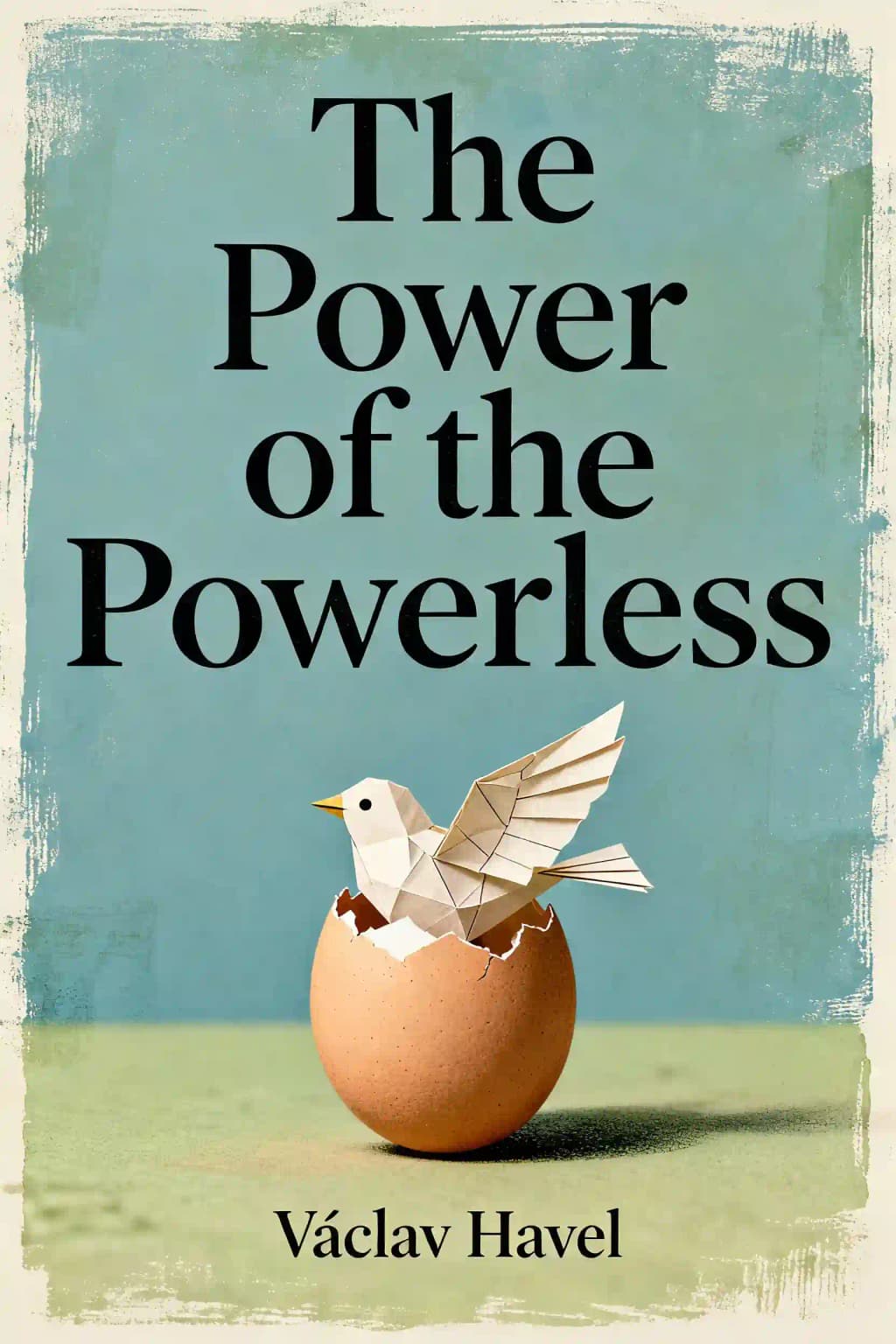
In the heart of Soviet-dominated Eastern Europe, a remarkable document emerged that would shake the foundations of totalitarian power. "The Power of the Powerless" by Vaclav Havel, written in 1978 between the formation of Charter 77 and the birth of Poland's Solidarnosc movement, stands as one of the most penetrating political analyses ever to emerge from behind the Iron Curtain. The essay's impact was immediate and far-reaching-when underground copies reached Polish activists like Zbigniew Bujak, they found in Havel's words the theoretical framework they had been searching for. Havel, who would later become the first president of post-communist Czechoslovakia, crafted not just a critique of Soviet-style totalitarianism but a profound meditation on human dignity that continues to resonate in our contemporary struggles against authoritarianism. What makes this work so enduring is its fundamental insight: that power ultimately rests not in institutions or weapons, but in the willingness of ordinary people to live within lies-and consequently, that the greatest resistance begins with the simple decision to live within truth.
Capítulo 2
The Greengrocer's Dilemma: How Totalitarianism Captures the Soul
Imagine a greengrocer placing a sign among his carrots, potatoes, and onions that reads "Workers of the World, Unite!" Why does he do this? Not from genuine enthusiasm for communist solidarity, but because it's expected. This seemingly trivial act forms the cornerstone of Havel's analysis of what he calls the "post-totalitarian" system-a system that no longer relies primarily on terror and brutal force but on something more insidious: the complicity of its citizens in their own oppression. The sign, mundane as it appears, represents a profound shift in how modern authoritarian systems maintain control.
The greengrocer places the sign in his window not out of belief but to signal his obedience, participating in a complex ritual of social compliance. It communicates: "I know what I must do. I behave as expected. I am beyond reproach." He would never display a sign reading "I am afraid and therefore obedient" because, as a human being with dignity, he would be ashamed. Instead, his expression of loyalty takes the form of an ideological slogan, concealing the true foundations of both his obedience and the system's power behind something seemingly noble. This daily act of small surrender becomes part of the fabric of society, where each citizen becomes both victim and supporter of the system.
This is the genius of ideology in the post-totalitarian system-it offers citizens the illusion of identity, dignity, and morality while making it easier to surrender these very things. It serves as a veil behind which people hide their adaptation to the status quo, an excuse for everyone from the fearful greengrocer to the power-hungry official. The system creates a complex web of social pressure where everyone monitors everyone else, making resistance not just dangerous but socially awkward. The primary function of ideology is creating the appearance that the system harmonizes with the human order and the universe itself, making opposition seem not just illegal but unnatural.
The more complex and established a power system becomes, the more it needs ideology as a bridge between regime and people. In schools, workplaces, and public spaces, ideological conformity becomes the currency of social acceptance. This explains ideology's crucial role in the post-totalitarian system, serving as the all-embracing excuse for its machinery of control. The system requires not fanaticism but passive acceptance-the willingness to "live within a lie." This lie becomes self-perpetuating as each person's small acts of compliance-from hanging posters to attending mandatory meetings to repeating approved phrases-reinforce the system's power. The genius of modern totalitarianism lies not in its use of force but in its ability to make citizens complicit in their own subjugation through these seemingly insignificant daily acts of ideological conformity.
The greengrocer's dilemma illustrates how modern authoritarian systems have evolved beyond mere physical coercion to create a sophisticated mechanism of social control, where each citizen becomes both jailer and prisoner, maintaining the system through their routine acts of compliance and silent acquiescence.
Capítulo 3
Living Within a Lie: The Mechanics of Post-Totalitarian Power
The post-totalitarian system represents a profound departure from classical dictatorships, operating on a scale and complexity previously unseen. It extends across vast power blocs controlled by a dominant superpower, with individual nations functioning as interconnected components within a rigid framework. Each country becomes infiltrated by sophisticated manipulatory instruments - from surveillance networks to propaganda apparatus - that serve the superpower's strategic interests. This external stability is reinforced through two primary mechanisms: nuclear deterrence that maintains global power balance, and the ever-present threat of military intervention against dissenting elements.
The system's durability stems from its historical foundations in legitimate 19th-century proletarian and socialist movements. Unlike temporary dictatorships built purely on force, it claims hereditary legitimacy from authentic social struggles, even though it has completely abandoned their original ideals. This historical connection provides a veneer of authenticity that helps maintain popular acquiescence. The system's ideology functions with mathematical precision, offering a comprehensive worldview that provides ready-made answers to existential, social, and political questions. In an age marked by metaphysical uncertainty and spiritual vacuum, this ideology serves as a secular religion, providing psychological comfort through absolute certainty - but at the devastating cost of surrendering individual reason and conscience to an authority that equates power with truth.
A fundamental tension exists between life's natural tendencies and the system's demands. While human existence naturally gravitates toward plurality, spontaneity, and individual expression, the post-totalitarian structure requires uniformity, predictability, and absolute compliance. Life continuously generates new, unexpected forms and relationships, but the system methodically reduces these to standardized, controllable patterns. This creates an irreconcilable conflict between organic human development and artificial systemic control.
The system's relationship with its citizens is purely instrumental - it serves people only to the extent necessary to ensure their continued service to it. Its primary purpose isn't merely maintaining political power but perpetuating its own mechanical momentum. Individual humans become mere fuel for this vast machine, their personal aspirations and natural social bonds subordinated to systemic requirements. Ideology serves as the crucial bridge between system and individual, creating elaborate justifications that present the system's demands as natural laws of human existence.
This fundamental dishonesty pervades every aspect of post-totalitarian society, creating a comprehensive structure of institutionalized hypocrisy. Democratic governance becomes bureaucratic control; working class subjugation is labeled liberation; censorship is euphemistically termed information management; abuse of power is presented as legal compliance; cultural suppression is called development; and imperial domination is disguised as liberation of the oppressed. To maintain this elaborate fiction, the regime must engage in continuous historical revision, statistical manipulation, and reality distortion, all while maintaining the pretense of respecting human rights and denying any persecution. This creates a society where appearance and reality become increasingly divorced, yet the facade must be maintained through universal participation in the collective lie.
Capítulo 4
The Power of the Powerless: Living Within Truth
What happens when the greengrocer finally snaps? When he stops displaying slogans, stops voting in sham elections, speaks his mind, and shows solidarity with others? In this revolt, he steps out of living within the lie, rediscovers his suppressed identity, and attempts to live within the truth.
The consequences are swift: demotion, reduced pay, evaporated vacation hopes, threatened educational opportunities for his children, harassment. Yet those enforcing these sanctions act not from conviction but from the same systemic pressure that once made the greengrocer display slogans-they're simply components of the post-totalitarian system's automatism.
By breaking the rules, the greengrocer hasn't committed a simple offense but something far more dangerous-he's exposed the system as a mere game, shattered appearances, and demonstrated that living a lie is indeed living a lie. He's shown the emperor is naked, allowing everyone to see behind the curtain and proving it's possible to live within the truth.
The system can only function if the lie is universal; it cannot coexist with truth. Anyone stepping out of line threatens the entire system. As long as appearance isn't confronted with reality, it doesn't seem like appearance. But when the alternative appears, it threatens the very existence of the lie, regardless of how small that alternative might be.
The greengrocer's power isn't physical but illuminating-exposing the system's unstable foundations. This is why living in truth must be suppressed more severely than anything else. The profound crisis of human identity from living within a lie possesses a moral dimension-it appears as a deep moral crisis in society. A person seduced by consumer values, whose identity dissolves in mass civilization's accoutrements, with no roots in the order of being or sense of responsibility beyond personal survival, is demoralized. The system depends on this demoralization.
Living within the truth, as humanity's revolt against an enforced position, attempts to regain control over one's sense of responsibility. It's clearly a moral act, not only because one pays dearly for it, but because it's not self-serving-the risk may bring general improvement or it may not. It's an all-or-nothing gamble not undertaken for utilitarian motives.
Capítulo 5
Charter 77: Truth as Political Action
The most important political event in Czechoslovakia after Husak's 1969 leadership was Charter 77, a watershed moment that emerged from an unexpected source. Its immediate catalyst was the trial of young musicians from "The Plastic People of the Universe," but this represented more than a simple legal proceeding. The trial embodied a fundamental clash between two irreconcilable worldviews: the rigid, bureaucratic puritanism of the post-totalitarian establishment versus the authentic desire of young people to live truthfully, express themselves through their music, and maintain their basic human dignity in the face of oppression.
What made this conflict particularly significant was that these musicians were not dissidents or political activists - they were ordinary citizens who simply refused to participate in the system of compromise and pretense. Their music, influenced by Western rock bands like The Velvet Underground, represented an uncompromising dedication to artistic truth rather than any explicit political agenda. The trial occurred during a pivotal moment when the Czechoslovak society was experiencing what many described as "post-apathy syndrome." After years of resignation following the 1968 Soviet invasion, people were increasingly "tired of being tired" - exhausted not by resistance but by their own acquiescence.
The trial catalyzed an unprecedented unity among previously disconnected groups - intellectuals, artists, workers, and former Communist Party members. This coalition crystallized around the powerful recognition that freedom is fundamentally indivisible - that an attack on alternative culture, even something as seemingly non-political as rock music, constituted an attack on the very possibility of living within truth. This realization would become central to Charter 77's philosophy.
Charter 77's emergence from this cultural conflict demonstrated a crucial insight about post-totalitarian systems: truly significant political movements often originate in the "pre-political" realm, where authentic living confronts systematic dishonesty. Actions become political not through their intended aims but because every genuine expression of freedom inherently threatens a system built on manipulation and control. The formal political articulation of resistance typically develops only after the initial confrontation between truth and power has already occurred.
This pattern was evident in the Prague Spring of 1968, where Communist reformers acted not from theoretical enlightenment but in response to mounting pressure from seemingly non-political spheres of life - literature, theater, everyday social interactions. Charter 77's genesis particularly highlighted how moral choices acquire political significance through their very authenticity. The movement's strength lay in its unprecedented solidarity across social and ideological boundaries, and in its signatories' willingness to speak truth regardless of personal consequences. As the philosopher Jan Patocka, one of Charter 77's first spokespeople, wrote shortly before his death during police interrogation: "There are some things worth suffering for." His words and fate embodied the moral force that gave Charter 77 its enduring political impact.
Capítulo 6
Beyond Traditional Politics: The Limitations of Opposition
In post-totalitarian societies, traditional political life is systematically eliminated and replaced by ritualistic ideological performances. Citizens face complete suppression of public political expression and organization, with even informal gatherings viewed with suspicion. This creates a pervasive atmosphere of fear where people not only lose their opportunity for political participation but also their desire for it. The very concept of independent political thought becomes both unrealistic and potentially dangerous, leading many to retreat into private life.
The system's thoroughness in destroying conventional political structures means that normal channels of dissent - political parties, public debates, independent media - cease to exist. People become conditioned to view politics as merely ceremonial, consisting of mandatory participation in state-organized demonstrations and perfunctory voting in single-candidate elections. This ritualization of political life creates a deep cynicism about political engagement.
Yet even in these hostile conditions, certain individuals maintain their commitment to politics as a vocation. These rare figures continue to think independently and attempt to organize politically, viewing it as an essential part of living within truth. Often working in isolation, they preserve the continuity of political thought through the darkest periods, maintaining intellectual traditions that would otherwise be lost. When genuine political movements eventually emerge from "pre-political" confrontations, these isolated thinkers - these "generals without an army" - provide crucial intellectual foundations and historical perspective to new movements.
However, those political activists who never abandoned traditional political work often demonstrate a crucial blind spot. Having maintained their focus on conventional political opposition, they frequently fail to grasp how fundamentally different the post-totalitarian system is from both democratic and classical dictatorial systems. They continue to apply strategies and concepts from democratic societies without recognizing that the very nature of political action has been transformed. This leads them to overemphasize traditional political work while underestimating the significance of seemingly "pre-political" activities - cultural resistance, informal networks, and living in truth - from which genuine social change actually emerges.
The concept of "opposition" particularly illustrates this confusion. When imported from democratic contexts, where opposition means a legitimate alternative political force competing for power within established rules, the term becomes problematic in post-totalitarian systems. In democracies, opposition parties have recognized rights, can present alternative programs, and participate in open political competition. None of these conditions exist in post-totalitarian societies, where any independent activity is viewed as inherently threatening to the system.
Charter 77 provides a telling example of this conceptual confusion. Its founding declaration explicitly stated it was not an opposition movement, as it offered no alternative political program and sought only to engage in dialogue about human rights. Yet the Czechoslovak government immediately branded it as opposition, revealing how the system defines opposition as any activity that escapes total manipulation and denies the system's absolute claims on individual loyalty. This demonstrates how traditional political concepts become distorted when applied to post-totalitarian contexts, requiring new frameworks for understanding political action and resistance.
Capítulo 7
The Parallel Polis: Building Alternative Structures
If the fundamental purpose of "dissident movements" is serving truth and defending individuals' rights to free and truthful lives, then the most mature stage of this approach is what Vaclav Benda calls "parallel structures." These structures represent a comprehensive alternative to the official system, operating alongside but independent from state institutions.
When those living within the truth are denied influence on existing social structures, they begin creating an independent life of society that naturally develops its own structures. These structures emerge from "dissent" but extend far beyond what that term typically indicates. They encompass parallel forms of education, parallel economies, parallel cultural institutions, and even parallel information networks. For example, underground universities where banned professors taught small groups in private apartments, or samizdat publishing networks that circulated forbidden literature.
Ivan Jirous first formulated the concept of a "second culture" in Czechoslovakia, initially focusing on nonconformist rock music and related artistic events. This included underground concerts, private art exhibitions, and unofficial literary readings. The concept recognizes that appealing to legal codes in post-totalitarian systems has limitations, despite its tactical value. These cultural initiatives became spaces where authentic expression could flourish outside official channels.
The legal code in such systems serves dual purposes: it provides a facade of legitimacy while enabling the manipulation of society. Like ideology, it functions as an excuse that wraps power's base exercise in noble legal language, creating the illusion of justice while concealing reality. For instance, laws protecting "public order" might be used to suppress peaceful gatherings, while "economic crimes" could target independent businesses.
Living within the truth may begin simply-like our greengrocer refusing to display political slogans or vote in false elections. But it can grow into more concrete actions: organizing fellow workers, writing letters about injustice, or sharing unofficial literature. These individual acts of resistance gradually connect with others, forming networks of mutual support and solidarity. Workers might establish unofficial unions, neighbors might create informal childcare networks, or communities might develop alternative supply chains for scarce goods.
The independent life of society emerges from living within the truth as its articulated expression. This spectrum includes self-education through flying universities and reading circles, free creative activity in underground theaters and music scenes, civic attitudes expressed through environmental initiatives and human rights monitoring, and independent social self-organization like mutual aid networks and unofficial religious communities. From this independent life emerge what we call "citizens' initiatives," "dissident movements," or "oppositions"-visible manifestations of a deeper social reality. These parallel structures don't directly confront the regime but rather create spaces where authentic life can flourish, gradually expanding the sphere of freedom within an unfree society.
Capítulo 8
Beyond the Post-Totalitarian System: Toward a New Politics
The post-totalitarian condition, with its absence of normal political life and unforeseeable prospects for change, forces us to examine our situation in deeper terms and consider our future within global, long-range prospects. Our fundamental confrontation with the system occurs at a level far more profound than traditional politics.
Traditional democracies offer no fundamental solution to the crisis of modern civilization. In these systems, citizens enjoy many personal freedoms unknown to us, but they too ultimately fall victim to the same automatism. They cannot defend their identity, prevent their superficialization, or transcend concerns about personal survival to become responsible members of the polis. Western parliamentary democracies, with their professional party apparatuses, complex capital accumulation, and omnipresent dictatorship of consumption and advertising, cannot be imagined as the source of humanity's rediscovery of itself.
As Solzhenitsyn noted in his 1978 Harvard lecture, freedoms not based on personal responsibility are illusory, and traditional democracies chronically fail to oppose violence and totalitarianism. While democracy might be an appropriate transitional solution for Soviet bloc countries to restore civic awareness and political plurality, clinging to traditional parliamentary democracy as one's political ideal would be shortsighted.
Any existential revolution must provide hope for moral reconstitution of society-a radical renewal of our relationship to the human order that no political system can replace. We need a new experience of being, renewed rootedness in the universe, higher responsibility, and transformed relationships with others and the human community.
The political structures emerging from this new spirit should prioritize human factors over formalized relationships. They must rehabilitate values like trust, openness, responsibility, solidarity, and love. These structures should be open, dynamic, and small enough to preserve personal trust and responsibility. They should place no limits on the genesis of different structures and resist any accumulation of power.
Capítulo 9
The Brighter Future: Already Among Us
Do our current "dissident" groups and independent citizens' initiatives already prefigure these "post-democratic" structures? These small communities, bound by shared tribulations, create humanly meaningful political relationships. They are communities more than organizations, motivated by belief in their actions' significance despite lacking external success, joined by solidarity and fraternity rather than formalized ties. From environmental activists to human rights defenders, these groups demonstrate how authentic social bonds can emerge from shared moral commitments rather than institutional mandates.
These groups emerge, live, and disappear under pressure from authentic needs, unburdened by hollow traditions. Their attempts to create an articulate form of "living within the truth" and renew higher responsibility in an apathetic society suggest moral reconstitution. Whether organizing local food cooperatives, independent media outlets, or grassroots political movements, they operate with a flexibility and responsiveness that bureaucratic structures cannot match. Are these informal, non-bureaucratic, dynamic communities that comprise the "parallel polis" rudimentary models of more meaningful "post-democratic" political structures?
Havel experienced how signing Charter 77 immediately creates deeper relationships and powerful feelings of genuine community among virtual strangers-something rare in official structures. This phenomenon manifested in unexpected ways: shared apartments became meeting spaces, underground publications circulated hand-to-hand, and networks of mutual support emerged organically. Perhaps this comes merely from facing a common threat, though the authorities work tirelessly to contaminate these human relationships through infiltration, surveillance, and the spreading of mistrust.
The real question is whether the "brighter future" is really so distant. What if it has been here all along, and only our blindness and weakness have prevented us from seeing it around and within us, and from developing it? We see glimpses of this future in community gardens, citizen journalism initiatives, mutual aid networks, and countless other grassroots efforts that embody authentic democratic participation.
Havel's profound insight remains as relevant today as when he first articulated it: the greatest power lies not in weapons or institutions but in the simple human decision to live within truth. In a world increasingly dominated by sophisticated propaganda, algorithmic manipulation, and "alternative facts," his message reminds us that the most revolutionary act remains the most fundamental-to live as if truth matters, regardless of the consequences. This commitment to truth manifests in countless ways: whistleblowers exposing corruption, journalists pursuing difficult stories, citizens documenting injustice, and ordinary people refusing to participate in systems of deception. For in that simple decision lies the power that no system, however sophisticated, can ultimately withstand. The future Havel envisions is not a utopian dream but a practical possibility emerging wherever people choose to live in truth.