Capítulo 1
When Ordinary People Become Extraordinary Activists
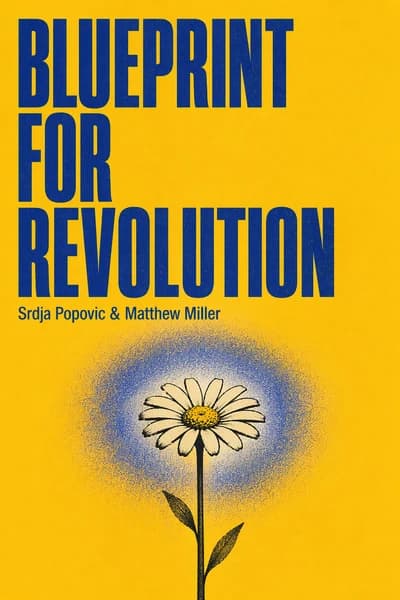
What if the most powerful force for change wasn't found in presidential palaces or corporate boardrooms, but in the hands of ordinary citizens armed with nothing more than creativity and conviction? "Blueprint for Revolution" has become something of a cult classic among activists worldwide, with dog-eared copies passed between organizers from Cairo to Wall Street. When Egyptian protesters toppled Hosni Mubarak in 2011, many carried signs featuring the same clenched fist symbol that had become iconic in Serbia's revolution a decade earlier. The book's author, Srdja Popovic - once a bass guitarist in a punk band - transformed into an unlikely revolutionary consultant after helping to overthrow Serbian dictator Slobodan Milosevic through creative nonviolent resistance. His practical wisdom has since guided activists in over 50 countries, making this perhaps the most influential handbook for peaceful revolution in the 21st century.
Capítulo 2
From Punk Rocker to Revolutionary Strategist
My political awakening began in Belgrade's Republic Square when the punk band Rimtutituki performed anti-war songs from a flatbed truck circling the square. Their provocative lyrics like "If I shoot, then I won't have time to fuck" mocked Milosevic's militarism during Serbia's darkest days. This moment taught me that activism could be cool and effective, not boring or futile.
As Milosevic tightened his grip-refusing election results and seizing control of universities-my friends and I formed Otpor! ("resistance"), creating a black fist logo that we spray-painted across Belgrade. Our branding strategy worked brilliantly; the omnipresent symbol created the impression of a massive movement, attracting curious youth who had to prove their commitment by spray-painting fists themselves before joining.
We committed to nonviolence not just from principle, but practicality-we could never outpunch Milosevic's security forces, but could build a movement so popular he'd have to accept free elections. We also avoided centralized leadership, making us harder to crush when police inevitably targeted us.
When police arrested me near Republic Square in December 1998, they beat me severely and shoved a gun in my mouth. But something unexpected happened: the more they cracked down, the stronger we grew. Getting arrested became a badge of honor-even nerdy kids who were detained found themselves scoring dates with attractive classmates the next day.
Our secret weapon was humor. While movements often cite Gandhi or King as inspiration, Otpor! discovered that laughter effectively fights the fear that fuels dictatorships. We staged comedic street theater, like releasing turkeys wearing white flowers (representing Milosevic's despised wife) in Kragujevac, forcing policemen to chase them while citizens laughed. Once you've seen burly cops chasing turkeys like cartoon characters, you can't fear them anymore.
Capítulo 3
Start Small to Win Big: The Power of Achievable Goals
Have you ever wondered why some movements fizzle while others flourish? The secret often lies not in grand ambitions but in selecting the right initial battles. Consider Israel in 2011, where economic privatization had led to cuts in social programs and a housing crisis. Rather than tackling this entire complex system, an unlikely hero emerged-Itzik Alrov, an ultra-Orthodox insurance salesman and synagogue singer.
Alrov understood that effective activism starts small. He focused on cottage cheese, a beloved Israeli staple that had doubled in price after government subsidies ended. He created a simple Facebook page calling for a boycott, initially attracting just 32 followers. After media coverage, his movement exploded to 100,000 supporters. The dairy companies first ignored, then tried to appease with half-measures, but Israelis held firm until prices dropped to their target of five shekels.
This victory inspired college students to protest housing costs, leading to massive demonstrations and eventual policy changes. The cottage cheese rebellion demonstrated the power of "picking battles big enough to matter, but small enough to win."
Gandhi exemplified this principle with his Salt March in 1930. Recognizing Britain's military superiority made armed conflict futile, Gandhi identified their numerical disadvantage-just 100,000 British soldiers ruling 350 million Indians. To unite these millions, Gandhi needed a simple, universal cause: salt. The British salt tax prevented Indians from freely collecting a life necessity from their own coastlines. Beginning with just 77 followers, by journey's end, 12,000 Indians had joined. The movement spread nationwide, forcing the British to concede rather than use military force against peaceful protesters seeking a biological necessity.
Food makes an ideal rallying point for activism because it transcends political, religious, and racial divides-everyone must eat. The author cites successful food campaigns like teenager Sarah Kavanagh's petition that convinced Gatorade to remove flame retardant chemicals, and bloggers who pressured Kraft to eliminate artificial dyes from macaroni and cheese.
Harvey Milk similarly transformed from a conservative insurance actuary to a gay rights icon by understanding this fundamental principle. After failing twice in San Francisco politics while focusing solely on gay rights, Milk brilliantly pivoted to address something all San Franciscans cared about-dog poop in public parks. In a calculated media stunt, he stepped in dog excrement on camera and promised to solve this universal nuisance. This tactical shift earned him widespread support and eventually helped him win election, proving that activists must first build credibility by delivering results on issues that matter to the broader public before tackling more divisive causes.
Capítulo 4
Creating a Compelling Vision of Tomorrow
What drives people to risk everything for change? Not abstract ideals of freedom or democracy, but a tangible vision of a better life they can almost taste. The Maldives offers a powerful example of this principle in action.
Despite being a tropical paradise known for luxury tourism, the Maldives suffered under Mamoon Abdul Gayoom's brutal 30-year dictatorship. While tourists enjoyed pristine resort islands, the capital Male was an overcrowded, oppressive city of 100,000 residents crammed into two square miles. Gayoom maintained power through brutal police tactics-dissenters were tortured by being covered in honey and left for insects, handcuffed to trees and beaten, or imprisoned in metal sheds on remote islands.
Everything changed when the 2004 Indian Ocean tsunami devastated the Maldives, washing away half the country's economy. Desperate for international aid, Gayoom was forced to accept Western demands to allow political parties and hold genuine elections.
The opposition faced significant challenges: it consisted primarily of foreign-educated dissidents disconnected from ordinary citizens, Islamist groups seeking sharia law, and drug addicts-many deliberately addicted by the regime in prison. The breakthrough came when dissidents organized rice pudding cookouts near Male's artificial beach. This national staple drew hundreds of curious residents, creating community gatherings where people could connect. When police confiscated vats of pudding from these "illegal assemblies," rice pudding became a powerful symbol of resistance.
Maldivian activists found inspiration in "Bringing Down a Dictator," a documentary about Serbia's Otpor! movement. After connecting with CANVAS-the Centre for Applied NonViolent Actions and Strategies-they learned about creating a compelling "vision of tomorrow."
A vision of tomorrow isn't some corporate buzzword but a concrete picture of what people are fighting for. The Serbs had wanted "a normal country with cool music"-a return to the openness they'd experienced under Tito. To help Maldivians create their own vision, CANVAS organized a training session where activists role-played as different sectors of society. Through this exercise, they discovered that people care less about abstract freedoms than basic needs: respect, safety, honest pay. Activist Imran Zahir's boat trip to remote atolls revealed elderly Maldivians sitting catatonic on beaches with no pensions or healthcare-inspiring a platform addressing these concrete needs rather than just opposing torture or censorship.
Capítulo 5
Understanding the Pillars of Power
Every dictator, no matter how fearsome, stands on pillars that can be shaken. When training Syrian activists in a nondescript Mediterranean hotel, I faced skepticism about nonviolent resistance against Assad's exceptional brutality. Many had lost loved ones to government violence and believed only force could remove the dictator.
To convince them, I shared Serbia's struggle against Milosevic, showing images of war and explaining how neither military intervention nor internal opposition had succeeded initially. My colleague Slobodan explained the practical advantages of nonviolence: dictators excel at violence, so attacking them that way means fighting where they're strongest. Additionally, violent campaigns can only utilize physically strong activists, while nonviolent movements can include everyone-grandmothers, professors, poets-building the critical mass needed to topple a regime.
When discussing sanctions, I redirected the Syrians from traditional government-imposed sanctions to creative actions they could take themselves. Using the Four Seasons hotel in Damascus as an example, I showed how targeting luxury establishments frequented by international visitors could pressure businesses connected to Assad's regime. By organizing protests at the hotel chain's headquarters in Western cities, they could force international companies to withdraw from Syria, cutting off revenue streams that funded Assad's military operations.
This approach demonstrates Dr. Gene Sharp's "pillars of support" theory-every regime depends on key institutions and groups to maintain power. No dictator's authority is absolute; it relies on the willing consent of people who follow orders. The activist's task is to disrupt this normal flow by identifying and shaking these pillars. These pillars vary by context-tribal elders in African villages, provincial doctors and teachers in Serbian towns, or stockholders in corporations.
By targeting these support structures rather than confronting the dictator directly, activists can systematically undermine a regime's stability. The Syrians gradually embraced this concept, beginning to see Assad not as an unstoppable force but as a man dependent on economic structures that could be weakened.
Capítulo 6
The Revolutionary Power of Humor
Have you ever noticed how dictators lack a sense of humor? There's a reason for that. Humor serves as a powerful weapon against authoritarian regimes by neutralizing their primary tool: fear. When conventional protest tactics invite predictable police responses, humor creates situations authorities aren't trained to handle.
Consider two protest scenarios in Turkey: a conventional anti-government demonstration that provokes predictable police violence, versus a "kiss protest" where couples simply make out in response to religious authorities condemning public kissing. The latter leaves police confused and powerless-they have no protocol for handling people who are being funny rather than confrontational.
Early in our campaign against Milosevic, we placed a barrel with his face painted on it in Belgrade's main pedestrian area with a sign reading "Smash his face for just a dinar." Initially people hesitated, but soon crowds formed to take swings at the dictator's image. When police arrived, they faced an impossible choice: arrest ordinary citizens enjoying themselves or arrest the barrel itself. They chose the latter, creating an absurd spectacle that undermined the regime's authority. The photographs of police hauling away the barrel made the cover of two opposition newspapers, showing everyone that Milosevic's feared police were really just "comically inept dweebs."
While humor varies culturally, the need to laugh is universal. As Mark Twain said, "The human race has unquestionably one really effective weapon-laughter.... Against the assault of laughter nothing can stand." Good activists, like good comedians, need to know their audience and master timing.
In 1982 Poland, activists in Swidnik protested state propaganda by taking their television sets for walks during the evening news broadcast. Instead of simply turning off their TVs, they placed them in wheelbarrows and strolled around town during the official 7:30 newscast. The government couldn't arrest anyone-there was no law against walking televisions-and could only respond by moving curfew earlier, which failed to stop the movement.
By 1987, Polish resistance escalated their humor with a massive rally ostensibly celebrating the Russian Revolution. Solidarity called on people to "break the passivity of the popular masses" and wear red. The streets filled with citizens in red clothing, shoes, and accessories, creating a spectacle that mocked Communist ideology. Authorities faced a dilemma: how could they break up a rally supporting Communism?
Even in Syria under Assad's brutal regime, activists have deployed humor effectively. They poured red dye into Damascus fountains, creating the appearance of blood while forcing confused police to stand guard helplessly for days. They dropped thousands of Ping-Pong balls inscribed with anti-Assad slogans down steep streets, compelling security forces to chase after them like clowns. They even hid USB speakers playing resistance songs in garbage and manure piles, forcing police to dig through filth to silence them.
Across the globe, activists have found ingenious ways to spread their message with minimal risk. In Sudan, GIRIFNA ("We Are Fed Up") supporters carried oranges everywhere as their symbol against Omar al-Bashir's dictatorship-a perfect low-risk strategy since no one could be arrested for carrying fruit. In Siberia, when authorities repeatedly denied protest permits, activists staged demonstrations with toys-Lego figures, stuffed animals, and action figures holding tiny protest signs-forcing embarrassed officials to declare that "toys are not citizens of Russia."
Capítulo 7
Making Oppression Backfire
What if the very tactics meant to crush your movement could become your greatest strength? In Burma (Myanmar), the military regime made a catastrophic mistake when they violently cracked down on protesting monks in 2007. The gentle monk Ashin Kovida, inspired by a smuggled copy of "Bringing Down the Dictator" about Serbia's Otpor movement, sold his robes to print pamphlets and organized a march of 400 fellow monks. When the army opened fire, killing dozens and imprisoning thousands of monks with harsh sentences, they crossed a line that backfired dramatically. The public's outrage at this violence against revered religious figures sparked what became known as the Saffron Revolution, eventually leading Burma toward democratic reforms.
Oppression isn't some demonic force bubbling from evil hearts-it's a calculated decision. Authorities use it to punish disobedience and prevent future problems by instilling fear. But the ultimate goal isn't fear itself; it's obedience. As Gene Sharp realized, dictators succeed because people choose to obey out of fear.
In Serbia, we neutralized this fear with knowledge-creating detailed "Plan B" preparations for arrests. We documented every step of the process: the tight handcuffs, the vomit-smelling cells, the good cop/bad cop interrogations. We prepared standard answers to their questions about Otpor's leadership and financing. We arranged legal representation and notification systems for families. Soon, prison became less frightening and arrests even became badges of honor, complete with color-coded t-shirts indicating how many times you'd been detained.
From the police perspective, cracking down on Otpor became increasingly uncomfortable. Officers found themselves interrogating students whose humor reminded them of their younger selves, only to receive the same rehearsed, useless answers. Outside the station, crowds sang and chanted, handing flowers to officers. Parents and lawyers flooded the building and phone lines, politely asking "Why are you beating our wonderful children?" Released activists received rock star receptions. Eventually, Serbia's secret police reportedly concluded that each arrest was creating twenty new Otpor members.
In Subotica, a town near the Hungarian border, activists faced a terrifying officer named Ivan-a six-foot-five brute who crushed wrists under his boot and struck protesters with sadistic pleasure. The campaign of public shaming through posters with Ivan's photo in local shops completely changed his behavior. Though he wasn't fired, Ivan was no longer the same man. Living in total social isolation with his wife facing awkwardness at the salon, his children mocked at school, and drinking buddies avoiding him at the local bar, Ivan still showed up to arrest protesters but without the previous brutality.
Beyond tactical responses to individual oppressors, making oppression backfire can serve as a core strategy. When Russia's Vladimir Putin prosecuted Pussy Riot for their cathedral performance of "Punk Prayer," the vindictive 2,800-page indictment and harsh prison sentences transformed an obscure band into worldwide celebrities. The more Putin pushed, the more famous they became, with Madonna supporting them and the remaining members recording songs taunting Putin.
Making oppression backfire relies on simple arithmetic: exercising power comes at a cost, and activists must make that cost rise until opponents can no longer afford it. Even dictators rely on finite resources of manpower, time, and money. Assad's bombing of Syrian cities not only requires funds for weapons and soldiers but destroys his tax base.
Capítulo 8
Unity: The Indispensable Foundation of Success
Why did Belarus's democratic movement fail in 2010 despite years of building pressure against Lukashenko's dictatorship? Nine candidates ran against him, each representing different parties and splinter groups. This atomization of opposition forces confused voters and wasted energy on internal fighting rather than uniting against their common enemy. The result? Lukashenko claimed victory in what appeared to be a relatively free election-the worst possible outcome for democracy advocates.
Unity is both crucial and elusive in nonviolent movements. Dictators like Mubarak intentionally atomize society, making gatherings illegal and preventing coalition-building. But unity faces another fundamental obstacle: the human conviction that we know better than others.
The first tactical unity is message discipline. FEMEN demonstrates both the power and pitfalls of messaging. Initially focused on women's rights with their signature topless protests, they gained media attention for their core cause. But as they expanded to protest everything from public toilets to Barbie dolls to "bloody Islamist regimes," their message became diluted. Contrast this with Otpor!'s laser focus on "He's finished"-a simple slogan that folded all aspirations into one goal.
Beyond message, movements need identity cohesion. When shown photos of Woodstock hippies versus Iraq War protesters, people recognize the former as a movement, the latter as just a protest. The hippies share visible cultural markers, values, and behaviors that transcend location. This unified identity makes movements immediately recognizable and creates belonging beyond single events.
Administrative unity matters too, as Students for a Democratic Society (SDS) painfully learned. Despite explosive growth from 2,500 members in 1964 to 100,000 by 1969, SDS collapsed when it abandoned structured leadership. Their 1969 convention descended into chaos with competing factions distributing literature showing they had almost nothing in common. Without organizational unity, everything falls apart-movements are like airplanes; without a pilot at the controls, they crash.
To ensure unity, use the "line of division" principle-draw a line on paper and see how many people you can include on your side. Harvey Milk won when he focused on quality-of-life issues rather than just gay-specific concerns. Egyptian revolutionaries expanded their religious line of division in 2011 when Muslims and Christians protected each other during prayers in Tahrir Square.
By contrast, Russian anti-Putin protests failed to expand beyond educated, middle-class urbanites, never connecting with ordinary working people from smaller towns who saw the cosmopolitan protesters as unrelatable. Environmental activists like the "Pissed-Off Polar Bears" could be more effective by adapting their message to local concerns-appearing as dried corn cobs in Iowa or starving cattle in Nebraska rather than exotic arctic animals.
Capítulo 9
Strategic Planning: The Roadmap to Victory
Occupy Wall Street failed by naming itself after a tactic rather than an identity like "The 99 Percent," limiting its appeal despite widespread support. The movement made a fundamental error: mass demonstrations should be victory laps, not opening moves. While Egypt's activists organized for two years before occupying Tahrir Square, others mistakenly believed occupation alone was a magical tactic that would deliver results without preparation.
Colonel Bob Helvey, a decorated Vietnam veteran who became Gene Sharp's disciple, teaches the crucial concept of the "goose egg"-your ultimate target. Many movements fail by misidentifying their goose egg, as happened in the Arab Spring when activists focused on toppling dictators rather than establishing democracy. The key to success is "inverse sequence planning"-starting with your imagined goal and working backward to the present. This approach forces you to clarify what you truly want.
By visualizing your ultimate goal in detail, you can work backward to identify the practical steps needed to achieve it. Like imagining being a specific kind of rock star helps clarify which venues to target and audiences to cultivate, movements must break down their dreams into concrete actions. As Churchill said, "However beautiful the strategy, you should occasionally look at the results."
Effective planning requires distinguishing between three levels of action: Grand Strategy (the overall conception coordinating all resources toward objectives), Strategy (the practical distribution of means to achieve objectives), and Tactics (limited, immediate plans that adapt to changing circumstances). These require different mindsets-strategic thinkers plan patiently for the long game while tacticians excel at adapting to immediate circumstances.
The key to success, as demonstrated by Otpor!, is maintaining momentum through escalating actions-following pranks with concerts, concerts with marches, marches with elections, and election fraud with civil disobedience. Like an action movie, movements must constantly move forward to something bigger and more engaging to avoid losing their audience.
Capítulo 10
The Triumph of Nonviolence
Nelson Mandela's journey from nonviolence to armed resistance and back again illustrates how even principled leaders can be driven to violence when facing severe oppression. After his 27-year imprisonment, Mandela refused President Botha's offer of freedom conditioned on rejecting violence, but eventually embraced reconciliation over bloodshed.
Guns create a seductive feeling of power-even in the police officer who shoved his weapon into my mouth during an arrest. Yet when it comes to social change, armed resistance typically fails. Research by Chenoweth and Stephan analyzing 323 conflicts between 1900-2006 found nonviolent campaigns succeeded 53% of the time versus just 26% for violent ones. Nonviolent movements also attract far larger participation and lead to more stable democracies afterward.
Violence triggers tribal instincts that strengthen oppressors, as when some Otpor! members briefly supported Milosevic during NATO bombings. Nonviolent campaigns succeed by pulling pillars of power to their side rather than pushing them down through force. Unarmed protesters appear sympathetic while armed groups alienate potential supporters and blur moral distinctions between oppressors and resisters.
Even carefully planned nonviolent actions can quickly turn ugly without proper discipline. Successful movements must actively maintain discipline through education and preparation. Jim Lawson prepared civil rights activists for lunch counter sit-ins by subjecting them to simulated taunts, spitting, and humiliation so they could remain nonviolent under real provocations. During Otpor! campaigns in Serbia, we placed beautiful girls in the front rows of protests to minimize police violence and create a buffer between officers and rowdy young men. We played music, sang songs honoring the police, and deputized "protest police" volunteers with red ribbons to isolate potential troublemakers.
Defending against provocateurs is crucial-fringe groups from soccer hooligans to anarchists will inevitably try to hijack protests. Italian Occupy activists effectively used social media to identify and distance themselves from Black Bloc members trying to co-opt their demonstrations. This nonviolent discipline works both internally and externally, demonstrating leadership capability and making it easier to gain support from regime officials and international organizations.
Capítulo 11
Ordinary People, Extraordinary Change
The principles of nonviolent activism aren't just for overthrowing dictators-they work just as effectively in suburban America or urban slums. Consider "Kathy," a composite of ordinary American suburban activists who never considered themselves political until facing local injustice. When her city council rezoned land near her children's school for a shopping mall, her initial attempts at engagement-calling officials, writing letters-proved ineffective. Recognizing the pillars of power in her religious community, she enlisted local clergy to pressure the mayor. This strategic move forced the mayor to hold another public hearing where community sentiment overwhelmingly opposed the mall. By identifying power structures, building broad support, and graciously declaring victory when the rezoning was reversed, Kathy demonstrated that effective activism doesn't require overthrowing dictators.
In Kibera, Nairobi's massive slum, residents took collective action when outside efforts failed. Local teenagers with GPS devices mapped the neighborhood, categorizing safety concerns and resources. Using cheap paper maps with tracing paper overlays, residents contributed their knowledge, growing the database to hundreds of data points. With UNICEF support, the project expanded to send safety alerts via text message, helping people avoid crime and violence. This grassroots effort wasn't about overthrowing corruption but creating community resilience.
When movements begin forming, there's rarely outside help available. In Serbia, it took us nearly ten years to realize Otpor! needed to confront Milosevic alone. The politicians failed us, the international community was clueless, and the opposition was disorganized. We had to forge our own "holy trinity" of unity, planning, and nonviolent discipline. Otpor! succeeded through enthusiasm and creativity-characteristics essential for any movement.
While modern technology makes activism more accessible through phones, social networks, and cameras, many successful movements existed before these tools. Media coverage often portrays contemporary activism as mere "Facebook and Twitter revolutions," but this unhealthy obsession with technology misleads people into thinking all that's needed is a Facebook group and leaderless protest. Despite millions of views, the "Kony 2012" video failed to create real change. What truly matters is community and people.
Our world worships the strong and mighty, with magazine covers celebrating the richest businessmen, famous actors, and flashiest cars. This perpetuates the false notion that only elites matter and all change emanates from them. In your activist career, skeptics will either doubt your ability to achieve anything as an individual or claim you must be a puppet of larger forces. In both cases, they're really expressing disbelief in their own power to make a difference.
The most enduring lesson from successful movements worldwide is that lasting change comes not from armies or consultants but from ordinary people like Rosa Parks, Harvey Milk, and Gandhi-revered not because they were special, but because they had the courage to act up and the smarts to do it right.