Capítulo 1
The Symphony of Discovery: Where Science Meets Art
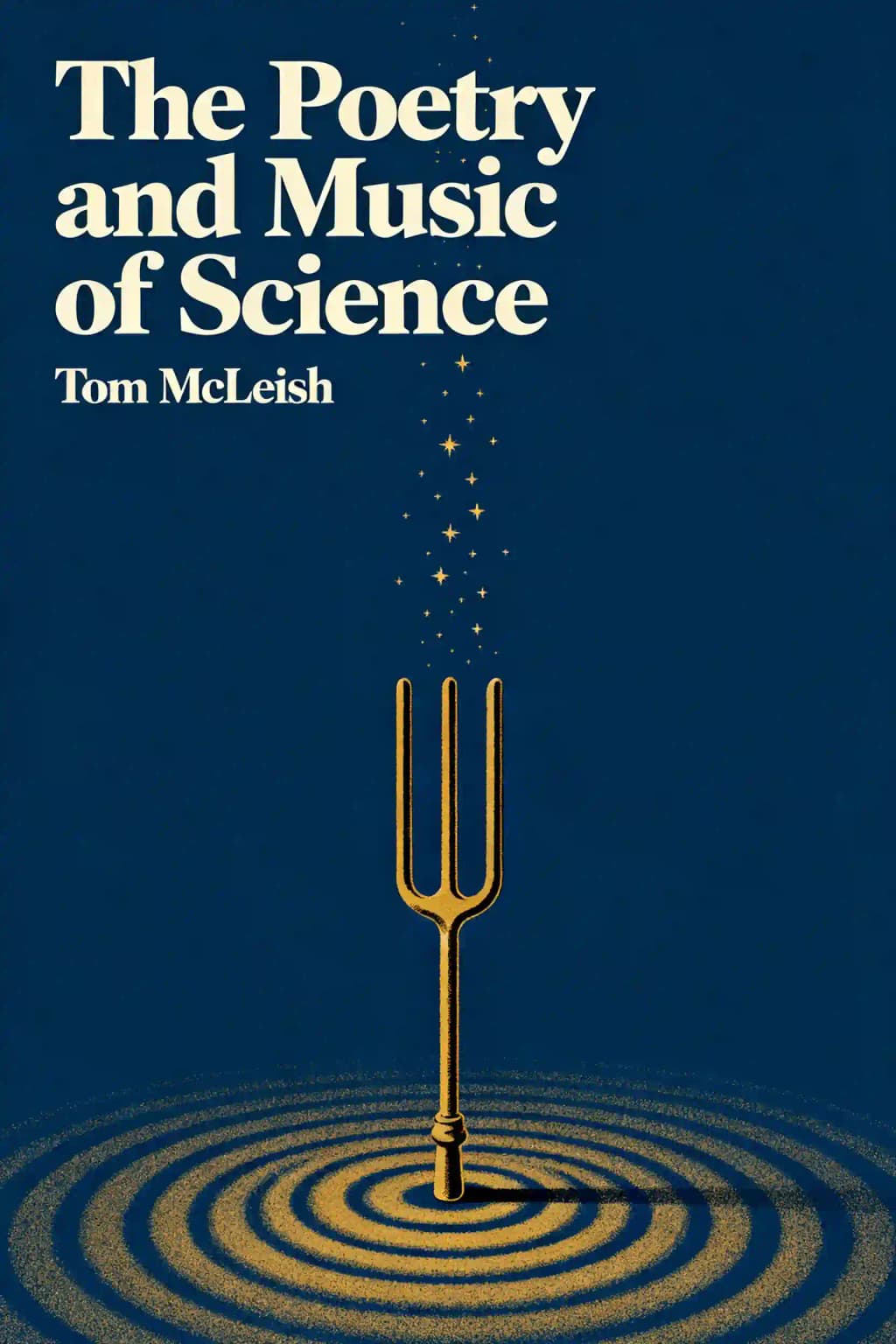
Have you ever wondered why we often see science and art as polar opposites? This false dichotomy has shaped our educational systems, career paths, and even how we understand human creativity. In Tom McLeish's "The Poetry and Music of Science," this artificial boundary crumbles as he reveals the profound creative core shared by scientific inquiry and artistic expression. The book has become a quiet revolution in interdisciplinary thinking, praised by figures from physicist Brian Greene to novelist Marilynne Robinson for bridging C.P. Snow's infamous "two cultures" divide.
McLeish's work arrives at a critical moment when STEM education often neglects the creative aspects of scientific discovery, while arts education sometimes views science as mechanistic and soulless. This cultural relevance has made it required reading in progressive science curricula at institutions like MIT and Stanford, where educators are reimagining how we teach discovery. As Shakespeare once wrote about his muse, science too struggles with inspiration, works against the "sands of time," and creates beauty through constraint - themes McLeish explores with remarkable depth and insight.
Capítulo 2
The Artificial Divide: Reimagining Science as Creative Endeavor
The perceived division between science and art runs deep in our cultural consciousness. We often associate words like "inspiration," "passion," and "composition" exclusively with artistic pursuits, while terms like "experiment," "formulation," and "hypothesis" belong to the scientific realm. But this separation is fundamentally misleading. Both domains engage in imposing order on chaos, seeking patterns and meaning in the world around us.
The philosopher Karl Popper and physicist-novelist C.P. Snow both recognized this artificial barrier of "Two Cultures," warning that it restricts our understanding of human potential. This false dichotomy doesn't just limit our theoretical understanding - it has practical consequences. Children who might excel in science are steered away because they see themselves as "creative types," while the full richness of human experience becomes compartmentalized and diminished.
When artists and scientists engage in honest conversation, the overlap in their creative processes becomes strikingly apparent. William Blake captured this tension beautifully, acknowledging both the mystery of creation and the methodical approach of science. Art thrives within constraints - a sonnet's fourteen lines, a symphony's structure, a painting's frame - finding freedom within boundaries. G.K. Chesterton noted that art isn't about unlimited freedom but about finding richness within limitations.
Science operates similarly, with creativity flourishing within the constraints of natural laws and empirical evidence. The stereotype of science as emotionless and mechanical misses the deeply human aspects of scientific inquiry. Scientists experience the same trials, errors, and moments of inspiration as artists. The difference lies not in the creative process but in the domains to which that creativity is applied.
Capítulo 3
The Muse's Whisper: Inspiration in Scientific Discovery
Shakespeare's Sonnet 100 captures the paradoxical nature of inspiration beautifully. The poet calls upon his absent muse while simultaneously creating the very art he claims requires her presence. This tension between struggle and sublime creation resonates deeply with scientists as well as artists. The muse's song and the skilled pen represent the dual nature of creativity - the flash of inspiration followed by the disciplined craft of execution.
Scientists, too, experience barren periods where ideas seem distant, followed by breakthroughs that appear almost mystical in their arrival. Einstein emphasized that formulating the right question often matters more than solving known problems. New questions fuel advances and underpin paradigm shifts in scientific understanding. The traditional narrative of science often obscures the crucial role of imagination, focusing instead on methodology and verification.
Lawrence Principe and Thomas Kuhn have shown how historical timing and imaginative leaps enrich scientific inquiry. Galileo, Kepler, and Newton exemplify how well-timed questions coincide with revolutionary progress. This interplay of timing and imagination underscores a creative continuity in science throughout history.
The Book of Job reveals that engagement with nature's mysteries has been part of human experience since ancient times. While historical science was intertwined with imaginative art, this unity is often misrepresented as a recent phenomenon. The mutual evolution of literature and science has enriched narrative depth across both domains. Commonly, we associate emotional responses with art and rational analysis with science. Yet experiences like that of physicist Subrahmanyan Chandrasekhar, who described a profound aesthetic response to mathematical representations of black holes, demonstrate the emotional resonance inherent in scientific discovery.
Capítulo 4
Visual Thinking: Science's Hidden Creative Engine
Einstein once remarked that his thought processes were primarily visual and only later translated into words and mathematical symbols. This visual thinking lies at the heart of many scientific breakthroughs. Our brains don't passively receive visual information but actively construct perceptions, projecting meaning onto what we see. The famous "rotating snakes" illusion demonstrates how our minds infer motion from static images, revealing the creative nature of visual perception itself.
In scientific creativity, the visual metaphor is key to understanding complex ideas. "Seeing" equals comprehending, as reflected in everyday language: "I see what you mean." Carl Friedrich Gauss emphasized that geometry relies fundamentally on intuition rather than logic alone. Einstein's theory of relativity emerged from visual contradictions he imagined about the nature of light.
Mathematical physics parallels artistic creation in fascinating ways. Physicists describe forming models through playful manipulation of symbols, similar to artists sketching scenes. Both involve choosing certain parameters and excluding others, creating representations that capture essential features while necessarily simplifying reality. The creative process isn't linear but involves dynamic tension between representation and what is represented.
Medieval thinkers like Robert Grosseteste understood this connection between vision and understanding. Grosseteste's insights into color reveal a mathematical space where perception and mental connectivity intersect. Gregory of Nyssa emphasized the mind's power to see beyond appearances, transforming visual perception into deeper wisdom. Augustine conceptualized knowledge as an extension of vision from sensory perception to intellectual understanding and ultimately to wisdom.
Contemporary collaborations between scientists and artists further illuminate these connections. At the University of Leeds, discussions between physicists and artists revealed striking parallels in their creative processes. Both domains navigate from abstract concepts to material experiments through cycles of rejection, refinement, and resolution. Both rely on visual imagination to bridge non-visual notions with tangible reality.
Capítulo 5
The Narrative Mind: Science and the Art of Storytelling
The dialogue between mathematician Roger Penrose and novelist Ben Okri reveals profound correspondences between mathematical precision and narrative structure. Okri's experience with iterative rewriting parallels the scientific quest for authenticity, with both domains navigating constraints in pursuit of truth. This intersection highlights a mutual commitment to structure in both scientific and literary endeavors.
The 16th and 17th centuries weren't marked by a singular scientific revolution but rather a continuity of intellectual exploration. Figures like Copernicus, Galileo, and Newton radically transformed humanity's cosmological understanding. This era also witnessed the realization of mathematical projects into laws of motion and the birth of robust experimental methods.
During the Enlightenment, fiction and science developed as complementary intellectual pursuits. The early novel stood not just as a companion to scientific endeavor but as its imaginative counterweight, creating landscapes of possibility where scientific rationality found narrative expression. This synergy flourished in centers of commerce and dialogue, weaving dense networks of discourse that enlivened both literary and scientific pursuits.
Isaac Newton's interests transcended physics and mathematics, encompassing theology and alchemy. This rich tapestry of pursuits emphasized a 'vitalist' metaphysics where matter was imbued with life. John Milton's "Paradise Lost" echoes this theme, envisioning living exchanges between celestial bodies. Both Newton and Milton challenged orthodox views, crafting a complex panorama of thought that suggests deeply interwoven connections between literature and science.
The 17th century witnessed a shift from authoritative to personal interpretation in both science and literature. Robert Boyle embodied this spirit, pioneering experimental science and its literary form. He crafted writings that allowed readers to replicate experiments, fostering an educational connection between author and audience. The rise of probability theory, highlighted by Blaise Pascal, complemented this movement, enabling more nuanced understandings of uncertainty and prediction.
Capítulo 6
The Creative Process: From Ideation to Verification
Henry James, the influential nineteenth-century novelist, explored how reflection on writing mirrored scientific investigation in profound and revealing ways. Through his extensive letters and prefaces, he meticulously documented how the creative process in developing novels paralleled scientific endeavors, identifying four crucial stages: ideation, incubation, reflection, and verification. James described moments of inspiration as unpredictable yet powerful forces shaping his novels, noting how seemingly mundane activities, such as strolling through London's bustling streets, allowed fleeting observations of human nature to transform into rich narratives. These "germs of stories," as he called them, often sprouted from glimpses of strangers' interactions or overheard fragments of conversation.
This organic ideation process, blending spontaneous and deliberate insights, mirrors scientific discovery where curiosity leads to unexpected yet foundational ideas. Just as scientists might stumble upon breakthrough insights while contemplating seemingly unrelated phenomena, James found that his most compelling characters and plot developments often emerged from indirect observation and intuitive connections. Ideas for novels, as James revealed through his detailed notebooks, mature through both conscious and unconscious reflections, akin to seeds awaiting proper conditions to germinate. This incubation involves pondering potential developments over time, allowing characters and situations to evolve naturally in the mind, much like the scientific process where hypotheses simmer subconsciously until clarity emerges. James particularly emphasized the importance of this "dormant period," during which ideas cross-pollinate and strengthen.
Illumination embodies the clarity and completeness of thought as fresh insight arrives, often presenting itself as a sudden breakthrough. For James, characters reached a point where they seemed to unfold their own stories, developing personalities and motivations that appeared to exist independently of their creator, as if observed rather than manipulated. He described this phenomenon in "The Art of Fiction" as characters becoming "more real than reality." But he cautiously warned against rushing these insights, noting how over-imposing intention could distort a narrative's natural development. This parallels the scientific method's emphasis on allowing evidence to guide conclusions rather than forcing data to fit preconceived theories. Scientific inquiry mirrors this delicate balance between preconception and openness to unexpected observations, requiring both structured methodology and receptiveness to serendipitous discoveries.
Creativity in both art and science hinges on a delicate balance: imagination thrives under structural constraints, while structure gains vitality through imagination. James demonstrated this through his increasingly complex narrative techniques, particularly in later works like "The Golden Bowl" and "The Wings of the Dove," where innovative storytelling methods were contained within rigorous formal frameworks. Illumination alone cannot sustain creativity without the rigorous discipline of form - a principle James articulated through his famous "house of fiction" metaphor, explaining how storytelling, like architectural integrity, needs clarity and structure to avoid chaos. Similarly, scientific endeavor risks becoming disordered without paradigms to guide exploration, yet these frameworks must remain flexible enough to accommodate new discoveries. James's approach to revision, involving multiple drafts and careful refinement, exemplifies how creative inspiration must be tempered by methodical verification, much like scientific findings require repeated testing and validation.
This synthesis of spontaneity and structure, of inspiration and verification, demonstrates how creative and scientific processes share fundamental patterns of discovery and development, despite their apparent differences in purpose and method.
Capítulo 7
The Mathematical Sublime: Music and Numbers
Mathematics and music share a profound connection that transcends mere analysis. Both fields evoke deep emotional responses through abstract patterns and structures. Mathematician Andrew Wiles exhibited profound emotions after resolving Fermat's Last Theorem, demonstrating how mathematical discovery can evoke joy comparable to artistic experiences.
Viewing music from a distance reveals its geometric and numerical structure, akin to the connectivity of mathematical theories. Numbers persist in music's fabric, from harmonic progressions to unresolved returns, paralleling mathematical narratives. Performance in mathematics, like music, carries aesthetic expressions through the elegant presentation of proofs and theorems.
In the medieval curriculum, music stood among the "quadrivium" alongside astronomy, geometry, and arithmetic. Unlike modern perceptions aligning it with humanities, medieval thinkers saw music as an ordering force over time and space, a reflection of cosmic harmony. Robert Grosseteste glimpsed music's role as connective tissue between disciplines, embracing ratios and proportions that provided guidance to the harmonies in natural elements.
Augustine embraced music not only as an art but as a profound window into human understanding. In "De Musica," he explored how rhythm intertwines with numbers, highlighting music as intrinsic to both sense perception and cognitive direction. This dialogue-driven exploration situated music as a bridge between physical resonance and intellectual comprehension.
Robert Schumann crafted an astonishing array of compositions in a mere decade, from 1841 to 1851. His creative surges shaped and reimagined genres, transforming song cycles and innovating in chamber and symphonic works. Schumann's music arose from binding diverse streams of creativity, striking a balance between literary and musical influences. Facing dualities of constraints and passions, including personal and existential battles, Schumann built harmony and singularity amidst chaos.
Capítulo 8
Emotion and Reason: The Heart of Scientific Creativity
The creative process in science reveals an intricate interplay between emotion and reason, a relationship far more complex than traditionally acknowledged. These dualities parallel cognitive neuroscience's Systems 1 and 2, as described by Daniel Kahneman, highlighting fast, intuitive thinking versus slow, deliberate reasoning. Even Richard Dawkins, renowned for his emphasis on rational inquiry and often cautious about emotion in science, acknowledges that while feelings may differ from pure truth-seeking, they remain instrumental in scientific discovery. This recognition suggests that emotional engagement isn't merely incidental but fundamental to breakthrough thinking.
Medieval philosophy offers profound insights through its exploration of the dynamic interplay between desire (*affectus*) and reason (*aspectus*) in creative processes. Robert Grosseteste, the 13th-century philosopher and scientist, identified the necessity of directed desire for successful rational pursuits, framing intellectual and moral ambitions as fundamentally congruent. His work demonstrated how emotional investment drives sustained intellectual inquiry, comparing the researcher's passion to an archer's aim - both requiring focus and dedication. This dialogue situates creativity within both tangible and abstract domains, intertwining emotional and cognitive revitalization in ways that continue to influence modern understanding of scientific creativity.
The seventeenth and eighteenth centuries marked crucial philosophical shifts, exemplified by Baruch Spinoza's geometric method of rational structuring juxtaposed against David Hume's impassioned skepticism. Spinoza sought to analyze emotions with mathematical precision, while Hume boldly advocated for emotion as an essential guide in truth-seeking. Hume's revolutionary perspective challenged Enlightenment rationality by attributing scientific discovery primarily to passionate inquiry rather than detached analysis. His assertion that "reason is, and ought only to be the slave of the passions" represented a radical departure from contemporary thinking, suggesting that emotional engagement drives rational investigation.
Nobel laureate Leo Esaki's groundbreaking work on electron tunneling provides a compelling modern example of science's dual nature. His published papers present logical, public results, yet his personal accounts reveal an emotional journey powered by imagination, curiosity, and persistence. Esaki's experience, like many others, demonstrates how emotions such as excitement, frustration, and eventual triumph become inextricably linked with scientific discovery. This duality is eloquently captured in Francois Jacob's distinction between "day science" (logical, methodical, public) and "night science" (intuitive, exploratory, private) - a framework that acknowledges both the rational and emotional dimensions of scientific work.
The historical record reveals that even the most celebrated scientists experienced intense emotional engagement during their creative struggles, despite the traditional tendency to sanitize scientific accounts of emotional content. Einstein's famous thought experiments, for instance, were driven by both logical reasoning and emotional investment in the beauty of physical laws. Personal connections with science, often imbued with complex emotions like pride, jealousy, and wonder, fundamentally shape scientific inquiry. While fear of failure or ridicule may deter potential scientists, moments of insight are frequently described as graceful "gifts" rather than merely products of logical deduction. This perspective suggests that scientific creativity emerges from a delicate balance between emotional engagement and rational analysis, with each component essential to the process of discovery.
The contemporary understanding of scientific creativity increasingly recognizes that emotional investment - from the initial spark of curiosity to the satisfaction of discovery - plays a crucial role in sustaining the often lengthy and challenging pursuit of scientific knowledge. This recognition challenges the traditional view of science as a purely rational endeavor and suggests that nurturing both emotional and intellectual aspects of scientific work may be key to fostering innovation and breakthrough thinking.
Capítulo 9
The Unity of Creation: Bridging the Gap
The enduring gap between human consciousness and the world remains a central philosophical concern that has challenged thinkers across generations. Hannah Arendt's exploration of the human condition and Immanuel Kant's epistemological investigations highlight profound themes of alienation and the seemingly insurmountable chasm between human reason and objective reality. Albert Camus, through his concept of the absurd, delves deeper into the human longing for meaning in what appears to be an indifferent universe. This existential tension has driven both philosophical inquiry and artistic expression throughout history.
Kant's groundbreaking proposal of an aesthetic bridge between these realms offers a compelling solution. He suggests that creativity serves as a unique connective force between human understanding and the external world, operating through what he termed the "productive imagination." This faculty allows humans to synthesize sensory experience with conceptual understanding, creating meaningful patterns and relationships that bridge the subjective-objective divide.
The traditional division of "Two Cultures" - as famously articulated by C.P. Snow - between sciences and humanities increasingly appears artificial when examined through this lens. Instead, we find unity in the diverse ways humans engage with reality, whether through scientific observation, artistic interpretation, or philosophical contemplation. These approaches represent different facets of the same human drive to understand and connect with the world. For instance, both a physicist's mathematical model and a poet's metaphor attempt to capture and communicate fundamental truths about reality.
Art and science engage in a sophisticated dance of distance and intimacy, demonstrating complementary approaches to understanding. Scientists must maintain objective distance for analysis while artists often seek intimate engagement with their subjects. Yet both disciplines frequently swap these positions: artists step back to compose and scientists immerse themselves in direct observation. This dynamic interplay reveals the artificial nature of strict disciplinary boundaries.
The interwoven nature of art and science manifests not merely as an intersection of separate domains but as a fundamental unity of human creative endeavor. The visual image (whether in painting or scientific visualization), narrative word (in literature or theoretical explanation), and mathematical measure (in both artistic proportion and scientific calculation) form a powerful trinity that extends human experience toward deeper understanding and potential healing. This unity becomes evident in fields like medical imaging, where scientific measurement and visual artistry combine to enhance human health.
The creative process itself follows a universal narrative that transcends disciplinary boundaries. This journey encompasses distinct yet interconnected stages:
• Vision: The initial spark of possibility
• Desire: The emotional drive to create
• Industry: The disciplined work of creation
• Constraint: The limiting factors that paradoxically enable creativity
• Incubation: The essential period of unconscious processing
• Illumination: The moment of breakthrough
• Verification: The testing and refinement of ideas
• Arrival: The completion and integration of the creative work
Each stage represents an intricate dance between cognition and emotion, where vision and desire fuel the creative process while constraints, rather than merely limiting, actually shape and guide creation toward more innovative solutions. The medieval concepts of aspectus (intellectual perception) and affectus (emotional engagement) offer valuable insight into this duality, suggesting that creativity emerges from the complex interaction between rational understanding and emotional connection.
This unified view of creativity helps explain why breakthrough insights often occur at the intersection of disciplines. When we recognize the fundamental unity of human creative endeavor, we can better appreciate how advances in one field can illuminate others. For example, the visualization techniques developed for scientific imaging have influenced modern art, while artistic principles of composition enhance the communication of scientific data.
Capítulo 10
Creativity as Human Birthright: Beyond Disciplinary Boundaries
The journey of creativity interlaces art, science, and philosophy, driven by a quest to unveil hidden structures of the world. From medieval visions of regained divine knowledge to modern scientific inquiry, human ingenuity has sought to understand nature's mysteries. Marie Curie's invocation to understand rather than fear reflects the enduring human drive to dispel ignorance through knowledge.
Biblical inspiration, particularly from the Book of Job, illuminates the shared human and divine capacity for deep insight, urging responsible, awe-inspired engagement with nature. This enduring narrative acknowledges humanity's discomfort with worldly imperfections, probing a relentless pursuit of understanding what "is" versus what "ought to be."
The artificial separation between scientific and artistic creativity has impoverished our understanding of human potential. By recognizing the shared wellsprings of creativity across disciplines, we can nurture more holistic approaches to education, innovation, and cultural development. Children should not be forced to choose between being "scientific" or "creative" - these capacities coexist and reinforce each other.
As we face complex global challenges requiring both analytical rigor and imaginative solutions, this integrated understanding of creativity becomes increasingly vital. The poetry and music of science aren't metaphorical flourishes but essential aspects of scientific discovery itself. Similarly, the precision and structure within artistic creation mirror scientific methodology in profound ways.
By embracing this unified view of human creativity, we honor the full spectrum of human potential and open new pathways for discovery and expression. The greatest scientists have always been artists at heart, and the most profound artists have embodied the precision and observation of scientists. In this recognition lies the potential for a more integrated, creative approach to addressing humanity's most pressing questions.