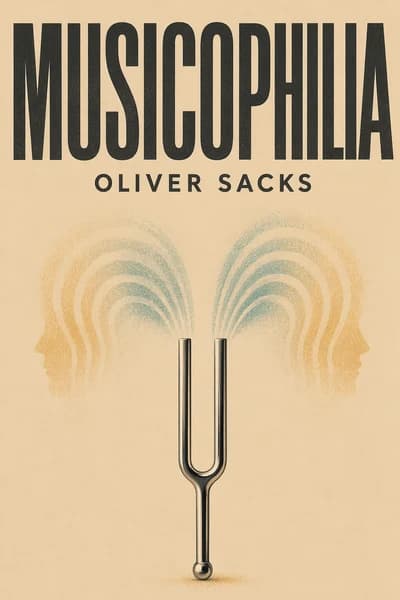
Musicophilia
Tales of Music and the Brain
Resumen de Musicophilia
In "Musicophilia," renowned neurologist Oliver Sacks explores the mysterious relationship between music and the brain. When lightning struck Tony Cicoria, he inexplicably became obsessed with piano - just one of many mind-bending cases revealing how music can both heal neurological disorders and reshape our minds.

Temas clave en Musicophilia
- neurological music processing
- musical hallucinations
- brain injury recovery
- auditory imagery
- music therapy
Citas de Musicophilia
Music occupies more of our brain than language does—almost every neural subsystem we have is involved.
Music can move us to the heights or depths of emotion.
What happens when music hijacks the brain?
Musical capacities may lie dormant in all of us, waiting for the right-or wrong-neural circumstances to emerge.
Personajes en Musicophilia
- Oliver SacksNeurologist and author who explores music's power
- Tony CicoriaSurgeon who developed a musical obsession
- Mrs. O'CElderly woman experiencing musical hallucinations
Sobre el Autor
Sobre el autor de Musicophilia
Oliver Sacks, the renowned neurologist and bestselling author of Musicophilia: Tales of Music and the Brain, combined his clinical expertise with a storyteller’s flair to explore the profound relationship between music and the human brain. A graduate of Oxford University, Sacks became celebrated for his case-study-driven narratives that bridge neuroscience and humanity, as seen in his iconic works like The Man Who Mistook His Wife for a Hat and Awakenings—the latter adapted into an Oscar-nominated film.
His writing, frequently featured in The New York Times, delves into neurological mysteries with empathy and scientific rigor. Musicophilia, a cornerstone of neuropsychology literature, examines conditions like musical hallucinations, perfect pitch, and musicogenic epilepsy, blending patient stories with insights into brain plasticity.
Sacks’ other notable books, including Hallucinations and An Anthropologist on Mars, further cement his legacy in making complex neurological concepts accessible. His works have been translated into over 25 languages and adapted into plays, operas, and films, solidifying his global influence. Awakenings alone has inspired generations of medical and literary audiences since its 1973 publication.
Descargar resumen de Musicophilia
Obtén el resumen de Musicophilia como PDF o EPUB gratis. Imprímelo o léelo sin conexión en cualquier momento.
Preguntas Frecuentes Sobre Este Libro
Musicophilia explores the profound relationship between music and the human brain through case studies of individuals with neurological conditions. Oliver Sacks examines how music can trigger recovery in Parkinson’s patients, unlock creativity after brain trauma, or cause hallucinations, emphasizing its universal yet mysterious role in human cognition and emotion.
This book is ideal for music enthusiasts, neuroscience students, and general readers intrigued by how art intersects with biology. Clinicians and therapists will also find insights into music’s therapeutic potential for conditions like Alzheimer’s, PTSD, and stroke recovery.
Yes—Sacks combines scientific rigor with storytelling, making complex neurology accessible. The book’s blend of case studies (like a lightning-strike victim turned pianist) and analysis of music’s cognitive impact has earned praise for its depth and readability, offering fresh perspectives for casual and academic audiences alike.
Sacks describes cases like Tony Cicoria, who developed an intense passion for piano after a lightning strike. He theorizes brain trauma may disrupt inhibitory circuits, unleashing latent creative pathways in the right hemisphere—a phenomenon termed “sudden musicophilia”.
The book explores:
- Amusia: Inability to perceive music (e.g., patients hearing symphonies as “clattering pots”).
- Musical hallucinations: Phantom songs caused by hearing loss or brain damage.
- Parkinson’s and Alzheimer’s: Music’s role in restoring movement or memory.
Yes—Sacks details how rhythmic music temporarily “unfreezes” Parkinson’s patients, enabling coordinated movement. This aligns with therapies using metronomes or dance to bypass damaged neural pathways.
Sacks profiles individuals with extraordinary musical abilities despite cognitive disabilities, such as blind pianists with perfect pitch or autism-spectrum prodigies. He links these skills to heightened right-brain activity compensating for deficits elsewhere.
The book describes patients involuntarily “hearing” songs due to auditory deprivation or brain lesions. Sacks explains these hallucinations as the brain attempting to fill sensory voids, often tied to memory networks.
Some scholars note Sacks prioritizes anecdotal cases over systematic data. However, his narrative approach is widely praised for humanizing neurology and inspiring further research into music’s therapeutic applications.
Like The Man Who Mistook His Wife for a Hat, this book uses patient stories to explore neurodiversity. However, Musicophilia specifically highlights music’s unique power to heal, disrupt, and define human experience.
Sacks discusses amnesiacs like Clive Wearing, who retained musical memory despite losing all other recall. This underscores music’s deep ties to emotional and procedural memory systems bypassing damaged hippocampal regions.
As music therapy gains clinical traction, Sacks’ work remains foundational for understanding its scientific basis. The book also addresses modern issues like earworms and sensory overload, linking them to brain plasticity and auditory processing.