Capítulo 1
The Art of Detecting Deception: Why Bullshit Matters More Than You Think
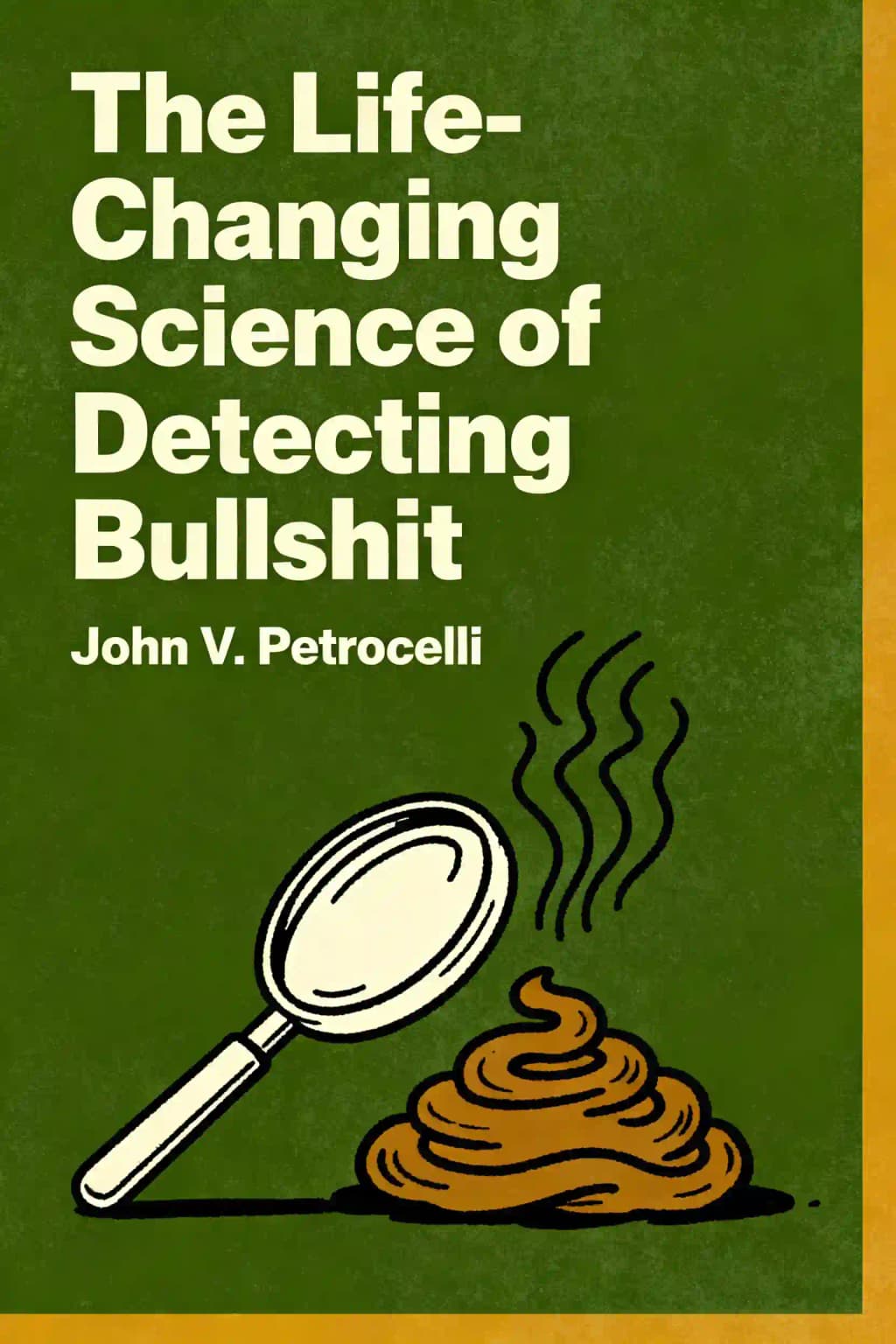
In a world increasingly saturated with misinformation, John V. Petrocelli's "The Life-Changing Science of Detecting Bullshit" arrives as a cultural necessity. This provocative work has quickly become required reading in top business schools and psychology programs across the country, with Bill Gates naming it one of his "5 Books That Made Me Think Differently" in 2022. The book's unexpected popularity stems from its practical approach to a universal problem: how easily we're all deceived by information that sounds plausible but lacks evidential foundation. Petrocelli, a Wake Forest University experimental social psychologist, doesn't just theorize-he provides actionable tools for navigating our post-truth landscape. As former President Barack Obama noted after reading the book, "The ability to distinguish fact from fiction might be the most important skill Americans need today." Whether you're making financial decisions, evaluating health claims, or simply scrolling through social media, this book reveals why we fall for bullshit and, more importantly, how we can train ourselves to spot it before it costs us dearly.
Capítulo 2
Understanding Bullshit: More Than Just Lies
Bullshit isn't simply lying-it's something potentially more dangerous. According to philosopher Harry Frankfurt, whose seminal 1986 essay "On Bullshit" inspired Petrocelli's research, bullshitting involves communicating with little to no concern for truth, evidence, or established knowledge. Unlike liars who deliberately hide known truths, bullshitters often believe their own claims, freeing them from the cognitive burden of remembering falsehoods. This self-conviction makes them particularly persuasive and harder to challenge.
The degree to which something qualifies as bullshit is inversely proportional to its basis in truth and evidence. When people disregard established knowledge-whether semantic (dictionary definitions), logical (rules of reasoning), systematic (mathematical principles), or empirical (observable data)-they're engaging in bullshit communication. For instance, when someone claims "studies show" without citing specific research, or uses scientific-sounding language without understanding the underlying concepts, they're engaging in what Petrocelli calls "pseudo-profound bullshit."
Consider the used-car dealer who hasn't investigated a vehicle's history but makes confident claims about its condition. He's not necessarily lying about known problems; he's bullshitting by making assertions without evidence. Similarly, a financial advisor who recommends investments without researching market conditions, or a politician who makes sweeping promises without feasibility studies, are classic examples of bullshitting in action. This distinction explains our different emotional reactions: lies provoke anger and serious consequences, while bullshit is often overlooked despite potentially greater impact. Ironically, while lies might get someone fired, effective bullshitting might lead to promotion or even presidency.
The most impactful bullshitters aren't distant figures but those closest to us-friends, family, and trusted associates. When people we personally know repeat the same unfounded claims we might hear from paid television analysts, it tends to have significantly more influence on our thinking. This "proximity effect" makes social media particularly dangerous, as it amplifies bullshit through trusted personal networks.
To categorize bullshit by potential harm, Petrocelli introduces the "Bullshit Flies Index": one fly for harmless bullshit causing mere eye-rolling (like exaggerated fishing stories), two flies for bad bullshit leading to undesirable behaviors (such as fad diet claims), and three flies for dangerous bullshit resulting in harmful decisions (like anti-vaccination propaganda or financial scams). The severity depends entirely on the potential consequences when the bullshit is wrong. This classification system helps identify which forms of bullshit deserve immediate attention and which can be safely ignored.
The proliferation of bullshit in the digital age has created what Petrocelli terms "bullshit cascades," where misinformation spreads exponentially through social networks, gaining credibility through repetition rather than verification. Understanding these mechanisms is crucial for developing effective countermeasures against the spread of harmful bullshit in both personal and professional contexts.
Capítulo 3
The Hidden Costs of Bullshit: From Wine Tasting to Mass Starvation
Bullshit carries enormous costs-financial, psychological, and sometimes even fatal. The wine industry exemplifies how bullshit affects consumer decisions. Robert Hodgson, a retired statistics professor and winery owner, discovered that wine competition medals appeared to be awarded almost randomly, with each wine having roughly a 9% chance of winning gold regardless of quality. In his experiments with blindfolded wine experts, judges' ratings of identical wines varied by an average of 4 points, with only 10% able to consistently rate wines within a 2-point range. More shockingly, when Frederic Brochet gave 54 wine experts a white wine colored with food dye, they all described it using typical red wine terminology-never detecting they were drinking disguised white wine.
This phenomenon extends far beyond wine. "Bullshit markups" occur when products carry prices far exceeding reasonable profit margins-like restaurant wine's 400% markup or soda's outrageous 1,000% markup. Confidence tricks cost US consumers over $800 million yearly, with average losses of $6,000 per complaint.
People pay these markups for three key psychological reasons. First, they sometimes prefer bullshit over truth when it aligns with their worldview. Second, "hearing is believing"-humans naturally accept information as true initially before critically evaluating it. Daniel Gilbert's research demonstrates that accepting information aids comprehension, while rejecting falsehoods requires mental effort that can be derailed by distractions. Third, we rely heavily on intuition over evidence-based reasoning, making judgments we can't explain and favoring quick thinking over formal reasoning.
Consider the Myers-Briggs Type Indicator (MBTI), completed by 2.5 million people annually and used by 89 Fortune 100 companies. Despite generating at least $125 million yearly, it lacks scientific validity. Originally created as a parlor game by Katharine Cook Briggs and her daughter Isabel (neither were psychologists), the MBTI is notoriously unreliable-the same person often gets different results on different days. It merely repackages self-reported information into eloquent language while ignoring context, which psychological research shows is crucial for predicting behavior.
The psychological costs of bullshit are equally devastating. Repeated exposure to false claims creates "illusions of truth"-we begin believing statements simply because we've heard them before. Research by Lisa Fazio shows that even when we possess knowledge contradicting false statements, we're more likely to believe them after previous exposure.
The most extreme example of bullshit's deadly consequences is Mao Zedong's Great Leap Forward (1958-1962), which resulted in approximately 36 million deaths-six times the Holocaust's toll. When Mao declared war on "four pests" including sparrows, millions of Chinese citizens participated in their extermination, killing over 4.3 million birds believed to each consume four pounds of grain annually. This ecological intervention backfired catastrophically-without sparrows to control crop-eating insects, their populations exploded, devastating grain fields and triggering the Great Chinese Famine.
Capítulo 4
Why We Fall for Bullshit: The Psychology of Bullibility
"Bullibility"-a combination of "bull" and "gullible"-describes our natural tendency to accept bullshit as fact by failing to recognize when someone disregards truth. This explains how Bernard Madoff perpetrated the largest fraud in US history. Despite being a respected financial industry veteran and former NASDAQ chairman, Madoff operated a massive Ponzi scheme that collapsed in 2008 when investors requested $7 billion in returns while he only had $300 million remaining.
Even sophisticated, intelligent investors fell victim, including Jerome Fisher (founder of Nine West shoes), Robert Chew (who invested his family's life savings), and remarkably, Stephen Greenspan (a psychology professor who specialized in studying gullibility). They ignored red flags like impossibly consistent returns, lack of independent oversight, opaque investment strategies, and excessive secrecy.
Everyone is susceptible to bullshit, despite believing they can detect it. Our bullibility stems from four key factors:
1. Personal factors: Personality affects bullibility, but everyone is vulnerable. Bertram Forer's 1949 study demonstrated this when participants rated generic personality statements as highly accurate descriptions of themselves-the "Barnum effect." Highly agreeable people may be particularly susceptible, as demonstrated in Laurent Begue's replication of Milgram's obedience studies, where agreeable participants were most likely to continue delivering "painful shocks" when instructed.
2. Contextual factors: Situations powerfully influence our vulnerability. Langer's copy machine study revealed how easily people comply with requests accompanied by reasons-even meaningless ones. When experimenters asked to cut in line with no reason, compliance was 60%. But adding "because I'm in a rush" or the placebic "because I have to make copies" increased compliance to 94% and 93% respectively!
3. Cognitive factors: Our thinking patterns dramatically influence our susceptibility. A critical error is confusing argument with evidence-while arguments explain theories, only evidence provides verification through systematic observation. Deanna Kuhn found only 16% of people generate genuine evidence when asked, with most offering mere arguments or "pseudoevidence." Familiarity breeds belief-the easier something is to imagine or recall, the more likely we'll believe it's true.
4. Emotional factors: Our emotional states significantly impact our ability to detect bullshit. Joseph Forgas demonstrated this by manipulating participants' moods before having them evaluate truthfulness in interrogation videos. Happy participants made more errors in detecting deception, while sad participants showed increased skepticism and accuracy. This happens because mood affects what memories we recall and how thoroughly we process information.
Sometimes people are bullible because they actively prefer bullshit over truth. Our fundamental social motivations-the need to belong, maintain consistency, and feel justified-can override our commitment to accuracy. Solomon Asch's conformity experiments dramatically illustrate this tendency. When faced with a simple line-matching task, 76% of participants gave obviously wrong answers just to conform with confederates who deliberately answered incorrectly.
Capítulo 5
When and Why People Bullshit: The Perfect Storm
Understanding when and why people bullshit helps us position ourselves against its unwanted effects. Harry Frankfurt theorized that bullshit emerges when people feel obligated to speak on topics they know little about. Petrocelli's Bullshit Studies Lab at Wake Forest University tested this with an experiment where participants explained why a fictional candidate named Jim withdrew from a city council race. The results confirmed Frankfurt's theory: participants who felt obligated to provide opinions bullshitted nearly twice as much (44%) as unobligated participants (24%).
Surprisingly, knowledge level had minimal impact-those with some knowledge of Jim's character produced similar bullshit percentages (33%) to those with no knowledge (36%). The obligation to speak, not ignorance alone, drives bullshit production.
Frankfurt also theorized that bullshitters are "trying to get away with something." Experiments confirmed this-people bullshit more when they believe they won't be caught. When participants thought their explanations would be evaluated by people who didn't know Jim, their bullshit percentage was significantly higher (41%) than when they believed knowledgeable evaluators would review their responses (29%).
Both situational factors (in one's context or social environment) and person factors (specific to individuals) influence whether someone feels obligated to provide an opinion and how easy it is to get away with bullshit:
1. Social expectations to know everything: Implicit social pressures create obligations to have opinions, even when they're bullshit. In our 24-hour news cycle world, we expect ourselves and others to have opinions about everything. Experts rarely admit "I don't know" because their identities are at risk.
2. Accountability: Accountability-having to answer for one's actions or beliefs-typically improves decision quality by discouraging bullshit-based reasoning. When participants were told they'd need to explain their opinions to a sociology professor, they produced significantly less bullshit compared to those without accountability.
3. Bullshit contagion: When participants believed the evaluating professor shared their views, they bullshitted just as much as under no-accountability conditions. However, when participants either didn't know the professor's attitudes or believed they differed, bullshitting decreased significantly. This reveals that accountability only reduces bullshit when people expect their claims to be critically evaluated by someone who might disagree with them.
People most likely to bullshit are motivated by avoiding embarrassment, making positive impressions, avoiding judgment, gaining advantages, or escaping punishment. These high-propensity bullshitters show chronic disregard for evidence, unlike those with high need for evidence who maintain healthy skepticism. When presented with contradictory facts, bullshitters respond irrationally or fabricate data "only they have access to."
Capítulo 6
The Tactics of Bullshit Artists: How They Operate
Bullshit artists employ common influence tactics but use them more frequently and with greater skill than most people. Understanding these tactics can significantly improve your bullshit detection abilities:
1. Completely disregard evidence that disproves the claim: Effective bullshit artists actively dismiss or ignore evidence that contradicts their claims. Dr. Douglas Biklen, who introduced facilitated communication for nonverbal autistic individuals, continued promoting this pseudoscientific practice for over 30 years despite dozens of controlled studies showing it failed completely. When confronted with scientific evidence, he dismissed it with excuses about "confrontational situations" and anxiety affecting results.
2. Focus attention on unreliable, anecdotal evidence: Bullshit artists rely heavily on anecdotal evidence and compelling stories that distract from relevant data. Stories about apparent psychic connections or miraculous cures are more memorable than statistics. As Michael Shermer explains, we need controlled experiments, not anecdotes about Aunt Mary's cancer being cured by Marx Brothers movies.
3. Use pseudo-profundity: This is the art of sounding deep while saying nothing of substance. Deepak Chopra exemplifies this tactic with tweets like "Attention and intention are the mechanics of manifestation." His statements sound profound but fail the "unclarifiable unclarity test"-if reversed, they make no meaningful difference. Corporate gibberish is another form of pseudo-profundity, filled with ambiguous language like "leverage," "value add," and "synergy."
4. Exaggerate levels of credibility: Bullshit artists artificially inflate their expertise through various credibility-boosting tactics. Barbara Arrowsmith-Young presents herself as the foremost authority on learning disabilities despite lacking scientific evidence for her $24,000 program that claims to "build stronger brains." She bolsters her credentials by mentioning her degrees and name-dropping neuropsychologists, while avoiding mention that no controlled studies support her claims.
5. Engage in unsubstantiated character building and assassination: Bullshit artists not only exaggerate their own credentials but also engage in evidence-free character building for allies and character assassination for critics. Donald Trump exemplified this tactic with multiple advisors: praising Steve Bannon as "a brilliant tactician" when appointing him, then claiming "he lost his mind" after firing him.
6. Appeal to interpersonal relationships: Pharmaceutical sales director Lance Murphy exemplifies how interpersonal relationships facilitate bullshitting. With his charismatic personality and practiced communication skills, Murphy builds trust with doctors to sell his oncology medications. "I focus on the relationship. If the interpersonal relationship is good-if there is trust and a freeness to talk about anything-yes, there might be more bullshit involved," Murphy admits.
Capítulo 7
Your Bullshit Detection Wheelhouse: Practical Tools for Skeptics
To effectively detect bullshit, we need more than common sense, which often presents contradictions. Critical thinking-a learned process of deliberation, fact-finding, and self-reflection-is essential for evaluating information properly.
The bullshit detection wheelhouse requires developing two key habits: an attitude of skepticism and a practice of questioning, following the Royal Society's motto "nullius in verba" (take nobody's word for it). You don't need to ask every possible question when suspecting bullshit-just a few well-chosen ones can help assess claims and prompt diagnostic follow-ups.
When questioning potential bullshitters, use a structure of "What? How? (not Why?) And Have you considered...?" This approach forces bullshitters to clarify claims and provide evidence rather than theoretical arguments. Having "control data" about how someone normally communicates helps establish a baseline for detecting unusual patterns that might signal bullshitting.
Four categories of self-reflective questions can help detect bullshit:
1. Clarify the claim by identifying precisely what's being claimed, underlying assumptions, unfair comparisons, and whether extraordinary claims have extraordinary evidence.
2. Assess the communicator's credibility, expertise, willingness to engage critically, motivation, and rhetorical signs of bullshit like vague attributions or defensive responses.
3. Evaluate the claim by examining plausible reasons, strength of evidence, potential problems, omitted information, and possible thought experiments.
4. Assess yourself by questioning whether your conclusions are evidence-based, if you've sought additional information, if personal biases affect your judgment, and what implications accepting or rejecting the claim might have on your other beliefs.
When bullshitters use numbers and statistics, they typically exploit them in misleading ways. Ask four key questions: Are the numbers plausible? Are the descriptive statistics consistent with the claim? How were the numbers collected? What are the probabilities of the numbers reported?
Linguistic patterns can reveal when someone isn't concerned with truth. Research shows bullshitters tend to produce more words overall and rely heavily on sense-related words (seeing, touching, hearing). They shift focus away from themselves by using fewer self-oriented pronouns (I, me) and more other-oriented pronouns (you) and third-person identifiers. Red flag phrases include "My gut tells me," "Trust me," "What if I told you," and sweeping generalizations without evidence.
Capítulo 8
Learning from Expert Bullshit Detectors: Wisdom from the Trenches
Some people are rarely fooled by bullshit. These expert bullshit detectors have developed specialized knowledge through years of experience that makes it difficult for others to deceive them. Their expertise comes not just from book learning, but from thousands of interactions where they've encountered and decoded various forms of deception.
Curtis Baker, an automobile enthusiast with twenty years of experience buying and selling cars, explains that car dealers often "bullshit by omission"-not sharing critical information about potential expensive repairs. His approach involves thorough research: checking online forums for common problems with specific models, developing multiple options, and calculating a car's true value beyond monthly payments. Baker focuses on discovering a vehicle's true value by considering maintenance costs, risks, interest payments, insurance costs, and depreciation rather than just monthly payments. He recommends creating a five-year cost projection for any vehicle purchase and always getting an independent mechanical inspection. Baker notes that dealers often hide problems by scheduling test drives when engines are pre-warmed and using temporary fixes for transmission issues.
Tim Terry, a master jeweler with over 40 years experience, advises never taking your fiancee-to-be diamond shopping, as jewelers target the wearer rather than the buyer, doubling your expected costs. Terry exposes the diamond industry's fabricated scarcity myth perpetuated by De Beers since the 1940s, noting that diamonds actually lose over 50% of their value once purchased. Lab-grown diamonds, chemically identical to natural ones but 30% cheaper, reveal the industry's inflated pricing. He shares specific tactics jewelers use, such as strategic lighting to enhance stone brilliance, emotional manipulation through romance-focused sales pitches, and the deliberate confusion of technical terms to justify higher prices. Terry recommends focusing on cut quality over size and suggests considering alternative stones that offer better value.
Christina Pryce, a real estate expert with fifteen years in the market, emphasizes that coded language in real estate is primarily for other agents, not buyers. Terms like "beautiful," "turnkey," and "spacious" sell properties while words like "cozy" (small), "custom" (weird features), or "TLC" (needs work) signal problems to industry insiders. She's developed a comprehensive list of these code words and their true meanings. To help overwhelmed clients make decisions, she recommends using a weighted additive model spreadsheet that ranks home features by importance and systematically evaluates properties against their priorities. Pryce also teaches clients to look for subtle signs of problems, such as fresh paint in isolated areas, new carpet in single rooms, or recent repairs that might indicate larger issues.
Expert bullshit detectors engage in five critical thinking skills: interpretation, analysis, evaluation, inference, and self-regulation. They ask probing questions about claims, examine evidence quality, consider alternative explanations, connect information to draw reasonable conclusions, and assess their own biases. Unlike average people, experts use different standards of comparison and reference points, looking beyond what captures everyone else's attention. They maintain detailed records of their experiences, regularly update their knowledge through industry publications and peer networks, and often develop systematic approaches to evaluation that can be taught to others. These experts also emphasize the importance of emotional distance when making decisions, noting that the best deals often come when you're willing to walk away.
Capítulo 9
Creating a Life Without Bullshit: A New Communication Climate
The science of detecting bullshit may not transform society broadly, but it can fundamentally change individual lives. By cultivating a critical mindset and embracing inquisitive questioning, we awaken our inner scientists. If enough people collectively stand against bullshit, we could create a world based on evidence-based communication and reasoning rather than baseless arguments and incompetent authority.
To create an anti-bullshit culture, follow these guidelines:
1. Become comfortable using the term "bullshit" if we're going to effectively call it out. The discomfort and humor around the word actually make it harder to identify bullshit when we encounter it.
2. When calling out bullshit, follow six key rules: (a) Only call bullshit when you're certain it is bullshit; (b) Be considerate and consider you might be confused; (c) Attack the claim, not the person; (d) Allow bullshitters to restate claims or acknowledge reasoning errors; (e) Admit your own bullshit when caught-don't double down; and (f) Offer evidence-based reasoning rather than countering bullshit with more bullshit.
3. Treat bullshit like lies-as false until proven otherwise. Research shows people judge liars more harshly than bullshitters, creating vulnerability as we're more likely to misremember bullshit as true simply through exposure.
4. Make calling out bullshit contagious by changing social norms. People are influenced through normative social influence (conforming to be accepted) and informational social influence (believing what others say is true). By refusing to accept bullshit, we can promote critical thinking and evidence-based communication.
5. Rather than directly confronting bullshitters with evidence, model critical thinking yourself. Getting them to ask "What am I really saying?" and "How do I know this to be true?" can nudge them toward evidence-based reasoning. Self-discovered inconsistencies motivate change far better than external counterarguments.
6. Cultivate intellectual humility-recognizing our knowledge is limited and our beliefs might be wrong. When we're not expected to have opinions about everything, there's less pressure to have all the answers, reducing situations where we bullshit.
The hallmark of educated thinking is countering bullshit with critical thinking and evidence-based reasoning. This requires abandoning comforting fantasies about how the world works, accepting that wishing doesn't make things true, and recognizing our inherent biases. Our beliefs shape our identities and guide our decisions-we respond not to the world as it is, but as we believe it to be. Fighting bullshit requires a collective effort to make calling it out part of our communication culture. Even when conformity is strongest, one person calling bullshit can stop its effects. With evidence and allies, we can create a future with less bullshit and better decision-making.