Capítulo 1
The Timeless Wisdom of a Modern Spiritual Master
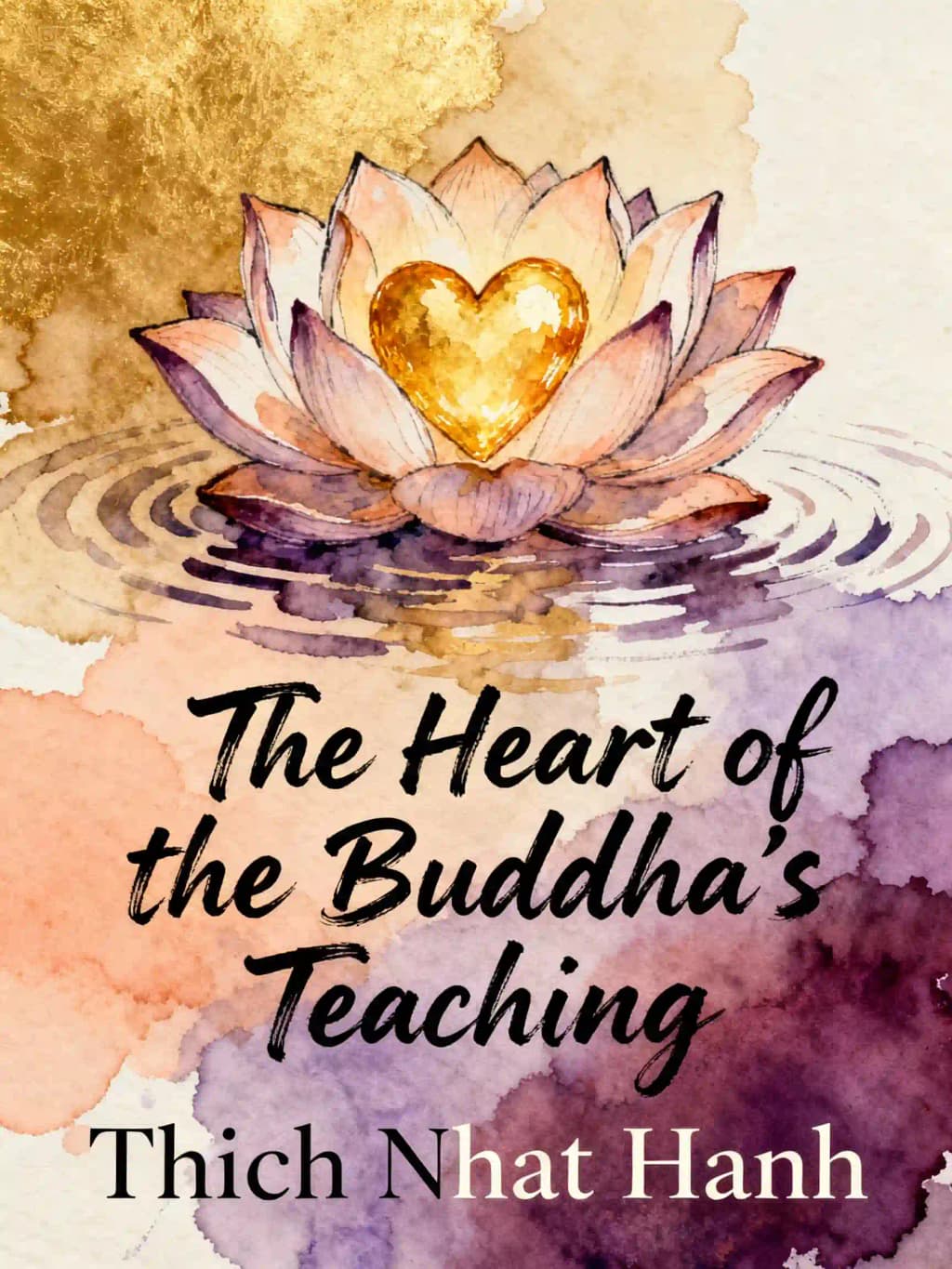
The Heart of the Buddha's Teaching stands as one of the most accessible gateways to Buddhist philosophy for Western readers. Thich Nhat Hanh, the Vietnamese Zen master nominated for the Nobel Peace Prize by Martin Luther King Jr., crafted this masterpiece to distill 2,500 years of Buddhist wisdom into practical guidance for contemporary life. Since its publication in 1998, it has become essential reading for spiritual seekers worldwide, with celebrities like Oprah Winfrey and Benedict Cumberbatch citing its profound influence on their lives. What makes this work extraordinary is how it transforms ancient teachings into living practices that address modern suffering. As the late author bell hooks noted, "Thich Nhat Hanh's teachings cross all boundaries of religion, culture, and nationality"-a testament to how this gentle monk's approach transcends traditional religious frameworks to offer universal tools for living with greater awareness and compassion.
Capítulo 2
Entering the Heart of Buddha's Wisdom
Buddha was not a distant deity but a human being who suffered just as we do. For forty-five years after his enlightenment, he taught only about suffering and its transformation. While the ocean of suffering may seem vast, liberation becomes possible when we turn toward awareness rather than running away.
Even amid our deepest pain, we must not overlook life's wonders-the sunset painting the sky, a child's spontaneous smile, the miracle of flowers and trees. Our wounds can become doorways to profound understanding if we embrace rather than flee from them. This approach stands at the core of Buddha's first and most essential teaching: the Four Noble Truths.
After achieving enlightenment at age twenty-nine, Siddhartha Gautama spent forty-nine days in peaceful realization before walking to Deer Park to share his insights with five former companions. Despite their initial skepticism, they listened as he taught that suffering exists, suffering has causes, well-being is possible, and there is a path to liberation. When one monk named Kondanna understood these truths, the Buddha exclaimed, "Kondanna understands!" and tradition says the earth shook as voices throughout the cosmos proclaimed that an enlightened one had set the wheel of Dharma in motion.
This teaching emphasized the Middle Way between harsh austerity and indulgent pleasure-seeking. The First Truth acknowledges suffering (dukkha)-the bitterness we all experience. The Second Truth identifies suffering's origins-the things we consume spiritually and materially that cause our pain. The Third Truth offers hope through cessation (nirodha)-the good news that healing is possible by refraining from what causes suffering. The Fourth Truth is the path (marga)-the Noble Eightfold Path that leads to liberation.
When studying these teachings, our only task is to remain open. If we simply compare them to our existing ideas, accepting what matches and rejecting what differs, we learn nothing. Instead, we should be like earth receiving rain, allowing the teachings to penetrate the seeds within our consciousness.
Capítulo 3
Beyond the Misconception of Universal Suffering
A common misunderstanding of Buddhism is the belief that "everything is suffering." This bleak interpretation contradicts the Buddha's actual teaching. While the First Noble Truth identifies suffering, many students have mistakenly tried to prove that everything on Earth is suffering through theories like the "Three Kinds of Suffering"-a later development, not the Buddha's original teaching.
For two millennia, some practitioners have mechanically repeated "Everything is suffering" as if this repetition alone could bring insight. The Buddha never intended this. He wanted us to recognize suffering when it's present and joy when suffering is absent. The common argument that "impermanent therefore suffering therefore nonself" is illogical. Impermanence and nonself are universal marks of all things, but suffering is not. A table is impermanent and without separate self, but it only causes suffering if we become attached to it.
The Buddha taught that nirvana-the joy of extinguishing concepts-is actually one of the Three Dharma Seals, not suffering. Similarly, it's an oversimplification to say all suffering comes from craving alone; other afflictions like anger, ignorance, and wrong views also cause suffering. We must identify specific causes of our specific suffering to find healing.
Think about it this way: when you have a toothache, you finally understand that not having a toothache is happiness. Yet when the pain subsides, we often forget to treasure our well-being. Mindfulness helps us appreciate the happiness already present in our lives.
The Third Noble Truth-the cessation of suffering-follows three stages. First is "Recognition," where we acknowledge that well-being is possible, even if we're currently suffering. Second is "Encouragement," where we actively engage with practices that bring peace. The Buddha reminds us that walking on Earth, washing dishes, or practicing with community are all miracles. The greatest miracle is simply being alive.
In the third stage, "Realization," we understand that suffering and happiness are not separate. True joy emerges when we can embrace our suffering and transform it. Like skilled gardeners who don't discriminate between flowers and garbage, we learn to transform our pain into compassion.
Capítulo 4
The Path of Transformation
The Noble Eightfold Path offers a practical framework for transforming suffering into well-being. These eight elements-Right View, Right Thinking, Right Speech, Right Action, Right Livelihood, Right Diligence, Right Mindfulness, and Right Concentration-are deeply interconnected, with each containing all the others.
Right View forms the foundation of the path. It involves deeply understanding the Four Noble Truths and recognizing which seeds in our consciousness are wholesome and encouraging their growth. Our perceptions often contain errors that cause suffering. The Buddha taught that most perceptions are erroneous, colored by our afflictions, memories, and subjective experiences. To achieve Right View, we must look deeply into our perceptions until they become insights.
Right View isn't an ideology or system but a living insight into reality that fills us with understanding and peace. From the perspective of ultimate reality, Right View is actually the absence of all views, as no single viewpoint can capture the whole truth.
Right Thinking emerges from Right View and leads to Right Action. Much of our thinking is unnecessary, like a cassette player that won't turn off. Through mindfulness, we can observe whether our thoughts are useful. Right Thinking involves four key practices: questioning our perceptions with "Are you sure?"; bringing ourselves fully into the present moment by asking "What am I doing?"; recognizing our compulsive patterns by acknowledging "Hello, Habit Energy"; and cultivating our mind of love (Bodhichitta) to bring happiness to many beings.
When we practice Right View and Right Thinking, we dwell deeply in the present moment, where we can touch seeds of joy and peace. This creates the foundation for Right Speech, which requires cultivating loving speech and deep listening. Sometimes silence is the most powerful form of speech-a "thundering silence." Through mindful speech, we can create understanding and harmony in our relationships.
Capítulo 5
The Art of Mindful Living
Right Mindfulness stands at the heart of Buddha's teachings. When Right Mindfulness is present, all other elements of the Eightfold Path are also present. Mindfulness is the energy bringing us back to the present moment-to cultivate mindfulness is to cultivate the Buddha within.
The Seven Miracles of Mindfulness are: being present to touch deeply what's before us; making others present also; nourishing the object of our attention; relieving others' suffering through presence; looking deeply (vipashyana); understanding, which forms the foundation of love; and transformation of suffering.
In the Discourse on the Four Establishments of Mindfulness, the Buddha offers four objects for practice: our body, feelings, mind, and objects of mind. The first establishment, "mindfulness of the body in the body," begins with observing positions and movements, recognizing body parts, seeing the elements (earth, water, fire, air) that compose us, and practicing mindful breathing.
The second establishment is "mindfulness of the feelings in the feelings"-observing our pleasant, unpleasant or neutral feelings without clinging or rejecting them. Like a mother who loves her child whether crying or smiling, we embrace all feelings with mindfulness. We can even embrace difficult emotions like anger, which is like a fire filling us with smoke. By breathing mindfully, we calm our anger and suffer less right away.
The third establishment is "mindfulness of the mind in the mind"-being aware of mental formations (chitta samskara). When a mental formation arises, we practice mere recognition-mindfulness becomes its good friend. All mental formations exist as seeds in our store consciousness before manifesting in mind consciousness.
The fourth establishment is "mindfulness of phenomena (dharmas) in phenomena"-the objects of our mind. The Buddha taught five kinds of meditation to help calm our minds when observing dharmas: counting the breath, observing interdependence, observing impurity, observing with love, and observing different realms.
True mindfulness practice extends beyond meditation cushions into everyday life. When we practice mindfulness, we generate the Buddha's energy within us-energy that can transform the world. A Buddha is mindful all day; we are part-time Buddhas. With mindfulness, our hands become Buddha hands that can protect those we love, and our eyes become Buddha eyes that see with understanding and compassion.
Capítulo 6
Living Ethically in the Modern World
Right Action and Right Livelihood address how we engage with the world ethically. Right Action means mindful physical action that touches love and prevents harm. It's closely linked with four of the Five Mindfulness Trainings: reverence for life, generosity, sexual responsibility, and mindful consumption.
The First Training commits us to protecting all life forms and avoiding killing through any means, including our consumption patterns. The Second Training addresses exploitation and social injustice, promoting generosity and preventing others from profiting from suffering. The Third Training focuses on sexual responsibility, protecting individuals, couples and families from misconduct and abuse. The Fifth Training encourages mindful consumption, avoiding toxins in what we eat, drink, watch, read, and discuss.
Right Livelihood means earning your living without transgressing ideals of love and compassion. The sutras define it as avoiding trades in arms, slaves, meat, alcohol, drugs, poisons, or fortune-telling. We should find work beneficial to humans, animals, plants and earth-or at least minimally harmful-though this can be challenging in modern society where many industries damage the environment.
Consider the dilemma of a farmer who wants to receive the Five Mindfulness Trainings while running a cattle farm. Though he treats his animals well, each slaughter leaves an impression on his consciousness. As his insight deepens through practice, a solution will emerge.
Right Livelihood is a collective karma, not just personal. When we meditate on interconnection, we see that the butcher isn't solely responsible for killing animals-meat consumers share responsibility. Millions make their living in the arms industry, but responsibility lies with all-politicians, economists, and consumers. We must create alternative jobs so no one depends on weapons manufacturing.
To practice Right Livelihood means practicing Right Mindfulness-hearing the telephone as a bell of mindfulness, breathing before answering, smiling while serving others, walking mindfully between meetings. When we work in ways that encourage compassion, we practice Right Livelihood.
Capítulo 7
The Three Dharma Seals: Keys to Understanding Reality
The Three Dharma Seals-impermanence, nonself, and nirvana-authenticate genuine Buddhist teachings. Any teaching lacking these seals cannot be attributed to the Buddha.
Impermanence reveals that nothing remains static-flowers, mountains, feelings, consciousness all change constantly. Rather than causing suffering, understanding impermanence brings joy and appreciation. When we truly comprehend that everything changes, we cherish each moment and each relationship more deeply.
Imagine how differently you might treat your partner if you constantly remembered they won't always be with you. By visualizing ourselves three hundred years from now during arguments, we immediately recognize how precious our time together truly is.
Nonself shows that nothing has separate existence-everything must inter-be with everything else. Like cookies made from the same dough that imagine themselves separate, we create barriers between ourselves and others, causing needless suffering. Through practicing nonself, we recognize that our happiness is inseparable from others'.
Our eyes, ears, and body cannot exist by themselves but depend on countless non-eye and non-ear elements. Even when we try to run away from family conflicts, we carry all these relationships within our consciousness.
Nirvana, the third seal, is the ground of being itself-the substance of all that exists. Like waves already being water, we already contain nirvana, the dimension beyond birth and death, permanence and impermanence. Nirvana isn't separate from the phenomenal world but is revealed when we extinguish all concepts and notions.
The Buddha offered impermanence and nonself not as doctrines to worship but as instruments-rafts to cross to the shore of well-being, to be abandoned once we arrive.
Capítulo 8
The Doors to Liberation
The Three Dharma Seals open the Three Doors of Liberation-emptiness (shunyata), signlessness (animitta), and aimlessness (apranihita). These doors lead to concentration and freedom from fear, confusion, and sadness.
Emptiness, the First Door of Liberation, means being empty of a separate, independent self. We cannot exist by ourselves alone-we can only inter-be with everything in the cosmos. Reality goes beyond notions of being and nonbeing. When we practice emptiness, we see that "I am this food. This food is me." The one who eats and the food eaten are both empty of separate selves, making their communication perfect.
When we meditate on emptiness, we prepare ourselves for the inevitable changes of life. Everyone we cherish will someday get sick and die, but by staying in touch with life as it is, we can go beyond time and space, beyond "me and mine," and taste true liberation.
Signlessness (animitta), the Second Door of Liberation, teaches us to look beyond appearances. Signs are instruments for our use but not absolute truth-they can mislead us. The Diamond Sutra states, "Wherever there is a sign, there is deception, illusion."
Water can appear as square, round, solid, liquid, or gas depending on its container or state, but these are merely signs, not its true nature. Until we break through signs, we cannot touch reality and will continue to suffer. When we free ourselves from signs, we enter the heart of reality-nirvana.
Aimlessness (apranihita), the Third Door of Liberation, teaches that there is nothing to do, nothing to realize. A rose's purpose is to be a rose; your purpose is to be yourself. We already have everything we're looking for-we are already Buddhas.
Just being in the moment is the deepest practice of meditation. The Heart Sutra says there is "nothing to attain" because enlightenment is already within us. In aimlessness, we see we don't lack anything, and our striving halts. We can enjoy every moment without running after anything.
Capítulo 9
The Buddha Within and Around Us
The Buddha is represented as having "three bodies" (kaya): Dharmakaya, the source of enlightenment; Sambhogakaya, the body of bliss; and Nirmanakaya, the historical embodiment of the Buddha. Before passing away, the Buddha told his disciples that while his physical body would not remain, his teaching body (Dharmakaya) would always be with them.
The Dharmakaya is the embodiment of the Dharma, always enlightening everything. Anything that helps us wake up-trees, birds, pebbles-is part of the Dharmakaya. For those who are awake, the Dharma speaks through everything, from morning light to a baby's cry.
The living Dharma isn't just found in sutras or talks, but manifests in mindful daily life. When we walk mindfully with peace and joy, the "sun of the Dharmakaya" shines in us. The Dharmakaya expresses itself through both action and non-action-an oak tree teaches the Dharma simply by being fully an oak tree.
The Sambhogakaya is the Buddha's body of bliss, enjoyment, and celebration-the fruits of his deep practice. When we practice mindfulness, we too can experience this boundless peace and joy. Simply breathing in while looking at the blue sky or drinking tea mindfully allows us to feel happy being alive.
The Nirmanakaya is the physical manifestation or transformation body of the Buddha. Shakyamuni Buddha was a real human being who embodied the Dharmakaya through his presence. But there are many other transformation bodies expounding the Dharma-trees, birds, violet bamboo, and yellow chrysanthemums.
Each of us has these three bodies within us: a Dharma body, an enjoyment body, and a physical body. By living mindfully and transforming ourselves, we allow the Buddha to continue through us, sharing the Dharma with many other beings.
Taking refuge in Buddha, Dharma, and Sangha is fundamental to Buddhism, representing universal values that transcend cultural boundaries. Unlike blind faith, Buddhist refuge is based on practice and personal verification. Our faith grows concrete through our own insight and experience.
When we take refuge in the Buddha, we express trust in our capacity to walk toward beauty, truth, and understanding. This refuge is reciprocal-"I entrust myself to Buddha, Buddha entrusts herself to me." The Buddha takes refuge in us for understanding, love, and compassion to remain alive in the world.
Capítulo 10
The Web of Interdependence
Interdependent Co-Arising (pratitya samutpada) forms the foundation of Buddhist practice. Though sometimes called cause and effect, it's more complex-cause and effect co-arise, with everything resulting from multiple causes and conditions. The chicken is in the egg and the egg in the chicken, arising in mutual dependence.
The Buddha expressed it simply: "This is, because that is. This is not, because that is not." Like three reeds standing by leaning on each other, all phenomena depend on countless conditions. Looking deeply at a table reveals the forest, sunshine, rain, carpenter, and ultimately the entire cosmos that brought it into being. Nothing has a single cause, and everything is simultaneously cause and effect.
The Buddha taught twelve links (nidanas) in the "chain" of Interdependent Co-Arising, not as a linear sequence but as an interconnected web where each link contains all others. These links include ignorance, volitional actions, consciousness, mind/body, the six sense bases, contact, feelings, craving, grasping, becoming, birth, and old age and death.
The Buddha never intended us to understand the Twelve Links linearly. Every link contains every other link-ignorance isn't just in the past but present in each cell and mental formation now. In compost there are flowers, and in flowers there is compost-we shouldn't throw away our ignorance but transform it into understanding.
There is a positive side to the Twelve Links that Buddhist teachers have overlooked. When ignorance ends, clear understanding arises, giving rise to the Great Aspiration (mahapranidhana) or mind of awakening (bodhichitta). This propels us toward the beautiful and wholesome rather than the hell realms.
We study the Twelve Links to diminish ignorance and increase clarity. The key is guarding the six senses and maintaining mindfulness of feelings and contact. The Buddha cautioned against attachment to either being (bhava) or nonbeing (abhava)-reality lies somewhere between. With nonattachment, we ride the wave of birth and death without fear. Nirvana isn't found by abandoning birth and death but in their very midst.
Capítulo 11
Cultivating Love and Compassion
The Buddha taught the Four Immeasurable Minds (Brahmaviharas)-love, compassion, joy, and equanimity-as the dwelling places of true love. These practices grow daily until they embrace the whole world, bringing happiness to ourselves and everyone around us.
Maitri (love) is the intention and capacity to offer joy and happiness. It requires looking and listening deeply to understand what will truly bring happiness. Without understanding, love becomes misguided-like offering durian fruit to someone who finds its smell repulsive. True love has roots in friendship (mitra) and develops as unconditional energy expecting nothing in return.
Karuna (compassion) is the intention to relieve suffering. Through mindful breathing, deep listening, and looking, we develop the capacity to touch another's pain. Simply sitting close, listening deeply, and being in communion brings relief. One compassionate word, action, or thought can transform suffering.
Mudita (joy) arises naturally when dwelling in mindfulness. True love always brings joy to ourselves and those we love. While happiness relates to both body and mind, joy relates primarily to mind-like seeing a stream in the desert (joy) versus drinking from it (happiness). Mudita isn't merely "sympathetic joy" at others' happiness; it's deeper-a joy filled with peace and contentment that embraces both others' happiness and our own.
Upeksha (equanimity) means nonattachment and letting go-not indifference. It's climbing the mountain to view the whole situation without taking sides. It embodies samatajnana, "the wisdom of equality," seeing everyone as equal without discrimination. Without upeksha, love becomes possessive, imprisoning the beloved like capturing a breeze in a tin can. True love preserves freedom for both yourself and your beloved.
Through these practices, we cultivate the capacity to receive, embrace and transform suffering without being overwhelmed by it. Shariputra demonstrated this quality when falsely accused, responding with humility rather than anger. True inclusiveness means making our hearts big enough to transform pain through deep looking and understanding.
The Buddha taught that while one arrow causes suffering, a second arrow of anger multiplies it hundredfold. Through the Four Immeasurable Minds, we develop hearts without limits that can receive, embrace and transform injustice without being destroyed by it.
The Buddha is within each of us, accessible through mindful practice. We must develop new habits of mindful living to replace old patterns, creating communities of harmony and deep looking. As Thich Nhat Hanh observed at Vulture Peak, the same beauty that Buddha saw centuries ago exists everywhere in the present moment if we have the awareness to see it. Happiness lies within our hearts, accessible through mindful breathing. When suffering, we should ask how to free ourselves rather than blame others. By looking deeply into our suffering using the Four Noble Truths, we can transform relationships and find meaning in life.