Capítulo 1
Finding Peace in a World of Constant Change
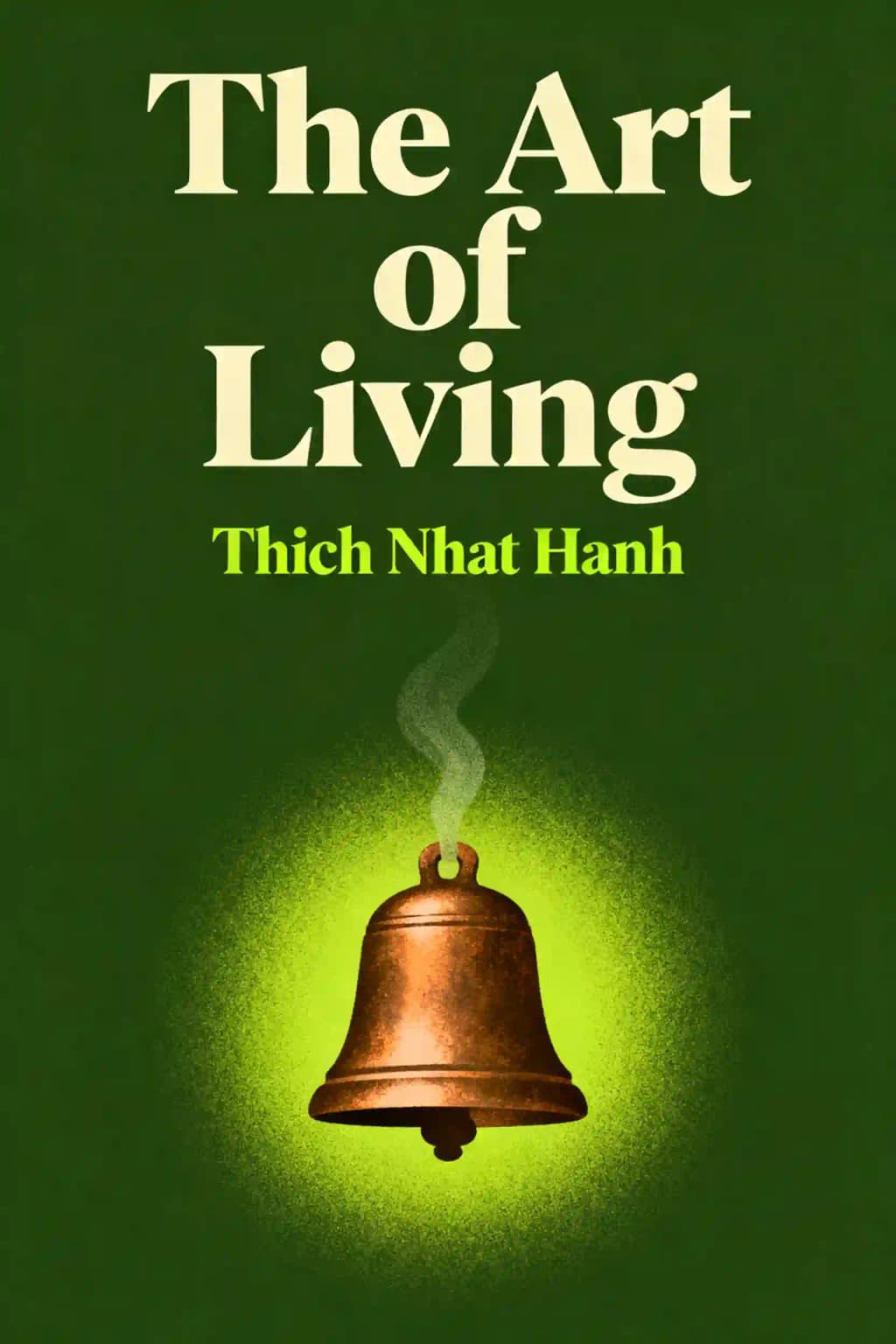
When Oprah Winfrey first encountered the teachings of Thich Nhat Hanh, she described the experience as "life-changing." His gentle wisdom about living mindfully in the present moment resonated so deeply that she featured him on her Super Soul Sunday program, introducing millions to his transformative approach to life. What makes this Vietnamese Zen master's teachings so powerful is their remarkable simplicity and accessibility. In "The Art of Living," Thich Nhat Hanh (affectionately called "Thay" or teacher by his followers) distills decades of Buddhist wisdom into practical guidance for navigating our complex modern world. This isn't just another self-help book-it's a profound exploration of what it means to be truly alive, written by a man who survived war, exile, and political persecution through the very practices he teaches. His mindfulness centers have attracted celebrities like Gwyneth Paltrow and Orlando Bloom, while his teachings have influenced mindfulness programs at Google, the World Bank, and Harvard Business School. Through this final collection of lectures before his debilitating 2014 stroke, Thay offers us nothing less than a path to freedom from suffering and a way to touch happiness in every moment of our lives.
Capítulo 2
The Wonder of Interbeing: We Are More Than We Think
Look deeply at a flower. What do you see? Not just petals and stem, but sunshine, clouds, soil, rain, and countless other elements that make the flower possible. Without any of these "non-flower" elements, the flower could not exist. This profound insight reveals the true nature of reality-emptiness.
Emptiness doesn't mean nothingness. Rather, it means being empty of a separate, independent existence while being full of everything else. This is what Thich Nhat Hanh calls "interbeing"-the deep interconnection of all things. Nothing exists by itself alone. We humans contain earth, water, air, sunlight, our ancestors, education, and culture. If we removed these "non-us" elements, there would be nothing left we could call "us."
Our bodies themselves demonstrate this truth. As biologist Lewis Thomas observed, we are "shared, rented, and occupied" by trillions of microorganisms that outnumber our human cells. We function as communities rather than isolated individuals. The whole planet operates as one living, breathing cell.
We can observe interbeing in our daily lives. Looking at a child, we see her parents and ancestors in her features, mannerisms, and talents. She isn't separate but a continuation. When I practice calligraphy, I cannot remove my father from my hand-his gestures live in mine. There is no separate self drawing the circle; we are all drawing it together.
This awareness liberates us from the prison of separateness. When we understand that we inter-are with everything, our fear and suffering diminish. After hearing about pirates attacking Vietnamese boat refugees and an eleven-year-old girl who jumped overboard after being raped, Thich Nhat Hanh couldn't sleep. Through meditation, he visualized himself as a boy born into poverty in Thailand who became a pirate out of desperation. He realized that without education or guidance, he might have become that pirate himself. His anger dissolved into compassion as he embraced both the girl and the pirate, seeing himself in them both.
The insight of emptiness shows us that suffering is collective, transmitted through generations and society. When we free ourselves from separateness, we gain compassion and understanding. We are what we think, say, and do, with our actions rippling across space and time. As Sartre said, "Man is the sum of his actions." We exist only in our actions, continuing as energy long after our physical forms change.
Capítulo 3
Beyond Birth and Death: The Illusion of Permanence
We tend to think we're born at one point and die at another, with a fixed self moving through time in between. But looking deeply reveals a different reality. You existed in your mother's womb, in the sperm and egg before conception, in your grandparents, and infinitely backward. There is no moment when you did not exist.
Like a cloud becoming rain, we continue in different forms. When we look at the sky and see a cloud disappear, we think it no longer exists. This misperception happens because we're caught in appearances rather than seeing reality's true nature. The cloud hasn't died; it's playing hide-and-seek, perhaps becoming the tea in my cup.
We too constantly change form. Looking at childhood photos reveals how dramatically we've transformed, yet we're neither exactly the same person nor completely different. The child in those photos remains alive in every cell of our body.
Heraclitus said, "You can never bathe in the same river twice." The river constantly flows, and we too constantly change-cells dying and being born, thoughts and feelings shifting moment to moment. Our body and mind are an ever-changing continuum. Despite appearing the same and keeping the same name, we are different in each moment. No scientific instrument can find anything in us that remains unchanged that we could call a self or soul.
When we understand this, we realize we don't need to fear death. Nothing is lost-it only changes form. The law of conservation of energy tells us nothing can be created or destroyed, only transformed. While alive, we are energy, and after death, we continue as transforming energy that can never be lost.
If we're grieving a loved one, this insight helps us see how they continue. They remain alive within and around us in different forms. We can still communicate with them: "I know you are there. I'm breathing for you, smiling for you, enjoying life with you."
Capítulo 4
Our Many Bodies: Continuing Beyond the Physical
We aren't limited to our physical bodies. Through the lens of emptiness and interbeing, we can identify at least eight different "bodies" or collections of energy that comprise who we are. When we recognize all our bodies, we live more fully and face physical disintegration without fear.
Our human body allows us to feel, heal, transform, and experience life's wonders. Yet often our minds abandon our bodies, wandering to projects and worries instead of remaining present. Our body is a masterpiece of cosmic evolution, carrying stars, moon, universe, and ancestral presence. Countless life-forms support our existence.
Beyond our physical form, we possess a buddha body-the capacity to be awake, present, understanding, compassionate, and loving. "Buddha" simply means someone who is awakened. Every human being has seeds of mindfulness, love, understanding, and compassion. Don't doubt your buddha nature-remember times when you've understood, forgiven, or loved.
Our spiritual practice body grows from our buddha body. It's the art of generating happiness and handling suffering. We cultivate this "Dharma body" by nurturing seeds of awakening and mindfulness daily. Every peaceful step and mindful breath strengthens it. While possessions can be stolen, no one can take away your spiritual practice.
We also have a community body-the people with whom we share aspirations and who support us. We need spiritual friends to grow. Just four or five like-minded people is enough to start. The key elements are love, trust, joy, harmony and brotherhood.
Our body outside the body is our presence in many places without our physical body. Through books, teachings, art, or influence, we transform into thousands of "me" reaching everywhere. Our continuation body is the energy we produce through thoughts, speech, and actions-all carrying our signature into the future. Like stars whose light travels for millions of years after extinction, we continue.
Our cosmic body encompasses the entire phenomenal world. Without the cosmos, our human body couldn't exist. Like a wave on the ocean, our human body connects to all other waves. We contain stardust, mountains, rivers, and black holes. Every moment, the cosmos flows through us, renewing us.
Finally, our ultimate body is reality itself, beyond all perceptions, forms, and ideas-the true nature of the cosmos. Like a wave that is simultaneously water, we are both our individual manifestation and the ultimate reality itself.
Capítulo 5
The Art of Stopping: Finding Freedom in the Present
We've been running for thousands of years, making it difficult to stop and truly experience the present moment. One morning while contemplating a mountain at dawn, Thich Nhat Hanh realized he wasn't alone-all his ancestors were looking with him. They needed nothing more than to sit and enjoy the sunrise together. When we stop running, our entire lineage stops with us.
As soon as we stop, happiness and peace emerge. Though it appears nothing is happening, everything is happening-we touch our cosmic body and eternity. In Plum Village practice centers, bells serve as reminders to stop, breathe, and return to ourselves, transforming ordinary moments into eternal, fulfilled ones.
The third door of liberation, aimlessness, means arriving in the present moment to discover that everything we've been seeking is already here. It doesn't mean doing nothing, but rather not chasing after objects of desire. When we remove these objects of craving, we find happiness and freedom available right now.
We've inherited the habit of running after things, sacrificing our present happiness for future goals. We chase dreams, success, even enlightenment, while disregarding the wonders right before us. We postpone heaven, thinking the ultimate is for later, not now.
Many believe true fulfillment comes only after death, in heaven or a Pure Land. We feel this life is insufficient and that we must shed our bodies to touch the ultimate. But if we wait until death for happiness, it may be too late. We can touch all life's wonders with our human body right now.
The ninth-century Zen master Lin-Chi taught "humans and buddhas are not two"-you are already enough. We don't need anything special to cultivate our buddha body, just a simple, authentic life. Our true self doesn't need a particular job, money, fame, or status. Freedom is both practice and habit. We must train ourselves to walk, sit, and eat as free people.
Sometimes doing nothing is the most powerful action. There are people whose presence is crucial for others' well-being, though they may not seem productive in conventional terms. Like a single calm person on a boat of panicking refugees who can save everyone through their peaceful presence-this is the action of non-action.
Capítulo 6
Walking the Path of Freedom
To practice walking meditation, invest your entire being in each step to truly arrive in the present moment. This practice helps stop both physical and mental running. Make each step with complete presence-breathe until you feel fully arrived, then take another step, imprinting "the seal of arrival" on the ground.
The mantra "I have arrived; I am home" represents your commitment to stop running and recognize that true life exists only in the here and now. Begin with slow walking meditation to master stopping and arriving, then progress to walking mindfully at any speed. Each step taken in mindfulness brings healing and relaxation.
Walking meditation connects you with your sovereignty and freedom. You don't need to reach a destination to arrive-you arrive with every step, touching nirvana, your cosmic body, your ultimate body with each mindful movement.
Humans evolved walking to chase or escape. That energy remains in our cells though we no longer hunt or flee. We've evolved from Homo erectus to Homo sapiens and now have the chance to become Homo conscius-a mindful, awakened species that walks in freedom. Walking peacefully brings the ultimate dimension into the historical dimension, training us not to run.
Everyone has a deep desire they want to realize in their lifetime. This is your dearest dream, your ultimate concern. When identified and nurtured, it becomes a source of happiness, energy, and motivation. Your dream gives your life meaning and vitality. Take time to be still and discover what your deepest desire truly is. Is it money, power, fame-or something else? Once you identify your deepest intention, you can live authentically and become the person you want to be.
We often think we realize our dreams at the end of a path, but in Buddhism, you must live your dream in the present moment. Every step and breath becomes the realization of your dream. Your dream doesn't take you from the present; it becomes reality now. If you dream of liberation, enlightenment, and happiness, direct all thoughts, words, and actions toward realizing these. You needn't wait until journey's end-as soon as you step toward liberation, liberation is already there. There is no way to happiness; happiness is the way.
Capítulo 7
Embracing Impermanence: The Key to Living Fully
Our human lifespan is brief compared to turtles living hundreds of years or redwoods surviving millennia. With such limited time, we must ask: How are we living? What are we accomplishing? Death comes unexpectedly, and we cannot bargain with it-waiting until tomorrow is too late.
The present moment is our only opportunity to truly live. The past has gone, the future hasn't arrived, and this moment is a miracle we possess right now. By contemplating impermanence, we touch freedom and happiness in the present, seeing reality as it is and embracing change.
Impermanence isn't something to fear-it's wonderful and necessary for life. Without it, seeds couldn't become plants, children couldn't grow, healing couldn't happen, dreams couldn't manifest. Thanks to impermanence, everything becomes possible.
Though we intellectually accept impermanence, we often behave as though everything will last forever. This prevents us from taking immediate action to change situations or bring happiness. The Buddha offered contemplation on impermanence not as a mere concept but as a tool for developing insight.
The difference between the notion and insight of impermanence is like a match and its flame. The match (notion) is useful only to produce the flame (insight), which then consumes the match. When this insight becomes living wisdom present in every moment, it liberates us.
This insight has transformative power. When someone you love makes you angry and you want to lash back, remembering impermanence-imagining them as ash in a few decades-can instantly dissolve your anger. Recognizing life's brevity makes petty arguments seem foolish, transforming anger into love.
Many people I've loved have passed away. That I still breathe is a miracle, and I breathe for them. Each morning when I exercise, I don't do it for fitness or health-I do it to celebrate being alive. This mindful movement nourishes both body and mind, allowing me to appreciate my body just as it is with deep gratitude.
Even with aging, illness, or pain, we can enjoy moments when suffering subsides. If you can still breathe, enjoy your breathing. If you can still walk, cherish your walking. Connecting with peace and freshness helps embrace difficulties. We fear dying yet struggle to imagine growing old or becoming unable to walk. Contemplating impermanence helps us value every step, knowing future abilities may change.
Capítulo 8
The Art of Happiness: Finding Joy in the Present
The art of happiness is living deeply in the present moment-the only place where life truly exists. With mindfulness, concentration, and insight, we can free ourselves from restlessness and craving, realizing we already have enough conditions to be happy. This is the contemplation on non-craving. By practicing mindful breathing and returning to ourselves, we escape regrets about the past and worries about the future, connecting instead with the healing elements available within and around us.
The Buddha compared our craving to a fish biting attractive bait without seeing the hidden hook. We chase after desirable things-money, power, sex-blind to their dangers, destroying our body and mind in pursuit. We fear losing what we crave, but when we finally release it, we discover we've lost nothing. Instead, we gain freedom and the present moment.
True happiness doesn't depend on external conditions-money, possessions, or status. In Plum Village, monks and nuns live without bank accounts or salaries, yet find joy in simplicity and service. Happiness comes from cultivating compassion and understanding, bringing nourishment and healing to ourselves and others.
Restlessness is that feeling of being unable to be still-rushing, hurrying, always thinking we should be somewhere else. We seek refuge in work, entertainment, or technology to distract ourselves from painful inner feelings. But these distractions only temporarily mask our suffering. Mindfulness helps us identify what we're running from and gives us courage to stop, embrace our feelings, and truly care for ourselves.
In just ten to fifteen minutes, we can create a moment of peace by coming home to our body. Find a quiet place, get comfortable, and bring awareness to your breathing-following the rising and falling of your abdomen. Notice any tension in your body and gently release it. Feel the points where your body contacts the floor or chair, and let the earth receive your weight. Send love to all your organs, smiling to every cell. Recognize that everything you need is right here in this moment.
Happiness isn't something to postpone-it can only be found in the present moment. Mindfulness transforms any moment into a happy one by helping us recognize the conditions of happiness already present. Whether a moment is happy depends not on the moment but on our awareness. With mindfulness, we can appreciate wonders that many creatures never experience: the blue sky, ocean waves, birdsong. These marvels are available to us-the question is, are we available to them?
Capítulo 9
Transforming Suffering into Peace
Living fully requires courage to face what prevents our happiness. We must identify and transform our afflictions, becoming both artists and warriors who cut through whatever entangles us. As Master Tang Hoi said, "Letting go is the action of heroes." Only by confronting our suffering can we find the path to well-being.
When we master the art of suffering, we suffer much less, transforming our mud into lotuses of love and understanding. The path to happiness requires identifying what prevents it-whether projects, craving, restlessness, or emotional blocks like anger and fear. Disentangling ourselves demands courage to change our livelihood, determination to avoid stress-inducing commitments, and bravery to open communication with loved ones.
Letting go brings joy and happiness but requires courage. Like leaving a busy, polluted city for the countryside, we feel the relief of freedom as soon as we leave our entanglements behind. Simply naming what we want to release makes us feel lighter. The more we can let go of, the more freedom we experience.
Some obstacles to happiness can't be easily cut through or released. Deep sorrow or despair requires both a warrior's fearlessness and an artist's skill to transform. When Vietnam was divided and war raged in 1954, Thich Nhat Hanh fell into deep depression after his mother died. Through mindful breathing and walking, he eventually healed. These practices can overcome depression, despair, anger and fear.
Strong emotions are like storms that come, stay a while, and pass. Belly breathing is essential for surviving these emotional storms. Like a tree whose branches may blow wildly while the trunk remains stable, we bring our mind down to our abdomen where it's calm. By focusing completely on our breathing and the rising and falling of our abdomen, we can weather any emotional storm.
We shouldn't fear suffering itself but rather not knowing how to handle it. When painful feelings arise, instead of suppressing them, we must allow them to surface, identify them clearly, and embrace them. We invite mindfulness to recognize and embrace our pain with gentleness and compassion. Like a mother embracing a crying baby, mindfulness comforts suffering even before understanding its cause.
Without encountering difficulties and suffering, we could never grow spiritually or touch profound peace, joy, and freedom. Suffering is essential for generating understanding and compassion-without it, we cannot be truly happy. Just as lotuses cannot grow without mud, happiness and peace are born from transforming suffering and pain.
Capítulo 10
Touching Nirvana in This Very Life
By transforming our suffering through mindfulness, concentration, and insight, we can touch nirvana in the present moment. Nirvana isn't some distant place but a pleasant state of coolness and freshness available to us now. The word "nirvana" comes from rural India, describing the pleasant coolness felt when placing hands in completely extinguished fire ashes-a metaphor for the refreshing peace experienced when we transform our burning afflictions of craving, fear, anxiety, and despair.
There's an intimate connection between suffering and nirvana-without suffering, we couldn't recognize nirvana's peace, just as without hot coals, we couldn't have cool ashes. Each of us can touch small moments of nirvana daily. Like removing thorns from your foot one by one brings increasing relief, the removal of afflictions is the presence of nirvana.
We need our body-our feelings, perceptions, mental formations, and consciousness-to touch nirvana. When anger transforms into compassion, when we experience the peace of walking meditation, when we stop running and enjoy life's wonders in the present moment-these are experiences of nirvana.
Many mistakenly think nirvana is a blissful afterlife state, but this dangerously misunderstands the Buddha's teaching. Nirvana isn't something we access after death; it's associated with life in the here and now. Western Buddhist scholars have erroneously defined nirvana as "eternal death" ending reincarnation, but why would millions follow a religion teaching eternal death? The true nature of reality transcends notions of being and nonbeing, birth and death. Only when alive can we touch nirvana.
Even after enlightenment, the Buddha remained human with all the suffering that entails. He wasn't made of stone-he experienced feelings, emotions, pain, cold, and hunger like us. But he knew how to suffer, using his afflictions to experience awakening, which made him suffer less than most.
One mindful breath or step can bring real happiness and freedom. Small moments of peace steadily accumulate to create great awakening. Many mistakenly think enlightenment means permanent freedom from suffering, but awakening and suffering always go together. If we run from suffering, we'll never find awakening-it exists right in suffering's heart. The coolness of nirvana comes from transforming the fire's heat.
The seven concentrations-emptiness, signlessness, aimlessness, impermanence, non-craving, letting go, and nirvana-bring freedom from fear, anxiety, anger, and despair while deepening our connection to the present moment. Through interbeing, we learn to cherish all aspects of ourselves, reconcile with loved ones, and transform suffering into insight.
With these practices, life gains profound quality-more joy, peace, and compassion in everything we do. We realize we don't need to wait for heaven or nirvana; we can touch them right here on Earth by connecting deeply with the present moment and transcending concepts of birth, death, being and nonbeing. Every mindful step becomes an act of gentle revolution against a destructive way of living.