Capítulo 1
When Your Job Becomes Your Identity
We live in an era where our jobs have become far more than a means to pay the bills. For millions of Americans, work has transformed into the central source of meaning, identity, and purpose. A recent Pew Research study found Americans are nearly twice as likely to cite career over spouse when asked what gives their life meaning, with work outranking both faith and friendships. This phenomenon, dubbed "workism," defies historical patterns where increased wealth typically correlated with working less. Instead, America's highest earners now work more than ever, desperately seeking meaning through their careers. Even teenagers have internalized this mindset-95% rank having an enjoyable career as extremely important, higher than making money or helping others. Simone Stolzoff's "The Good Enough Job" arrives at a critical moment when burnout rates are soaring and a post-pandemic workforce is questioning whether the relentless pursuit of career fulfillment is truly worth the sacrifice. Drawing from psychology, sociology, and personal narratives, Stolzoff offers a revolutionary perspective on reclaiming our relationship with work before it consumes us entirely.
Capítulo 2
The Dangerous Pursuit of Perfection
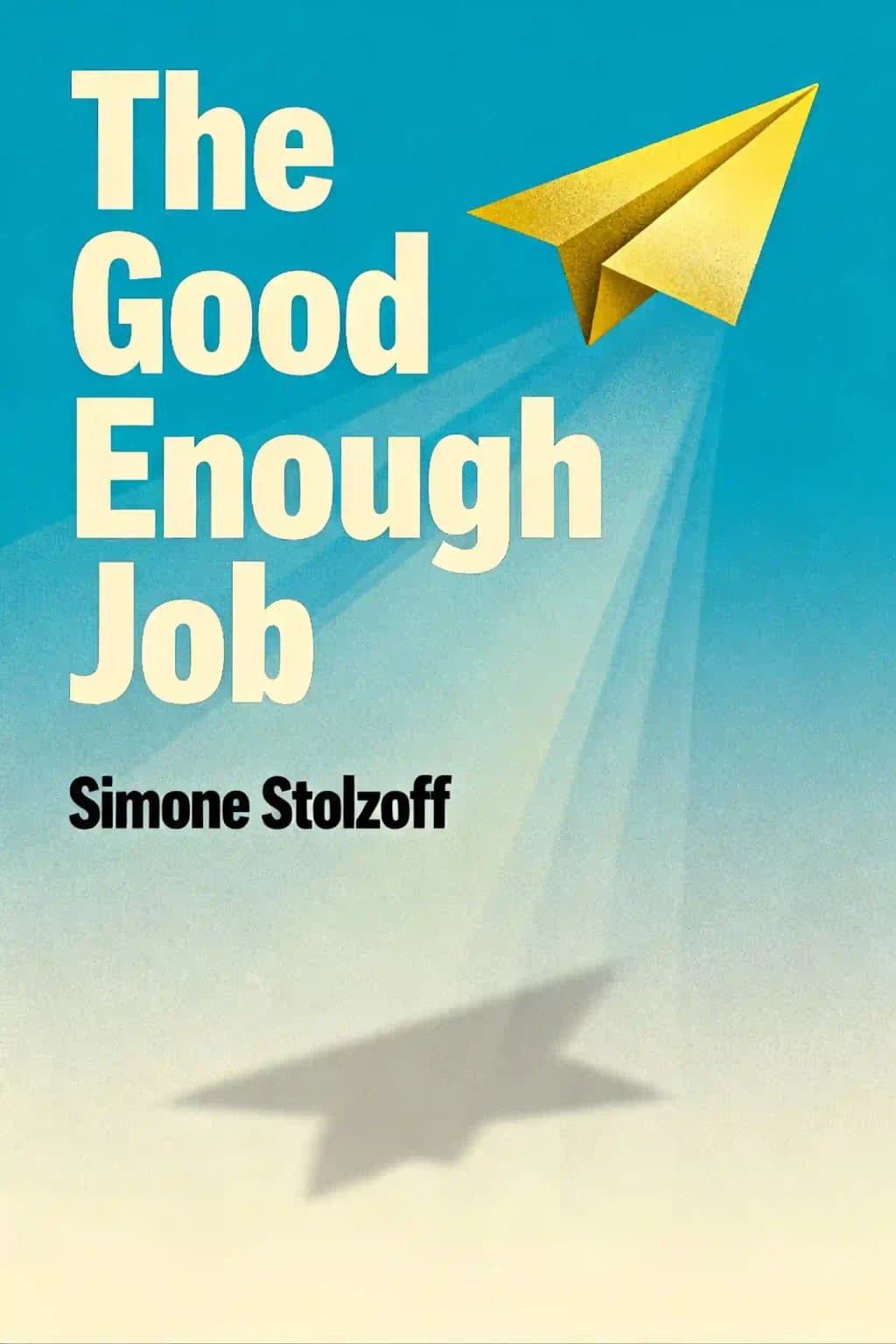
The title "The Good Enough Job" references psychoanalyst Donald Woods Winnicott's concept of "good enough" parenting. Winnicott observed that perfect parenting creates dependency while "good enough" parenting builds resilience. Our workplaces suffer from similar idealization-when we expect work to fulfill us completely, we set ourselves up for inevitable disappointment.
This obsession with finding the perfect career has real consequences. Research shows that "obsessive passion" for work leads to burnout, stress, and contributes to declining fertility rates in countries like Japan. In the United States, inflated career expectations correlate with rising depression and anxiety among young people. Globally, overwork kills more people annually than malaria.
Consider Divya's story. After building a successful dairy-free product line called Prameer with her mentor Chef Stephen Fischer, she watched their relationship deteriorate as the business grew. When Fischer eventually betrayed her by removing her 50% ownership stake, claiming "it's just business," Divya was devastated. The experience forced her to confront how thoroughly she had merged her identity with her work.
During her recovery, Divya developed multiple facets of herself-becoming a skateboarder, community builder, and finding joy in cooking for pleasure rather than profession. Research confirms that people with greater "self-complexity" are more resilient to setbacks, as their identity isn't tied to just one aspect of themselves. Now running a new food company, Divya maintains firm boundaries: "I know my price."
The solution isn't to stop caring about work-after all, we'll spend roughly 80,000 hours working in our lifetime. Rather, we need balance. "Good enough" offers a more forgiving ideal that doesn't romanticize work's potential nor accept endless toil. It invites us to define our relationship with work without letting it define us.
Capítulo 3
When Work Becomes Religion
As traditional religious institutions decline in America, work has emerged as a replacement source of meaning, purpose, and identity for many. Social scientist Ryan Burge discovered that the "nones"-those with no religious affiliation-have become America's largest religious group. His small First Baptist Church in rural Illinois, once vibrant with fifty regular attendees, now hosts just a dozen worshippers in a side room-mirroring the nationwide decline in religious participation.
Work's sacred status in American culture has deep historical roots. Until the 16th century, labor was viewed as mere toil. The transformation began with Martin Luther, who reframed work as a divine calling, and John Calvin, who suggested hard work indicated one's salvation status. Max Weber later identified how this "Protestant ethic" perfectly complemented capitalism's growth imperative. Today's prosperity gospel preachers like Joel Osteen, who teaches that faith and productivity lead to material wealth, represent the modern evolution of this fusion between religion and work.
The dramatic growth of religious non-affiliation stems from several converging factors: the internet enabling doubters to find community, the politicization of religion driving liberals from churches, and increasing social isolation. With fewer Americans participating in community groups overall, work has filled the void-especially for younger generations who are 11% less likely than Gen X to join community organizations by age 25.
I experienced firsthand the quasi-religious significance we assign to career choices when torn between two job offers: a dream writing position or a prestigious, higher-paying design role. I agonized over the decision for weeks, consulting everyone from loved ones to my Uber driver, even considering psychedelics for clarity. After taking the design job, I initially felt I'd made a mistake, becoming insufferable to those around me. Gradually, by loosening my grip on work and reconnecting with other aspects of life-playing soccer, reading, cooking with housemates-I began to see my job as "good enough."
Ryan Burge, despite his viral success and growing public profile, counterbalances work demands through faith. While religious traditions actively separate divinity from productivity-through practices like Shabbat or prayer times that "interrupt the bazaar"-Ryan maintains balance not through strict work-life boundaries, but by holding multiple identities. He turns down lucrative opportunities that would keep him from his Sunday sermons or his sons' soccer games.
The common trait among fulfilled people is "self-determination"-actively choosing what to value rather than inheriting the values of surrounding systems. Religious traditions help answer what makes life valuable by offering practices, teachings, and community. In our secular world, work provides one potential container for identity and meaning, with its own value system measured by productivity and earnings. While work can be a legitimate source of meaning, relying solely on it creates vulnerability.
Capítulo 4
The Myth of Dream Jobs
Two years before publishing his bestseller "What Color Is Your Parachute?", Richard Bolles was laid off from his position as an Episcopal minister. His revolutionary book introduced the radical notion that personal satisfaction should be central to professional success-a departure from the prevailing view of work as merely a means to an end. In the fifty years since its publication, mentions of "dream jobs" have grown by 10,000 percent, as love and meaning have supplanted security as our highest professional virtues.
At fifteen, Fobazi Ettarh discovered her dream job while browsing books in her high school library. After reading a short story about a queer teenager that helped her accept her own sexuality, she recognized how her school librarians had supported her by recommending LGBTQ+ literature without judgment. Inspired to provide that same acceptance for others, Fobazi set her sights on becoming a school librarian herself.
From childhood, we're conditioned to pursue dream jobs as life's ultimate objective. Steve Jobs famously advised Stanford graduates, "You've got to find what you love... Don't settle." But this conventional wisdom creates unrealistic expectations. Artist Adam J. Kurtz reframed the cliche "Do what you love and you'll never work a day in your life" to "Do what you love and you'll work super fucking hard all the time with no separation or any boundaries and also take everything extremely personally."
Becoming a librarian requires significant investment-typically a master's degree in library science costing tens of thousands of dollars. For Fobazi, who is Black, the industry's idealistic self-image as "the last truly democratic institution" quickly revealed contradictions. She discovered libraries' hidden history-some Southern libraries chose to shut down rather than integrate during the civil rights movement. In her first job, a supervisor told her "No one becomes a librarian to make a living wage," while another referred to an Asian colleague as "the diversity hire."
The notion that work should be fulfilling is relatively recent. For most of the twentieth century, the "Fordist compromise" defined the worker-employer relationship-eight-hour days, five days a week in exchange for decent pay, healthcare, vacation, and retirement benefits. As manufacturing jobs moved overseas and wages stagnated from the 1970s onward, management needed new ways to motivate workers. Companies like Kodak and IBM rebranded workplaces as hubs for social activity and personal growth. Today, nine out of ten people would accept lower pay for more meaningful work.
At a 2017 library conference, Fobazi was struck when a panelist called librarianship a "sacred duty." Having grown up with a pastor mother, she found this language disturbing given the field's problems. This phenomenon-which Fobazi termed "vocational awe" in an academic paper-describes the belief that certain workplaces and institutions are inherently good and beyond critique. This mindset allows workplace issues like undercompensation, racism, or sexism to be viewed as isolated incidents rather than systemic problems.
A job remains fundamentally an economic relationship. Treating it as something else-a passion or sacred duty-undermines workers' ability to demand necessary changes. During the COVID-19 pandemic, vocational awe was fully exploited as workers deemed "heroes" and "essential" were rarely given additional protections or compensation. Fobazi ultimately resigned from her tenure-track position, leaving not just her dream job but her librarian career entirely, noting that "vocational awe preys on workers' passion" and institutions rely on an endless supply of passionate replacements.
Capítulo 5
When Work Becomes Your Identity
At sixteen, Megan Greenwell broke a major human trafficking story for her high school newspaper, exposing Lakireddy Bali Reddy's modern-day slavery operation that led to his eight-year federal prison sentence. This early success cemented her identity as a journalist, launching an impressive career trajectory: Columbia University's newspaper editor, Washington Post war correspondent in Baghdad at 23, part of a Pulitzer Prize-winning team, and leadership roles at prestigious publications.
After becoming Deadspin's first female editor-in-chief, private equity buyers gutted the newsroom, replacing female leaders with white men. Though she landed another dream job at Wired, she found herself "a broken shell" unable to disconnect from work. When offered the permanent editor-in-chief position, she realized her burnout was complete and resigned at 37, despite Anna Wintour's personal plea to stay. The hardest part wasn't quitting but confronting who she was without journalism-"I'm flailing because I don't know who I am."
Psychologists use "enmeshment" to describe when interpersonal boundaries become blurred, preventing independent identity development. While typically applied to codependent relationships with people, ambitious professionals like Megan often become enmeshed with their careers instead. Our identities aren't fixed at birth but constructed over time, with adolescence being particularly crucial according to psychoanalyst Erik Erikson.
Identity crises were common among ambitious professionals interviewed for this book. Former soccer player Travis Cantrell felt he had to "turn off part of who he was" upon retirement. Startup employee Alice Walton struggled with feelings of failure after being laid off during COVID-19, despite knowing it wasn't her fault. Video producer Ezra Fox couldn't reconcile his self-narrative as "successful" with losing his job after seven years.
Americans have internalized capitalism's values, measuring self-worth through productivity. We celebrate "productive members of society" while deriding those who rely on social services as "welfare queens" and "freeloaders." This value system isn't just imposed externally-we impose it on ourselves. From the feudal economy of medieval Europe to merchant capitalism to industrialization, the relationship between workers and their labor has fundamentally changed. Workers once produced only what they needed with sun-regulated hours, but capitalism incentivized owners to pressure workers to produce more for less.
Psychologist Janna Koretz, who specializes in high-pressure careers, finds clients often "delude themselves" into thinking they're only as valuable as their output. Many feel lost when there are no more career ladders to climb, creating a cycle where people work constantly because they don't know what else to do. Koretz recommends two practices to break this pattern: first, intentionally creating "time sanctuaries" where work is impossible-similar to Rabbi Abraham Joshua Heschel's description of Shabbat as "a cathedral in time." Second, she suggests trying different identities by investing in non-work activities, starting small rather than immediately pursuing ambitious goals that recreate work-like pressure.
Despite her professional accomplishments, Megan never felt "accomplished" until nearly two decades into her career. She envied her sister's healthier relationship with work-not her sister's marketing job itself, but her ability to stop at 5 p.m. and maintain hobbies and friendships outside work. Nine months into her sabbatical, she still loved journalism and aspired to run another newsroom, but had finally "taken her foot off the gas" enough to find worth in other ways.
Capítulo 6
When Colleagues Become Family
Taylor Moore, a creative "blowhard" with a Santa-like appearance, followed a winding career path from Alabama to New York, working various jobs before landing at Kickstarter in 2012. As the company's receptionist, he became the literal face of the organization, hosting happy hours, midnight movie clubs, and Dungeons and Dragons games that even the founders attended. For Taylor, Kickstarter wasn't just a workplace-it was the center of his social universe, where colleagues became friends, bandmates, romantic partners, and political allies.
Many companies cultivate family-like cultures-from ustwo's self-proclaimed "fampany" to Airbnb's "Airfam" to Salesforce's Hawaiian "ohana" concept. While workplace friendships correlate with higher engagement and productivity, they create fundamental tensions. As career advisor Alison Green notes, "family" rhetoric often means "unreasonably long hours with an unreasonably high workload for unreasonably low pay." Unlike families, workplace relationships remain conditional, with business needs ultimately trumping personal loyalties.
Research shows employees with workplace friends report higher productivity, retention, and satisfaction-even 75% fewer sick days. Yet these relationships come with costs: emotional exhaustion, conflict avoidance, and information silos. Most troublingly, studies show employees in family-like workplaces are less likely to report wrongdoing, as whistleblowing feels like betraying the "family unit."
In August 2018, Kickstarter's leadership overruled their Trust and Safety team's decision to keep a satirical comic book called "Always Punch Nazis" on the platform after right-wing site Breitbart criticized it. When employees discovered this reversal, they organized an emergency company-wide meeting where the power dynamic between management and staff became starkly visible. Taylor, a five-year employee, argued this was about ethical principles, not just internal rules.
As union membership in America declined from one-third of workers in the 1950s to just one-tenth by 2021, Kickstarter employees began organizing after management's reversal on the Nazi-punching comic was followed by the forced resignation of Justine Lai for sharing leadership's decision on Slack. Taylor, recognizing the power imbalance ("They can fire us; we can't fire them"), began recruiting colleagues for a union drive. The same social bonds that made Kickstarter feel family-like enabled organizing, with Taylor, Travis Brace, RV Dougherty, and Clarissa Redwine leading efforts not because they disliked the company but because they believed it was worth fighting for.
Despite management opposition and the firing of key organizers, employees voted 46-37 in February 2020 to form the first wall-to-wall union at a U.S. tech company, securing better severance during pandemic layoffs and eventually ratifying their first collective bargaining agreement in June 2022. As Clarissa reflected, "When you're a worker in a system where you're only ever rewarded for outworking your peers, it can create a really unhealthy understanding of your place in the power structure. We turned our friendships and shared experiences into power."
Capítulo 7
The Radical Act of Working Less
Josh Epperson, with his long dreadlocks and easy smile, has spent the last three years running what he calls "The Experiment"-accepting only meaningful work that pays well ($130/hour) and allows him to work under twenty hours weekly. Despite working just 10-15 hours most weeks, he maintains a six-figure income, leveraging his expertise for time rather than money.
This approach is historically consistent-for most of human history, the wealthy worked less. Leisure was once a status symbol, derived from Latin "licere" meaning "to be permitted to abstain from occupation." Aristotle considered leisure "the goal of all human behavior." Yet Americans have lost this perspective, working significantly more hours than French, German, and even Japanese counterparts.
Josh grew up in Section 8 housing in Reston, Virginia with his mother and sister, surrounded by "couldn'ts"-toys he couldn't buy, clothes he couldn't wear, sometimes dinners he couldn't eat. He found refuge in skateboarding, punk music, and pot, developing an anti-authoritarian perspective from age twelve. With neither parent attending college and his father mostly absent, Josh always worked, primarily as a lifeguard, while school took a backseat to survival.
American overwork varies by class and industry. While some work long hours for meaning, others like Josh's younger self work exhaustively just to survive. The lowest-earning Americans worked nearly 25% more hours in 2016 than in 1979 as wages stagnated. Overwork isn't just about hours but also intensity and unpredictability-gig workers like Derek DeRoche must constantly be available without guaranteed income, saying "So much for being my own boss."
American management culture, focused on meticulously tracking workers' hours, stems largely from Frederick Winslow Taylor's "Principles of Scientific Management." Born to wealthy parents in 1856, Taylor rose quickly at Midvale Steel, where he developed his management theory using stopwatches to measure workers' efficiency, breaking jobs into discrete actions to find "one best way" for each task. Today, technology platforms continue his legacy-Amazon fulfillment centers use countdown timers, Uber drivers race clocks, and employee monitoring software tracks keyboard activity, making workers "a little more robot-like."
After leaving Prophet, Josh took a three-month sabbatical to reclaim his identity. While the first two weeks felt like vacation, he soon struggled with feeling unproductive without economic output. Interrogating this guilt, Josh realized he wanted to "be compelled by awe and wonder" rather than corporate productivity. He downsized his lifestyle, trading his Land Rover for a Honda and moving to a cheaper apartment. With more unstructured time, Josh found his creative work improved significantly.
Josh's experiment reflects a global trend of workers deprioritizing work: Japan's "hodo-hodo zoku" avoiding promotions to maximize free time, China's "tang ping" (lying flat) movement resisting constant work, and America's "Nap Bishop" preaching rest as resistance to capitalism. These movements respond to broken promises and the realization that material betterment isn't life's sole meaning.
Iceland's groundbreaking four-day workweek trials from 2015-2019 covered over 1% of the workforce across diverse industries. The results demolished the myth that productivity requires long hours-output remained stable or improved, with one call center handling 10% more calls than the control group. Workers reported more energy for hobbies, social lives, and family. Beyond productivity arguments, working less allows people to be fuller versions of themselves-better friends, parents, neighbors, and citizens.
Capítulo 8
Reclaiming Space Between Work and Life
Walking through Google's campus reveals an environment where work and leisure blur together-redwood groves, fitness centers, gourmet cafes, and amenities that make it nearly impossible to distinguish campus boundaries. The deliberately "Googley" interiors contrast with locked exteriors that keep tourists out and employees in. Like Huxley's vision, these technological environments don't require oppression; people willingly stay within them, sacrificing autonomy for comfort.
The 1903 Larkin Administration Building designed by Frank Lloyd Wright offered workers gardens, lunchrooms, bathrooms, healthcare, and cultural activities-creating an environment where workers' needs were met but their actions could be supervised. This "industrial betterment" blurred the line between worker welfare and social control, foreshadowing today's Silicon Valley campuses where perks serve to keep employees at work longer.
Companies calculate the ROI of employee benefits, using perks to extend workdays. Wall Street banks offer free dinner after 7pm and car service after 9pm, creating dependencies that keep workers late. Digital tools like workplace communication apps keep knowledge workers perpetually connected. Slack's San Francisco headquarters, ironically, discourages this always-on culture with its philosophy: "Work hard and go home," recognizing that free perks can't replace genuine job satisfaction.
Brandon Sprague, a Google software engineer from a blue-collar Massachusetts family, rejected Bay Area's exorbitant housing costs by purchasing a $9,500 used box truck to live in. For five years, he slept in the truck on or near Google's campus, until the company discovered his arrangement and prohibited on-campus vehicle living, forcing him to park across the street instead.
Wharton professor Nancy Rothbard identifies two types of workers: "segmentors" who strictly separate work and personal life (like a firefighter who changes clothes and showers before hugging his children), and "integrators" who comfortably blur these boundaries (like Adam Grant, who enjoys working long hours). Brandon initially lived as an integrator at Google, with almost no distinction between work and personal life, until he realized he was spending 70-80% of his waking hours furthering Google's business goals, becoming a "zombie" who needed to establish better boundaries.
The pandemic erased spatial and temporal boundaries between work and home life. A National Bureau of Economic Research study found remote work led to 13% more meetings and 8% longer workdays-averaging 48 additional minutes per worker. For many, it felt like "sleeping at the office" rather than working from home. Beverly Sotelo, an Oakland elementary teacher, struggled teaching first-graders from her 382-square-foot studio while her five-year-old daughter attended remote kindergarten nearby.
Despite executive claims about "water cooler magic," open office plans have failed to deliver on promises of innovation through chance encounters. Studies show productivity and face-to-face communication actually decrease in such environments, while employees feel pressured to work longer hours with lower engagement. Anne Helen Petersen notes these designs "double as both a cost-cutting method and a way for everyone in the office to know what everyone else is doing," making actual work difficult due to constant interruptions or social judgment for using headphones to concentrate.
Capítulo 9
Breaking Free from the Status Game
As a first-generation Cambodian American in New York City, Khe Hy saw life as a series of games, with his primary objective being to belong. Without the latest Jordans and with strict parents who forbade dating, young Khe focused on making money to gain status. By fifth grade, he was selling baseball cards at flea markets for profit, later teaching himself HTML to build websites for local businesses. His twin goals were earning cash and getting into an elite college, both of which he achieved, graduating top of his class and entering Yale.
Despite rapid professional success-buying a New York apartment at 28, earning a million dollars annually before 30, and becoming one of BlackRock's youngest managing directors at 31-Khe felt increasingly empty. Each promotion or bonus temporarily numbed his existential dread, but the effect diminished over time. At 33, the breaking point came when stress-induced alopecia forced him to spray-paint his balding scalp before a friend's wedding, making him realize his wealth and status wouldn't save him from unhappiness.
We rarely equate success with happiness-instead, we associate it with wealth. Though 97% of Americans claim they define success as "following interests and talents to become the best at what they care about," 92% believe others define success through wealth, high-profile careers, and fame. This disconnect reveals how we're driven by "resume virtues"-the grades, titles, and awards validated by others' approval. The status game humans have played throughout history is rooted in survival instinct; higher status historically meant better access to food, mates, and safety. Our brains reward status achievements with short bursts of serotonin that quickly fade, leaving us constantly seeking more.
Status-seeking serves clear purposes in structured environments like video games, where success metrics are unambiguous. Jobs like investment banking offer similar "value clarity"-success measured by money made for yourself and the firm. This simplicity is seductive; philosopher C. Thi Nguyen calls it "value capture" when we adopt externally defined values rather than determining our own. Examples abound: becoming obsessed with Fitbit steps rather than overall health, fixating on research citations rather than inspiring students, or preoccupying ourselves with social media metrics instead of meaningful connections.
External rewards can undermine intrinsic motivation, as demonstrated by the famous preschool drawing experiment. Children who expected rewards for drawing subsequently showed less interest in the activity than those who drew without promised incentives. This "if-then" reward structure transforms play into work by requiring people to forfeit autonomy. Khe's life followed this pattern-good grades for college admission, college for high-paying jobs, jobs for fancy things, fancy things for happiness-but each achievement left him wanting more.
Khe's departure from BlackRock led to existential questions as friends and colleagues asked "What's next?" Without the structure of finance, he briefly considered tech companies, life coaching, and venture capital before realizing these were just different versions of the same status game. Instead, he discovered joy in curating content recommendations for friends. What began as an email titled "Some Rad Reads from my Recent Vacation" to 36 friends evolved into RadReads, a newsletter with over 40,000 subscribers. Now living in Manhattan Beach, Khe earns a living through his newsletter and an online productivity course that serves as a "Trojan horse" to help professionals align their lives with their values.
Capítulo 10
Finding Your "Good Enough" Job
Despite writing a book about right-sizing work's place in life, I struggle with my own productivity addiction, often working 50-60 hours weekly between my full-time job and this manuscript. The problem with self-imposed boundaries is their permeability-they break when underlying beliefs about self-worth remain tied to productivity. Individual interventions like "set boundaries" or "practice self-care" inevitably fail without institutional support, like trying to shield yourself from the sun with a cocktail umbrella.
Yet structural interventions also have limitations: generous vacation policies without reduced workloads make little difference, and even progressive legislation like France's "Right to Disconnect" or Japan's paternity leave policies show modest results when cultural attitudes remain unchanged. Real change requires both structural protections and cultural willingness to reimagine work's role.
Just as we need to feel safe to properly rest and dream, economic security is essential for a healthy relationship with work. Despite having stable employment, I still fear losing my livelihood or career momentum, which drives my overwork. I've internalized capitalism's values: growth equals progress, stagnation equals death. Universal basic income represents an important moral stance-treating basic human needs as rights rather than benefits earned through employment.
The Stockton UBI experiment, which gave 125 residents $500 monthly stipends, demonstrated that economic stability increases rather than decreases pursuit of full-time work. Recipients were 12% more likely to have full-time jobs after the experiment, reported lower anxiety and depression, and experienced "new opportunities for self-determination, choice, goal-setting, and risk-taking."
Workplace burnout has reached crisis levels-41% of Americans feel burned out, only 36% feel engaged, and nearly half planned to leave their jobs in 2021. Creating healthier workplace cultures requires two essential preconditions: leaders must model the behavior they want to see, and companies must implement systems protecting employee time off. Mathilde Collin, CEO of Front, demonstrates this approach after experiencing severe burnout herself. She removed work apps from her phone, left her laptop behind on vacation, and worked from home one afternoon weekly with just a notebook. Her personal practices led to company-wide policies like frequent three-day weekends and bonuses for limited phone use.
Toni Morrison's father once told her, "You don't live there. You live here. With your people. Go to work. Get your money. And come on home." This wisdom captures the essence of a good enough job-it's your livelihood, not your life.
Through various jobs, I've found meaning, purpose, and lifelong friends. But fundamentally, a job is an economic contract-an exchange of labor for money. This transactional view doesn't undermine caring about your work; rather, it liberates both employers and employees. It frees employers to set clear expectations and employees to advocate for fair compensation without guilt. Most importantly, it frees us from expecting our jobs to fulfill our every need.
Those with the healthiest relationships to work share one trait: a strong sense of who they are outside of work. As Morrison said, "You are not the work you do; you are the person you are." A good enough job allows you to be the person you want to be. Perhaps we should amend our small talk from "What do you do?" to "What do you like to do?"-a question that lets people define themselves on their own terms.