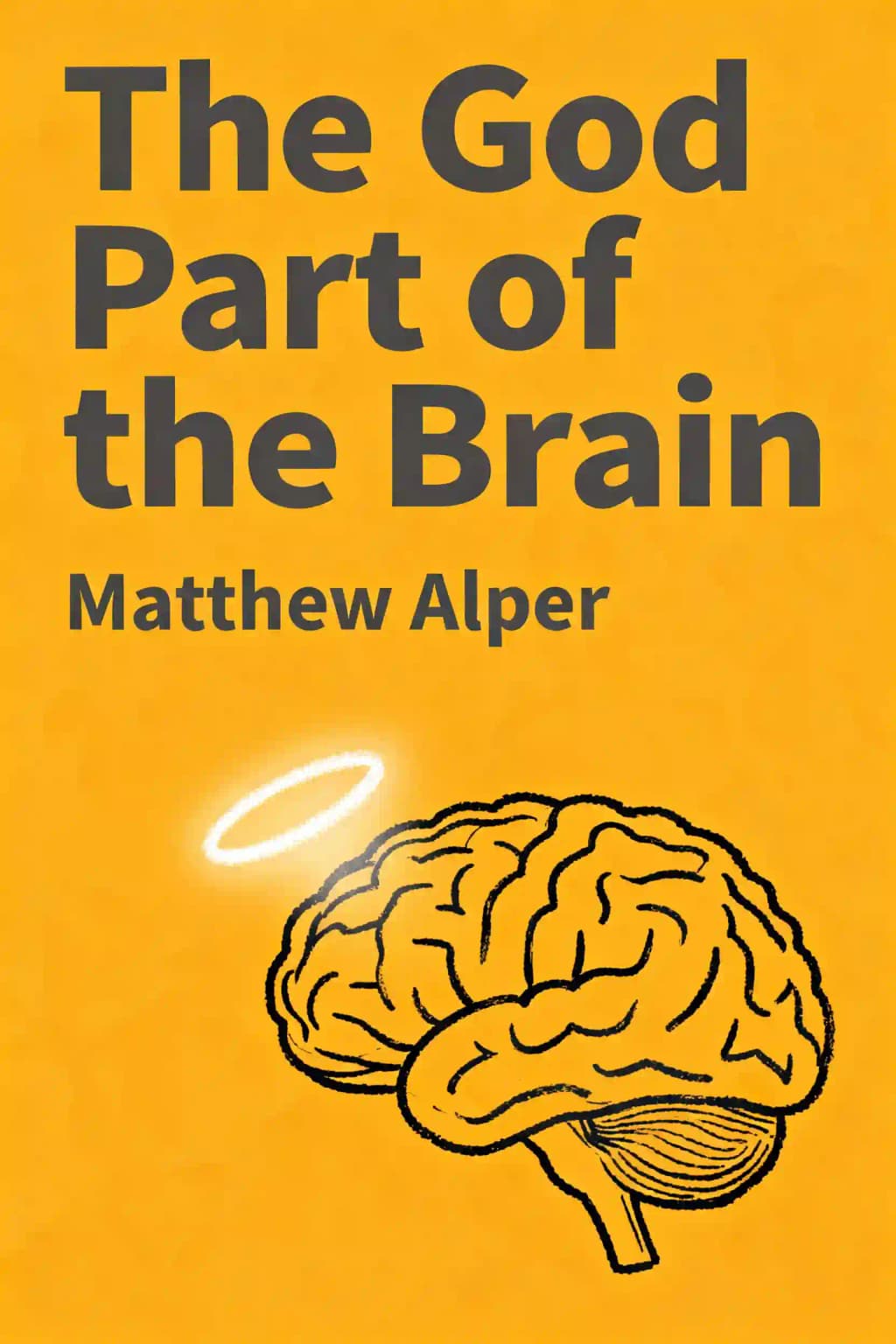
Is God hardwired in our brains? Matthew Alper's cult classic, adopted by 25+ universities, explores spirituality as evolutionary biology. Two-time Pulitzer winner E.O. Wilson called it "excellent reading" for challenging our fundamental understanding of belief itself.
Matthew Alper, author of The "God" Part of the Brain: A Scientific Interpretation of Human Spirituality and God, is a pioneering thinker in neurotheology, exploring the intersection of neuroscience and spiritual belief.
A philosophy graduate with a decades-spanning career spanning teaching, screenwriting, and anthropological fieldwork, Alper draws on eclectic experiences—from truck smuggling in Central Africa to lecturing on evolutionary psychology—to argue that spirituality arises from brain evolution.
His groundbreaking 1997 book, which posits that belief in God is a neurological adaptation, established him as a foundational voice in neurotheology and a prominent secular humanist. Alper’s work has been featured in The Washington Post, NBC, and Coast to Coast AM, and his memoir Icarus of Brooklyn delves into his existential quest and psychedelic explorations that informed his research.
A sought-after speaker, his ideas continue to shape debates on science, religion, and consciousness. The "God" Part of the Brain has been translated into multiple languages and remains a seminal text in the study of biological origins of spirituality.
The "God" Part of the Brain argues that spirituality stems from evolutionary brain adaptations rather than divine forces. Matthew Alper proposes that humans developed neurological mechanisms to cope with existential anxiety, framing spiritual experiences as biological survival tools. The book blends neuroscience, philosophy, and evolutionary theory to challenge traditional views of religion as metaphysical.
This book suits skeptics, believers, and anyone exploring spirituality’s origins through science. Neuroscience enthusiasts, philosophy students, and readers interested in neurotheology will find it compelling. Alper’s accessible style makes complex theories approachable for general audiences.
Yes—it’s praised as a pioneering "cult classic" in neurotheology. Critics highlight its bold synthesis of science and spirituality, though some contest its reductionist approach. It’s ideal for those open to rethinking spirituality’s biological roots.
Matthew Alper holds a BA in Philosophy of Science and wrote this book after diverse careers (teacher, screenwriter). His exploration of mental health and psychedelics informed his research on the brain’s spiritual functions.
Alper asserts spirituality arises from a brain region evolved to mitigate mortality anxiety. He posits a "spiritual gene" driving humans to seek transcendental meaning as an adaptive survival mechanism.
He attributes them to neurophysiological processes, like the "transcendental function" overriding ego-driven fear of death. Euphoric states during prayer or meditation are framed as brain-based coping strategies.
It’s considered foundational, predating modern neurotheology works. Unlike purely academic texts, Alper blends memoir and science, making it accessible yet controversial.
Critics argue it oversimplifies spirituality’s complexity and sidesteps "why" questions about consciousness. Some religious readers reject its biological reductionism.
He frames spirituality as a trait selected for survival, helping humans manage anxiety about mortality. This adaptation, he claims, enabled cooperation and meaning-seeking in early societies.
Its provocative thesis sparked debate, earning praise from scientists and skeptics alike. Over 25 years, it’s remained relevant for bridging science and spirituality accessibly.
He interprets them as brain-induced phenomena, where the "transcendental function" creates illusions of divine light or serenity to ease death anxiety.
Siente el libro a través de la voz del autor
Convierte el conocimiento en ideas atractivas y llenas de ejemplos
Captura ideas clave en un instante para un aprendizaje rápido
Disfruta el libro de una manera divertida y atractiva
Without God, however, we are merely mortal beings.
Science represents a constant contradiction to religion.
God was, at its most basic level, a
Desglosa las ideas clave de The "God" Part of the Brain en puntos fáciles de entender para comprender cómo los equipos innovadores crean, colaboran y crecen.
Destila The "God" Part of the Brain en pistas de memoria rápidas que resaltan los principios clave de franqueza, trabajo en equipo y resiliencia creativa.

Experimenta The "God" Part of the Brain a través de narraciones vívidas que convierten las lecciones de innovación en momentos que recordarás y aplicarás.
Pregunta lo que quieras, elige la voz y co-crea ideas que realmente resuenen contigo.

Creado por exalumnos de la Universidad de Columbia en San Francisco
"Instead of endless scrolling, I just hit play on BeFreed. It saves me so much time."
"I never knew where to start with nonfiction—BeFreed’s book lists turned into podcasts gave me a clear path."
"Perfect balance between learning and entertainment. Finished ‘Thinking, Fast and Slow’ on my commute this week."
"Crazy how much I learned while walking the dog. BeFreed = small habits → big gains."
"Reading used to feel like a chore. Now it’s just part of my lifestyle."
"Feels effortless compared to reading. I’ve finished 6 books this month already."
"BeFreed turned my guilty doomscrolling into something that feels productive and inspiring."
"BeFreed turned my commute into learning time. 20-min podcasts are perfect for finishing books I never had time for."
"BeFreed replaced my podcast queue. Imagine Spotify for books — that’s it. 🙌"
"It is great for me to learn something from the book without reading it."
"The themed book list podcasts help me connect ideas across authors—like a guided audio journey."
"Makes me feel smarter every time before going to work"
Creado por exalumnos de la Universidad de Columbia en San Francisco

Obtén el resumen de The "God" Part of the Brain como PDF o EPUB gratis. Imprímelo o léelo sin conexión en cualquier momento.
Why does every human civilization throughout history develop religious beliefs? From ancient cave paintings to modern cathedrals, our species demonstrates an unwavering tendency to perceive reality as divided between physical and spiritual realms. This universal pattern suggests something profound: either we've all independently discovered the same cosmic truth, or something within our shared biology compels us to see the world this way. What if our spiritual experiences aren't evidence of divine reality but rather the product of specialized neural circuitry that evolved to help us cope with mortality awareness? This question launched Matthew Alper on a quest worthy of an Arthurian knight seeking the Holy Grail. Abandoning conventional life, he journeyed through philosophy, theology, anthropology, and neuroscience in search of answers. After years wandering philosophical woods and studying ancient texts, he returned with what might be the most scientifically grounded explanation for why humans universally perceive a spiritual reality. The implications are staggering - if God exists primarily as a function of our brains, what does this mean for religion, meaning, and human purpose?