Capítulo 1
The Four Horsemen of the Digital Apocalypse
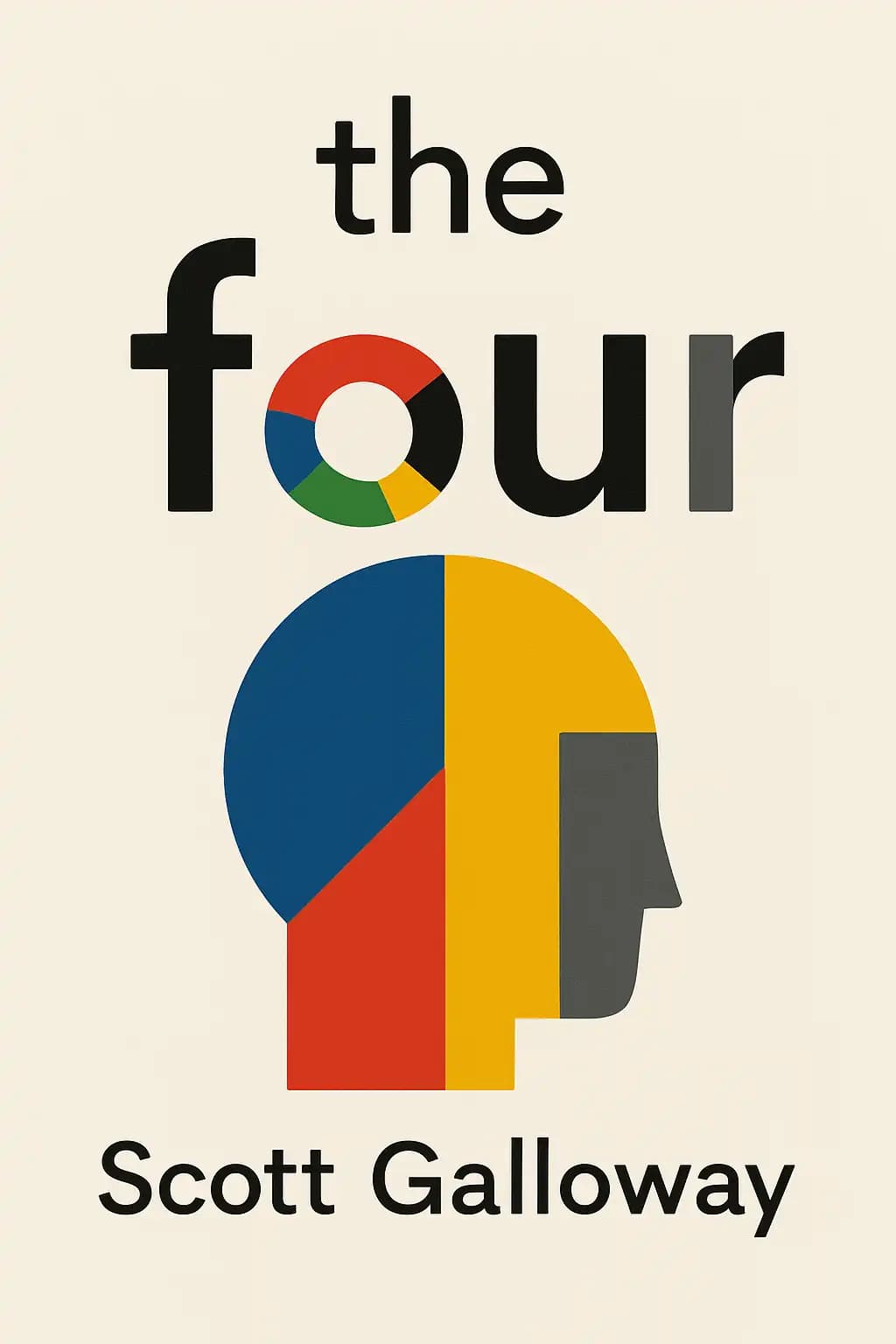
In an age where technology has become our oxygen, four companies have risen to godlike status, infiltrating every aspect of our lives. Amazon, Apple, Facebook, and Google-collectively worth over $2.3 trillion-have transformed from scrappy startups to global behemoths that shape how we shop, communicate, find information, and perceive ourselves. Scott Galloway's "The Four" has become required reading in Silicon Valley boardrooms and MBA programs alike, with tech luminaries from Satya Nadella to Sheryl Sandberg citing its insights. Even Barack Obama included it on his 2018 reading list, noting how it changed his perspective on modern monopolies. The book's cultural impact extends beyond business circles-it's sparked congressional hearings on tech regulation and inspired a generation of entrepreneurs to understand the new rules of digital dominance. As we surrender more of our data, dollars, and attention to these companies, Galloway's analysis becomes not just business strategy but a survival guide for the digital age.
Capítulo 2
The New Gods: How The Four Captured Our Primal Instincts
The Four Horsemen-Amazon, Apple, Facebook, and Google-have achieved unprecedented power by tapping into our most fundamental human drives. While they've created remarkable products and services, their true genius lies in how they've connected with our evolutionary psychology.
Amazon appeals to our hunter-gatherer instincts. For 90% of human history, we collected resources to survive scarcity-the downside of gathering too much was merely wasted effort, while too little meant death. This explains our compulsive collecting despite modern abundance. Amazon brilliantly channels this instinct through its "Earth's Biggest Store" promise, offering unparalleled selection and convenience. Jeff Bezos recognized that retail wasn't just about products but about satisfying our deep-seated gathering impulses. While traditional retail evolved from corner stores to department stores to malls to big-box discounters, Amazon reimagined the entire experience around our primal needs.
Apple taps into our desire for beauty, status, and transcendence-essentially, our yearning to feel closer to God and more attractive to potential mates. Steve Jobs intuitively understood that technology could be more than functional; it could be divine. Apple's products create the same emotional response as walking into a magnificent cathedral-a feeling of approaching perfection. By positioning itself as a luxury brand with the five key attributes (iconic founder, artisanship, vertical integration, global reach, and premium pricing), Apple achieves what no other tech company has managed: selling millions of products that only 1% of the world can rationally afford, capturing 92% of smartphone industry profits with just 18% market share.
Facebook exploits our fundamental need for connection. The Harvard Grant Study concluded after 75 years that "happiness is love"-relationships make us happier than any other factor. Facebook brilliantly facilitates these connections, giving us dopamine hits when we see friends' updates or receive likes on our posts. With 2 billion users spending 50 minutes daily on its platforms, Facebook has become humanity's connective tissue. It occupies the top of the marketing funnel-the "awareness" stage where we develop desires by seeing what others have and do.
Google has become our modern deity, answering 3.5 billion queries daily with the omniscience once attributed to gods. As traditional religion declines, particularly among educated populations, Google fills the void by providing immediate answers to every question. We place unprecedented trust in Google, sharing our deepest secrets-things we wouldn't tell priests, doctors, or loved ones. About one in six Google queries are questions never asked before, demonstrating extraordinary faith in its capabilities.
The Four have mastered what I call the "body framework"-appealing to different organs that drive human behavior. Google serves as our prosthetic brain, Amazon connects our brain to our acquisitive instincts, Facebook appeals to our hearts, and Apple migrated from the head to become a luxury brand appealing to our desire for beauty and status. This explains their extraordinary success-they've built their empires not just on technology but on a profound understanding of human nature.
Capítulo 3
Amazon: The Everything Store That Devours Retail
Amazon's path to dominance began with Jeff Bezos's vision of an "everything store," but its true power comes from a unique combination of storytelling and ruthless execution. Unlike traditional retailers who promise profits within years, Amazon replaced profits with vision through simple, powerful messaging: Earth's Biggest Store, achieved through investments in lower costs, greater selection, and faster delivery.
This storytelling gives Amazon exceptionally cheap capital-most retailers trade at 8x profits, while Amazon trades at 40x. This capital advantage enables Amazon to make massive investments that competitors can't match, like building warehouses near population centers to reduce shipping from two days to one. While competitors can't afford similar investments, Amazon goes underwater with the world's largest oxygen tank, forcing other retailers to follow and drown.
Amazon's culture embraces failure as the path to success-a distinctly American trait. The U.S., with its lenient bankruptcy laws, attracts risk-takers and produces most of the world's billionaires. This "failure gene" is central to Amazon's success-the ability to get up after being knocked down and swing harder the next time.
While e-commerce itself struggles with profitability, Amazon has leveraged its trusted brand to expand into highly profitable businesses. Amazon Web Services grew 49-81% in 2015 while retail grew only 13-20%, with AWS contributing 52% of Amazon's operating income. Amazon Media Group approaches Twitter's revenue levels, while Amazon Prime has penetrated 44% of U.S. households.
The future of retail belongs to multichannel integration. Consumers want the ability to reserve products on their phones, pay later, pick up in-store, and skip checkout lines. Amazon's acquisition of Whole Foods gives it 460 intelligent warehouses posing as stores, creating delivery hubs for Amazon Fresh and return locations for online orders.
Amazon's voice technology, Alexa, threatens the very foundation of brand building. When shopping migrates online, visual merchandising disappears, and voice further circumvents attributes brands have spent generations and billions building. L2's tests show Amazon offering lower prices on voice orders versus clicks, while steering customers toward Amazon Basics products in key categories.
While Jeff Bezos publicly advocates for universal minimum income, Amazon quietly revolutionizes warehouse operations with robotics. After acquiring Kiva Systems for $775 million in 2012, Amazon has been replacing human workers with robots. As Amazon grew revenues by $28 billion in 2016 in a flat retail environment, it likely destroyed 76,000 retail jobs that year alone.
Amazon has assembled all pieces for zero-click ordering: AI, purchase history, warehouses near 45% of Americans, millions of products, voice technology in wealthy households, cloud computing dominance, hundreds of physical stores, and the world's most trusted consumer brand. Amazon's machine learning capabilities will enable anticipatory retail-automatically sending products calibrated to customer needs based on returns and voice feedback.
What makes Amazon truly unstoppable is its willingness to sacrifice short-term profits for long-term dominance. While other companies focus on quarterly earnings, Amazon reinvests gross margin dollars back into the business. This strategy has created a virtuous cycle-lower prices lead to more customers, which attracts more sellers to the platform, which creates more selection and lower prices, which brings more customers. The result is a retail juggernaut that seems unstoppable in its march toward becoming the first trillion-dollar company.
Capítulo 4
Apple: The Luxury Brand That Transcends Technology
Apple has achieved what no other tech company has managed-transcending the brutal lifecycle of technology firms to become a multigenerational luxury brand. While most tech companies age in "dog years," rapidly rising and falling as innovation cycles accelerate, Apple has extended its life by transitioning from a tech company to a luxury brand.
This transformation began with Steve Jobs's instinctive understanding of elegance, evident from the 1977 Western Computer Conference where Apple's beautifully designed products stood out among ugly metal boxes. The iPod marked Apple's definitive shift toward luxury with its glossy white design standing out among awkward gray competitors. The company completed its metamorphosis with the Apple Watch, debuted by supermodels and advertised in Vogue rather than tech publications.
Apple's genius lies in creating meta-scarcity-selling millions of products that only 1% of the world can rationally afford. This explains how the iPhone captured just 18.3% of global smartphone shipments but 92% of industry profits in early 2015. iPhones map perfectly to wealth geography-Manhattan is iOS territory while the Bronx is Android; Beverly Hills uses iPhones while South-Central LA uses Android.
The company embodies the five key attributes of luxury brands. First, an iconic founder-Steve Jobs's compelling life story elevated him to mythic status, and his death in 2011 completed his transformation from icon to saint. Second, artisanship-Apple's luxury language is simplicity, "the ultimate sophistication," with meticulous attention to detail creating iconic products that appear effortless and inevitable.
Third, vertical integration-Apple's physical stores became temples to the brand, positioning Apple alongside luxury icons like Vuitton and Cartier on prestigious shopping streets. Apple Stores generate nearly $5,000 per square foot-50% more than their closest retail competitor. Fourth, global reach-Apple's 492 stores in exclusive shopping districts across 18 countries attract over 1 million daily visitors, a staggering number compared to Disney's Magic Kingdom's 20.5 million annual visitors.
Fifth, price premium-an iPhone 7 costs $749 versus a Blu R1 Plus at $159, following HP's strategy of making the best products and "charging the shit out of engineers desperate to buy them." This premium pricing has created casualties among mid-level luxury brands as young consumers prioritize phones over fashion.
While traditional business barriers to entry are crumbling in tech due to Moore's Law and digital innovation, successful firms must build deeper moats rather than taller walls. Apple's 492 retail stores form an impenetrable moat that competitors like Samsung would need decades to replicate. This physical retail presence creates a barrier that digital-only competitors cannot easily overcome.
Jobs wasn't an inventor but a visionary who understood luxury retail when others proclaimed the "disintermediation" of tech through e-commerce. He recognized that premium electronics must be sold like other luxury items-in "shining temples" with "brilliant lights" and "ardent young 'genius' salespeople." This strategy enabled Apple to achieve what no other luxury company has: being both the premium-priced product and the low-cost producer.
With cash reserves exceeding the GDP of Denmark, Apple could truly "dent the universe" by launching the world's largest tuition-free university. Education is ripe for disruption, with prices rising faster than healthcare while innovation stagnates. Instead, Apple continues to focus on what it does best-creating beautiful products that make us feel closer to perfection and more attractive to others, a strategy that has made it "the most profitable company in history."
Capítulo 5
Facebook: The Social Network That Owns Our Identities
Facebook may be the most successful enterprise in human history, with 2 billion users-more than the Catholic Church and approaching soccer's 3.5 billion fans in just a fraction of the time. Users spend 35 minutes daily on Facebook alone, and 50 minutes including Instagram and WhatsApp-more time than any behavior outside family, work, or sleep. At $420 billion market value, Facebook might even be undervalued considering its dominance.
Facebook creates desire by showing us what others have. It occupies the top of the marketing funnel-the "awareness" stage where we develop wants. When friends post images of J.Crew sandals in Mexico or drinks at Soho House Istanbul, we covet these experiences. Facebook has achieved what no media company ever has: combining massive scale (1.86 billion users) with precision targeting based on users' own detailed personal data.
With one-sixth of humanity using Facebook daily in 2017, the platform collects unprecedented data about who users are, what they like, and what they plan to do. This privacy nightmare is a marketer's dream, making traditional research methods obsolete. Facebook's app can even listen through your phone's microphone, analyzing ambient noise to determine who you're with and what you're doing. The platform's targeting capabilities have become so precise that with 150 likes, their model can predict someone's personality better than their spouse; with 300 likes, it understands you better than yourself.
The most successful companies in our algorithmically-driven economy reach billions of people while continuously learning from them. These "Benjamin Button" products become more valuable with use, unlike physical goods that depreciate. Facebook sits at the pinnacle of this graph, dominating both in reach and intelligence gathering. Its algorithms track usage to improve offerings, creating network effects where each user makes the platform more valuable.
When Snapchat emerged as a potential threat with its ephemeral photo-sharing and strong teen appeal, Facebook positioned itself to crush the young company. Facebook has systematically cloned Snapchat's features, including camera-first interfaces, Stories, selfie filters, and disappearing messages. The company's acquisition of Instagram for $1 billion in 2012-initially ridiculed-proved to be one of the greatest acquisitions in business history, now worth fifty-plus times the purchase price.
Google and Facebook are redrawing the media map, positioned to control more media spend than any two firms in history. They already control 51 percent of global mobile ad spend-ground zero for growth in media. In 2016, these two firms accounted for 103 percent of all digital media revenue growth, meaning that without them, digital media joins newspapers, radio, and broadcast TV as declining sectors.
Facebook's business model resembles Saudi Arabian oil fields-extracting maximum value from user data with minimal effort. While Saudi Aramco can produce oil at $3 per barrel and sell it for $50, it would be foolish for them to divert resources to expensive fracking operations. Similarly, Facebook's "oil" is the billions of identities it tracks in increasing detail. By analyzing users' clicks, likes, and posts, Facebook easily categorizes people into marketable buckets and serves them targeted content.
Facebook resists being labeled a media company despite 44 percent of Americans using it for news. This resistance stems from two factors: media companies receive lower stock valuations than tech firms, and media companies bear responsibility for editorial standards. Unlike traditional news outlets that attempt balance and fact-checking, Facebook optimizes solely for engagement and profit. The platform's algorithms don't distinguish between true and false stories-one click equals one click-leading to the proliferation of fake news.
While media platforms have empowered and connected billions, the shift from old to new media brings risks. Facebook and Google's "Don't call us media, we're a platform" stance represents a dangerous abdication of social responsibility. This enables authoritarians and hostile actors to exploit fake news, threatening modern civilization-as history shows that controlling and perverting media has been common to the greatest threats humanity has faced.
Capítulo 6
Google: The Modern Oracle That Knows Our Secrets
Google has become our modern religion, answering 3.5 billion queries daily with the omniscience once attributed to gods. As traditional religion declines in mature economies, particularly among the educated and internet users, Google fills the void by providing the knowledge and certainty humans crave.
Our fundamental desire for knowledge dates back to ancient times. While our ancestors lived with mysteries and unanswered prayers, Google provides immediate answers to every question. Unlike traditional religion that offered safety only to the righteous, Google delivers facts that calm our reptilian fear brain, satisfying our survival instinct with accessible information.
Google functions as a modern prayer system-we send our queries and receive answers from a higher intelligence. Unlike scientific attempts to prove prayer's effectiveness, prayers to Google are consistently answered. Anyone with a smartphone or internet connection can have any question answered, regardless of background or education level, with no judgment for asking "wrong" questions.
The trust we place in Google is unrivaled. Like a god, it knows our deepest secrets-things we wouldn't share with priests, doctors, or loved ones. About one in six Google queries are questions never asked before, demonstrating unprecedented trust. Google maintains its godlike status by clearly distinguishing between organic search results (appearing impartial and untethered from the marketplace) and paid content. This dual approach-preserving neutrality while generating ad revenue-creates a perception of fairness while allowing Google to profit by charging companies that want to intercept our hopes, dreams and worries.
Like the precogs in the film Minority Report, Google can predict the future through our search queries. People have typed in murder-related searches before committing crimes-from "necksnap break" to "could you kill someone in their sleep and no one would think it was murder?" This predictive power will grow more potent with AI layered over search data and movement tracking.
If Google is the internet age's god of information, the New York Times was its predecessor. The Times' motto "All the News That's Fit to Print" reflects its aspiration to judge what's important and what we should know. Yet despite doing journalism better than any media firm globally, the Times struggles to extract value from its newsroom-while Google and Facebook profit from Times content without providing much in return.
Google has achieved omniscience, if not omnipotence and immortality. Unlike Apple's luxury transformation, Google has become a public utility-ubiquitous, increasingly invisible, and so dominant its name risks becoming a verb. This dominance makes it uniquely vulnerable to antitrust suits, particularly from the EU which has filed four formal charges since 2015.
The genius of Google began in 1998 with Stanford students Sergey Brin and Larry Page, but the crucial step was hiring Eric Schmidt as CEO, who turned Google into his Pequod to harpoon Moby-Dick. Behind its friendly facade of goofy names, simple homepage, and "Do No Evil" philosophy, Google executed one of business history's most ambitious strategies: organizing all the world's information.
Another way Google cheats is by borrowing your information, only to sell it back to you. Google rapidly gutted media advertising revenue while claiming to provide "a valuable free service" to publishers. Marissa Mayer testified that newspapers had a "natural obligation" to let information be crawlable, suggesting they should be grateful despite Google's devastating impact on their business model. By 2016, information had become polarized by algorithms that determine your political viewpoint in milliseconds.
Google's dominance stems from its ability to function as our collective memory and information processor. We trust Google's results more than our own memories, making it the nerve center of our shared brain. It dominates knowledge while charging pennies, creating an intimate relationship despite its massive scale. This position at the center of our information ecosystem gives Google unprecedented power to shape how we understand the world.
Capítulo 7
The Horsemen's Playbook: Strategies for Digital Dominance
The Four haven't achieved their extraordinary success through conventional business practices. They've employed specific strategies that combine technological innovation with deep psychological insights and ruthless competitive tactics.
Stealing is a core competence of high-growth tech firms, despite our romantic view of entrepreneurs as maverick innovators. The Four didn't start as global megalodons but as improvisational garage projects that evolved through adaptation. Young companies with nothing to lose can get away with deception and thievery unavailable to established firms with reputations to protect.
The horsemen's sins fall into two categories: stealing IP from others while viciously protecting their own, and profiting from assets built by someone else. This explains why first-mover advantage is often not an advantage-industry pioneers end up with arrows in their backs while the horsemen arrive later to learn from their mistakes.
Great companies often rely on IP theft to grow at unprecedented speed and scale. The pattern resembles America's own development-as a scrappy startup nation, the U.S. stole British textile technology despite export prohibitions. Apple's famous "theft" follows this pattern-Steve Jobs turned Xerox's unfulfilled GUI vision into the industry-changing Macintosh, seeing value where others couldn't.
The Four have mastered what I call the "T Algorithm"-eight factors that enable trillion-dollar valuations: product differentiation, visionary capital, global reach, likability, vertical integration, AI, accelerant, and geography.
Product differentiation isn't just about the widget but can occur at discovery, purchase, delivery, or usage. Surprisingly, most value creation comes from removal-eliminating friction-rather than adding features. Amazon succeeds not just by offering more for less, but by removing the hassles of traditional shopping.
Visionary capital-the ability to attract cheap capital by articulating a bold, simple vision-creates a massive competitive advantage. Google's "organizing the world's information," Facebook's "connecting the world," and Amazon's customer-centric approach all captivate investors, resulting in lower capital costs. This enables them to place more bets on innovation, offer better employee benefits, and outspend competitors.
Global reach isn't just about accessing 7 billion consumers versus 300 million; it's about market diversity and countercyclical protection that investors reward with cheaper capital. Modern horsemen need their products to "get a passport" within five years. Apple defines global reach, being accepted in every sovereign nation.
Being perceived as likable creates a barrier against bad publicity and regulatory intervention. When Microsoft achieved influence, its lack of likability made it a target for district attorneys and regulators worldwide. By contrast, Google appears cuter than Microsoft, with Sergey, Larry, and Marissa Mayer presenting compelling public faces.
Vertical integration-controlling the consumer experience from production to sale-provides tremendous advantage. All Four control their distribution-they source, merchandise, retail, and support their products. Apple's genius move into retail put them on track to trillion-dollar status.
Mastery of data and AI enables continuous improvement through learning algorithms. The Four have become "wizards" with unprecedented understanding of customers through data collection and analysis. Google aggregates intention data, Facebook connects activities to specific identities, Amazon knows shopping patterns, and Apple tracks media preferences.
Being perceived as a career accelerant attracts top talent. The war for tech-enabled talent is the number one issue for all Four firms. Their reputation among potential employees may be even more important than consumer brand equity. The Four are known for propelling talented twenty-somethings to impressive roles, compensation, and prestige by thirty.
Geography matters-few companies have added tens of billions in value without being near world-class technical universities. Three of the Four (Apple, Facebook, Google) are near Stanford and UC Berkeley, while Amazon is close to University of Washington. Like electricity plants built near coal mines, tech companies must be near their raw material: top engineering, business, and liberal arts graduates.
Capítulo 8
The Fifth Horseman: Who Could Join the Tech Titans?
At some point, there will be a Fifth Horseman-a trillion-dollar company with market dominance-or one of the Four will be replaced. Several contenders show promise but face significant challenges in matching the Four's combination of advantages.
Alibaba has already surpassed Walmart to become the world's largest retailer, managing $485 billion in gross merchandise value while collecting only $15 billion in revenue. Dominating 63% of China's retail commerce with nearly half a billion active users, Alibaba has reshaped China's retail landscape. Despite its massive scale and successful $25 billion IPO, Alibaba faces significant challenges to global dominance: heavy dependence on the volatile Chinese market, lack of brand recognition in the West, entanglements with the Chinese government that concern Western investors, and challenges recruiting top talent outside China.
Tesla has accomplished more than any startup automobile company in recent memory, positioning itself as the market leader in electric vehicles. Its Model S received unprecedented industry acclaim while its forthcoming $35,000 Model 3 generated 325,000 reservations within a week. Tesla's advantages include unparalleled product quality, technical innovation, and vertical integration through owned dealerships and direct customer relationships. Despite never recording a profitable quarter, Tesla trades at nine times revenue versus traditional automakers' 0.5 times, demonstrating investors' belief in Elon Musk's vision.
Uber has built a massive global network with 2 million drivers-more than Delta, United, FedEx, and UPS combined-operating in 81 countries and 581 cities. The service has become the default transportation solution for urban dwellers worldwide, disrupting traditional taxi services. Despite its $70 billion valuation and strong position in the T Algorithm, Uber faces significant likability challenges from its controversial leadership culture, sexual discrimination charges, regulatory conflicts, and questions about its impact on employment relationships.
Despite looking like a dinosaur in the digital age, Walmart remains formidable with nearly 12,000 stores across 28 countries, generating more revenue than any other company in the world. These locations serve as potential warehouses, customer service centers, and showrooms-a significant market advantage as e-commerce firms realize physical infrastructure is essential. While Walmart has access to immense capital, it trades at a profit multiple typical for retail, making investors punish any earnings hits from increased capital expenditures.
Though no longer the dominant "Beast of Redmond," Microsoft still powers 90% of desktop computers with Windows, while Office remains the default productivity suite. Its enterprise focus provides a marketplace with less competition than consumer tech. Microsoft has found new growth through its cloud offering Azure and its acquisition of LinkedIn-the professional counterpart to Facebook with three distinct revenue streams (advertising, recruiter access, premium subscriptions).
Unlike Uber, Airbnb has significant product differentiation-a houseboat in Marin differs dramatically from a townhouse in South Kensington. This variance gives Airbnb stronger competitive positioning than Uber, whose service is increasingly indistinguishable from competitors like Lyft. Airbnb has also achieved more impressive liquidity, requiring critical mass of supply in individual cities plus global demand awareness, whereas Uber only needs local liquidity in each market.
The most likely Fifth Horseman will combine several key elements: a differentiated product that creates enormous value by removing friction, a visionary leader who can articulate a compelling story to attract cheap capital, global reach that transcends cultural boundaries, a likable brand that avoids regulatory scrutiny, vertical integration that controls the customer experience, sophisticated AI and data capabilities, status as a career accelerant for top talent, and proximity to world-class universities. While several contenders show promise in some areas, none yet matches the Four's complete package of advantages.
Capítulo 9
Surviving and Thriving in the Age of the Four
The digital economy has created a winner-take-all marketplace where exceptional performers command outsized rewards while average ones stagnate. LinkedIn has put everyone on a global job market, where the exceptional are constantly recruited while the merely good compete with millions worldwide. The gap between good and great might be just 10 percent in skill but translates to 10x difference in rewards.
While intelligence, hard work and treating people well remain fundamental, emotional maturity has become the critical differentiator in the digital age. Workers must respond to multiple stakeholders and constantly shift between roles, requiring poise under stress and adaptability. Those who manage their emotions, take direction well, and understand group dynamics thrive in fluid organizational structures.
Despite famous dropouts like Zuckerberg and Gates, college remains essential for white-collar success. Even these tech titans benefited significantly from their brief college experiences. College graduates earn ten times more over their lifetime than those with only high school diplomas. Beyond education, prestigious universities provide networking opportunities with bright minds and future successful connections.
For those unable to attend college, alternative credentials like CFA, CPA, Union Card, Pilot's Instrument Rating, or RN certification provide necessary differentiation in a competitive global market. Achievement is a transferable habit that can be cultivated across domains. Winners are competitors willing to risk failure by stepping onto the field.
Despite digital utopian predictions about remote work, wealth and opportunity have concentrated in cities, where over 80% of global GDP is generated. Cities consistently outperform their countries in growth, with 36 of the world's 100 largest economies being U.S. metropolitan areas. A young person's geographic trajectory serves as a strong predictor of career success.
Beyond developing core skills, career advancement requires strategic self-promotion. Identify your ideal medium to showcase your work. The path to under-compensation is doing excellent work that never gets explicitly attached to you. Building an audience takes persistent effort.
True wealth comes from equity, not paychecks. Aim to have equity comprise 10% of compensation by age thirty and 20% by forty. Without company equity options, create your own through tax-advantaged accounts and disciplined saving. The definition of rich isn't high income but when passive income exceeds living expenses.
External hires earn nearly 20% more than company veterans despite lower performance, so practice serial monogamy in your career. Dedicate yourself fully to a good employer for 3-5 years where you can gain skills and sponsorship. When appropriate, explore options and be transparent with your current employer about attractive offers.
Corporations aren't people-they have "neither bodies to be punished, nor souls to be condemned." They don't deserve your loyalty and can't return it. Organizations that demand loyalty are often manipulating you. Instead, be loyal to actual people who value relationships.
"Follow your passion" is advice from people who are already rich. Instead, follow your talent. Identify what you're naturally good at and commit to becoming exceptional at it-you don't have to love it initially, just don't hate it. Excellence leads to recognition and compensation, which creates enjoyment.
Don't expect justice in the corporate world. You'll face unfair treatment and impossible situations beyond your control. Accept that some failure isn't your fault, but be gracious regardless of circumstances. The best revenge is living well and forgetting those who wronged you.
Nothing is ever as good or bad as it seems-all situations eventually normalize. After major success, be risk-averse; regression to the mean is powerful, and good luck inevitably reverses. Similarly, when beaten down, remember you're not as incompetent as circumstances suggest. The key is resilience-getting up after being knocked down and swinging harder.
Capítulo 10
The World After the Four: Implications for Society
The Four create enormous value but also concentrate unprecedented power. While they improve billions of lives daily through their manifestation of "god, love, sex, and consumption," they also avoid taxes, invade privacy, and destroy jobs because they can. The scale of their success is staggering-Facebook reached 1 billion users in less than a decade and is valued at $448 billion with just 17,000 employees, while Disney, worth less than half that, employs 185,000 people.
This concentration of wealth creates growth without broad prosperity. Unlike industrial giants like GM and IBM that employed hundreds of thousands with middle-class wages, the Four collectively employ only 418,000 people (Minneapolis's population) while amassing $2.3 trillion in value (comparable to France's GDP). This distortion hollows out the middle class, bankrupts towns, and fuels political anger.
Despite having far less computing power in the mid-twentieth century, humanity tackled enormous projects like the Manhattan Project (130,000 people) and the Apollo program (400,000 workers). Today, the Four horsemen possess near limitless computing power, generations of research on AI and optimization, and employ some of the most intelligent people ever. Yet what is their ultimate mission? Not curing cancer or eliminating poverty, but "to sell another fucking Nissan."
The old economy created broader prosperity-Unilever's $156 billion market cap supports 171,000 middle-class households, while Facebook's $448 billion supports just 17,000 employees. America is becoming a nation of 3 million lords and 350 million serfs.
The retail transformation is creating devastating consequences for ordinary workers. The author recalls working as a box boy earning $13/hour as a union member, which paid for his UCLA education in 1984. Today's retail environment increasingly divides into two segments: "scale" stores using robots and technology to deliver 90% quality at 60% price, and high-end stores where employees are experts serving wealthy customers. This bifurcation means fewer opportunities for "remarkably unremarkable" people who once found decent-paying retail jobs that supported middle-class lives.
Not all retailers are doomed. A "rebel force" of innovative companies like Sephora, Home Depot, and Best Buy are successfully fighting Amazon by investing heavily in both people and technology. They recognize that consumers no longer visit stores just for products (which Amazon delivers easily) but for expertise and human interaction. Whether this human-centric strategy or Amazon's efficiency-focused approach will ultimately prevail remains uncertain, with millions of jobs hanging in the balance.
While Facebook and Google's "Don't call us media, we're a platform" stance represents a dangerous abdication of social responsibility, enabling authoritarians and hostile actors to exploit fake news. Without a protected fourth estate pursuing truth, we risk that "the next big medium may, again, be cave walls."
Understanding the Four provides insight into our digital age and building economic security, even if fighting them may be futile. The Four will eventually die-the mortality rate in business is 100 percent. The question is when, and by whose hand. Until then, they will continue reshaping our economy, our society, and ourselves in profound and often unsettling ways.