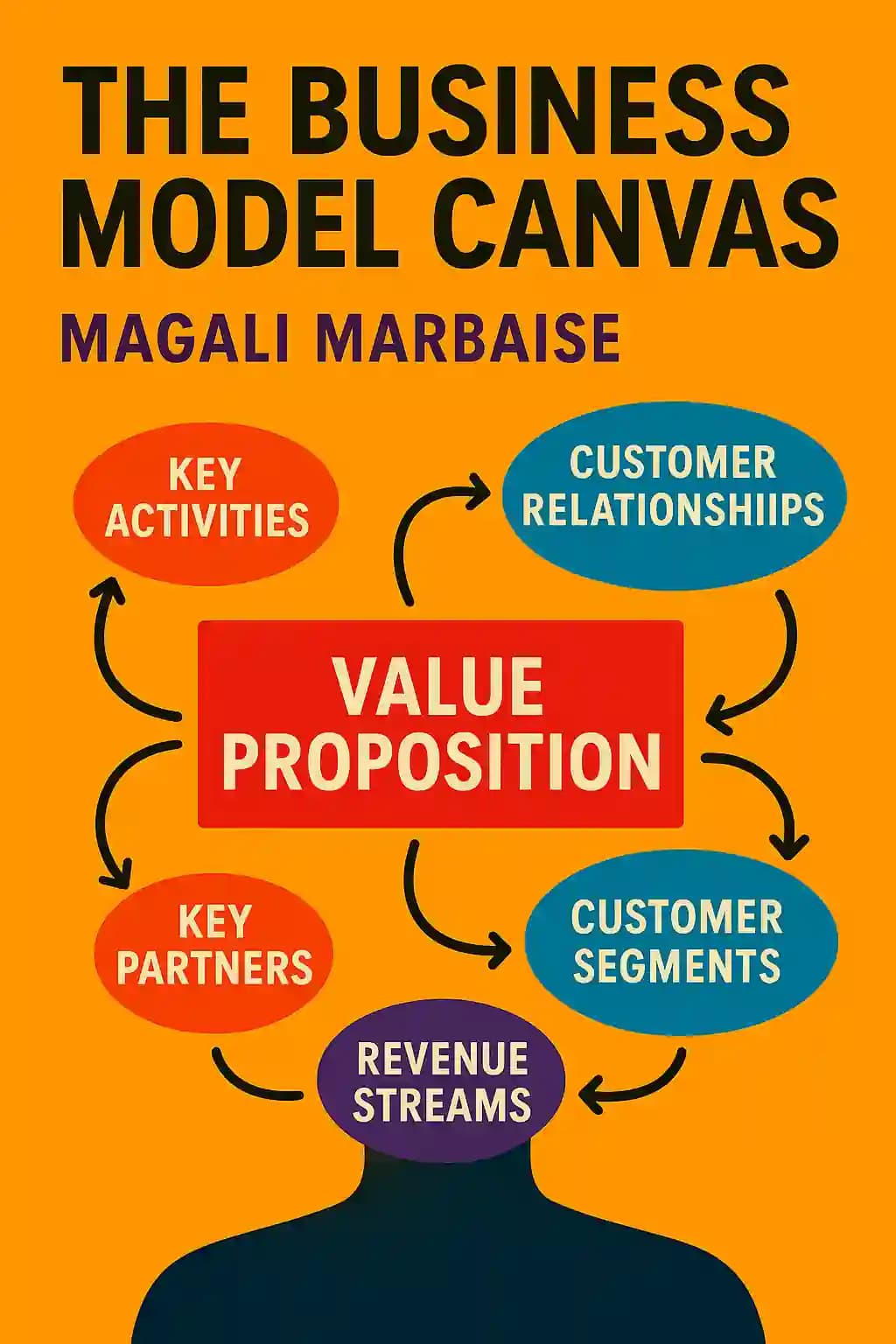
Capítulo 1
Reimagining Business: The Canvas That Changed Entrepreneurship
When Alexander Osterwalder and Yves Pigneur published "Business Model Generation" in 2010, few could have predicted how their visual framework would revolutionize business planning worldwide. The Business Model Canvas quickly became the go-to tool for entrepreneurs from Silicon Valley startups to Fortune 500 boardrooms. Tim Ferriss, author of "The 4-Hour Workweek," credits the canvas with helping him structure his business ventures, while companies like Nestle and Microsoft have incorporated it into their innovation processes. What makes this deceptively simple nine-box template so powerful? Unlike traditional business plans that gather dust on shelves, the canvas transforms abstract business concepts into tangible, visual components that anyone can understand and modify. It's not just a planning tool-it's a new language for business innovation that has spread to over 45 countries and been translated into 30 languages, becoming standard curriculum in business schools globally.
Capítulo 2
The Anatomy of Business Innovation: Breaking Down the Canvas
The Business Model Canvas stands apart from traditional business planning approaches through its elegant simplicity and visual nature. Rather than producing lengthy documents filled with assumptions and projections that quickly become outdated, the canvas distills business essentials onto a single page. This visual thinking approach creates an accessible, readable system that entrepreneurs can use to reflect on their business model at a glance.
The genius of the canvas lies in its non-linear approach. Unlike traditional business plans that follow a rigid sequence, the canvas allows users to jump between different elements, making connections and spotting inconsistencies immediately. This flexibility encourages creative thinking and rapid iteration-essential qualities in today's fast-changing business environment.
The canvas consists of nine carefully arranged, interrelated blocks that create synergies resulting in unique strategies for each company. These nine components don't exist in isolation; they form an interconnected ecosystem where changes in one area ripple throughout the entire model. For example, adding a new customer segment might require different channels, relationships, and perhaps even resources or partnerships.
What makes the canvas particularly valuable for entrepreneurs in small businesses or startups is that it doesn't require a strongly hierarchical structure. Instead, it offers a systematic approach to articulate different components of the business without imposing unnecessary complexity. This accessibility democratizes business planning, making strategic thinking available to anyone with a vision-not just those with MBA degrees or consulting backgrounds.
The canvas also serves as a powerful communication tool. When team members, investors, or partners can literally see the business model laid out before them, conversations become more productive. Abstract concepts transform into concrete elements that can be discussed, challenged, and refined. This visual representation creates a shared language that bridges the gap between different functional areas and expertise levels within an organization.
By organizing ideas in template boxes, users move quickly and effectively to action rather than getting lost in theoretical discussions. The overview provided helps define priorities, create concrete action plans, and adopt a creative, adaptable approach that simplifies business development while improving customer interactions and boosting employee communication.
Capítulo 3
Creating Value: The Heart of Every Business Model
At the core of the Business Model Canvas lies a fundamental question: How does your business create value? This question drives the exploration of seven interconnected components that collectively define a company's value creation system.
The value proposition sits at the center of this system-it's the promise you make to customers about the problems you'll solve or the needs you'll fulfill. Think about how Airbnb doesn't just offer accommodations but promises authentic local experiences, or how Tesla doesn't just sell cars but offers environmental consciousness combined with cutting-edge technology. A compelling value proposition articulates why customers should choose your offering over alternatives. It might focus on newness (like the first iPhone), performance (like BMW), customization (like Nike's personalized shoes), design (like Apple products), brand/status (like Rolex), price (like Walmart), cost reduction (like Salesforce's cloud software), risk reduction (like insurance products), accessibility (like car-sharing services), or convenience (like food delivery apps).
To deliver this value proposition, companies need key resources-the assets that power the business model. Physical resources might include manufacturing facilities or retail locations; intellectual resources encompass brands, patents, and proprietary knowledge; human resources represent the talent and expertise within the organization; and financial resources cover the capital needed to operate. Consider how differently Netflix (digital content and algorithms) and Starbucks (prime retail locations and trained baristas) allocate their resources based on their distinct business models.
These resources enable key activities-the critical tasks a company must perform to make its business model work. For a software company, this might be development and platform maintenance; for a consulting firm, problem-solving and networking; for a manufacturer, production and supply chain management. Amazon's key activities include not just selling products online but maintaining a massive logistics infrastructure and developing cloud computing services.
No company operates in isolation, which is why key partnerships form another crucial element. These strategic relationships with suppliers, collaborators, or even competitors strengthen a company's market position and extend capabilities beyond internal resources. Consider how Apple partners with manufacturers like Foxconn, content creators for its App Store, and even competitors like Microsoft for office software on Mac computers. Smart partnerships allow companies to focus on their core strengths while leveraging others' expertise in complementary areas.
The value created must reach the right customer segments-groups of people or organizations with common needs, behaviors, or attributes. These might be segmented by demographics, psychographics, geography, or behavior. Some businesses serve mass markets (like consumer goods), while others focus on niche markets (like specialized medical devices), multi-sided markets (like credit card companies serving both cardholders and merchants), or segmented markets (like banks offering different services to different wealth brackets).
To connect with these customers, companies need appropriate channels-interfaces for delivering the value proposition. These might include direct channels like company websites or stores, or indirect channels like wholesale distribution or partner retailers. The channel mix affects both customer experience and economics of the business model. Consider how Nike balances direct sales through its website and stores with distribution through sporting goods retailers and department stores.
Finally, customer relationships define how companies establish and maintain connections with each customer segment. These might range from personal assistance (like luxury retail) to self-service (like gas stations), automated services (like online banking), communities (like user forums), or co-creation (like Lego's design competitions). The relationship strategy significantly impacts customer acquisition, retention, and upselling opportunities.
When these seven elements work in harmony, they create a coherent value creation system that differentiates a company from competitors and establishes its unique position in the marketplace. The brilliance of the canvas is that it makes these connections visible and tangible, allowing entrepreneurs to spot inconsistencies or opportunities that might otherwise remain hidden.
Capítulo 4
Financial Equilibrium: Balancing Costs and Revenue
While creating value is essential, capturing that value in the form of sustainable revenue is what ultimately determines a business model's viability. The financial aspects of the Business Model Canvas address this critical dimension through two key components: cost structure and revenue streams.
The cost structure identifies what parts of the business incur costs and how these costs behave. Some businesses are cost-driven, focusing primarily on minimizing expenses (like budget airlines), while others are value-driven, prioritizing premium value creation over cost considerations (like luxury hotels). Costs can be fixed (rent, salaries) or variable (raw materials, transaction fees), and many businesses experience economies of scale (costs decreasing as volume increases) or economies of scope (costs decreasing as the business diversifies).
Understanding your cost structure requires honest assessment of what drives your expenses. For a software company, developer salaries might represent the largest cost; for a retailer, inventory and real estate; for a manufacturer, raw materials and equipment. The canvas prompts you to identify not just the obvious costs but the hidden ones that might undermine profitability if overlooked.
Revenue streams, on the other hand, determine how a company actually makes money from each customer segment. The diversity of potential revenue models is remarkable, extending far beyond simple product sales:
Asset sales involve transferring ownership rights for physical products (like retail goods or cars). Usage fees charge for the use of a particular service, with payment based on the extent of use (like telecommunications or hotels). Subscription fees provide continuous access to a service (like Netflix or gym memberships). Lending/renting/leasing grants temporary exclusive usage rights for an asset over a fixed period (like car rentals or equipment leasing).
Licensing allows customers to use protected intellectual property in exchange for fees (like software licenses or music rights). Brokerage fees derive from intermediation services between parties (like real estate agents or payment processors). Advertising generates revenue by featuring specific products, services, or brands in various contexts (like media companies or search engines).
Each revenue stream may have different pricing mechanisms-fixed menu pricing (predetermined prices based on static variables), dynamic pricing (prices that change based on market conditions), auctioning (price determined by competitive bidding), yield management (price based on inventory and time of purchase), real-time market pricing, or negotiation.
The relationship between cost structure and revenue streams determines financial viability. A sustainable business model generates revenue that consistently exceeds costs over time, creating profit that can be reinvested in growth or distributed to shareholders. The canvas helps visualize this relationship, making it easier to identify potential imbalances or opportunities for optimization.
Consider how different this looks across business models: A software-as-a-service company might have high initial development costs but low marginal costs for each additional user, with subscription revenue providing predictable, recurring income. A restaurant, by contrast, faces significant ongoing costs for ingredients, labor, and real estate, with revenue coming primarily from individual meal purchases. The canvas helps entrepreneurs understand these dynamics and design models appropriate for their specific context.
What makes the financial components particularly valuable is how they connect to the value creation elements. Changes in customer segments, value propositions, or channels inevitably impact both costs and revenues. By making these connections explicit, the canvas helps entrepreneurs develop financially sustainable models that deliver value to customers while capturing sufficient value for the business.
Capítulo 5
Workshop Magic: Bringing the Canvas to Life
The true power of the Business Model Canvas emerges when it moves from theory to practice through interactive workshops. These sessions transform abstract business concepts into tangible strategies through a collaborative, visual process that engages diverse perspectives.
Imagine a large room with a giant canvas drawn on paper covering an entire wall. Participants gather around with stacks of colorful sticky notes and markers in hand. The energy is palpable-this isn't a passive presentation but an active co-creation process. The workshop facilitator explains the nine components of the canvas, and then the magic begins.
Participants start placing sticky notes on the canvas, each representing an element of the business model. Someone might write "24/7 customer support" on a note and place it under "Value Proposition." Another person might add "Technical expertise" under "Key Resources." As the canvas fills up, patterns emerge, connections become visible, and gaps in thinking are exposed.
What makes this approach so effective is its flexibility and inclusivity. The sticky notes can be moved, removed, or replaced as discussions progress. Nothing feels permanent, which encourages experimentation and reduces resistance to new ideas. A junior employee might feel comfortable suggesting a radical channel strategy when it's just a sticky note that can easily be repositioned rather than a formal proposal that could be rejected.
The workshop structure typically involves asking targeted questions for each component: What unique value do we provide? Which customer problems are we solving? How do customers want to be reached? What key resources power our business? These questions stimulate focused discussion and prevent conversations from wandering into unproductive territory.
The simplicity of the format-just nine boxes and some sticky notes-belies its power to stimulate creativity while involving employees from all levels. A receptionist might offer insights about customer pain points that executives have never considered. A technical specialist might identify resource constraints that would otherwise be overlooked. This cross-functional collaboration leads to more robust, realistic business models than those developed in isolation by leadership teams.
For maximum effectiveness, workshops should include participants from different departments, experience levels, and perspectives. An impartial facilitator can help challenge assumptions and ensure all voices are heard. The process should balance structure with flexibility, allowing for both divergent thinking (generating many possibilities) and convergent thinking (selecting the most promising options).
After the initial model is developed, companies should regularly test their assumptions, using hypotheses to fine-tune the model as the business evolves. The canvas isn't meant to be created once and filed away-it's a living document that should be revisited and revised as market conditions change, customer needs evolve, and new opportunities emerge.
When rethinking an existing business model, leaders should ensure their approach is legitimate and consistent, involving all company levels for comprehensive input. They should assess existing elements before deciding whether to start fresh, and designate a project leader to ensure smooth implementation of new guidelines that emerge from the workshop.
The workshop approach transforms the canvas from a static template into a dynamic tool for business transformation-one that harnesses collective intelligence and creates shared ownership of the resulting strategy.
Capítulo 6
Case Study: Reinventing the Bookstore
Let's step into a real-world application of the Business Model Canvas through the story of a traditional bookstore facing industry disruption. With online retailers capturing increasing market share and local competitors intensifying pressure on the school textbook market, this non-specialized bookstore finds itself at a crossroads. The store manager, recognizing the need for strategic renewal, gathers staff from all departments-from veteran booksellers to cashiers to stock managers-for a canvas workshop.
As the team assembles around the large paper canvas, the manager explains they have complete freedom to begin with any section of the model. They decide to start with customer segments, identifying their current focus: schools, universities, libraries, and loyal pensioners who value personal recommendations. This prompts discussion about segments they're not effectively serving-particularly younger readers who increasingly shop online.
Moving to value proposition, they list their current strengths: wise advice from knowledgeable staff and competitive pricing on textbooks. But the conversation reveals limitations: their expertise is strong in literature but weaker in specialized technical fields, and their pricing advantage is eroding as online competitors offer deeper discounts.
Examining channels, they note their reliance on traditional communication methods-email, telephone, and in-person interactions. The store's website exists but functions primarily as a digital business card rather than a sales channel. This realization sparks debate about digital transformation possibilities.
For customer relationships, they identify their trust-based connections with institutional buyers and individual customers who value personalized recommendations. These relationships represent a significant competitive advantage but require substantial time investment from experienced staff.
Revenue streams analysis reveals heavy dependence on direct sales and institutional invoicing, with predictable seasonal patterns tied to academic calendars. The team recognizes their vulnerability to disruption in these traditional revenue models.
Turning to key resources, they acknowledge their human expertise as their greatest asset, along with favorable financial arrangements with suppliers that enable competitive pricing. However, they lack digital infrastructure and have limited physical space that constrains inventory diversity.
Key activities include market research to anticipate demand for textbooks and the cultivation of bookseller expertise through ongoing training. The team realizes they've neglected activities related to digital presence and community building.
For key partnerships, they list specialized suppliers and distributors who provide favorable terms. Discussion reveals potential for new partnerships with local cultural institutions or even limited collaboration with competitors on special orders.
Finally, examining cost structure highlights ordering costs and high salary expenses for knowledgeable staff. The analysis shows that personnel costs, while essential to their value proposition, create financial pressure as margins shrink.
With this comprehensive picture of their current model visible on the canvas, the team begins reimagining their approach. They add, remove, and rearrange sticky notes, exploring possibilities for each component. The physical nature of the canvas makes the process tangible and engaging, with employees from all levels contributing insights.
The revised model that emerges places the customer at the heart of their strategy. They decide to optimize their value proposition by doubling down on expertise in carefully selected niches while developing a more robust online presence. They plan to enhance customer relationships through literary events and reading groups that create community connections beyond transactions.
Their new configuration addresses various customer segments more intentionally-from loyal older customers who value in-person service to younger readers who might be attracted by digital engagement and special events. They revise key activities to include readings, literary events, and enhanced employee training in digital tools.
The cost structure shifts to accommodate website development while maintaining investment in knowledgeable staff. New partnerships with local cultural institutions and independent publishers are identified to create unique offerings unavailable from online giants.
Communication channels are expanded, particularly through website enhancement that transforms it from an information portal to an engagement platform with ordering capabilities, event registration, and community features.
This reimagined business model doesn't abandon the bookstore's core identity but evolves it to meet changing market realities. By placing the customer at the center and systematically addressing each canvas component, the team develops a more resilient, responsive approach that builds on strengths while addressing vulnerabilities.
The case illustrates how the canvas transforms abstract strategic challenges into concrete, actionable plans through collaborative visualization and systematic thinking. The bookstore emerges with not just a new strategy but a shared understanding among staff of how the business creates and captures value in a changing landscape.
Capítulo 7
Beyond the Canvas: Addressing Limitations
While the Business Model Canvas offers tremendous value as a strategic tool, understanding its limitations is essential for using it effectively. Like any framework, it excels in certain contexts but may need supplementation in others to provide a complete picture of business strategy.
The first significant limitation is the canvas's focus on value proposition over broader strategic goals. While articulating how a business creates value for customers is crucial, it doesn't fully address longer-term strategic positioning or organizational purpose. The canvas helps answer "how" questions about business operations but provides less guidance on "why" questions about organizational direction and competitive advantage.
This limitation becomes particularly apparent when working with multidisciplinary organizations. The canvas applies beautifully to single-activity companies like startups or focused business units, but its simplicity can become a constraint when mapping complex enterprises with multiple business lines, diverse customer segments, and varied revenue models. A global conglomerate might need multiple canvases for different divisions, potentially missing important synergies or conflicts between them.
Perhaps the most significant blind spot is the canvas's limited consideration of competition. By focusing primarily on internal structures and customer relationships, it can create an insular view that doesn't adequately account for competitive forces shaping the market. A business model might appear sound in isolation but prove unsustainable when subjected to competitive pressures or industry disruption.
Additionally, the canvas provides only static analysis at a given moment rather than accounting for business evolution over time. It captures a snapshot of the current or desired state but doesn't inherently incorporate mechanisms for tracking changes, planning transitions, or managing the dynamics of business transformation. This can be problematic in rapidly evolving industries where yesterday's winning model quickly becomes today's liability.
Fortunately, these limitations can be addressed by complementing the canvas with other strategic tools. The BCG (Boston Consulting Group) matrix offers a valuable complement by evaluating both product markets and growth prospects through four strategic business categories: stars (high growth, high market share), question marks (high growth, low market share), cash cows (low growth, high market share), and dogs (low growth, low market share).
This portfolio analysis helps companies determine priorities within their product lineup, ensuring long-term value creation and effective cash flow management-strategic elements the canvas doesn't directly address. While the canvas helps define how a business operates, the BCG matrix helps determine where to allocate resources across different business activities.
Similarly, Porter's Five Forces model fills the competitive analysis gap by determining industry attractiveness through examination of five key forces: threat of new entrants, threat of substitute products or services, bargaining power of customers, bargaining power of suppliers, and competitive rivalry within the industry. This framework helps businesses understand their competitive advantage through their ability to generate profits or capture resources in the context of these forces.
By combining the Business Model Canvas with these complementary tools, organizations can develop more comprehensive strategies that address both operational design (how the business works) and strategic positioning (where the business stands relative to competitors and market forces). The canvas serves as an excellent starting point-providing clarity, alignment, and a shared language-but benefits from integration with other frameworks that address its blind spots.
The most effective approach is to view the canvas not as a complete strategic solution but as a powerful component in a broader strategic toolkit. Used in this way-with awareness of both its strengths and limitations-it becomes even more valuable for business planning and innovation.
Capítulo 8
Transforming Ideas into Action: The Canvas as Catalyst
The Business Model Canvas isn't just a planning tool-it's a catalyst for transformation that bridges the gap between strategic thinking and practical implementation. Its greatest strength lies in its ability to convert abstract business concepts into tangible actions that drive organizational change and market innovation.
What makes the canvas particularly powerful is how it democratizes business planning. Traditional business plans often become the domain of specialists-consultants, MBAs, or dedicated planning departments-creating distance between strategy formulation and execution. The canvas, by contrast, invites participation from throughout the organization, breaking down silos and creating shared ownership of the resulting strategy.
This inclusive approach yields multiple benefits. It surfaces insights from those closest to customers, operations, and products that might otherwise be missed in top-down planning processes. It builds buy-in and commitment from those who will implement the strategy, reducing resistance to change. And it creates a common language that helps align diverse functions around a coherent vision of how the business creates and captures value.
The visual nature of the canvas also accelerates decision-making and adaptation. When the entire business model is visible on a single page, interconnections become apparent, trade-offs become explicit, and inconsistencies become obvious. This visibility enables faster identification of both problems and opportunities, allowing organizations to respond more nimbly to changing market conditions or internal constraints.
For entrepreneurs and startups, the canvas provides structure without rigidity-offering guidance while preserving the flexibility essential for innovation. It helps focus limited resources on the most critical aspects of the business while ensuring all essential elements receive attention. This balanced approach prevents the common entrepreneurial pitfalls of either excessive planning (analysis paralysis) or insufficient planning (premature execution).
For established organizations, the canvas offers a fresh perspective on existing operations, challenging implicit assumptions and revealing opportunities for renewal. By decomposing the business into its fundamental components, it allows for targeted innovation-changing specific elements while maintaining overall coherence. This modular approach makes transformation more manageable and less disruptive than wholesale reinvention.
The canvas also serves as an effective communication tool for stakeholders beyond the organization. It provides investors with a clear picture of how the business works and where their capital will create value. It helps potential partners understand how collaboration might create mutual benefit. And it gives customers insight into the organization's approach to meeting their needs.
Perhaps most importantly, the canvas keeps the focus on value-both for customers and for the organization itself. By placing value proposition at the center of the framework, it ensures that activities, resources, partnerships, and financial models all align around delivering meaningful benefits to customers while capturing sufficient value to sustain the enterprise.
This dual focus on value creation and capture distinguishes the canvas from approaches that emphasize either customer benefits without financial viability or financial returns without customer value. The result is more sustainable business models that balance multiple stakeholder interests while adapting to changing circumstances.
In a business environment characterized by accelerating change and increasing complexity, the canvas provides a powerful tool for making sense of chaos, finding patterns in disruption, and charting paths through uncertainty. Its combination of simplicity and comprehensiveness, structure and flexibility, makes it an essential resource for anyone seeking to create, refine, or reinvent a business model for lasting success.