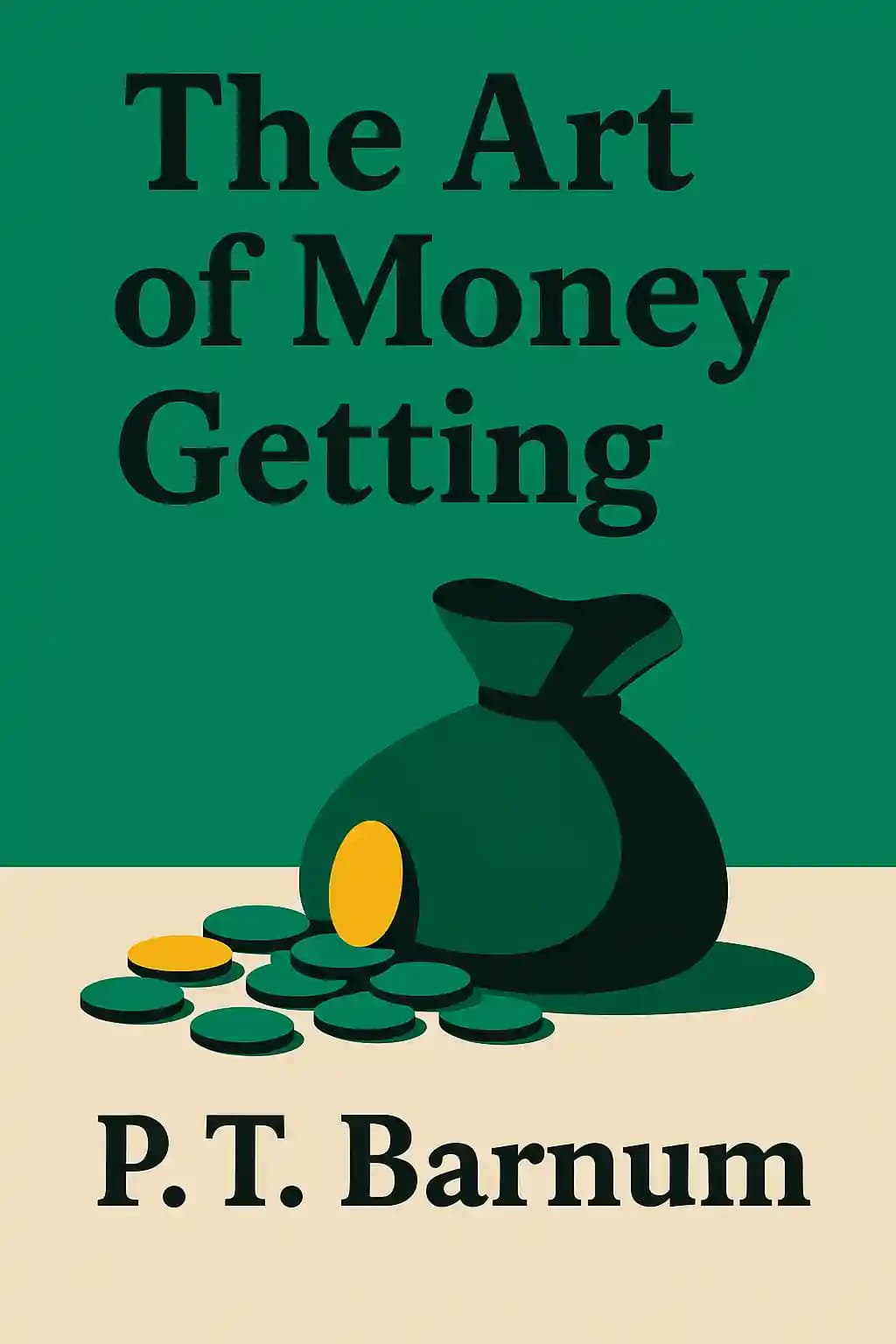
Before Shark Tank or Rich Dad Poor Dad, P.T. Barnum's 1880 masterpiece revealed timeless wealth principles that still resonate today. These "twenty golden rules" from America's greatest showman prove that honest business and common sense - not gimmicks - build lasting fortunes.
Phineas Taylor Barnum (1810–1891), author of The Art of Money Getting, was a pioneering American showman, entrepreneur, and self-made business magnate renowned for blending practical financial wisdom with audacious marketing prowess.
His book, a foundational work in self-help and business strategy, distills principles like thrift, perseverance, and ethical integrity—themes Barnum tested through his ventures, including founding Barnum’s American Museum and co-establishing the iconic traveling circus later known as "The Greatest Show on Earth." A master promoter, he leveraged his expertise in public engagement to advocate for financial prudence, famously declaring, “Advertise in some shape or other, because it is evident that if a man has a good article for sale, and nobody knows it, it will bring him no return.”
Beyond business, Barnum served in Connecticut’s legislature and as Bridgeport’s mayor, championing civic improvements and co-founding Bridgeport Hospital. His candid autobiography, The Life of P. T. Barnum, Written by Himself (1855), remains a vital companion to The Art of Money Getting, offering insights into his philosophy of relentless innovation and calculated risk-taking.
Over 150 years after its publication, Barnum’s pragmatic advice continues to influence entrepreneurs, with modern critics hailing his work as a blueprint for balancing ambition and ethics in commerce.
The Art of Money Getting by Phineas Taylor Barnum is a nineteenth-century guide to financial success, outlining 21 principles for wealth-building. Key themes include selecting the right vocation, avoiding debt, perseverance, using quality tools, and disciplined business practices. Barnum blends pragmatic advice with ethical considerations, emphasizing integrity, charity, and strategic advertising as cornerstones of sustainable prosperity.
Entrepreneurs, small-business owners, and anyone interested in timeless financial principles will benefit from this book. Its focus on foundational strategies—like debt avoidance, systematic work habits, and vocational alignment—makes it particularly relevant for individuals seeking actionable, no-nonsense guidance for personal or professional growth.
Yes. Despite its 1882 publication, Barnum’s emphasis on discipline, adaptability, and ethical business practices remains relevant. The book’s concise structure (21 short chapters) and focus on universal principles—like avoiding speculative ventures and prioritizing health—offer enduring value for modern readers navigating economic uncertainty.
Barnum’s core ideas include:
Barnum argues debt stifles growth by creating dependency and reducing flexibility. He advocates living within one’s means, prioritizing savings, and avoiding speculative investments. Discipline, not luck, is framed as the key to financial stability—a principle reinforced through anecdotes from Barnum’s own business failures and recoveries.
Selecting a vocation aligned with one’s skills and market demand is critical. Barnum warns against entering oversaturated markets and stresses geographic strategy—launching businesses where demand exists but competition is limited. He also cautions against unrealistic passion projects, urging practicality over idealism.
Barnum likens perseverance to “keeping your hand on the plow”—consistently working toward goals without distraction. He criticizes laziness and encourages daily, systematic effort, arguing that sustained action outpaces sporadic bursts of motivation. This ethos reflects his own comeback from bankruptcy in the 1850s.
Advertising is deemed essential for visibility and customer acquisition. Barnum advises clear, honest messaging that highlights a business’s unique value. He famously leveraged newspapers and provocative stunts (like his American Museum exhibits) to generate buzz—a tactic still applicable in digital marketing today.
Integrity is non-negotiable; Barnum warns against deceitful practices like overpromising or exploiting customers. He ties long-term success to trust, advocating for transparency, charitable giving, and ethical decision-making—even when shortcuts seem tempting.
Barnum links physical health to financial success, advising moderation in diet, alcohol, and work habits. He argues that poor health drains productivity and resources, making self-care a strategic business investment rather than a luxury.
The book is divided into 21 concise chapters, each focusing on a specific rule—e.g., “Don’t Mistake Your Vocation,” “Be Systematic,” and “Preserve Your Integrity.” This modular format allows readers to digest advice incrementally, with practical examples drawn from Barnum’s ventures and observations.
Barnum’s principles align with modern concepts like financial literacy, lean entrepreneurship, and customer-centric branding. His warnings against debt, emphasis on adaptability, and focus on ethical practices resonate in an era of economic volatility and socially conscious consumerism.
Siente el libro a través de la voz del autor
Convierte el conocimiento en ideas atractivas y llenas de ejemplos
Captura ideas clave en un instante para un aprendizaje rápido
Disfruta el libro de una manera divertida y atractiva
Debt quickly transforms from servant to master.
Financial independence means having choices.
The journey to financial prosperity begins with self-awareness.
Debt initially presents itself as a solution.
Strategic placement also involves timing.
Desglosa las ideas clave de The Art of Money Getting en puntos fáciles de entender para comprender cómo los equipos innovadores crean, colaboran y crecen.
Destila The Art of Money Getting en pistas de memoria rápidas que resaltan los principios clave de franqueza, trabajo en equipo y resiliencia creativa.

Experimenta The Art of Money Getting a través de narraciones vívidas que convierten las lecciones de innovación en momentos que recordarás y aplicarás.
Pregunta lo que quieras, elige la voz y co-crea ideas que realmente resuenen contigo.

Creado por exalumnos de la Universidad de Columbia en San Francisco
"Instead of endless scrolling, I just hit play on BeFreed. It saves me so much time."
"I never knew where to start with nonfiction—BeFreed’s book lists turned into podcasts gave me a clear path."
"Perfect balance between learning and entertainment. Finished ‘Thinking, Fast and Slow’ on my commute this week."
"Crazy how much I learned while walking the dog. BeFreed = small habits → big gains."
"Reading used to feel like a chore. Now it’s just part of my lifestyle."
"Feels effortless compared to reading. I’ve finished 6 books this month already."
"BeFreed turned my guilty doomscrolling into something that feels productive and inspiring."
"BeFreed turned my commute into learning time. 20-min podcasts are perfect for finishing books I never had time for."
"BeFreed replaced my podcast queue. Imagine Spotify for books — that’s it. 🙌"
"It is great for me to learn something from the book without reading it."
"The themed book list podcasts help me connect ideas across authors—like a guided audio journey."
"Makes me feel smarter every time before going to work"
Creado por exalumnos de la Universidad de Columbia en San Francisco

Obtén el resumen de The Art of Money Getting como PDF o EPUB gratis. Imprímelo o léelo sin conexión en cualquier momento.
Money-making has always been an art form, not a science. P.T. Barnum understood this better than most. Despite his reputation as a showman and promoter of celebrated hoaxes, when it came to financial wisdom, Barnum was remarkably straightforward and insightful. His principles cut through the noise of get-rich-quick schemes that plague us even today. What makes his advice so compelling is its timelessness-these aren't trendy tactics that expire with changing markets, but fundamental truths about human nature and economic success that remain as relevant now as they were in 1880. Warren Buffett reportedly keeps a copy of Barnum's wisdom nearby, and for good reason. These aren't just strategies for accumulating wealth; they're principles for building a life of sustainable prosperity and genuine satisfaction.