Capítulo 1
The News Diet: Why Breaking Your Media Addiction Will Change Your Life
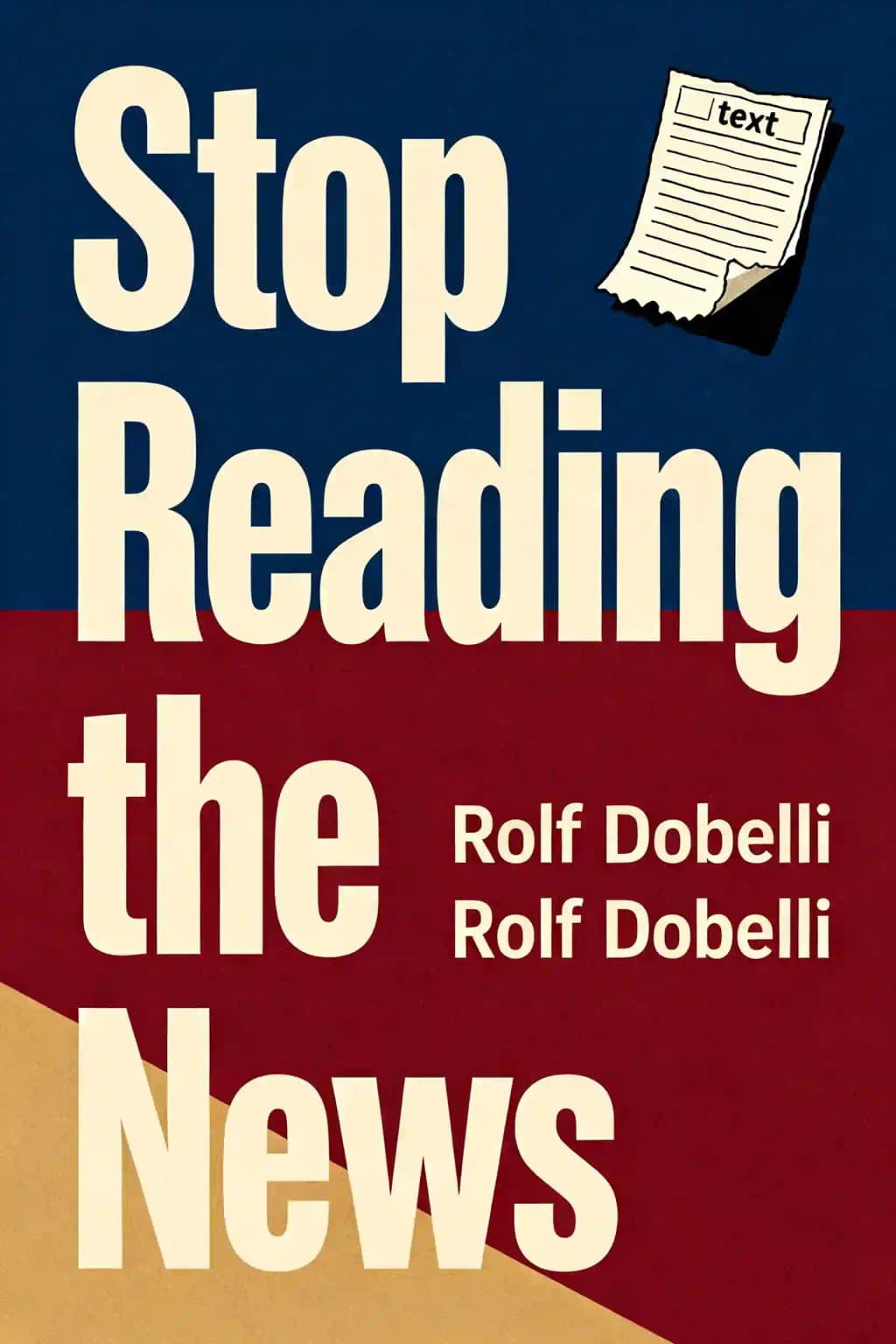
Have you ever considered that your daily news habit might be as harmful as smoking or sugar? In April 2013, I stood before fifty journalists at the Guardian and argued exactly that. After I concluded that their work was "basically entertainment," the room fell silent. You could have heard a pin drop. That day, my article against news consumption became one of the year's most-read pieces, generating hundreds of comments. This wasn't just another hot take-it was the beginning of a movement. Since 2010, I've lived entirely news-free, experiencing clearer thinking, more valuable insights, vastly more time, and an improved quality of life. The book "Stop Reading the News" has become a cult classic among Silicon Valley executives, with figures like Bill Gates practicing regular "think weeks" completely disconnected from news. As our digital landscape grows increasingly toxic, more people are discovering that the most radical act of self-care might be cutting the news cord completely.
Capítulo 2
The Accidental News Junkie: My Personal Journey
My news addiction began innocently in childhood with the typical family routine: morning newspaper delivery, radio bulletins at specific hours, and evening television news. Even as a child, I found it odd that newspapers maintained the same thickness regardless of how much had actually happened the previous day.
As a teenager, my consumption intensified. While friends played sports or socialized, I spent Saturdays in the library reading newspapers cover to cover. I admired the elderly gentlemen in horn-rimmed glasses who seemed so wise and well-read, aspiring to their intellectual appearance. Reading newspapers made me feel like an informed young man connected to world events.
Though university studies temporarily displaced my habit, it returned with vengeance when I started working at Swissair. Flying constantly, I'd collect every available newspaper, stuffing unread ones into my briefcase to finish later in hotel rooms. This international news consumption gave me an almost euphoric feeling, as though I was illuminating every facet of the world daily.
When the internet arrived in the 1990s, my addiction exploded. Suddenly there was everything-comprehensive, immediate, and free. I became obsessed with PointCast, a screensaver displaying scrolling headlines like Times Square on my own screen. As newspapers established websites, the news became endless-by the time you finished reading, new headlines had appeared.
I subscribed to every notification, newsletter, RSS feed and podcast available. Though I felt connected to the world's pulse, the news was insidiously consuming me. My attention fractured into tiny pieces, making it difficult to read longer texts. I gradually tried scaling back-deleting newsletters, limiting myself to fewer sites and scheduled visits-but nothing worked. I swung from link to link like an orangutan in an endless news jungle.
Finally, I made a drastic decision: no more news, full stop. Despite having journalist friends whom I respect for their intelligence and moral purpose, I recognized they're trapped in an industry that has little to do with real journalism. The transformation in my mental clarity and quality of life has been remarkable-and I promise, you're not missing anything important.
Capítulo 3
Mental Junk Food: The News-Sugar Connection
News is simply "information on events from across the world"-bus accidents, earthquakes, presidential meetings, celebrity divorces, cabinet reshuffles, missile launches, corporate firings, awkward tweets, stabbings, peace agreements, shark attacks, and market closings. Media outlets grandiosely label these snippets as "breaking news" or "top world headlines," but they're largely irrelevant to your personal world. These events, while momentarily captivating, rarely impact our daily decisions or long-term well-being. Consider how many "breaking news" alerts you've received about political scandals, market fluctuations, or celebrity drama that had zero impact on your life a week later.
The news business began in the 17th century, spreading rapidly across Europe with hundreds of dailies appearing within decades. From London's first newspapers to Amsterdam's early gazettes, these publications transformed how society consumed information. The fundamental fraud-selling the new as the relevant-persists to this day across all media platforms, from traditional newspapers to social media feeds and 24/7 news channels. In recent years, our addiction to news has become a dangerous mania, nearly impossible to escape, amplified by smartphones that keep us perpetually connected to the news cycle.
Unlike books and well-researched long-form pieces, news cannot truly satisfy our hunger for knowledge. It's mental junk food-appetizing, easily digestible, but extremely damaging. Just as sugary snacks provide quick energy but poor nutrition, news offers quick hits of information without depth or context. We can consume countless articles but we're just gorging on empty information calories, with side effects that only become apparent later: anxiety, shortened attention spans, and a distorted worldview.
Consider your own experience: Have you consumed roughly 20,000 news items in the past year? That's about 55 stories per day - a conservative estimate for many people. Be honest: can you name a single one that helped you make a better decision about your life, career, or business? When I ask friends this question, they can rarely provide more than two examples-a dismal hit rate of less than 0.01%. In my ten news-free years, I can think of only one useful piece I missed: a 2010 volcanic eruption in Iceland that canceled my flight. Even then, I would have learned about the cancellation directly from the airline.
The relationship between relevance and media attention seems inverse: the greater the fanfare, the smaller the relevance. Major news outlets might spend weeks covering a celebrity trial while barely mentioning groundbreaking scientific discoveries or significant policy changes. Journalists often miss what actually matters, chasing sensational stories rather than substantive developments. As Tolstoy noted in Anna Karenina back in 1877, newspapers publish "a great deal that was superfluous and exaggerated." News organizations sell irrelevance as relevance-it's the fundamental battle of "the relevant versus the new." This pattern has only intensified in the digital age, where clickbait headlines and artificial urgency dominate our information landscape.
Capítulo 4
Breaking the Habit: A Practical Detox Plan
I advocate complete, radical abstinence from news. Make it difficult to access your usual sources-unsubscribe from newsletters, delete news apps immediately, sell your TV, remove news sites from your browser favorites. When traveling, bring good books and deliberately ignore newspapers lying around. Walk past airport news stands and sit far from TV screens at gates.
If you must maintain the illusion of "staying informed," skim weekly summaries like The Economist's "The world this week" or similar publications. Instead, focus on reading complex, expert-written magazines and books that present the world in all its complexity. Try reading a book weekly, and if it's truly enlightening, read it twice-the second reading is exponentially more powerful than the first.
The first week of news abstinence will be the hardest. You'll feel anxious, expecting catastrophes, disadvantaged compared to others, and socially isolated. You'll constantly fight the urge to check your favorite news sites. Resist these impulses and commit to thirty days without news. After thirty days, you'll realize you haven't missed any relevant information-if something truly significant happens, you'll hear about it from friends or family.
You'll have reclaimed ninety minutes daily-that's one workday per week or a month per year. Use this time for deep reading, online courses, or thinking. Bill Gates dedicates full weeks twice yearly to pure thought ("Think Week"). By the third stage of abstinence, you'll develop an outright aversion to news headlines.
If radical news abstinence seems too extreme, try the soft option: avoid all daily news sources but read one weekly paper or magazine in print form (to avoid distracting hyperlinks). Read it in a single sitting with a time limit of sixty minutes. Choose publications that are least sensationalist and least reliant on advertising. Eventually, narrow your reading to specific sections or articles. Some friends read only the feature articles in The Economist or Der Spiegel. Reading just fifty-two articles yearly will cover all major events.
Capítulo 5
The Distortion Machine: How News Warps Reality
Our nervous system reacts disproportionately to visible, scandalous, shocking, personal and polarizing stimuli while responding weakly to abstract, complex, slowly developing information requiring interpretation. News media systematically exploits this distortion, focusing on the wrong elements of stories. In a bridge collapse, they'll focus on the car and driver rather than the structural issues that actually matter. When an employee commits fraud, they'll investigate his personal life rather than the systemic risk management failures.
This creates a fundamentally distorted risk perception-terrorism is overplayed while chronic stress is downplayed; plane crashes are overplayed while antibiotic resistance is downplayed. Even with awareness, we cannot compensate for this tendency-our brains are simply too weak to make the distinction.
The news is incapable of explaining anything. Its brief reports are like tiny, shimmering soap bubbles bursting on the surface of a complex world. News corporations pride themselves on accurately reporting facts, but these are usually just consequences of deeper underlying causes. There's an inverse relationship between consuming images and reports and understanding what's happening-the more news you consume, the less you comprehend.
News corporations focus on easy content: anecdotes, scandals, celebrity gossip and disasters because they're cheap to produce and easy to digest. Even journalists who understand the "engine room" aren't given space to explain it because readers prefer juicy morsels to thorough articles.
News reports are like unconnected dots in a puzzle book-no matter how many you consume, no image emerges without the connecting lines of context. News suggests there are only events without context, when nearly everything in the world is complex. Consuming news creates the illusion of understanding, leading to dangerous overconfidence, as shown in Professor Slovic's horse-betting study where more information didn't improve predictions but dramatically increased confidence.
Capítulo 6
The Biological Price: News as a Health Hazard
Humans are wired to react more strongly to negative information-a survival mechanism called "negativity bias" observable even in one-year-old infants. This innate tendency means bad news has twice the psychological impact of good news. Research shows that negative events or feedback consistently produce larger and more lasting neural responses than positive ones. News media doesn't create this weakness; it expertly exploits it through dramatic headlines, crisis-focused coverage, and emphasis on threats and dangers.
Each alarming story stimulates our sympathetic nervous system, triggering the release of adrenaline and cortisol. This stress hormone floods our bloodstream, weakening our immune system and inhibiting growth hormones. Studies have shown that just three minutes of negative news in the morning can increase the likelihood of reporting a negative day by 27%. Chronic stress from news consumption leads to anxiety, digestive problems, increased blood pressure, and increased susceptibility to infection. The cumulative effect can manifest in symptoms like disrupted sleep patterns, decreased appetite, and difficulty concentrating.
We all have anxieties that sometimes overwhelm us. While healthy coping mechanisms exist (like the Stoic practice of distinguishing between what we can and cannot control), news consumption thwarts these methods by constantly introducing new threats beyond our control. Professor Davey's research at the University of Sussex has shown that negative television reports intensify personal anxiety even when completely unrelated to your situation. For instance, watching coverage of a natural disaster across the globe can trigger anxiety about personal safety, despite no direct threat.
News creates a vicious cycle: consuming news leads to chronic stress, stress depletes willpower, lack of willpower makes us more likely to consume news, leading to more stress. This cycle is particularly evident in the era of smartphones, where the average person checks news apps 58 times per day. The result is clear: news consumption reduces quality of life, increases stress, weakens health, and may even shorten lifespan through chronic elevation of stress hormones.
Our brains contain roughly eighty-six billion nerve cells connected by over a hundred trillion synapses, forming a complex network that responds dynamically to environmental inputs. Contrary to earlier beliefs, our brains constantly reshape themselves throughout adulthood, with nerve cells breaking old connections and forming new ones - a process called neuroplasticity. When we expose ourselves to the torrent of news, particularly through digital devices, it literally rewires our mental apparatus at a biological level, creating neural pathways that favor quick, shallow processing over deep understanding.
As researcher Nicholas Carr explains in "The Shallows": "When we go online, we enter an environment that promotes cursory reading, hurried and distracted thinking, and superficial learning." This rewiring affects how our brain functions even when we're not actively consuming news. Regular exposure to the rapid-fire nature of news content reduces our capacity for sustained attention, deep reading, and analytical thinking. Studies show that heavy news consumers demonstrate decreased ability to focus on long-form content and show reduced activation in brain regions associated with empathy and emotional processing.
Capítulo 7
The Cognitive Trap: How News Reinforces Our Mental Errors
We're prone to approximately 120 systematic cognitive errors, and news reinforces these mistakes rather than correcting them. Take confirmation bias-our tendency to seek information that confirms our existing beliefs while ignoring contradictory evidence. When presented with a sequence like 3, 6, 9, 12, most assume the next number is 15, overlooking other possibilities like 14 or 52 because we latch onto patterns that fit our expectations.
This cognitive error becomes dangerous with political views or financial decisions. The more news we consume, the more confirmatory information we encounter, even for false opinions. News no longer functions as a probe testing inaccurate beliefs but instead cements them.
Confirmation bias is most dangerous with ideologies-"opinions to the power of ten" that constitute entire worldviews. These self-built mental prisons cause impulsive actions and terrible decisions. News becomes ideology's accomplice by reinforcing confirmation bias and polarizing public discourse.
The world operates as a complex, dynamic process of chaos where cause and effect don't connect linearly. Most events result from hundreds or thousands of interacting causes, yet we attribute them to just a few. The 2008 financial crisis exemplifies this-a "poisonous cocktail" of circumstances from housing euphoria to criminal behavior by rating agencies created the collapse.
In hindsight, these connections seem obvious, creating the illusion that crises are comprehensible and predictable. This cognitive error-hindsight bias-makes us believe we could have seen disasters coming when actually nothing was clear during the events themselves.
News amplifies this bias through brutal simplification. Whether reporting on a bicycle accident or worldwide financial crisis, news attributes events to just one or two causes, ignoring dozens of other factors and their complex interactions. This gives consumers the dangerous illusion that the world is simpler and more explicable than it actually is.
Capítulo 8
The Attention Thief: Reclaiming Your Mental Space
News consumption comes at an exorbitant price in time-not just the 58-96 minutes per day spent actively consuming it, but also the "switching cost" of refocusing afterward and the lingering distraction as stories haunt your thoughts. This adds up to roughly a month per year. From a global perspective, the cost is staggering-a billion people spending just one hour following a terrorist attack equals over 100,000 years of human attention.
While information is no longer scarce, attention is our most precious resource. As Seneca observed 2,000 years ago, we're tight-fisted with money yet spendthrift with time, though time is the only commodity with which we ought to be miserly. Despite countless time management strategies, nothing reclaims time more effectively than simply giving up the news.
Our brains automatically generate opinions on any topic presented to us, whether we're experts or not. This "opinion volcano" erupts uncontrollably, leading us to form views on issues we don't care about, questions that can't be fully answered, or topics too complex for casual analysis.
When confronted with complex questions like "Will there be a world war in the next twenty years?", we rapidly form opinions before consulting our brains for supporting reasons. This relates to the affect heuristic-an instant, one-dimensional feeling that's either positive or negative. The news is designed to generate these unnecessary affects, making it impossible to consume news affect-free.
Ninety percent of our opinions are superfluous, yet news constantly urges us to form them, robbing us of concentration and inner peace. As Marcus Aurelius wisely advised two thousand years ago: "You are at liberty not to form opinions about all and sundry, thereby sparing your soul unrest. For the things themselves demand no judgements from you."
Capítulo 9
Beyond Democracy: A New Vision for Informed Citizenship
The most common objection to abandoning news is the question of democracy-isn't news essential to it? Let's break this down: can citizens make good electoral choices without news, and who will monitor those in power?
Democracy thrived before the news glut-the intellectual fathers of modern democracy maintained rich political discourse through books, pamphlets, salons and public gatherings. Even Ancient Greece functioned democratically without newspapers or television. To vote sensibly without news, examine what candidates have achieved rather than promised. For referendums, think independently about arguments for and against, then discuss with friends until you understand opposing positions well enough to articulate them.
The news isn't just unnecessary for democracy-it's potentially harmful. The quality of political discourse has deteriorated precisely during the rising tide of news media. Like spectators standing on tiptoes at a football game, news outlets escalate their sensationalism, creating a race to the bottom that produces white noise and societal polarization.
Democracy requires two forms of journalism that differ from typical news: investigative journalism that uncovers facts and wrongdoing, and explanatory reporting that provides context and background. Both are difficult, expensive, and demand skill from producers and concentration from consumers. The current news format serves neither well.
Investigative journalism requires weeks or months of investment rather than quick copy-paste jobs. Journalists must know their subjects intimately, dig deeper to unearth facts, and double-check everything. These revelations don't need to be published as bite-sized news-timing is less important than thorough research.
I have an idea to revitalize public discourse without relying on stultifying news-the "news lunch." When I have lunch with friends or colleagues, I judge its success by whether I've learned something true and relevant. The most valuable lunches focus deeply on one topic per person. Each participant gets fifteen minutes to discuss their most important current work, allowing us to explore nuances, context, and deeper understanding.
This format could expand to public events: rent a restaurant, announce via app or website, and host daily lunches featuring a journalist presenting their most important current story (focusing on context rather than headlines) and a scholar presenting a slow-burning, abstract topic unlikely to appear in media. After the two fifteen-minute talks, participants enjoy a healthy lunch while discussing these topics. This transforms ordinary lunch breaks into intellectually, culinarily and socially rich experiences reminiscent of 18th-century salons.
Capítulo 10
Life After News: A Personal Transformation
At first I wasn't sure if my news-free experiment would be short-lived. My arguments were still embryonic, so I kept it private. In conversations about current events, I pretended to know but acted as if I hadn't given them much thought. I smiled along with others' reactions to TV news and assumed thoughtful expressions when disasters were mentioned. I faked my way through and dreaded meeting new people since small talk inevitably turned to current affairs.
In time, I grew more confident in my path as my arguments sharpened, my attitude cleared, time became more elastic, my decision-making improved, and my peace of mind deepened. You'll experience these same benefits. Don't worry about seeming boring at parties-you now understand the world better and can share that understanding. People will be fascinated by your news-free lifestyle, and you can always restart conversations by asking others what they think are the week's most important headlines.
If you're still not convinced by my arguments against news consumption, try this twenty-minute exercise. Take a piece of paper and create ten columns for the last ten years. In the upper half, write the most important news stories you remember from each year. In the lower half, note major developments in your personal life. Then draw lines connecting any news reports that directly influenced your life events. Most people draw zero lines-the world of news and your actual life are completely separate universes.
Still skeptical? Visit your library and read newspapers from 10-20 years ago. You'll find journalists missed important topics, picked the wrong signs, and misinterpreted them. Papers from 2007 barely mentioned the impending financial crisis. Today's "breaking news" will seem equally ridiculous a decade from now.
What constitutes a good life? Without answering this fundamental question, your life becomes an endless crisis-coping machine. You risk letting life pass you by without a clear philosophy to guide you. Inner peace has been considered a key component of a successful life for 2,500 years. News wreaks havoc on your peace of mind by stirring up negative emotions like fear, anger and jealousy. The Stoics taught that it's foolish to trouble yourself about things you can't control-like 99.9% of world events. As Epictetus said, "You become what you give your attention to." The freedom to choose what's relevant is fundamental to a good life. Our brains need detoxification, not more junk. Less is the new more.