Capítulo 1
The Legacy of Racial Ideas: America's Unfinished Journey
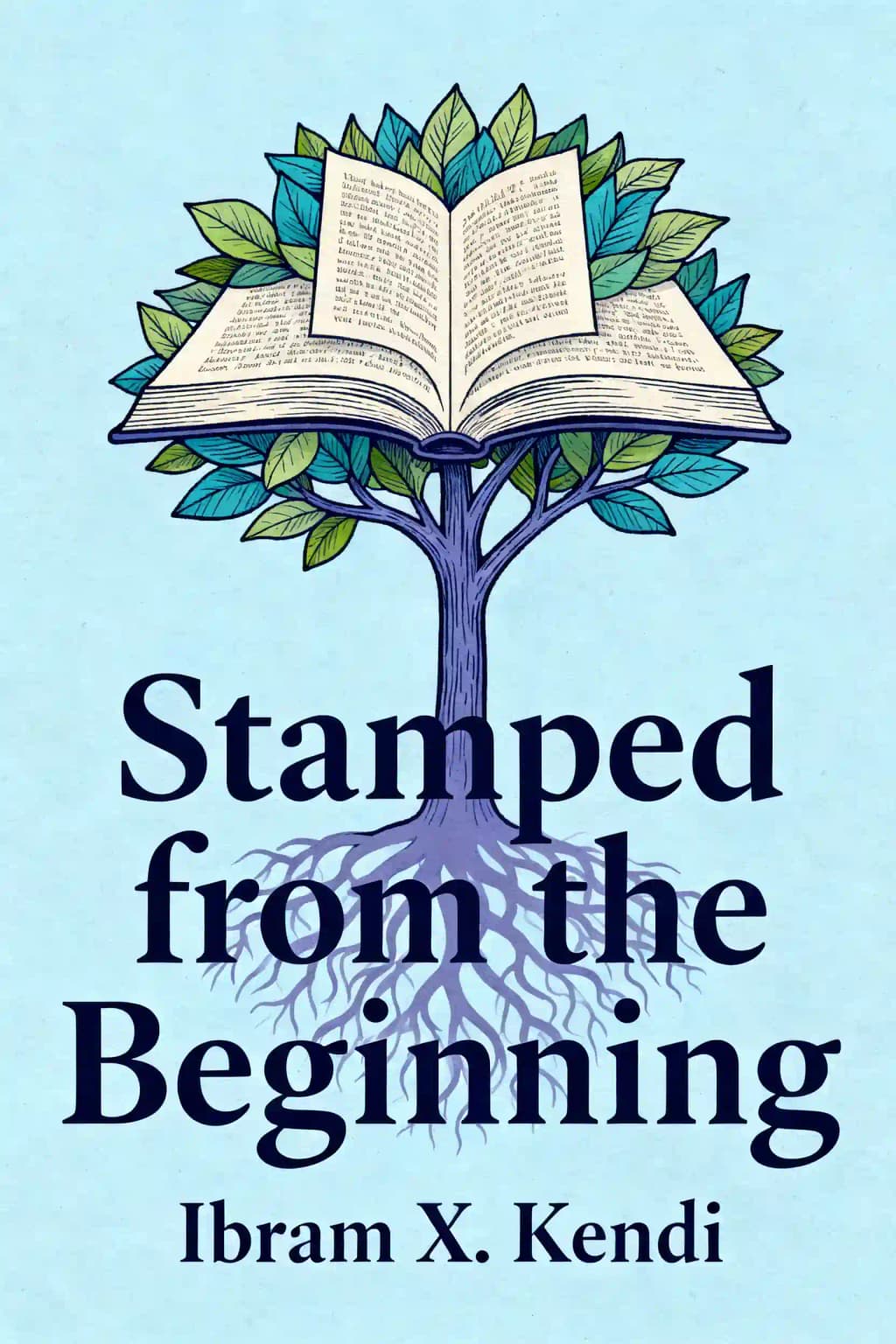
When Ibram X. Kendi's "Stamped from the Beginning" won the National Book Award in 2016, many were surprised-not just by its victory over bestselling biographies of Shirley Jackson and Eleanor Roosevelt, but by its unflinching thesis. Kendi's work challenges the comforting narrative that racism stems primarily from ignorance or hatred, instead arguing that racist ideas have been carefully crafted to justify discriminatory policies and protect power. "Follow the racist ideas," Kendi suggests, "and they lead not to ignorant minds but to powerful interests." This intellectual bombshell has since become required reading in universities nationwide, with Time magazine calling it "the most ambitious book on racism in America."
Capítulo 2
The Origins of Racial Hierarchy
Racist ideas didn't begin with American slavery-they preceded and enabled it. When Puritan ministers Richard Mather and John Cotton arrived in New England in the 1630s, they brought with them intellectual frameworks that justified human hierarchy. Drawing from Aristotle's philosophy, they positioned Europeans at the top of a natural order, with Native Americans and Africans below. This thinking wasn't accidental; it served to rationalize the enslavement of war captives and the first enslaved Africans who arrived in Boston in 1638.
The intellectual foundation for anti-Black racism had been developing for centuries before colonization. As Prince Henry of Portugal sought direct access to African gold and captives in the 1400s, his chronicler Zurara produced the first European defense of African slave trading. Rather than acknowledging the profit motive, Zurara framed enslavement as missionary work, portraying Africans as "living like beasts" who benefited from Portuguese bondage. These ideas spread through trading networks faster than Zurara's actual text.
By the time Columbus reached the Americas in 1492, Spanish colonists immediately applied racist constructions to indigenous peoples, calling them "Blacks from the land." When Bartolome de Las Casas, initially a slaveholder himself, campaigned to ease Native American suffering, he suggested importing enslaved Africans as replacements-creating the racist twin myths of physically strong Africans and weak Native Americans. Though he later regretted this recommendation after reading Zurara's book, the door to African slavery had been opened.
As English contact with Africans increased, writers applied climate theory to explain skin color differences, while others like George Best proposed the "curse theory"-that Noah's son Ham's descendants were cursed with blackness for disobedience. This sparked the first major racist debate: were Black people permanently inferior (curse theory) or temporarily inferior but capable of "whitening" (climate theory)? Both positions were racist, differing only in whether Black inferiority was permanent or temporary.
Capítulo 3
Saving Souls, Not Bodies
Religious justifications for slavery evolved as the practice expanded. Puritan leader William Perkins masked the master-slave relationship as a loving family dynamic, claiming equal souls but unequal bodies-a theological sleight of hand that allowed ministers like Richard Mather to preach to African souls while accepting the enslavement of their bodies.
By 1619, when the first recorded slave ship arrived in colonial America, the groundwork for racial hierarchy was firmly established. Virginia's 1625 census recorded Africans as distinct from White servants, and by 1627, "Negars" were categorized below servants in wills. In 1630, Virginia's first racial judicial decision ordered a White man whipped for "defiling his body" by having relations with a Black woman-America's first recorded instance of gender racism.
As scientific thinking developed in the 1660s, scholars like Robert Boyle and Isaac Newton reinforced racial hierarchies through supposedly objective observations. Boyle acknowledged that human pigmentation was only in "the thin Epidermes, or outward Skin" yet still judged Black skin an "ugly" deformity of normal Whiteness. Newton placed "perfect whiteness" at the center of his color wheel, with all other colors positioned by their "distance from Whiteness."
Cotton Mather, born in 1663 as the grandson of Richard Mather, would become instrumental in normalizing African slavery in colonial America. His sermons described Puritans as "the English Israel"-a chosen people-while portraying African souls as "white and good as those of other Nations, but are Destroyed for lack of Knowledge." This theological concept of White souls aligned with the cultural development of John Locke's unblemished White minds and the literary portrayal of noble African characters with European features.
Capítulo 4
Black Hunts and Witch Trials
Cotton Mather's obsession with maintaining social hierarchies manifested in a rigid binary view of enslaved Africans: they could either achieve righteous assimilated Whiteness through complete submission to God and their masters, or remain in segregated criminal Blackness as slaves to the Devil. This dichotomy became particularly evident during the Salem witch trials of 1692, where descriptions of supernatural evil consistently employed racial imagery. Witnesses and accusers repeatedly described the Devil as "a little black bearded man," "a black thing of considerable bigness," or "a dark man in black clothing." These racial associations weren't coincidental but reflected deep-seated prejudices that equated darkness with evil and whiteness with godliness.
Mather enthusiastically supported the trials and executions, showing particular zeal in cases involving those who challenged established hierarchies. He viewed religious dissidents who preached equality as especially dangerous, seeing them as threats to the carefully constructed social order that privileged elite white men like himself. The trials served as a powerful tool for reinforcing multiple hierarchies simultaneously: religious orthodoxy, class distinctions, slaveholder authority, gender roles, and racial supremacy.
Colonial newspapers played a crucial role in disseminating and reinforcing racist ideologies. Their pages regularly featured advertisements treating Black people as commodities alongside stories portraying them as dangerous criminals. This created a pervasive narrative that justified both enslavement and harsh control measures. Enslaved Africans faced an impossible situation: when they showed obedience, they were characterized as naturally suited for servitude, "beasts of burden" fulfilling their proper role. If they engaged in passive resistance, they faced brutal punishment. If they actively fought for freedom, they were labeled as "barbaric murderers" threatening civil society.
The 1712 New York slave revolt triggered a severe backlash. Colonial authorities responded with draconian new laws that not only increased restrictions on enslaved people but also targeted free Blacks, stripping them of property rights and other legal protections. The legislation explicitly characterized Black people as "idle, slothful people," codifying racist stereotypes into law and creating new barriers to Black economic advancement.
Even Mather's seemingly progressive support for smallpox inoculation in 1721 revealed the depth of racial prejudice in colonial society. Despite learning this life-saving practice from his enslaved man Onesimus, who shared knowledge of African inoculation techniques, Mather faced fierce opposition. White doctors spread conspiracy theories suggesting that Africans were plotting mass murder through inoculation, showing how even public health measures could become racialized battlegrounds.
By his death in 1728, Mather had helped establish a particularly insidious form of racist ideology that would influence American Christianity for centuries. His legacy normalized the idea that Christianity could simultaneously "civilize" and subjugate enslaved Africans - promising spiritual equality while justifying physical bondage. This theological framework provided religious cover for the continuation of slavery, suggesting that enslaved people could achieve spiritual whiteness while remaining in chains, a contradiction that served the interests of white slaveholding society.
Capítulo 5
Thomas Jefferson and the Paradox of Liberty
Thomas Jefferson embodied America's racial contradictions. Growing up on his father's Virginia plantation, his earliest memory involved being placed on horseback with a "kind and gentle" enslaved woman, associating slavery with comfort. As a young lawyer, Jefferson unsuccessfully defended an enslaved man seeking freedom, arguing that "under the law of nature, all men are born free." Yet when tasked with drafting the Declaration of Independence in 1776, his proclamation that "all Men are created equal" came while holding nearly two hundred enslaved people.
Jefferson's most influential racial writing came in his "Notes on the State of Virginia," where he rejected the idea of "incorporating the [freed] blacks into the state," citing "deep rooted prejudices," "real distinctions which nature has made," and the risk of "convulsions" that might end in "extermination of the one or the other race." Despite claiming to be open-minded, Jefferson declared he could "never find that a black had uttered a thought above the level of plain narration" and dismissed Phillis Wheatley's poetry with the devastating line, "Religion, indeed has produced a Phyllis Wheatley; but it could not produce a poet."
Jefferson's Notes contained numerous contradictions. He ignored the skilled enslaved workers who made his plantation self-sufficient while claiming Black intellectual inferiority. He wrote that Black people were "more adventuresome" yet lacked forethought, felt love more but pain less, and paradoxically both required less sleep yet desired more sleep than whites. While confidently asserting Black inferiority, Jefferson equated Native Americans with whites, claiming they were "in body and mind equal to the whiteman."
Despite these contradictions, Jefferson emerged as America's preeminent authority on Black intellectual inferiority for the next fifty years. His work became the most widely read American nonfiction book until the mid-nineteenth century, shaping racial discourse even as he maintained relationships with antiracist thinkers like Count Constantine Volney, who argued that Black Egyptians were responsible for "arts, sciences, and even the use of speech itself."
Capítulo 6
Colonization and the "Negro Problem"
Jefferson's most enduring legacy in race relations began in 1800 with Virginia's response to Gabriel Prosser's planned slave rebellion. After the failed uprising, Virginia secretly instructed Governor James Monroe to correspond with Jefferson about finding lands outside Virginia where "persons...dangerous to the peace of society may be removed." This idea eventually became the American Colonization Society (ACS), founded in 1816 to deport free Blacks to Africa.
When 3,000 Black men gathered at Philadelphia's Mother Bethel A.M.E. Church in January 1817 to discuss the ACS, they unanimously rejected colonization despite support from Black leaders like James Forten and Richard Allen. The attendees denounced the "unmerited stigma" cast upon them and refused to go to the "savage wilds of Africa," demonstrating their internalization of racist myths about the continent. Yet they also affirmed their commitment to America as "the land of our nativity" that had been "manured" by their "blood and sweat," resolving: "We will never separate ourselves voluntarily from the slave population of this country."
As European nations shifted from the slave trade to colonizing Africa, philosophers like Georg Wilhelm Friedrich Hegel provided intellectual justification, describing Africans as "a nation of children" in the "first stage" of human development. Such racist ideas justified Europe's colonization of Africa under the pretense of bringing "progress" to its people, just as enslavers claimed to bring progress to Africans in the Americas.
In the 1820s, Ralph Gurley transformed the American Colonization Society by linking it to the Protestant movement during the Second Great Awakening. As religious organizations mass-produced images of a white Jesus, both Blacks and whites unconsciously connected divine power with whiteness. The ACS gained support as racial tensions worsened in northern cities, with race riots erupting across major urban centers. By 1832, every northern state legislature had endorsed colonization, with northern supporters seeking to remove all Blacks while southern colonizationists focused on removing free Blacks.
Capítulo 7
William Lloyd Garrison and Abolitionism
After David Walker's powerful 1829 Appeal challenged Jefferson's racist ideas, William Lloyd Garrison emerged as the voice of abolitionism. Though Garrison criticized Walker's call for violent resistance, he acknowledged the Appeal contained "valuable truths." Walker died of tuberculosis in 1830, but his ideas lived on through activists like Maria Stewart, who pioneered as the first American-born woman to address mixed audiences of men and women.
Garrison founded The Liberator in 1831, demanding immediate abolition but advocating for gradual equality-believing Blacks needed to be "civilized" to achieve equality. Garrison's philosophy reflected uplift suasion-the belief that Black self-improvement would diminish White prejudice-despite mounting evidence that Black advancement did little to slow racism's spread.
As abolitionists flooded the South with anti-slavery literature in 1835, enslavers responded with rage. White mobs attacked northern Black neighborhoods, destroying homes, schools, and churches while claiming to protect white women from "hypersexual" Black men. Senator John C. Calhoun emerged as slavery's boldest defender, declaring it "a positive good" for both society and Black people.
In 1841, Frederick Douglass first spoke publicly about his escape from slavery, soon becoming a traveling speaker for the Massachusetts Antislavery Society. Though initially presented as a "chattel" or "piece of southern property," Douglass grew tired of being dehumanized and limited to telling only his personal story. When he veered into philosophy, White abolitionists would whisper, "Tell your story, Frederick," advising him to maintain "plantation manner of speech" lest he seem "too learned."
Harriet Beecher Stowe's "Uncle Tom's Cabin" (1852) achieved what Garrison had attempted for decades-shifting public sentiment against slavery-but did so by reinforcing racist ideas about Black docility and spiritual nature. While Garrison questioned Stowe's religious double standard and colonization stance, Frederick Douglass didn't fully criticize her portrayal of the "soulful" Uncle Tom, instead focusing on her colonization views.
Capítulo 8
Reconstruction and Its Betrayal
The Civil War and emancipation presented America with an unprecedented opportunity to address racial inequality. When Abraham Lincoln delivered his April 1864 speech in Baltimore, he compared the Union to a shepherd protecting Black sheep from Confederate wolves. However, this metaphor misrepresented reality, as most enslaved people weren't passive sheep waiting for liberation but actively fought for and secured their own freedom before joining Union forces.
After Lincoln's assassination, President Andrew Johnson's Reconstruction proclamations on May 29, 1865 crushed civil rights activists' hopes. He granted amnesty and rights to all but the highest Confederate officials, empowering southerners to bar Black voting, elect Confederate politicians, and institute discriminatory Black codes. The Thirteenth Amendment's exception allowing slavery "as punishment for crime" let the law replace the master. Southern lawmakers justified these policies by claiming Black people were naturally lazy, lawless, and oversexed.
Southern Blacks defended themselves against re-enslavement, demanding rights and land while offering powerful antiracist arguments. When accused of laziness, they pointed out that planters "lived in idleness all their lives on stolen labor." When told they couldn't support themselves, one emancipated person replied, "We used to support ourselves and our masters too when we were slaves and I reckon we can take care of ourselves now."
Radical Republican Thaddeus Stevens proposed redistributing 400 million acres from the wealthiest southerners, granting forty acres to each freedman and selling the rest to pay war debts, but his proposal failed. Most Republicans rejected land redistribution, claiming it would "ruin the freedmen" by teaching them they could acquire land without working for it-a hypocritical argument from wealthy men who had inherited property.
The Fourteenth Amendment emerged as a compromise, with its first clause prohibiting states from abridging citizens' "privileges or immunities" or denying "equal protection of the laws." Its deliberate ambiguity ensured both antiracists and racists would vie for its power after its June 1866 passage.
Capítulo 9
W.E.B. Du Bois and the Color Line
As Reconstruction collapsed, racist ideas evolved to justify the new order. The New South propaganda created an indelible postwar faith in racial progress, claiming "prejudice against color is slowly but surely dying out" while blaming Black economic disparities on supposed aversion to industry rather than discrimination. This "racial progress" narrative became America's dominant rejoinder to antiracists still pointing out discrimination.
At Fisk University, young Willie Du Bois consumed and reproduced assimilationist ideas as student newspaper editor. After graduating in 1888, Du Bois attended Harvard, where he delivered a commencement address contrasting European "Strong Man" civilization with African "Submissive Man" civilization, revealing his absorption of assimilationist notions that African Americans had been "socially and morally crippled by slavery."
Ida B. Wells's blazing 1892 pamphlet "Southern Horrors: Lynch Law in All Its Phases" challenged the racist justification for lynching. Examining 728 lynching reports, she found only about a third of victims had even been charged with rape. Wells condemned White men for lying about Black-on-White rape while hiding their own assaults on Black women.
The 1896 Plessy v. Ferguson ruling legalized separate but unequal treatment, with Justice Brown claiming the Constitution couldn't put an "inferior" race "upon the same plane" as whites. This decision, alongside Booker T. Washington's 1895 "Atlanta Compromise" speech urging Blacks to "begin at the bottom, not the top" and avoid "questions of social equality," solidified the New South's racial hierarchy.
Du Bois published his masterwork "The Souls of Black Folk" in 1903, introducing his theory of "double-consciousness"-the "peculiar sensation" of "always looking at one's self through the eyes of others." The book articulated the internal conflict many Black Americans felt between pride in their Blackness and pressure to assimilate into White society.
Capítulo 10
Angela Davis and Black Power
In September 1963, Angela Davis learned while studying abroad in France that four girls she knew personally had been killed in the Birmingham church bombing. Davis rejected the view that this was an isolated incident by southern extremists, seeing it instead as part of systematic racist oppression.
Malcolm X's autobiography became a transformative antiracist text, with his powerful metaphors about the knife of racism and his humanist philosophy. His message that White people weren't born racist but conditioned by American society, his call for antiracist Whites to fight racism in their own communities, and his fierce critique of accommodationist Black leaders resonated deeply.
The progression of racism quickly reasserted itself after the Voting Rights Act passed in 1965. The leaked Moynihan report portrayed Black families as a "tangle of pathology," and when the Watts rebellion erupted days later, compassion for Black Americans transformed into fear. New racist terminology emerged-"minority" became a racial identifier that ignored that most Black Americans lived in majority-Black spaces, while "ghetto" evolved from describing segregation to implying inferiority.
Against this backdrop, Stokely Carmichael launched the Black Power movement in 1966, demanding Black control of Black communities. While fundamentally democratic, racists could only interpret Black Power as Black supremacy, especially as urban rebellions spread. The Black Panther Party emerged in Oakland with a ten-point platform demanding community control, economic justice, and an end to police brutality, organizing community service programs while policing the police.
Richard Nixon's 1968 presidential campaign pioneered what historians call the "southern strategy"-though it was actually a national Republican strategy that would persist for decades. Nixon studied George Wallace's campaigns and developed a more sophisticated approach to appeal to racists who didn't consider themselves racist. His innovation: demean Black people and praise white people without ever explicitly mentioning race.
Capítulo 11
Reagan's War on Drugs and Mass Incarceration
Ronald Reagan embodied the racist backlash to Black Power in politics. Reagan's campaign popularized the welfare fraud story of Linda Taylor, a Black woman he falsely claimed received $150,000 in benefits, feeding white resentment despite the rarity of such fraud.
Reagan quickly dismantled economic gains made by middle and low-income Americans over four decades, cutting taxes for the wealthy while slashing social programs and increasing military spending. Within his first year, Black family median income declined by 5.2 percent, and 2.2 million more Americans fell into poverty, effectively wiping out much of the progress made against poverty in the previous two decades.
The Reagan administration's War on Drugs led to mass incarceration that disproportionately affected Black Americans. Between 1980 and 2000, the prison population quadrupled due to stiffer sentencing policies rather than increased crime rates. By 2000, Blacks comprised 62.7% of drug offenders in state prisons despite equal drug use rates across races. The National Household Survey on Drug Abuse confirmed that 6.4% of both Whites and Blacks were using illegal drugs, and a 2012 study found White youths were actually 32% more likely to sell drugs than Black youths.
During the crack epidemic, despite two-thirds of users being White or Latino/a, 84.5% of defendants convicted of crack possession were Black. This disparity stemmed from racial profiling and concentrated policing in Black neighborhoods. The false assumption that Black people committed more drug crimes created the racist image of "dangerous Black neighborhoods" versus "safe White suburban neighborhoods," affecting housing, policing, and political decisions.
Capítulo 12
From Obama to Black Lives Matter
When Obama won the presidency, racist ideas evolved into a new form of attack. Postracialists established ground rules: criticizing millions of Black people was acceptable, but criticizing a single White discriminator was labeled "racist." Despite Obama receiving similar White voter support (43%) as previous Democratic candidates, his victory depended on increased non-White and youth turnout. The notion of "postracial America" became the new dividing line between racists and antiracists as Obama took office amid the Great Recession, which reduced Black household income twice as much as White households.
The acquittal of George Zimmerman in 2013 inspired Alicia Garza to write a love note declaring "black lives matter," which Patrisse Cullors hashtagged and Opal Tometi built into an online platform. #BlackLivesMatter transformed from a declaration into a movement led largely by young Black women fighting discrimination in all forms.
The history of racist ideas reveals the failure of three traditional antiracist strategies: self-sacrifice, uplift suasion, and educational persuasion. A fundamental myth perpetuated by both racists and antiracists is that racism materially benefits most White people. While racist policies have benefited White people generally at Black people's expense, a society of equal opportunity without wealth concentration would actually benefit the vast majority of White Americans far more than racism does.
Antiracists don't need altruism-they need intelligent self-interest. Middle and upper-income Blacks benefit from challenging racism affecting poor Blacks; other minorities benefit from fighting anti-Black racism; and White Americans benefit from opposing racism that sustains other forms of oppression like sexism and homophobia. Only super-rich, Protestant, heterosexual, non-immigrant White Anglo-Saxon males need altruism to be antiracist-everyone else merely needs to recognize their intelligent self-interest.
Racial discrimination can only be eliminated when those with power are compelled to do so through effective protest and when antiracists seize and maintain power themselves. The most successful protests have been local efforts that expanded outward, with clear demands and persistent pressure. Ultimately, racial justice will come when Americans realize nothing is wrong with Black people and gain the courage to fight for humanity.