Niven's Ringworld - a colossal artificial planet that revolutionized sci-fi, sweeping the genre's triple crown (Hugo, Nebula, and Locus awards). First editions contain a famous physics error that Niven acknowledged, making these mistake-filled copies worth thousands to collectors today.
Larry Niven is the award-winning science fiction author of Ringworld and a master of hard science fiction known for creating scientifically plausible yet imaginative concepts. Published in 1970, Ringworld is part of his expansive Known Space series, exploring megastructures, alien civilizations, and humanity's place in the cosmos. Niven's background in mathematics and his meticulous approach to scientific accuracy have made him a pillar of the hard sci-fi genre.
Beyond Ringworld, Niven wrote The Ringworld Engineers and numerous other novels and short stories set in the Known Space universe, building one of science fiction's most detailed fictional worlds. His alien species designs and world-building techniques are considered among the most creative in the genre, balancing exotic imagination with scientific rigor. His work has influenced countless creators, with the Ringworld megastructure concept inspiring elements of popular franchises like the HALO video game series.
Ringworld won the Hugo, Nebula, and Locus awards—a rare triple crown in science fiction—and remains a cornerstone of the genre, celebrated for its grand scope and innovative vision.
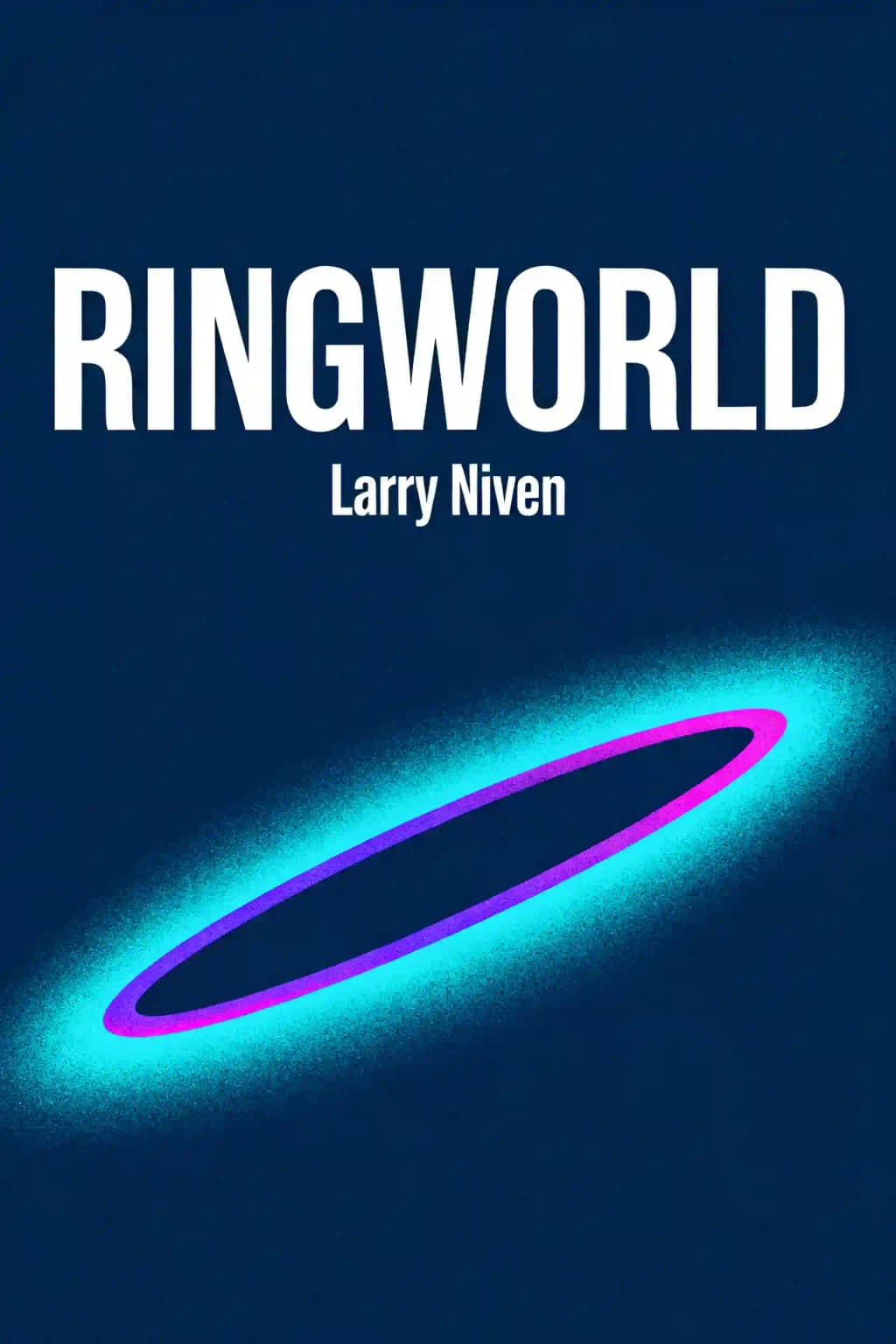
Ringworld by Larry Niven is a hard science fiction novel about Louis Wu and a multi-species crew exploring a massive artificial structure called the Ringworld—a ring one million miles wide that encircles a sun. Published in 1970, the novel follows their mission to determine if this abandoned megastructure poses a threat, but when their ship crashes on its surface, they must navigate collapsed civilizations, primitive natives, and technological mysteries to find a way home.
Ringworld by Larry Niven is ideal for readers who enjoy hard science fiction with detailed world-building and "Big Dumb Object" narratives. Fans of Arthur C. Clarke's Rendezvous with Rama or Isaac Asimov's Foundation series will appreciate Niven's engineering-focused approach to alien megastructures. The novel appeals to those interested in speculative physics, alien species interactions, and exploration-driven narratives rather than character-focused literary fiction.
Ringworld by Larry Niven remains worth reading as a Hugo and Nebula Award-winning classic that pioneered the concept of megastructure engineering in science fiction. While its characterization and treatment of female characters feels dated by modern standards, the novel's imaginative scope, scientific plausibility, and influence on subsequent sci-fi (including Halo's ring worlds) make it essential reading for understanding the genre's evolution. Readers should approach it as a product of 1970s science fiction sensibilities.
The Ringworld structure in Larry Niven's novel is an artificial ring approximately one million miles wide and 600 million miles in circumference, encircling a sun-like star. Built by an ancient, unknown civilization, the Ringworld rotates to create artificial gravity through centrifugal force at 99% of Earth's strength. Its habitable inner surface equals three million Earths in area, with breathable atmosphere, oceans, mountains, and a day-night cycle created by shadow squares connected by nearly invisible, ultra-strong wire.
In Ringworld by Larry Niven, the crew's ship Lying Bastard crashes after colliding with shadow-square wire, stranding Louis Wu, Nessus the Puppeteer, Speaker-to-Animals the Kzin, and Teela Brown on the surface. During their months-long journey to find escape technology, they encounter primitive humanoids who worship them as gods, survive violent storms, get trapped in a floating police station where they meet Prill, and ultimately discover that civilization collapsed due to a superconductor-eating mold. Teela chooses to remain with her new lover Seeker, while Louis devises an escape plan using shadow-square wire.
Louis Wu is the 200-year-old human protagonist of Ringworld by Larry Niven, kept physically youthful through boosterspice longevity drugs. He serves as an "everyman" character through whom readers explore the novel's universe, though he displays a somewhat colonial and callous attitude toward primitive Ringworld natives. Louis functions as the crew's primary problem-solver and theorist, constantly analyzing their situation and eventually devising the escape plan using the Fist-of-God mountain and shadow-square wire.
Teela Brown's luck in Ringworld by Larry Niven represents a Puppeteer breeding experiment through Birthright Lotteries, where all her ancestors for six generations were lottery winners, theoretically breeding humans for fortunate genetics. Her character arc involves experiencing pain and setbacks for the first time on the Ringworld. Louis ultimately theorizes that Teela's luck orchestrated the entire mission not to benefit the crew, but to unite her with her true love Seeker and help her mature through adversity.
The civilization collapse in Ringworld by Larry Niven occurred when a destructive mold was inadvertently introduced by trading ships like the one Prill served on. Louis Wu surmises this mold mutated and consumed the superconductors that the advanced Ringworld civilization depended upon for its technology. Without these critical components, the infrastructure failed catastrophically, causing billions of inhabitants to die and survivors to regress into primitive tribes living in ruins, waiting for the "gods" who built the ring to return.
The Puppeteers in Ringworld by Larry Niven are an alien species characterized by extreme cowardice and manipulative intelligence, with Nessus representing their race throughout the novel. They initiated the Ringworld mission because their entire homeworld is fleeing deadly radiation. The Puppeteers secretly manipulated other species for millennia—breeding Kzinti for reduced aggression through repeated wars and attempting to breed humans for luck through lottery systems. Their monstrous arrogance and species-wide manipulation serve as a central theme explored through Nessus's character.
The crew escapes Ringworld in Larry Niven's novel by exploiting a discovery about the Fist-of-God mountain—a thousand-mile-high formation not shown on ancient maps. Louis Wu deduces it resulted from a meteoroid impact that punctured the ring's underside, creating a hole above the atmosphere. The crew collects shadow-square wire, threads it through their crashed ship Lying Bastard, tethers it to a floating police station, and uses the station to drag their vessel up through the hole, where they can activate the hyperdrive to return home.
The Fist-of-God in Ringworld by Larry Niven is an enormous mountain formation near the crew's crash site, standing roughly a thousand miles high. Louis Wu discovers its significance when he notices it doesn't appear on ancient Ringworld maps, leading him to theorize it resulted from a meteoroid striking the ring's underside with enough force to deform the structure and puncture through the surface. The hole at the mountain's peak, located above the atmosphere, provides the crew's escape route off the Ringworld.
The main themes in Ringworld by Larry Niven include technological hubris and civilizational collapse, species manipulation and eugenics through the Puppeteers' breeding programs, and the concept of luck as a genetic trait. The novel explores how advanced civilizations can fall from single points of failure, the ethics of manipulating entire species for self-serving purposes, and colonial attitudes toward "primitive" cultures. Additionally, Niven examines how immense engineering achievements can outlast their creators, becoming archaeological mysteries that primitive descendants worship rather than understand.
Siente el libro a través de la voz del autor
Convierte el conocimiento en ideas atractivas y llenas de ejemplos
Captura ideas clave en un instante para un aprendizaje rápido
Disfruta el libro de una manera divertida y atractiva
The Ringworld is unstable.
Luck isn't a genetic trait.
The horizon doesn't curve down, but up.
Repeated use would make you dependent on the sensation.
Desglosa las ideas clave de Ringworld en puntos fáciles de entender para comprender cómo los equipos innovadores crean, colaboran y crecen.
Experimenta Ringworld a través de narraciones vívidas que convierten las lecciones de innovación en momentos que recordarás y aplicarás.
Pregunta cualquier cosa, elige tu estilo de aprendizaje y co-crea ideas que realmente resuenen contigo.

Creado por exalumnos de la Universidad de Columbia en San Francisco
"Instead of endless scrolling, I just hit play on BeFreed. It saves me so much time."
"I never knew where to start with nonfiction—BeFreed’s book lists turned into podcasts gave me a clear path."
"Perfect balance between learning and entertainment. Finished ‘Thinking, Fast and Slow’ on my commute this week."
"Crazy how much I learned while walking the dog. BeFreed = small habits → big gains."
"Reading used to feel like a chore. Now it’s just part of my lifestyle."
"Feels effortless compared to reading. I’ve finished 6 books this month already."
"BeFreed turned my guilty doomscrolling into something that feels productive and inspiring."
"BeFreed turned my commute into learning time. 20-min podcasts are perfect for finishing books I never had time for."
"BeFreed replaced my podcast queue. Imagine Spotify for books — that’s it. 🙌"
"It is great for me to learn something from the book without reading it."
"The themed book list podcasts help me connect ideas across authors—like a guided audio journey."
"Makes me feel smarter every time before going to work"
Creado por exalumnos de la Universidad de Columbia en San Francisco

Obtén el resumen de Ringworld como PDF o EPUB gratis. Imprímelo o léelo sin conexión en cualquier momento.
Imagine a structure so vast it encircles an entire star-a million-mile-wide ribbon with the surface area of three million Earths, spinning to create its own gravity. This is Ringworld, Larry Niven's masterpiece of engineering imagination that has influenced everything from Halo to Elon Musk's space habitation concepts. The novel takes us on an expedition to this marvel through the eyes of Louis Wu, a 200-year-old human explorer who has grown bored with humanity's homogenized culture. What begins as an adventure becomes a meditation on technology, evolution, and the fragility of even the most advanced civilizations. As we journey through this impossible structure, we'll discover that the true wonder isn't just in the engineering-it's in what happens when different species and evolutionary strategies collide with the remnants of a fallen technological utopia.
Louis Wu celebrates his 200th birthday by chasing the sunset through Earth's teleportation booths. Despite his extended lifespan, he's profoundly bored with Earth's homogenized culture where instant travel has erased meaningful cultural distinctions. This ennui makes him receptive when Nessus-a three-legged, two-headed Pierson's puppeteer-appears with an intriguing proposal. The puppeteer shows Louis a hologram of a star encircled by a blue hoop and proposes forming an exploration team, appealing to the adventurer spirit that has driven Louis to take multiple "sabbaticals" from civilization. An unlikely team assembles: Louis, the human explorer; Nessus, the seemingly cowardly puppeteer; Speaker-To-Animals, a massive orange-furred kzin whose species once waged wars against humanity; and Teela Brown, a twenty-year-old descended from five generations of Birthright Lottery winners. Each represents different evolutionary strategies: puppeteers evolved extreme caution, kzinti evolved aggression (tempered by defeats), humans evolved adaptability, and Teela possibly evolved for luck-though Louis objects that "luck isn't a genetic trait." Their diverse perspectives create a microcosm of the novel's themes, forcing each to reconsider assumptions about intelligence, courage, and survival.
The team's first revelation comes at an intermediate stop-the puppeteer fleet. They discover that the puppeteers, facing extinction from their civilization's waste heat, purchased advanced technology from mysterious "Outsiders" and relocated their entire planetary system. With a trillion puppeteers, they arranged their homeworld and four agricultural planets in a perfect pentagon-a stable formation where five worlds orbit each other. When their original sun expanded into a red giant, they added artificial lighting to their farming worlds. Later, when they detected the galactic core explosion, they began their exodus toward intergalactic space. "This explains why humans never found the puppeteer homeworld," Louis realizes. "We were searching near the wrong types of stars." The puppeteers' migration demonstrates a civilization thinking in geological timeframes-anticipating problems millennia in advance. Against this background of stellar engineering, they finally reveal the expedition's purpose: to investigate an artificial ring encircling a star-a structure so immense it dwarfs even the puppeteers' achievements.
Aboard their new ship-a transparent General Products hull fitted into a triangular wing, christened the "Lying Bastard"-the team approaches the Ringworld system. From afar, the structure appears as a halo around the G2 star, growing more impressive as they near. The Ringworld is a band ninety million miles in radius and nearly a million miles wide, rotating at 770 miles per second to create artificial gravity. Despite its seemingly delicate appearance, it's about fifty feet thick with extraordinary tensile strength. Most puzzling is its ability to block 40% of neutrinos-something no known material can do. Their attempts to contact the Ringworld using various methods yield no response. They discover an abandoned spaceport with idle fusion-ramships. As they approach to investigate, disaster strikes-X-ray lasers from automated meteor defenses hit their ship, destroying everything outside the hull and sending them on a collision course with the Ringworld. "We're under attack!" Speaker declares, but Louis realizes they've merely triggered automatic defenses. With no propulsion left, they're falling toward the ring while Nessus curls into a catatonic ball, paralyzed by the prospect of death.
The Lying Bastard crashes onto the Ringworld's surface, creating a massive furrow. The crew survives thanks to their stasis field and discover the surface beneath them is a translucent gray material-incredibly slippery and impervious to heat-the ring's foundation material. Upon exiting the ship, Louis climbs to higher ground and finds they've landed in a vast white sand desert. Unlike planetary worlds, the Ringworld has no curved horizon; land and sky merge at a distant vanishing point. "It's not like a planetary horizon at all," Louis marvels. "The land just keeps going up and up until it vanishes in the distance." As darkness falls suddenly from passing shadow squares, they witness an extraordinary sight: an enormous arch taking shape against the darkening sky-the Ringworld overhead. The arch narrows as it rises, striped in baby blue with white clouds and near-black bands, cut at the zenith by shadow squares. This moment captures the novel's sense of cosmic awe. The Ringworld fundamentally alters one's perception of space itself, with the horizon curving upward rather than downward, creating the illusion of an infinite arch across the sky.
Flying over the Ringworld on flycycles, the expedition makes a shocking discovery: the natives appear human. This raises profound questions about the relationship between Earth and the Ringworld-were humans transplanted between the two worlds? Their first contact ends disastrously. In a ruined city, they meet ghost-white humanoids who mistake them for returning Ringworld engineers. When Louis demonstrates his flashlight-laser, the spokesman becomes outraged, declaring fighting with light "forbidden," forcing the team to flee. As they journey onward, they witness evidence of civilization's collapse. Cities lie in ruins, with once-floating buildings crashed to the ground after catastrophic power failure. Louis theorizes that without transmutation technology, the Ringworld has no way to mine metals from its artificial structure. With only dirt above impenetrable foundation material, civilization fell and couldn't rise again. This exploration of technological dependency gives "Ringworld" its philosophical depth-a cautionary tale about what happens when a civilization becomes so reliant on advanced technology that it can no longer maintain it.
Stranded on the Ringworld, Louis and his companions discover a potential escape through Halrloprillalar, an ancient crew member who mentions the "cziltang brone"-a device making the Ringworld floor permeable. When no working device is found, Louis devises an alternative plan. He focuses on "Fist-of-God" mountain, an unnaturally tall peak spotted after landing. Louis theorizes it resulted from a meteor impact from below, potentially creating a hole through the Ringworld floor into space. Using strong "shadow square wire" from their crash, they connect their ship to a captured floating building and ascend the mountain. At the crater's rim, they fall through into space-successfully breaking through the floor. Tethered to the Lying Bastard, they'll eventually match the Ringworld's rotation and escape. As they depart, Louis realizes how little of this vast structure they've explored. Despite traveling thousands of miles, they've seen less than a fraction of a percent of the Ringworld's surface. "Ringworld" challenges us to build wonders while remembering that all constructions require constant renewal-a monument to achievement and a warning about fragility when knowledge is lost.