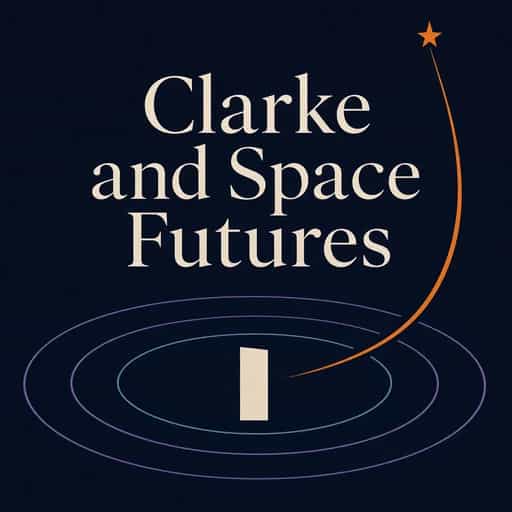
A massive alien cylinder enters our solar system in Clarke's multi-award-winning masterpiece that swept every major sci-fi honor. What secrets lie within this enigmatic vessel? Discover why this landmark novel has captivated readers for five decades, leaving them pondering its famous final line.
Sir Arthur Charles Clarke (1917-2008) was the acclaimed British science fiction author of Rendezvous with Rama and a master of hard science fiction who explored humanity's encounters with the incomprehensible unknown. Born in Somerset, England, Clarke's lifelong passion for space exploration shaped his visionary narratives about cosmic wonder and alien civilizations.
His mathematics and physics degree from King's College London, combined with wartime service as an RAF radar specialist, brought scientific rigor to his exploration of humanity's intellectual limitations when confronting advanced technology.
Clarke is best known for collaborating with director Stanley Kubrick on the landmark 1968 film 2001: A Space Odyssey and authored nearly 100 books, including Childhood's End. Knighted in 1988, he lived in Sri Lanka from 1956 until his death in 2008. Rendezvous with Rama won both the Hugo and Nebula Awards, establishing it as a defining work of exploration-driven science fiction that continues to inspire with its profound sense of wonder.
Rendezvous with Rama by Arthur C. Clarke is a science fiction novel about humanity's first encounter with an alien spacecraft in 2131. When a massive cylindrical object fifty kilometers long enters the solar system, Commander Bill Norton and the crew of Endeavour are dispatched to explore its mysterious interior. The novel follows their investigation of Rama's vast, self-contained world filled with cities, seas, and enigmatic technologies.
Rendezvous with Rama is ideal for science fiction enthusiasts who appreciate hard sci-fi focused on exploration and discovery rather than action. Readers fascinated by first contact scenarios, alien archaeology, and technological mysteries will find this Arthur C. Clarke novel compelling. The book also appeals to those who enjoy thought-provoking narratives that prioritize wonder and scientific speculation over character-driven plots.
Rendezvous with Rama remains a landmark work in science fiction that revolutionized the genre's approach to alien contact narratives. Arthur C. Clarke's meticulous world-building and sense of cosmic mystery create an unforgettable reading experience. While the novel prioritizes exploration over character development, its innovative concepts and atmospheric tension make it essential reading for anyone interested in classic science fiction.
Arthur C. Clarke was a British science fiction author and futurist known for works like 2001: A Space Odyssey. Rendezvous with Rama draws from Clarke's fascination with the possibility of ancient alien civilizations passing through our solar system. The novel reflects his interest in hard science fiction, emphasizing realistic space exploration and the profound implications of encountering technology vastly beyond human understanding.
Rama is a massive alien cylindrical spacecraft measuring fifty kilometers long and twenty kilometers in diameter that enters Earth's solar system in 2131. The perfectly geometric cylinder contains a self-sustaining interior world with artificial cities, a cylindrical sea, and mysterious technologies. Initially thought to be a derelict ship millions of years old, Rama proves to be a functional vessel following its own unknowable mission.
Biots are biological robots that emerge inside Rama as the spacecraft warms up near the sun. These highly specialized creatures appear to be built from organic material and perform various maintenance functions like surveillance and scavenging. The biots include crab-like creatures, shark-like beings, and three-legged entities with tentacles and blue eyes, each designed for specific tasks within Rama's ecosystem.
"Ramans do everything in threes" is a crucial observation made by Commander Norton that becomes the novel's key insight. This design pattern appears throughout Rama's architecture—three airlocks, three stairways, and various systems built in triplicates. The phrase takes on deeper significance at the novel's conclusion, suggesting that Rama may be the first of three similar vessels visiting humanity's solar system.
Rendezvous with Rama concludes as the spacecraft appears to plunge toward the sun but instead uses solar energy to accelerate and exit the solar system toward the Large Magellanic Cloud. The crew evacuates just before perihelion, watching biots throw themselves into the Cylindrical Sea as Rama's linear suns dim. Commander Norton becomes a celebrated hero but remains haunted by unanswered questions about the Ramans' purpose and whether humanity failed to understand their visit.
Commander Bill Norton is the protagonist of Rendezvous with Rama and captain of the spaceship Endeavour, which investigates the alien cylinder. Norton leads his diverse crew of over fifty experts through their dangerous three-week exploration of Rama's interior. After successfully preventing Mercury's attempt to destroy Rama and completing the mission, Norton is hailed as a hero and granted permission by Mars to father a third child.
The Cylindrical Sea is a massive ring of water encircling Rama's interior midpoint, dividing the cylinder into northern and southern continents. Initially frozen, the sea melts as Rama approaches the sun, creating a sustainable biome for oxygen-breathing organisms. Analysis reveals the water would be poisonous to humans, and the sea contains shark-like creatures that consume debris. The sea features underwater wave breakers and reaches depths requiring careful navigation.
James "Jimmy" Pak, the Endeavour's youngest crew member, makes a daring flight using a modified sky-bike called "Dragonfly" to reach Rama's southern continent. When electrical discharges from the "Horns" knock him from the sky, he becomes stranded and encounters crab-like biots scavenging his equipment. Norton's crew orchestrates a dramatic rescue, instructing Jimmy to leap off a five-hundred-meter cliff using his shirt as a parachute.
The main theme of Rendezvous with Rama explores humanity's insignificance in the face of vastly superior alien intelligence and technology. Arthur C. Clarke examines how humans respond to the unknowable, contrasting scientific curiosity with fear and paranoia, as demonstrated by Mercury's attempt to destroy Rama. The novel also meditates on cosmic indifference—the Ramans show no interest in humanity, treating our solar system merely as a refueling stop on their incomprehensible journey.
Siente el libro a través de la voz del autor
Convierte el conocimiento en ideas atractivas y llenas de ejemplos
Captura ideas clave en un instante para un aprendizaje rápido
Disfruta el libro de una manera divertida y atractiva
Any sufficiently advanced technology is indistinguishable from magic.
Even the most cursory examination of the objects scattered on the Plain indicated that Rama was not designed for Man.
The Ramans did everything in threes. But why?
Its portrayal of first contact through the lens of scientific exploration rather than conflict was revolutionary.
Desglosa las ideas clave de Rendezvous with Rama en puntos fáciles de entender para comprender cómo los equipos innovadores crean, colaboran y crecen.
Experimenta Rendezvous with Rama a través de narraciones vívidas que convierten las lecciones de innovación en momentos que recordarás y aplicarás.
Pregunta cualquier cosa, elige tu estilo de aprendizaje y co-crea ideas que realmente resuenen contigo.

Creado por exalumnos de la Universidad de Columbia en San Francisco
"Instead of endless scrolling, I just hit play on BeFreed. It saves me so much time."
"I never knew where to start with nonfiction—BeFreed’s book lists turned into podcasts gave me a clear path."
"Perfect balance between learning and entertainment. Finished ‘Thinking, Fast and Slow’ on my commute this week."
"Crazy how much I learned while walking the dog. BeFreed = small habits → big gains."
"Reading used to feel like a chore. Now it’s just part of my lifestyle."
"Feels effortless compared to reading. I’ve finished 6 books this month already."
"BeFreed turned my guilty doomscrolling into something that feels productive and inspiring."
"BeFreed turned my commute into learning time. 20-min podcasts are perfect for finishing books I never had time for."
"BeFreed replaced my podcast queue. Imagine Spotify for books — that’s it. 🙌"
"It is great for me to learn something from the book without reading it."
"The themed book list podcasts help me connect ideas across authors—like a guided audio journey."
"Makes me feel smarter every time before going to work"
Creado por exalumnos de la Universidad de Columbia en San Francisco

Obtén el resumen de Rendezvous with Rama como PDF o EPUB gratis. Imprímelo o léelo sin conexión en cualquier momento.
In 2077, a meteorite obliterated northern Italy, killing 600,000 people and finally awakening humanity to the existential threat posed by near-Earth objects. From this tragedy emerged Project SPACEGUARD, a global defense system uniting former adversaries in tracking any celestial body that might threaten Earth. By 2130, this sophisticated network identified approximately twelve new asteroids daily, with quantum computers calculating trajectories for over half a million tracked objects. When Object 31/439 appeared on Mars-based radar screens, it initially seemed like just another asteroid. But its unusual characteristics quickly captured scientific attention: detected at unprecedented distance, estimated at forty kilometers in diameter, and following a hyperbolic rather than elliptical orbit. This wasn't a solar system native; it was passing through at over 100,000 kilometers per hour. When Dr. William Stenton discovered it rotated every four minutes - impossibly fast for a natural object that size - scientists realized they were witnessing something extraordinary. The object's perfect cylindrical shape defied all known models of asteroid formation. Images from space probe Sita transfixed humanity: a geometrically perfect cylinder, fifty kilometers long and twenty across - unmistakably artificial. The perfect symmetry and smooth surface, broken only by a single kilometer-wide stain, left no doubt about its manufactured nature. Initial analysis revealed a metallic composition unlike anything in humanity's material science database, with unique reflective properties that made the cylinder shimmer with an otherworldly iridescence. Humanity was about to receive its first visitor from the stars.
The Space Advisory Council voted to redirect a probe to intercept the mysterious hollow object, naming it "Rama" after the Hindu god. As Commander Norton's Endeavour approached, the artifact's scale became overwhelming-a perfect cylinder weighing ten trillion tons, rotating every four minutes to create artificial gravity inside. Norton established humanity's first presence with the words, "Rama Base. Endeavour has landed." The landing site near Rama's North Pole provided a natural mooring between pillbox structures. With just three weeks before they'd need to separate to avoid the sun, time was precious. After monitoring the vessel, Norton and Lieutenant-Commander Mercer conducted the first EVA, discovering a mechanism that opened the wall and released Rama's atmosphere. Norton's solo journey through the final airlock paralleled Carter's discovery of Tutankhamun's tomb. Drifting into darkness at his safety line's end, he found himself at the highest point of an inside-out world. His flare revealed the cylinder's interior surface with possible forests or towns, geometric networks, and a cylindrical sea encircling everything.
The team mapped Rama's interior using flares, revealing a cavity fifty kilometers long by sixteen wide. The Northern Hemisphere contained three kilometer-long ladders set 120 degrees apart, each ending at a terrace leading to massive stairways with approximately thirty thousand steps. The Southern Hemisphere featured a huge central spike surrounded by six smaller ones. Between the hemispheres lay the "Central Plain"-the cylindrical main section divided by a "Cylindrical Sea" containing an oval island with tall structures they named "New York." Commander Norton led the initial descent team. As they descended, they experienced increasing artificial gravity from Rama's spin. The air was musty but nearly breathable at 30% of Earth's pressure. The massive stairway evoked awe comparable to Aztec ruins but on a vastly larger scale. Despite potentially being millions of years old, everything appeared pristine. Upon reaching the plain, they noted freezing temperatures and absolute silence where sounds vanished without echoes. Lieutenant Calvert observed this was humanity's first experience breathing another world's atmosphere, suggesting the Ramans were oxygen-breathers possibly 50% taller than humans.
Imagine standing on a stairway where "down" points outward toward the walls of a spinning cylinder, and the horizon curves upward until it's directly overhead. This was the disorienting reality of exploring Rama - a world turned inside out. The team continued toward "Paris," planning to examine the "Straight Valley" - a forty-meter-deep trench resembling an irrigation canal. Norton rappelled down to find the bottom covered with translucent, ice-like material with high friction. A profound silence weighed on them - quiet so absolute it demanded reverence. In Rama, the absence of sound was as tangible as the alien structures themselves. After weeks in darkness, a dramatic transformation began. The Cylindrical Sea started breaking up with thunderous reports. As solar heat penetrated Rama's hull, the ice fractured - first in hairline cracks, then massive fissures spider-webbing across the surface. Winter was ending in this artificial world, following patterns programmed eons ago by its creators.
Commander Norton ordered an evacuation through the 0.2g environment. Partway up the ladder, a soundless concussion of light flooded the cylinder as dawn broke. The fully illuminated Rama revealed its alien grandeur. Most striking was the Cylindrical Sea-a vertical band of water wrapped around the interior, defying physics. Norton observed mist rising from the newly thawed Sea, tilting with Rama's rotation before dissolving in turbulent patterns. The first tropical storm in perhaps millions of years was brewing in this ancient vessel. After the storm passed, Norton's team returned to a transformed Rama. The atmosphere had become perfectly breathable with tropical humidity. Most dramatically, the Cylindrical Sea had changed from blue to pea-green, now teeming with rapidly multiplying spherical microorganisms.
At "New York," the crew discovered not a city but an enormous machine resembling a chemical plant. Here they encountered the first active entities in Rama: crab-like "biots" (biological robots) methodically sorting debris, completely indifferent to humans. As Rama approached the sun, tensions escalated. The Hermian government, fearing Rama's trajectory, launched a nuclear missile without consultation. Norton faced a profound moral choice, concluding, "The human race has to live with its conscience. Survival is not everything." Lieutenant Rodrigo successfully neutralized the bomb. In their final exploration, the team found a "Temple of Glass" containing holographic images of a Raman - a tall, three-armed creature about 2.5 meters high. Their exploration ended when Rama began powering up for departure. Five million kilometers from the sun, Rama transformed, creating a perfectly reflective shield to harness solar energy. It swung around the sun, changing direction ninety degrees toward the Greater Magellanic Cloud, showing complete indifference to the worlds it had disturbed.
Despite his mission's success, Norton felt profound loss, having failed to understand the Ramans' true nature. They had merely used our solar system as a refueling stop before continuing onward. The encounter left humanity with more questions than answers. Who built this artifact? Where were they going? Dr. Carlisle Perera noted that "The Ramans do everything in threes" - evident in the three-armed biots, stairways, and straight valleys - suggesting a fundamental pattern that might help decipher more of the Raman mystery. If the Ramans truly operate in threes, might more cylindrical worlds be heading toward us? This possibility invites us to imagine future encounters. In the vastness of space, we're merely one species on an unremarkable planet. Yet our curiosity gives us purpose. Rama's visit reminds us that wisdom begins with acknowledging how much we have yet to learn - and perhaps wondering who else might be looking back at us from the night sky.