Capítulo 1
When the Bottom of the Valley Becomes Your Starting Point
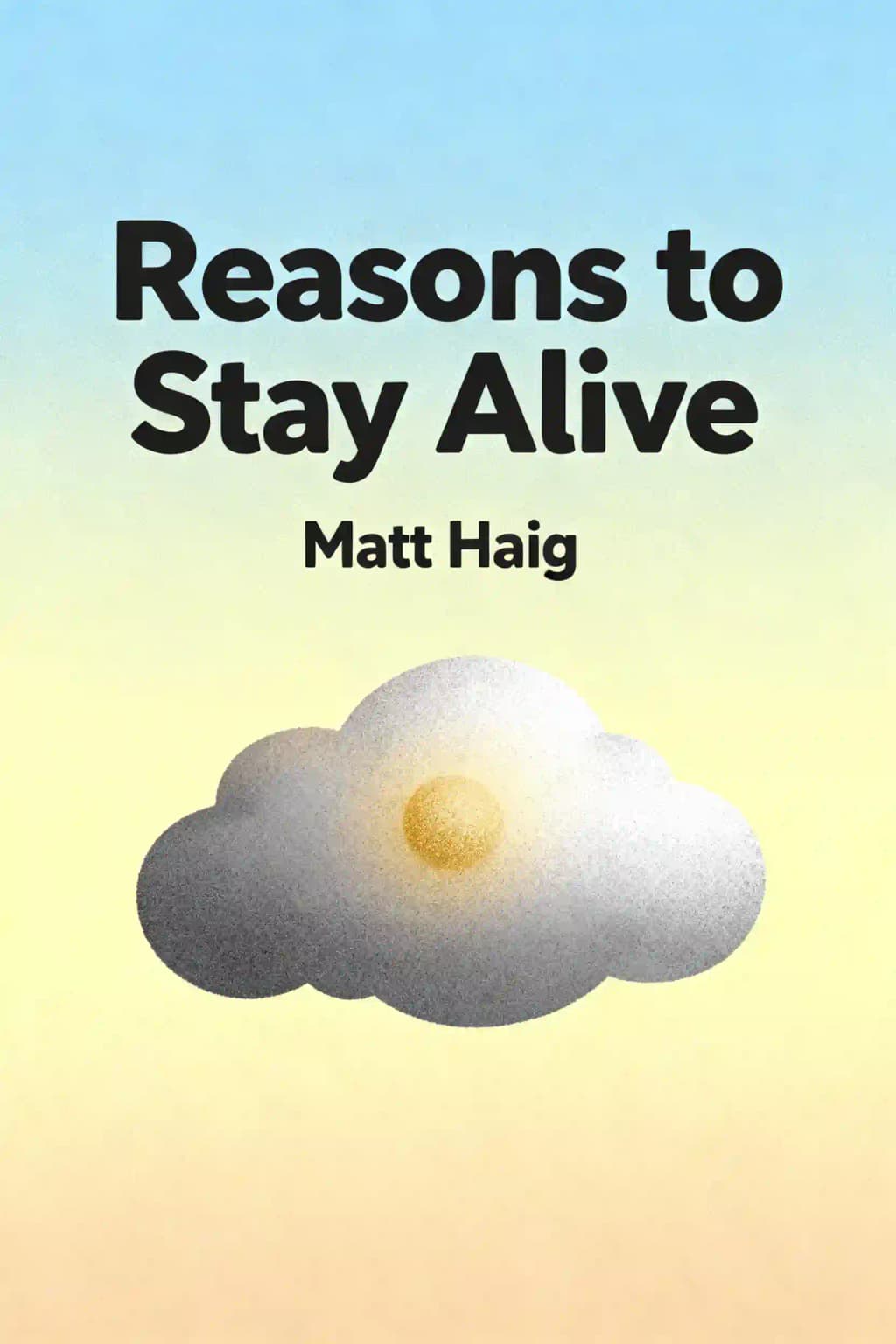
In the depths of depression, Matt Haig was convinced of two certainties: he would die, or he would go mad. The idea that he might one day write about his experience seemed as impossible as flying to Jupiter. Yet here we are, holding the evidence that depression lies. "Reasons to Stay Alive" has become a global phenomenon, selling over a million copies and appearing on countless celebrity bookshelves from Emma Watson to Gillian Anderson. This raw, unflinchingly honest memoir has been credited with saving countless lives, with readers often describing it as "the book that found me exactly when I needed it." What makes this work so powerful is Haig's ability to articulate the indescribable-to put words to an experience that feels, by its very nature, beyond language. Through his journey from the edge of a cliff in Ibiza to becoming one of our most beloved contemporary writers, Haig offers not just a lifeline to those suffering, but a profound meditation on what makes life worth living for us all.
Capítulo 2
The Day Death Seemed Like the Only Option
I remember the day the old me died. It began with a thought that something was wrong, followed by a strange biological sensation in my cerebellum-a pulsing, intense flickering with tingling. At twenty-four, living in Ibiza with my girlfriend Andrea, I was two weeks away from returning to London and adulthood when my mind broke.
What made this hell particularly terrifying was its invisibility. While I was experiencing the most intense suffering of my life, no one could see the flames consuming my mind. I stayed in bed for three days, unable to sleep or eat, while Andrea brought water and fruit that remained untouched. I didn't want to be dead exactly-I just didn't want to be alive. I wanted to never have existed at all.
The pain transcended language; I couldn't focus on anything, not even the book beside the bed. I worried about my sister in Australia, knocking on the mattress as we used to communicate through our bedroom walls as children. I had no concept of "depression" or "panic disorder"-I thought my experience was uniquely mine, which only intensified my isolation.
On the third day, I left the villa to kill myself.
The sun beat down mercilessly, the air fragrant with pine and sea. The cliff edge was only twenty steps away. A lizard near my feet seemed to judge me-lizards don't kill themselves, they're survivors. Behind me stood the villa, the nicest place I'd ever lived. Before me stretched the most glorious Mediterranean view, yet it couldn't stop me wanting to die.
This wasn't about being different or rebellious; this was pain in its purest form. I made it to the edge, knowing I could stop feeling this way with a single step. People with depression don't want happiness-they want absence of pain. But death wasn't less scary. I stood there summoning courage to die, then courage to live. Four people loved me, trapping me here. If I'm honest, I was terrified. Life always provides reasons not to die, if we listen. So I turned back toward the villa and threw up from stress.
Capítulo 3
The Invisible Inferno That No One Can See
Depression is notoriously difficult to understand because it's invisible. It's not simply "feeling a bit sad." The word itself is problematic-depression makes me think of a flat tire, something punctured and unmoving, but depression laced with terror is anything but flat or still. At its worst, you find yourself wishing for any physical pain, because the mind's torments can be infinite.
You can be a depressive and be happy, just as you can be a sober alcoholic. Depression doesn't always have an obvious cause. It can affect people who seem to have no reason to be miserable. It remains mysterious even to those who suffer from it.
What makes depression particularly deadly is how it alters your thinking. When you're in its grip, you can't imagine ever feeling better. This distortion is why suicide has become a leading cause of death in places like the UK and US, accounting for over one in a hundred fatalities. According to the World Health Organization, suicide kills more people than stomach cancer, cirrhosis, colon cancer, breast cancer, and Alzheimer's. As suicide victims are often depressives, depression is one of the deadliest diseases on the planet.
Yet people still don't treat depression with the gravity it deserves. We would never say to someone with cancer, "Come on, I know you've got tuberculosis, but it could be worse. At least no one's died." We wouldn't tell someone whose leg is on fire, "Yes, yes, your leg IS on fire, but talking about it all the time isn't going to help things, is it?" But these dismissive responses are commonplace for those suffering from depression.
The stigma is especially cruel because depression affects thoughts themselves. When depressed, you feel alone and scared to speak about it, internalizing everything. Depression speaks directly to you in a relentless, cruel voice: "Hey, sad-sack! Why try to get out of bed? Who do you think you are? You're going to go mad like Van Gogh. You might cut off your ear."
Capítulo 4
When Your Mind Becomes Your Enemy
A human body contains roughly a hundred trillion cells, each with about the same number of atoms-a universe in itself. Our brains alone have a hundred billion cells. Yet we simplify by thinking of ourselves in larger pieces: arms, legs, torso, head. Similarly, our minds simplify to cope with life. Depression, however, is like quantum physics of thought and emotion-it reveals what's normally hidden, unraveling everything you've known.
My symptoms were overwhelming: feeling like my reflection showed another person; tingling sensations throughout my body; inability to contemplate the future; fear of going mad; hypochondria; separation anxiety; agoraphobia; constant dread; exhaustion; chest tightness; feeling like I was falling while standing still; occasional inability to speak; infinite sadness; feeling disconnected; loss of appetite; insomnia; continuous scanning for warning signs I was dying or going mad; strange deja vu; darkness at the periphery of my vision; and a desperate desire to step out of myself, even for a second.
Adding anxiety to depression is like adding cocaine to alcohol-it presses fast-forward on everything. Unlike physical pain which you can separate from yourself, with depression the pain IS thought. You are your thoughts.
Medication didn't work for me initially. I was partly to blame. During my worst time, when depression co-existed with 24/7 panic disorder, I was scared of everything-literally my shadow. I'd see malevolence in ordinary objects. But what scared me most was anything that would change my state of mind. I experienced a reverse placebo effect-taking diazepam would instantly trigger panic, especially when I felt the drug having any effect. I didn't believe feeling well was possible, and feared feeling worse.
The disconnection I felt on diazepam is something others report too, so the drug itself was at least part of the problem. Medication is an attractive concept for everyone-the depressed person, pharmaceutical companies, and society. It reinforces our belief that everything can be fixed by consuming things, creating a just-shut-up-and-take-the-pill approach. It divides us into "us" and "them," allowing society to feel that "unreason" is being safely neutered.
Capítulo 5
The Unexpected Path Through Darkness
Bad days come in degrees. The really horrible ones, though unbearable, become useful later. You store them up-a bank of bad days. The day you ran from the supermarket. The day your tongue wouldn't move. The day you made your parents cry. The day you nearly jumped off a cliff. So when you're having another bad day, you can say, "This feels bad, but there have been worse." Even when you can think of no worse day, you know the bank exists and you've made deposits.
Depression's warning signs are difficult to spot, especially for those with no direct experience of it. We casually use "depressed" as a synonym for "sad," though the difference between them is like starvation versus feeling peckish. Depression is an invisible serious illness that's surprisingly hard for sufferers to recognize. When you feel worthless, you might think it's because you are worthless, not seeing it as a symptom.
Common signs include constant fatigue, low self-esteem, slow movements and speech, appetite changes, irritability, frequent crying, anhedonia (inability to feel pleasure), and sudden introversion. Sometimes I couldn't speak at all-my tongue felt immovable and talking seemed utterly pointless.
After three months at my parents' house and a winter in a cheap Leeds flat, I began experiencing brief moments of relief in April 2000. Though these positive moments were initially minuscule-just feeling sunshine on my face during walks with Andrea-they gradually expanded. By May, the good moments had increased a hundredfold. In June, we moved to a light-filled city center flat with white walls and large windows. Light became essential to my recovery, both literal light and metaphorical "white space"-the breathing room between paragraphs, between thoughts, between moments of darkness.
Books became not just a pleasure but a necessity during my recovery-"a Class A addictive substance." I read voraciously, finding in books both escape and self-discovery. Graham Greene's "The Power and the Glory" particularly resonated with me, its themes of guilt and redemption mirroring my experience with depression.
Capítulo 6
Breaking Free From Mental Imprisonment
When Andrea surprised me with a trip to Paris, I was terrified-unable to imagine traveling abroad after four years. The panic was immediate: curled in a fetal position, trembling, irrationally fearing I "wouldn't be able to breathe the air" there. But when Andrea offered to cancel, I faced a choice: admit defeat to my fear or push through it. Ultimately, my greater fear of "being totally mad" overcame my fear of travel.
In Paris, I managed without major panic attacks, discovering that "simply doing something that I had dreaded-and surviving-was the best kind of therapy." The new environment forced my mind to focus outward rather than inward, providing unexpected relief. Travel became a way to gain perspective, making me "feel me but at a lower volume." As Flaubert said, "Travel makes one modest. You see what a tiny place you occupy in the world"-a liberating perspective for someone with an illness that "intensifies the trivial."
In 2002, when Andrea's mother was diagnosed with ovarian cancer, I faced a turning point. After three years of Andrea supporting me through depression, it was my turn to be strong. When Andrea needed to take her mother to the hospital, I initially panicked at the thought of being left alone-my separation anxiety kicking in. But something shifted: "A switch flicked." I forced myself to stay behind, pacing anxiously through her parents' house. After fifty minutes alone, I realized I was still alive-"Three years of separation anxiety cured in less than an hour!"
Running became another powerful tool against my depression and anxiety. The physical symptoms of panic-racing heart, problematic breathing, sweating-were matched by running, giving these sensations a logical cause. The effort and discomfort became "a great focuser"-"a kind of active meditation." Like Haruki Murakami, I found running "a way of clearing the fog." The monotonous rhythm of feet on pavement became "a kind of metaphor for depression"-that internal debate about continuing when you want to stop. Each time I pushed through a difficult run, it gave me "a little bit of depression-beating power."
Capítulo 7
The Fearful Gift of Depression
Depression makes you feel alone-one of its main symptoms-so knowing others share your experience helps. While stories of writers like Hemingway, Plath, or David Foster Wallace can be frightening, most people with depression don't die by suicide. Famous people who've suffered depression demonstrate that "it can actually happen to anyone." These stories of recovery are powerful, like reading about Halle Berry overcoming her suicide attempt. "We love the narrative structure of rise-fall-rise-again" because it offers hope that wellness is possible.
Abraham Lincoln declared at age thirty-two: "I am now the most miserable man living," having already experienced two major depressive breakdowns. Though he contemplated suicide, Lincoln chose to live and channeled his suffering into purpose. Joshua Wolf Shenk argues that Lincoln's greatness wasn't achieved by overcoming depression but grew from it-his "melancholy was all the more fuel for the fire of his great work." Similarly, Winston Churchill's "black dog" of depression may have enabled his exceptional foresight about Nazi Germany when conventional minds failed to see the danger.
Depression can sometimes be a "fearful gift" that drives curiosity, philosophical thinking, and empathy. While depression is undeniably a nightmare, it can sometimes fuel creative work, as with Edvard Munch's "The Scream," inspired by a moment of existential terror, or Kafka's "The Metamorphosis," which can be read as a metaphor for depression.
Depression is an internal war, a black dog, a black hole, an invisible fire, a pressure cooker, a devil inside, a prison, an absence, a bell jar, a malicious code in the mind's operating system, a parallel universe, a life-long fight, a by-product of mortality, a living nightmare, an echo chamber, dark and hopeless and lonely, a collision between an ancient mind and a modern world, and simply "a fucking pain."
But depression is also smaller than you, even when it feels vast. It operates within you; you do not operate within it. Using the metaphor of a dark cloud passing across the sky: "You were there before it. And the cloud can't exist without the sky, but the sky can exist without the cloud."
Capítulo 8
Finding Balance in an Unbalanced World
Our world is systematically designed to depress us because happiness is fundamentally bad for the economy. Industries methodically profit from our deepest insecurities: anti-aging products require an entrenched fear of aging, political parties expertly exploit immigration fears, insurance companies sell carefully packaged worry, and tech companies constantly make us fear being left behind. Beauty companies create impossible standards, social media platforms feed on our FOMO, and advertising constantly reminds us of what we lack. In this environment, "to be calm becomes a kind of revolutionary act." Despite the relentless pressure to upgrade our lives, homes, and appearances, what truly matters isn't the accumulation of material possessions but authentic human connection-"Life is the people who love you. No one will ever choose to stay alive for an iPhone."
Anxiety, depression's frequent companion, accompanies approximately half of all depression cases. Though opposites in many ways - depression pulls you down while anxiety winds you up - their combination doesn't create balance but rather intensifies suffering exponentially. Modern life systematically exacerbates anxiety through constant stimulation-smartphones buzzing with notifications, social media feeds demanding attention, endless information overload, and the paralysis of infinite choices. From choosing between 50 types of breakfast cereal to deciding on career paths, the modern world bombards us with decisions. Despite its overwhelming intensity, anxiety is highly treatable, perhaps more so than depression, with numerous effective interventions available.
While medication provides relief for many, fundamentally slowing down is essential for managing anxiety, which "runs your mind at fast-forward" and "takes away all the commas and full stops we need to make sense of ourselves." Practical tools for managing anxiety include regular yoga practice, controlled breathing exercises (in for five, out for five), daily meditation, practicing acceptance rather than resistance, living mindfully in the present moment, and channeling love as an outward force to counter anxiety's inward pull. People struggling with mental illness aren't self-absorbed by choice-they're simply "feeling things that can't be ignored," often at an intensity that others might find difficult to comprehend.
Recovery isn't a straight line but follows a natural pattern of "peaks and troughs"-things get better, then temporarily worse, then better again, like waves on an ocean. Even fourteen years past my lowest point, depression isn't completely erased but returns in "flashes" when I'm physically tired, particularly anxious or eating poorly. The key is recognizing these moments as temporary states rather than permanent conditions. Depression eventually becomes "an aside. Something to put brackets around," with the vital lesson that "the way out is never through yourself" but through connection, community, and reaching outward rather than inward. Recovery doesn't mean never struggling again; it means having the tools and understanding to weather the storms when they come.
Capítulo 9
Embracing Sensitivity and Finding Meaning
The author acknowledges his emotional sensitivity as inseparable from his depression and anxiety. Though his breakdown left permanent ripples, he's progressed from constant misery to general happiness with occasional "blips." Rather than fighting his conditions, he's befriended them by appreciating his thin skin. This sensitivity allows him to experience life's full spectrum-from terror to wonder-and feel deeply connected to art, literature, and existence itself. Despite fearing depression, he accepts it as the price for his heightened ability to feel, concluding: "I am satisfied just to be."
Time troubles us because it leads to aging and death. We rush through life trying to accomplish things before it's too late, but this approach only makes time feel shorter. Pain lengthens time by forcing awareness of it. Meditation similarly lengthens time through present-moment awareness, contrasting with our tendency to worry about the future or regret the past. Our desperate race for status and possessions only shortens our experience of time-like gulping wine instead of savoring it.
Before his breakdown, the author distracted himself from worry through clubs, drinking, and seeking intense experiences, fearing quiet moments alone with his thoughts. After becoming ill, these escapes became impossible-even music or spicy food could trigger panic attacks. Unable to self-medicate with substances, he was forced to confront his mind directly. This led to his realization that happiness comes not from having only happy thoughts but from accepting all thoughts without becoming them. Like walking through a storm without being the storm, we can experience difficult feelings while knowing we are not those feelings.
Even in his darkest moments, he discovered an unbreakable core self that connects all humans-"I am you and you are me. We are alone, but not alone. We are trapped by time, but also infinite. Made of flesh, but also stars."
Capítulo 10
Forty Pieces of Wisdom for Living Well
Appreciate happiness when present, recognizing it in small moments like morning coffee or a child's laugh. Be gentle with yourself, treating your mind and body with the same compassion you'd offer a dear friend. Accept that the past cannot be changed, but your relationship with it can evolve. Find beauty everywhere - in urban landscapes, in worn objects, in aging faces. Understand that thoughts are just thoughts, neither facts nor commands. Practice mindfulness through daily rituals, whether washing dishes or walking to work. Be kind to others, knowing everyone fights invisible battles. Embrace nature, especially trees, whose presence has been scientifically proven to reduce stress and anxiety. Read without rushing, savoring words like fine wine. Accept love when offered, even when you feel undeserving. Remember your unchanging core self through all emotional states, like a deep ocean beneath stormy waves. Recognize that books provide escape routes and homes for uprooted minds, offering both sanctuary and adventure.
Love and be loved if you can, but don't make it a prerequisite for self-worth. Understand that there is always hope, even when you cannot feel it - like stars invisible in daylight but always present. Remember that the way people treat you is about their own stories, wounds, and limitations, not your worth. Exercise regularly, as it creates a different mental state through biochemical changes and emotional release. Be aware that happiness is not the absence of suffering but the ability to hold both joy and pain simultaneously, like a parent embracing both the challenges and delights of raising children. Know that nothing lasts forever-not pain, not pleasure - impermanence is life's only constant. Listen to what you really need, which is rarely what you think you want; the soul whispers while ego shouts. Live in the present as much as possible, as it's the only moment where change is possible. Travel not just to new places, but to new perspectives. Read books that challenge your view of the world, especially those from voices unlike your own. Be around nature daily, even if just tending to houseplants or watching birds. Try to understand people, even those who hurt you - their actions often reflect their own pain. Avoid the pursuit of happiness as a goal, which only leads to unhappiness; instead, pursue meaning and purpose.
The simple pleasures that return after depression can be the most profound: watching sunrises paint the sky in impossible colors, losing yourself in books that feel written just for you, savoring that first sip of cold beer on a warm evening, breathing fresh air after rain, exchanging tender kisses that speak without words, swimming in various bodies of water - from wild oceans to calm lakes, experiencing stories in darkened cinemas, feeling music resonate in your bones, discovering new depths of love, eating olives outside under Mediterranean skies, making peanut butter sandwiches that taste like childhood, inhaling the sharp scent of pine in Italian mountains, feeling health return after illness, witnessing the miracle of children being born, reading bedtime stories that create magical worlds, engaging in passionate political discussions with parents that bridge generations, revisiting favorite films and musicians that feel like old friends, laughing until tears come and sides ache, running down hills with abandoned joy, decorating Christmas trees that spark wonder, dancing at three in the morning when the world feels infinite, reaching ages once thought impossible during dark times, sharing meaningful conversations with friends and fascinating strangers, and writing about the journey through darkness into light, transforming personal pain into universal understanding.
Depression is not you. You are the sky - vast, eternal, and unchanging - and depression is just a cloud passing through, temporary despite its apparent permanence.