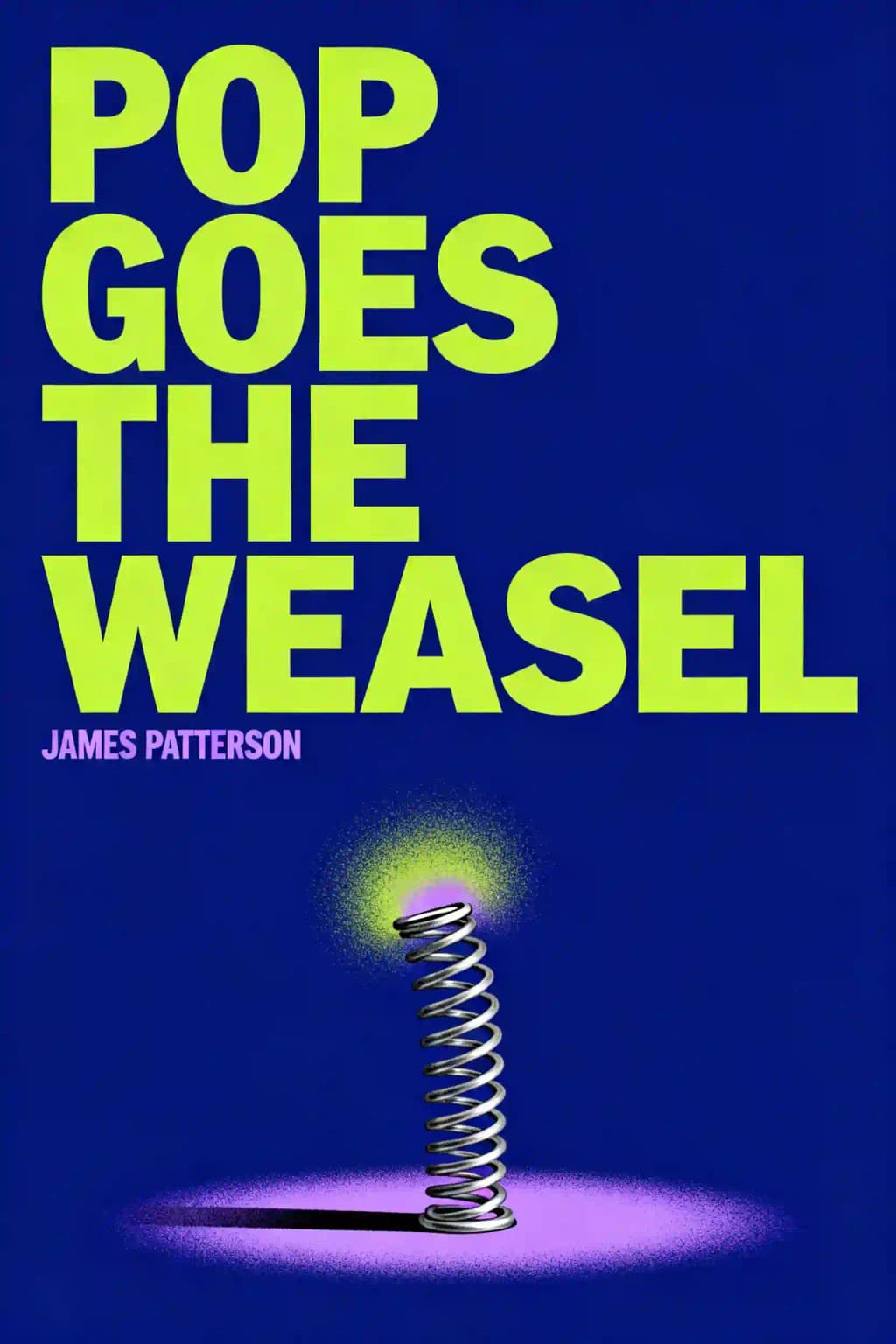
In "Pop Goes the Weasel," Patterson's fifth Alex Cross thriller delivers a chilling villain playing a deadly fantasy game. Consistently praised as Patterson at his peak, this psychological masterpiece explores systemic bias while asking: what happens when virtual worlds bleed terrifyingly into reality?
James Brendan Patterson is the bestselling author of Pop Goes the Weasel, a pulse-pounding crime thriller in his legendary Alex Cross series—the top-selling U.S. detective series of the 2010s. Born in 1947, Patterson has written over 200 novels.
His work features unforgettable characters like Alex Cross, a Washington D.C. forensic psychologist who hunts the most cunning serial killers. His expertise in psychological suspense stems from his advertising career, where he mastered the art of instant engagement.
Patterson has collaborated with notable figures including President Bill Clinton and has seen his work adapted into major films and television series.
He holds the Guinness World Record for most #1 New York Times bestsellers by a single author—67 titles—and was the first author to sell one million e-books. His books have sold over 425 million copies worldwide, making him the most widely read author of our time.
Pop Goes the Weasel is a psychological thriller featuring Detective Alex Cross as he pursues Geoffrey Shafer, a British diplomat and serial killer operating in Washington D.C. The novel explores a deadly cat-and-mouse game where Shafer uses his diplomatic immunity to evade justice while playing a violent fantasy game called the Four Horsemen, adopting the role of Death. Cross's investigation becomes intensely personal when his fiancée Christine is abducted, forcing him to confront the most dangerous nemesis of his career.
Pop Goes the Weasel appeals to thriller enthusiasts who enjoy psychological suspense and fast-paced narratives with dark, complex villains. Readers interested in procedural crime fiction with emotional depth will appreciate the dual focus on investigation and Alex Cross's personal life, including his family relationships and romantic struggles. The novel suits fans of the Alex Cross series as the fifth installment, though it can be read independently.
Pop Goes the Weasel showcases James Patterson at peak form, delivering relentless suspense through extremely short chapters and multiple cliffhangers that maintain rapid pacing. The novel features one of the most memorable villains in the Alex Cross series—Geoffrey Shafer's chilling portrayal of privilege and psychopathy creates genuine tension despite readers knowing his identity from the start. Patterson balances heart-pounding action with emotional stakes, grounding the thriller in Cross's vulnerability and the devastating impact of crime on his loved ones.
Pop Goes the Weasel is the fifth novel in James Patterson's Alex Cross series, published in 1999 by Little, Brown and Company. The book follows Cat and Mouse and precedes Roses Are Red in the series chronology. While Pop Goes the Weasel builds on Alex Cross's established character as a psychologist-turned-detective, the self-contained plot allows new readers to enjoy the thriller without reading previous installments.
Geoffrey Shafer, nicknamed "the Weasel," is a wealthy British diplomat living in Kalorama, Washington D.C., who serves as the novel's main antagonist. Outwardly appearing as an ideal family man with a wife and three children, Shafer is actually a former MI6 agent turned serial killer who uses his diplomatic immunity to evade arrest. He participates in a disturbing role-playing fantasy game called the Four Horsemen, where he adopts the character of Death and murders vulnerable victims—particularly prostitutes and marginalized individuals—while disguised as a taxi driver.
The Four Horsemen is a violent fantasy role-playing game where four participants—Death (Geoffrey Shafer), Conqueror (Oliver Highsmith), Famine (George Bayer), and War (James Whitehead)—commit real murders to fulfill their online personas. Originally conceived by Highsmith when the group was stationed in Bangkok, the game represents how online fantasy culture can become dangerously intertwined with reality for individuals with severe psychological disorders. Shafer uses the game to indulge his violent impulses under the guise of controlled play, though he proves far more out of control than the other participants.
Christine Johnson, Alex Cross's fiancée, is abducted by Geoffrey Shafer while vacationing in Bermuda with Cross and his family. The kidnapping serves as Shafer's counterattack against Cross's investigation, sending the detective into a desperate fury that ultimately leads to Shafer's arrest. In a devastating conclusion, after Shafer is acquitted in court, he reveals to Cross that Christine has been killed, representing the villain's ultimate cruel victory and the most personal loss Cross has suffered in his pursuit of justice.
Pop Goes the Weasel explores the duality of human nature through Geoffrey Shafer's public respectability contrasted with his hidden depravity, examining how privilege and power enable unchecked evil. The novel critiques systemic bias in law enforcement, highlighting how crimes against marginalized communities—referred to as "Jane Does" and "NHIs" (No Humans Involved)—receive less attention than those affecting affluent areas. Patterson also examines the complexities of justice when diplomatic immunity and legal maneuvering protect guilty parties from accountability.
Pop Goes the Weasel reveals the killer's identity in the opening chapter, shifting focus from whodunit mystery to a suspenseful cat-and-mouse pursuit where readers know Geoffrey Shafer's guilt before Cross does. This narrative choice creates dramatic irony as readers watch both perspectives unfold simultaneously through alternating viewpoints between Cross's first-person narration and Shafer's third-person chapters. The deeply personal stakes—with Christine's abduction and death—make Pop Goes the Weasel particularly emotionally devastating compared to Cross's other cases.
James Patterson employs extremely short chapters in Pop Goes the Weasel, often ending with cliffhangers to maintain rapid pacing and propel readers quickly through the narrative. The prose is direct and accessible, prioritizing plot and action over complex literary language to create a fast-moving thriller for wide audiences. Patterson alternates between multiple perspectives—primarily Alex Cross's first-person viewpoint and Geoffrey Shafer's third-person narration—providing contrasting insights that enhance dramatic irony and build suspense throughout the 432-page novel.
Pop Goes the Weasel contrasts affluent neighborhoods like Kalorama and Georgetown with the neglected, high-crime areas of Southeast Washington D.C. to highlight how socioeconomic status affects law enforcement priorities. The novel critiques the police department's indifference toward crimes against marginalized victims—prostitutes, homeless individuals, and predominantly Black communities—whose murders receive less investigation than those affecting wealthy areas. This systemic bias becomes central to Cross's frustration as he works extra hours on cases his department dismisses, revealing how victim demographics and media attention determine which investigations receive resources.
Geoffrey Shafer stands out as one of Alex Cross's most formidable nemeses because he combines extreme violence with sophisticated intelligence and legal protection through diplomatic immunity. His ability to maintain the facade of a respectable British diplomat and devoted family man while secretly operating as a deranged serial killer creates chilling cognitive dissonance. Shafer's engagement in brilliant courtroom countermoves and psychological manipulation—culminating in Christine's murder and his acquittal—demonstrates a villain who doesn't just threaten Cross professionally but destroys him personally, making their confrontation uniquely devastating.
Siente el libro a través de la voz del autor
Convierte el conocimiento en ideas atractivas y llenas de ejemplos
Captura ideas clave en un instante para un aprendizaje rápido
Disfruta el libro de una manera divertida y atractiva
We suffer more in imagination than in reality.
Desglosa las ideas clave de Pop Goes the Weasel (Alex Cross Novels) en puntos fáciles de entender para comprender cómo los equipos innovadores crean, colaboran y crecen.
Experimenta Pop Goes the Weasel (Alex Cross Novels) a través de narraciones vívidas que convierten las lecciones de innovación en momentos que recordarás y aplicarás.
Pregunta cualquier cosa, elige tu estilo de aprendizaje y co-crea ideas que realmente resuenen contigo.

Creado por exalumnos de la Universidad de Columbia en San Francisco
"Instead of endless scrolling, I just hit play on BeFreed. It saves me so much time."
"I never knew where to start with nonfiction—BeFreed’s book lists turned into podcasts gave me a clear path."
"Perfect balance between learning and entertainment. Finished ‘Thinking, Fast and Slow’ on my commute this week."
"Crazy how much I learned while walking the dog. BeFreed = small habits → big gains."
"Reading used to feel like a chore. Now it’s just part of my lifestyle."
"Feels effortless compared to reading. I’ve finished 6 books this month already."
"BeFreed turned my guilty doomscrolling into something that feels productive and inspiring."
"BeFreed turned my commute into learning time. 20-min podcasts are perfect for finishing books I never had time for."
"BeFreed replaced my podcast queue. Imagine Spotify for books — that’s it. 🙌"
"It is great for me to learn something from the book without reading it."
"The themed book list podcasts help me connect ideas across authors—like a guided audio journey."
"Makes me feel smarter every time before going to work"
Creado por exalumnos de la Universidad de Columbia en San Francisco

Obtén el resumen de Pop Goes the Weasel (Alex Cross Novels) como PDF o EPUB gratis. Imprímelo o léelo sin conexión en cualquier momento.
Geoffrey Shafer appears the quintessential British diplomat-Oxford-educated with a beautiful family in their elegant Washington DC townhouse. But beneath this polished veneer lurks a disturbing double life. By night, he transforms into "Death," one of four players in a global fantasy role-playing game called "The Four Horsemen." While the other players merely fantasize about violence, Shafer acts out his murderous scenarios in real life, driving a purple-and-blue taxi through Southeast DC to pick up prostitutes before brutally killing them. What makes Shafer uniquely terrifying is his methodical approach to murder. He rolls twenty-sided dice to determine his actions, transforming killing into a ritualized experience. The dice dictate whether he acts or waits, creating a bizarre moral abdication where he pretends fate, not his own depravity, determines who lives or dies. Despite taking medications like Thorazine and Xanax to manage his deteriorating mental state, he deliberately courts chaos, sending taunting messages to his fellow players: "DEATH IS ON THE LOOSE." Imagine a man who understands society's rules perfectly-which is precisely why he's so effective at breaking them. His entire existence is performance: playing the devoted husband while secretly despising his family, maintaining his diplomatic facade while plotting murders, even manipulating his psychiatrist for drugs and sexual gratification.
Detective Alex Cross counters Shafer's compartmentalized madness with an integrated moral identity. We meet him driving boys to visit incarcerated fathers-volunteer work showing his commitment to Southeast DC. Cross's home with grandmother Nana Mama and children Damon and Jannie provides emotional grounding amid daily horrors. Their rituals-boxing lessons, piano playing, Nana's sticky buns-create a sanctuary of normalcy. His relationship with Christine Johnson adds romantic depth, culminating in a marriage proposal at Washington National Cathedral. What distinguishes Cross is his insistence on justice for overlooked victims. When a teenager calls a murdered prostitute "just some street whore," Cross firmly asserts they're there for "all the Jane Does." His psychological training gives him unique insight into Shafer's pathology, helping him profile "the Weasel" as an organized family man caught in an escalating fantasy cycle. When Christine disappears during their Bermuda vacation, Cross experiences the case from a victim's perspective, deepening his commitment to justice.
The Jane Doe murders expose stark inequities in how society values human life. The novel contrasts minimal resources for investigating murders of Black women in Southeast DC versus white victims in Georgetown. Chief Pittman dismisses the possibility of a serial killer, calling it "criminals murdering criminals." Through Cross, we learn about victims like Nina Childs, an ER nurse raising two children, and teenagers Tori Glover and Marion Cardinal, whose bodies are arranged grotesquely. When Cross shares sixty-seven unsolved homicide reports with reporter Zachary Taylor, he reveals how Southeast murders receive fewer resources than cases in wealthier areas. Some Metro cops callously refer to Southeast as "self-cleaning ovens" and victims as "NHIs" - No Humans Involved. This institutional neglect creates perfect hunting grounds for predators like Shafer, who exploits these justice system blind spots. When Christine disappears in Bermuda, it immediately makes front-page news - a stark contrast to the Jane Doe murders that barely register in public consciousness.
The Four Horsemen game represents the novel's most disturbing innovation - a global network of ex-intelligence agents competing in elaborate murder fantasies. Each player assumes a biblical identity: Shafer is Death, Oliver Highsmith is Conqueror, George Bayer is Famine, and James Whitehead is War. What began as role-playing among MI6 agents in Bangkok evolved when Shafer began using real victims. Players roll twenty-sided dice to determine actions, creating an illusion of chance that absolves them of moral responsibility. They share "adventures" through encrypted channels, framing murder as mere competition. By converting killing into a scoring system, the players detach from human consequences. All four were trained by MI6 to kill without remorse through "sanctions" in Asia. The novel suggests their official work blurred moral boundaries, making the transition to recreational violence disturbingly seamless. Isn't this the ultimate dehumanization - turning suffering into entertainment? How many steps removed is this from society's fascination with true crime?
Diplomatic immunity serves as both plot device and metaphor, showing how privilege places certain individuals beyond justice's reach. When Shafer is arrested for Detective Hampton's murder, his diplomatic credentials create a legal barrier despite damning evidence-Hampton's blood on his clothes, traces in his bathroom, and security footage placing him at the scene. In a calculated move, Shafer waives his immunity, displaying arrogance and understanding that legal processes can be manipulated. His attorney Jules Halpern-undefeated for fifteen years at $1000 per hour-methodically dismantles the prosecution's case. The trial becomes theatrical. Shafer stages a suicide attempt for sympathy, presents edited footage portraying himself as a devoted father, and uses his psychiatrist as an alibi despite their inappropriate relationship. Halpern suggests Cross could be the murderer after revealing his investigation fingerprints on Hampton's car. When the jury returns "not guilty" after just six hours, Patterson critiques how justice fails despite overwhelming evidence, reflecting patterns in high-profile cases where wealth and status protect the guilty.
After Shafer's acquittal, Cross and British intelligence officer Andrew Jones operate outside formal systems to stop the Four Horsemen. This "endgame" explores when breaking rules becomes morally necessary against adversaries exploiting legal loopholes. Cross adapts through aggressive surveillance and subtle intimidation of Shafer. They monitor the Four Horsemen through unofficial channels, tracking finances, travel patterns, and encrypted communications globally. The final confrontation in Jamaica represents extralegal justice. When Shafer eliminates his former associates, Cross pursues him beyond official jurisdiction. Their underwater struggle ends with Shafer's apparent death, though his body remains unrecovered - suggesting justice sometimes exists outside legal documentation. Patterson distinguishes this vigilante justice through Cross's moral framework. Unlike Shafer who kills for pleasure, Cross acts solely to prevent further violence, prioritizing finding Christine over revenge. The epilogue reveals Shafer survived and murdered his wife Lucy in London, confirming conventional justice's failure. Where is the line between justice and vengeance when systems fail to protect the vulnerable?
"Pop Goes the Weasel" portrays violence as a game with distinct rules. For Shafer, murder is scored entertainment. For the justice system, investigations follow manipulable procedures. For Cross, the challenge becomes knowing when to follow or break rules to protect the vulnerable. The novel challenges simple notions of justice. We desire Shafer's punishment yet must confront the implications of extrajudicial justice. Christine's rescue brings relief, but we cannot ignore how the system failed countless Jane Doe victims deemed insignificant. Patterson shows that for some, violence is a structured game with rules and rewards. The Four Horsemen persist because their enabling conditions - institutional protection for powerful perpetrators, devaluation of marginalized victims, and the intoxication of power - remain embedded in society. The novel challenges us to examine how we too might treat violence as something to be consumed rather than confronted. The weasel may pop in Patterson's narrative, but the systems enabling him remain intact, awaiting the next player.