Milton's epic masterpiece explores humanity's fall from grace through 10,000 mesmerizing verses. Influencing Blake, Shelley, and Lewis, "Paradise Lost" sparked centuries of debate: is Satan villain or tragic hero? Discover why this 1667 classic outshined even Shakespeare for generations.
John Milton (1608–1674) was a renowned English poet and political pamphleteer. He crafted Paradise Lost, an epic poem widely regarded as the pinnacle of English literature.
Milton’s mastery of classical forms and theological inquiry shines in this exploration of disobedience, redemption, and humanity’s complex relationship with divinity. Blinded by 1652, he dictated the entire work to amanuenses, drawing from his deep knowledge of scripture and his firsthand experience with political upheaval during England’s Civil War.
His other notable works—including the sequel Paradise Regained and the tragic drama Samson Agonistes—further demonstrate his preoccupation with moral struggle and spiritual resilience. A Cambridge-educated scholar and former Secretary for Foreign Tongues under Oliver Cromwell, Milton’s radical views on free speech and governance permeate his writing.
Paradise Lost has been translated into over 50 languages and remains a foundational text in global literary studies, with its “paradise within thee” motif continuing to inspire philosophical and artistic discourse.
Paradise Lost is an epic poem that reimagines the biblical Fall of Man, exploring Satan’s rebellion against God, the temptation of Adam and Eve, and their expulsion from Eden. Milton portrays Adam and Eve’s relationship, their tragic disobedience, and the consequences of sin while emphasizing themes of free will, divine justice, and redemption. The poem culminates in their banishment from Paradise and the hope of a “paradise within” through faith.
This classic appeals to readers interested in epic poetry, theology, or Renaissance literature. Scholars of religious symbolism, students analyzing themes of free will versus predestination, and fans of complex antiheroes like Satan will find it compelling. Its rich language and philosophical depth suit those comfortable with challenging texts.
Yes, for its monumental influence on Western literature and exploration of timeless themes. Milton’s portrayal of Satan as a charismatic rebel, his lyrical treatment of human frailty, and the poem’s interrogation of divine justice offer enduring relevance. However, its dense syntax and archaic language may challenge casual readers.
Key themes include obedience to God, the hierarchical structure of the universe, and the consequences of pride. The poem contrasts Satan’s destructive defiance with Adam and Eve’s eventual repentance, highlighting free will’s role in spiritual redemption. It also examines the tension between divine foreknowledge and human agency.
The forbidden fruit represents the allure of forbidden knowledge and humanity’s susceptibility to temptation. The Garden of Eden symbolizes divine grace, innocence, and the perfect harmony between God and creation. Its loss reflects humanity’s fall into sin and the shift toward a more distant, faith-based relationship with the divine.
Milton’s Satan is a complex antihero: charismatic, ambitious, and tragically defiant. Though initially presented as a rebel challenging divine tyranny, his degradation into a serpent underscores the futility of resisting God’s order. This layered depiction invites debate about whether Satan embodies tragic heroism or sheer villainy.
This opening declaration states Milton’s aim to reconcile divine justice with human suffering. By framing Adam and Eve’s fall as a consequence of free will rather than predestination, Milton argues that God’s mercy—through Christ’s sacrifice—offers redemption, even after disobedience.
The poem suggests God grants humans free will, making them accountable for their choices. Though God foresees Satan’s success in tempting Eve, He does not interfere, emphasizing that Adam and Eve’s decision to sin—and later repent—stems from their own agency, not divine coercion.
Milton employs epic conventions (invoking a muse, in medias res), blank verse, and extended metaphors (e.g., Satan’s fall as physical and moral descent). His use of paradox (e.g., “darkness visible” in Hell) and dramatic soliloquies deepens the psychological and theological complexity.
Unlike Dante’s structured journey through Hell, Purgatory, and Heaven, Milton’s epic focuses on metaphysical conflict and moral introspection. Both explore sin and redemption, but Paradise Lost prioritizes theological debate over allegorical storytelling, offering a Protestant perspective on salvation.
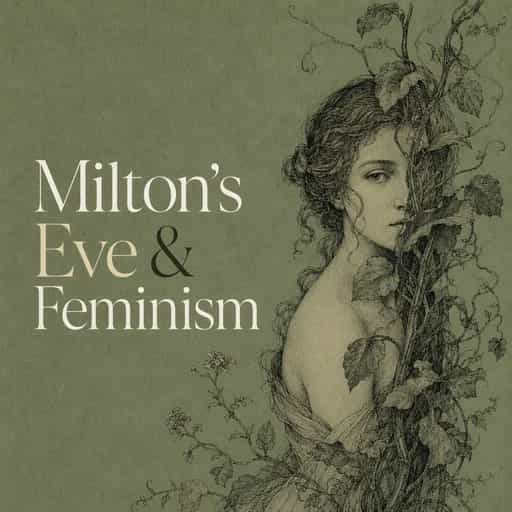
Critics debate Milton’s portrayal of Eve, which some argue perpetuates gender stereotypes by linking her curiosity to humanity’s fall. Others contest the poem’s theodicy, questioning whether it fully absolves God of responsibility for evil. Still, its ambition and linguistic mastery remain widely praised.
The poem’s exploration of ambition, moral ambiguity, and resilience resonates in modern discussions of power and ethics. Its portrayal of Satan as a manipulative leader and Adam and Eve’s journey toward self-awareness offers timeless insights into human nature and societal conflict.
Siente el libro a través de la voz del autor
Convierte el conocimiento en ideas atractivas y llenas de ejemplos
Captura ideas clave en un instante para un aprendizaje rápido
Disfruta el libro de una manera divertida y atractiva
The mind is its own place, and in itself / Can make a Heav'n of Hell, a Hell of Heav'n.
Long is the way and hard, that out of Hell leads up to light.
To be weak is miserable, / Doing or Suffering.
Which way I fly is Hell; myself am Hell.
Desglosa las ideas clave de Paradise Lost en puntos fáciles de entender para comprender cómo los equipos innovadores crean, colaboran y crecen.
Experimenta Paradise Lost a través de narraciones vívidas que convierten las lecciones de innovación en momentos que recordarás y aplicarás.
Pregunta cualquier cosa, elige tu estilo de aprendizaje y co-crea ideas que realmente resuenen contigo.

Creado por exalumnos de la Universidad de Columbia en San Francisco
"Instead of endless scrolling, I just hit play on BeFreed. It saves me so much time."
"I never knew where to start with nonfiction—BeFreed’s book lists turned into podcasts gave me a clear path."
"Perfect balance between learning and entertainment. Finished ‘Thinking, Fast and Slow’ on my commute this week."
"Crazy how much I learned while walking the dog. BeFreed = small habits → big gains."
"Reading used to feel like a chore. Now it’s just part of my lifestyle."
"Feels effortless compared to reading. I’ve finished 6 books this month already."
"BeFreed turned my guilty doomscrolling into something that feels productive and inspiring."
"BeFreed turned my commute into learning time. 20-min podcasts are perfect for finishing books I never had time for."
"BeFreed replaced my podcast queue. Imagine Spotify for books — that’s it. 🙌"
"It is great for me to learn something from the book without reading it."
"The themed book list podcasts help me connect ideas across authors—like a guided audio journey."
"Makes me feel smarter every time before going to work"
Creado por exalumnos de la Universidad de Columbia en San Francisco

Obtén el resumen de Paradise Lost como PDF o EPUB gratis. Imprímelo o léelo sin conexión en cualquier momento.
What happens when the greatest epic poem in English literature begins not in heaven, but in hell? John Milton, blind and politically defeated after the monarchy's restoration, dictated a work in 1667 that would transform a simple biblical tale into literature's most psychologically complex exploration of rebellion, temptation, and redemption. Paradise Lost doesn't just retell Adam and Eve's fall-it dares to enter Satan's mind, making him so magnificently articulate that William Blake later claimed Milton was "of the Devil's party without knowing it." From rock legends like Bono to fantasy authors like Philip Pullman, creators across centuries have found themselves haunted by Milton's cosmic vision. This isn't your Sunday school story. It's a sweeping drama that forces us to confront uncomfortable questions: Can rebellion be heroic? Is obedience always virtuous? And what does it really mean to be free?
Satan awakens on a burning lake, defeated but defiant: "Better to reign in Hell, than serve in Heaven." Rallying his fallen angels-scattered "thick as autumnal leaves"-he transforms catastrophic defeat into twisted victory. His shield stretches vast as the moon, his spear towers taller than Norway's tallest pine. This is no cartoon devil but a figure of terrible majesty, addressing his shattered army with such rhetorical brilliance you almost forget he's the villain. Yet Milton reveals the cracks. Approaching Eden, devastating self-awareness breaks through: "Which way I fly is Hell; myself am Hell." His punishment isn't external fire-it's the prison of his own corrupted nature. Glimpsing Adam and Eve's innocent happiness, he's briefly "stupidly good," disarmed by their beauty before hatred resurges. His arc traces a tragic descent from brightest angel to literal snake. By poem's end, his apparent triumph becomes hollow as he and his followers transform into serpents, eternally reaching for fruit that turns to ash. Pride doesn't just destroy Satan-it reduces him from sublime to pathetic, a warning about how resentment consumes even the most brilliant minds.
Milton's Paradise surpasses all mythical gardens. Trees bear "blooming ambrosial fruit," brooks run with nectar, and roses bloom without thorns. At its center stand Adam and Eve, "godlike erect, with native honour clad in naked majesty." Their nakedness signifies innocence - they feel no shame because they know no sin. Their relationship reveals both 17th-century limitations and genuine appreciation for marital love. Eve is created for "sweet attractive grace," Adam for "contemplation" - a hierarchy modern readers might question. Yet their bond contains real tenderness. Eve awakens beside a lake, falling in love with her reflection until a voice leads her to Adam. Though she initially found him "less fair," she discovers deeper connection when he calls her "part of my soul I seek thee, and thee claim my other half." Their days combine pleasant labor with spiritual devotion. They tend the garden - pruning excess growth, supporting climbing plants - work that satisfies rather than exhausts. Milton celebrates their physical union as "the perpetual fountain of domestic sweets," portraying married love as sacred. This Eden represents not just what humanity lost, but what we still yearn for: harmony with nature, each other, and something greater than ourselves.
From his throne, God watches Satan approach Eden with perfect foreknowledge of what will unfold. This creates Milton's central challenge: if God knows Adam and Eve will fall, why allow it? His answer establishes the poem's core theme - "I made him just and right, sufficient to have stood, though free to fall." Divine foreknowledge doesn't negate human choice. Knowing what someone will choose isn't the same as forcing that choice. This philosophical position lets Milton "justify the ways of God to men" by presenting the Fall as consequence of freedom rather than divine cruelty. When God declares that humanity's redemption requires someone "able, and as willing" to pay sin's price, the Son volunteers: "Behold me then, me for him, life for life." Milton populates Heaven with distinct personalities. Raphael visits Adam as friendly instructor, warning against Satan's temptations. Most memorable is Abdiel, who alone among Satan's legions remains faithful - "faithful found among the faithless, faithful only he." His solitary stand against overwhelming peer pressure exemplifies moral courage when rebellion seems popular.
Satan's strategy reveals sophisticated psychology. Finding humanity's single prohibition-the Tree of Knowledge-he exults, "O fair foundation laid whereon to build their ruin!" The pivotal moment comes when Eve suggests working separately. Adam resists, but Eve argues untested virtue has little value-unknowingly echoing Satan's own reasoning. Possessing a serpent, Satan approaches with calculated flattery, then lies that eating forbidden fruit granted him reason. He questions God's prohibition, suggesting God withholds knowledge to keep humans subservient: "your eyes shall be opened, and ye shall be as gods." Eve's reasoning reveals how temptation works through self-justification. She gazes at the fruit, questions why knowledge should be forbidden, convinces herself death cannot follow since the serpent ate and lives. With rationalization complete, "her rash hand in evil hour forth reaching to the fruit, she plucked, she ate." Adam's choice differs-not deceived but "fondly overcome with female charm," he eats knowingly, preferring death with Eve to life without her. His sin is love twisted into idolatry, placing his wife above his creator-a reminder that even noble feelings can lead us astray when they eclipse reason and conscience.
The aftermath reveals Adam and Eve transformed. Their "eyes opened" but minds darkened, shame becomes their first emotion as they fashion fig leaf coverings-poor substitutes for lost innocence. More devastating is their fractured union. Where harmony reigned, bitter accusations fly. Adam blames Eve for wandering; Eve retorts he should have stopped her. This pattern echoes every dissolving partnership-how conflict makes us forget shared responsibility and scramble to protect our righteousness. God's judgment comes not as immediate death but as consequences fundamentally altering existence. The serpent crawls on its belly; Eve bears children in pain; Adam labors against thorns until returning to dust. Though death is pronounced, it's delayed, and the Son compassionately clothes them with animal skins. The natural world itself disrupts. Angels tilt Earth's axis, bringing harsh seasons where perpetual spring once reigned. Sin and Death build a bridge from Hell to Earth. Adam's response evolves from despair to acceptance, gradually recognizing mercy in judgment-particularly the promise that Eve's seed shall bruise the serpent's head, the first glimmer of hope in their darkened world.
Before expulsion, Michael grants Adam prophetic visions of humanity's future. The brutal opening-Cain murdering Abel-introduces Adam to death. Further scenes reveal disease, violence, and the flood. Adam weeps but learns these disasters spring from sin's destructiveness, not divine cruelty. The post-flood world shows little improvement-Nimrod's tyranny, Babel's tower where technological advancement perverts into pride. Yet amid darkness, God selects Abraham, establishing a covenant preserving truth through generations. The visions trace Israel's history-Egyptian slavery, Mosaic liberation, Sinai's Law, Davidic kingship-all prefiguring the Messiah who will crush the serpent's head. The climax reveals Christ's incarnation, crucifixion, and resurrection. Michael explains Christ defeats Satan not through combat but through perfect obedience and sacrificial death-victory through apparent defeat, strength through vulnerability, life through death. Adam responds with profound wonder, realizing "suffering for truth's sake is fortitude to highest victory" and death becomes "the gate of life." These insights mark his spiritual maturation-movement from innocence through painful experience to deeper wisdom. The poem ends with Adam and Eve departing Eden hand in hand, facing "the world all before them." They've lost Paradise but gained something profound: wisdom born from failure proves more valuable than untested purity.