Capítulo 1
The Banality of Evil: How Ordinary Men Became Mass Murderers
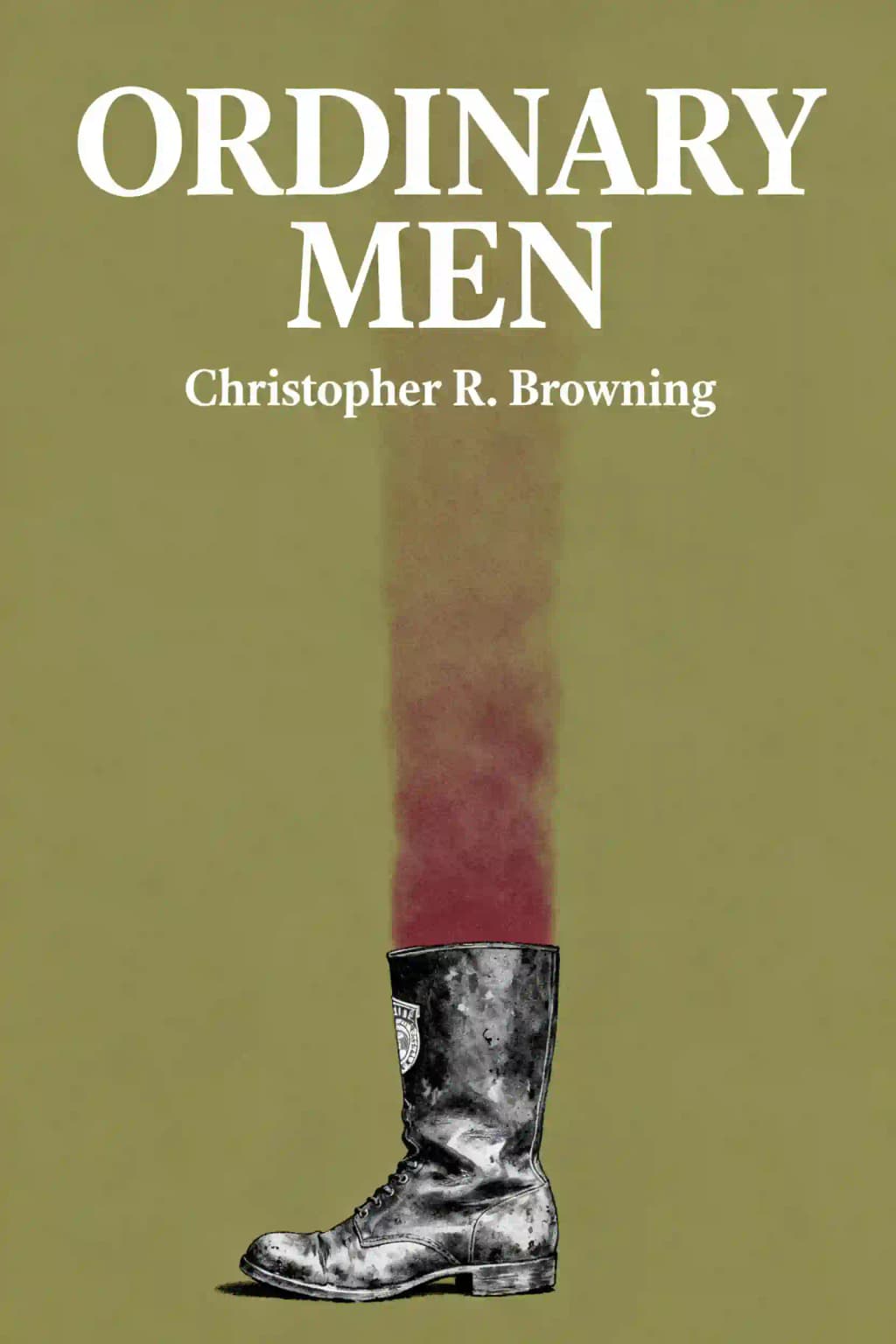
In 1992, Christopher Browning's "Ordinary Men" shocked the world by revealing how a battalion of middle-aged, working-class German policemen-not fanatical Nazis or SS troops-became responsible for the direct murder of 38,000 Jews and the deportation of 45,000 more to death camps. The book has since become a cornerstone of Holocaust studies, praised by historians like Raul Hilberg and frequently assigned in university courses worldwide. Even Hollywood has taken notice-Tom Hanks reportedly keeps a copy on his nightstand, and the book has influenced films exploring the psychology of violence like "Schindler's List." What makes this work so compelling is its central question: How did these unremarkable men-dock workers, truck drivers, and clerks from Hamburg with no special ideological fervor-transform into willing executioners in less than a year?
Capítulo 2
The Fateful Morning at Jozefow
On July 13, 1942, Major Wilhelm Trapp, a 53-year-old career policeman and World War I veteran, gathered the men of Reserve Police Battalion 101 in a misty Polish clearing. Trapp, known to his men as "Papa Trapp" for his fatherly demeanor, was visibly distressed. With trembling hands and tears streaming down his weathered face, he delivered shocking orders that would forever change the lives of everyone present: they were to round up the 1,800 Jews of Jozefow village and execute all except working-age men. These working-age men would be sent to labor camps, while the elderly, women, and children were to be shot.
In an unprecedented moment that deviated sharply from military protocol, Trapp made an extraordinary offer. His voice breaking, he told his men that if any of them didn't feel up to the task ahead, they could step aside without facing any consequences or repercussions. The battalion stood in stunned silence as the weight of both the orders and this unusual choice settled over them.
Only twelve men from the entire battalion of approximately 500 stepped forward to decline. Among them was a lieutenant who would later describe the profound shame he felt at being unable to participate, despite his moral objection to the task. The majority remained in formation, bound by a complex web of peer pressure, military discipline, and the human tendency to conform.
The remaining officers methodically divided the men into killing squads, support units, and transport teams. Those who had never fired a shot in anger - middle-aged family men from Hamburg who had joined the police force, not the military - were now ordered to escort terrified Jewish families to the forest. They forced their victims to lie face down and shot them in the back of the neck at point-blank range. The forest floor grew slick with blood as the day progressed. By evening, they had murdered 1,500 Jews-men, women, children, and infants. Many victims begged for mercy, some tried to run, others simply wept in silence.
The psychological impact was immediate and devastating. Many men vomited during the executions or suffered nervous breakdowns. Some shot wildly, missing their targets, unable to aim properly through their tears. Others had to be relieved and sent back to the village. One officer recalled how his men's faces transformed throughout the day-becoming pale, silent, withdrawn, their eyes taking on a vacant, haunted look that would persist for days.
That evening, instead of their usual boisterous behavior and camaraderie, the battalion returned to quarters in eerie silence. Some sought isolation, retreating to their bunks without eating. Others turned to alcohol, drinking heavily to numb their thoughts. Many avoided discussing what they had done, creating an unspoken pact of silence that would last for decades. The battalion's doctor reported numerous cases of anxiety and sleep disorders in the following days.
Yet despite this initial trauma and moral crisis, within months these same men would undergo a chilling transformation. They became increasingly efficient and callous executioners, hunting Jews with growing enthusiasm and diminishing remorse. This transformation from reluctant killers to willing participants in genocide would become one of the most disturbing examples of how ordinary people can become capable of extraordinary evil under specific circumstances.
Capítulo 3
The Path to Genocide: From Deportation to Direct Killing
Reserve Police Battalion 101 was not initially formed for mass murder. Composed primarily of middle-aged working-class men from Hamburg (average age 39), these were family men who had joined the police to avoid military service. When first deployed to Poland in 1939, they merely guarded POW camps and conducted routine police duties before returning to Germany.
Their second deployment in 1940 introduced them to Nazi racial policies when they forcibly evacuated Polish families to make room for ethnic Germans in the Warthegau region. Some witnessed killings of elderly Poles deemed too burdensome to transport, and the battalion provided firing squads for executing 100-120 Poles. By November 1940, they were guarding the newly sealed odz ghetto with orders to shoot Jews who approached the fence.
After returning to Hamburg in 1941, the battalion participated in deporting Hamburg Jews to ghettos in the East. Men who accompanied these transports learned about mass killings occurring at the destinations, with one escort commander hastily departing Minsk to avoid involvement. These experiences gradually desensitized the men to Jewish suffering while maintaining psychological distance from direct killing.
By June 1942, when the battalion was reassigned to Poland for their third deployment, most members had no experience with German occupation methods in eastern Europe. Only a few non-commissioned officers remained from the first Polish action, and less than 20% had served in the Warthegau. This relative inexperience made their rapid transformation into killers all the more striking.
Capítulo 4
The Psychology of Mass Murder: Rationalizations and Dehumanization
After the Jozefow massacre, the men developed various psychological mechanisms to continue functioning as killers. Perhaps most disturbing was the justification offered by a 35-year-old metalworker who deliberately shot children whose mothers had been killed. He claimed this was "soothing to my conscience" because "without its mother the child could not live any longer." The German word he used-"erlosen" (release)-carries religious connotations of redemption or salvation, revealing how perpetrators reframed murder as mercy. This religious framing of murder became a common coping mechanism, with several other officers similarly describing their actions in terms of providing relief or salvation to their victims.
The psychological transformation of ordinary men into killers involved multiple layers of rationalization. Some focused on technical aspects of the killing process, reducing it to a procedural task. Others emphasized following orders and maintaining discipline, while some convinced themselves they were preventing greater suffering. These justifications became more elaborate and entrenched over time, creating a self-reinforcing cycle of moral disengagement.
Despite their willingness to kill, the men showed a striking absence of expressed anti-Semitism in later interrogations. What is clear is that they had accepted the dehumanization of Jews as enemies standing outside their "circle of human obligation." Trapp had encouraged this mindset by reminding them that German women and children were being killed by bombing-implying their actions were justified retaliation. This narrative of defensive necessity was carefully cultivated by leadership, who consistently portrayed the killings as a response to external threats rather than aggressive actions.
While only twelve men initially refused to participate, a larger number-perhaps 10-20% of those assigned to firing squads-eventually sought release from shooting duties. Most who quit cited physical revulsion rather than ethical principles. The physical manifestations of stress included vomiting, nightmares, and trembling hands. Even Himmler acknowledged this kind of weakness could be tolerated, allowing those "whose nerves are finished" to step aside. This policy of allowing certain individuals to opt out actually strengthened the system by removing potential dissidents while maintaining the appearance of voluntary participation.
To address the psychological burden after Jozefow, two crucial changes were implemented: shifting from direct killing to deportation (where death occurred out of sight), and using Trawniki auxiliaries (SS-trained men from Soviet territories) for the worst "dirty work." This division of labor proved sufficient to transform the policemen into increasingly efficient and callous executioners. The psychological distance created by these changes allowed many participants to maintain their self-image as decent people while participating in mass murder. The bureaucratization of killing, with its emphasis on paperwork, logistics, and chain of command, further facilitated this psychological compartmentalization.
The long-term psychological impact on perpetrators varied significantly. Some developed severe alcohol dependencies, others experienced recurring nightmares and depression, while many seemed to successfully compartmentalize their experiences, returning to normal civilian life after the war with apparent ease. This range of responses highlights the complex interplay between individual psychology and systematic dehumanization in enabling mass murder.
Capítulo 5
The Descent into Brutality: Second Company at omazy
By early August 1942, Reserve Police Battalion 101's Second Company under Lieutenant Gnade was deployed to the northern sector of the Lublin district. At omazy, they demonstrated how quickly ordinary men could become hardened killers.
The "march to death" began after preparations were complete, with Jews moved in groups of 200-300 at a time. Those who collapsed were shot on the spot. Finding this process too slow, the remaining Jews were surrounded with rope and marched as one large group. When this approach created chaos, Sergeant Bentheim intervened, removing the rope so Jews could be marched in normal columns to the forest.
At the killing site, victims were separated by sex and ordered to undress, then forced to lie face down for hours under the hot August sun while waiting. Lieutenant Gnade, described as "a Nazi by conviction" and anti-Semite, was drunk during the operation-a common coping mechanism among the policemen who found such work "intolerable sober." He displayed unprecedented sadism, forcing elderly bearded Jews to crawl naked while his officers beat them with clubs.
The execution process was more efficient than at Jozefow. Jews were forced to run between guards to the grave, where drunk Hiwi auxiliaries shot them. As the grave filled, subsequent victims had to climb over corpses. When many Hiwis became too intoxicated to continue, German policemen formed firing squads that shot Jews lying in rows along the grave's sides. The shooting lasted until 7:00 p.m., with approximately 1,700 Jews killed in half the time it had taken at Jozefow.
Psychologically, the burden on the killers was reduced compared to their first massacre. The Hiwis did most of the shooting, the process was depersonalized, and men rotated quickly through firing squads. Unlike at Jozefow, no option to "step out" was offered, removing the "burden of choice." Under Gnade's contemptuous leadership, Second Company took a major step toward becoming hardened killers.
Capítulo 6
The Industrial Scale of Death: Deportations to Treblinka
Between October 1 and November 7, 1942, Reserve Police Battalion 101 helped deport more than 27,000 Jews to Treblinka in eight separate actions and killed approximately 1,000 more during roundups. The systematic campaign emptied multiple ghettos across the Lublin district, with Jews concentrated in "transit ghettos" at Miedzyrzec and ukow before deportation to death camps.
Lieutenant Gnade's operations in Miedzyrzec-nicknamed "Menschenschreck" (human horror) by the German policemen-were marked by exceptional brutality. Jews were beaten with whips in the main square, shot when they couldn't keep pace during the march to the train station, and crammed into cattle cars through relentless violence. Gnade later introduced "strip searches," forcing Jews to undress and surrender valuables before marching them to trains in only their underclothing despite the cold autumn weather.
The Miedzyrzec operation of August 25-26 became the battalion's largest and most brutal deportation. Captain Wohlauf even brought his pregnant bride along, causing indignation among the men who felt shame at having a woman witness their terrible actions. Jews were herded into the marketplace where they sat for hours in the intense August heat, many fainting as beatings and shootings continued. When the march to the train station began, those too weak to continue were shot, leaving corpses lining the route. The final horror came when 120-140 Jews were packed into each freight car with whips and guns.
After the main deportations, Security Police employed a cruel ruse to capture remaining Jews in ukow, announcing that new identity cards would be issued that would spare bearers from execution. When desperate Jews emerged from hiding, at least 200 were collected and shot outside ukow on November 11, with another group executed on November 14. Even battalion staff who had previously avoided direct participation-clerks, communications men, and drivers-were pressed into service.
Capítulo 7
The "Jew Hunt": Eliminating the Last Survivors
By mid-November 1942, Reserve Police Battalion 101 had directly executed at least 6,500 Polish Jews and deported 42,000 more to Treblinka. Their final task was to make the region completely judenfrei by hunting down all Jews in hiding. This systematic "Jew hunt" intensified after the ghettos were liquidated, with orders that any Jew found outside designated areas was to be shot on sight.
The battalion conducted large-scale forest sweeps, most notably in Parczew forest. In October 1942, they discovered Jews hiding in underground bunkers, forced them out, and executed them with neck shots while lying face down. One policeman estimated 500 Jews were killed in this operation. By spring 1943, surviving Jews had joined partisan bands, offering armed resistance during a second sweep.
Jews working on German agricultural estates were systematically eliminated. At Gut Jablon, thirty Jewish workers were loaded onto trucks, driven to the forest, and executed with neck shots, despite the German administrator's complaints. At Gut Pannwitz, whenever the Jewish worker population grew from refugees seeking sanctuary, the estate administration would call Captain Hoffmann to dispatch a police commando to shoot the "surplus" Jews.
The most common form of "Jew hunt" involved small patrols searching for individual bunkers reported by Polish informers and "forest runners." Policemen would follow Polish guides directly to hideouts, toss grenades into openings, and execute survivors with neck shots, leaving bodies for local villagers to bury. These patrols were so routine that policemen called them their "daily bread," with most unable to recall how many they had participated in.
The battalion's killers displayed growing callousness over time. One policeman's wife recalled an officer complaining he "had not yet killed any Jews" at breakfast, while another remembered men joking about eating "the brains of slaughtered Jews" after executions. Forming killing squads became easy for officers, with Adolf Bittner noting "often there were so many volunteers that some had to be turned away."
Capítulo 8
The Final Massacre: Operation Harvest Festival
In November 1943, Reserve Police Battalion 101 participated in "Operation Harvest Festival" (Erntefest), the single largest German killing operation against Jews in the entire war. With 42,000 victims in the Lublin district, it surpassed even the notorious Babi Yar massacre. Initially, Himmler had temporarily spared Jewish workers in labor camps due to their economic value to the Reich's war effort. However, by fall 1943, following successful Jewish uprisings in Warsaw, Treblinka, Biaystok, and Sobibor, he made the strategic decision to eliminate all remaining Jewish workers in one coordinated surprise operation to prevent any possibility of organized resistance.
The meticulous preparations for Erntefest demonstrated its unprecedented scale. Engineers supervised the digging of three-meter-deep zigzag trenches, carefully disguised as air raid protection measures to avoid arousing suspicion among the Jewish workers. These trenches were strategically positioned near existing labor camps and were designed to accommodate mass executions efficiently. On November 2, SSPF Sporrenberg conducted a detailed operational briefing with unit commanders, including forces specially brought in from across the General Government, coordinating what would become the largest single-day massacre of the Holocaust.
The operation began at dawn on November 3 at Majdanek, where Battalion 101 played multiple roles. They first helped march Jews from surrounding smaller work camps to the main site, then formed a tight security cordon around the camp perimeter. Between 16,500 and 18,000 Jews were systematically processed through the camp that day. In a grotesque attempt to maintain order and mask the sounds of execution, the SS set up loudspeakers that blasted music across the camp grounds. Jews were forced to strip naked and march to the trenches in groups, where SD execution squads waited with machine guns.
The following day brought even more horror at Poniatowa camp, where 14,000 Jews met the same fate. The battalion members witnessed firsthand the gruesome aftermath and disposal process. Bodies were methodically stacked on massive iron rail grills and burned in open pits, creating what survivors described as a "bestial stench" that permeated the area for days. Many policemen, hardened by previous actions, reported being physically sickened by the scale and industrial nature of the corpse disposal operation.
With the completion of Erntefest, the Nazis declared the Lublin district essentially judenfrei (free of Jews). This marked the end of Battalion 101's direct participation in the Final Solution. Their final tally revealed the shocking scope of their actions: approximately 38,000 Jews shot directly under their supervision, 45,000 deported to Treblinka death camp - totaling at least 83,000 Jewish victims. This staggering number was achieved by a battalion of fewer than 500 men, averaging over 160 victims per battalion member, highlighting the devastating efficiency of the Nazi killing machine and the role of ordinary men in extraordinary acts of genocide.
Capítulo 9
Why Did They Kill? Understanding Ordinary Men
Why did most men in Reserve Police Battalion 101 become killers while only 10-20% refused? Various explanations have been proposed: wartime brutalization, racism, task routinization, special selection, careerism, obedience, deference to authority, ideological indoctrination, and conformity. Each applies to some degree, but none without qualification.
Unlike the careful selection processes used for Einsatzgruppen officers and death camp personnel, Reserve Police Battalion 101's composition reflected not special selection but rather "negative selection." By age, geographical origin, and social background-middle-aged, working-class men from Hamburg-they were the least likely candidates for mass killers. The battalion was used simply because it was the only unit available for behind-the-lines duties.
Stanley Milgram's famous obedience experiments offer partial insight, demonstrating how ordinary people could inflict apparent harm when directed by authority figures, even without threats. In his standard experiment, two-thirds of subjects administered what they believed were dangerous electric shocks to victims. Compliance varied significantly with conditions: dropping when subjects had more direct contact with victims, disappearing when orders came from non-authority figures, and plummeting when peer groups modeled refusal.
Philip Zimbardo's Stanford prison experiment provides additional understanding. Despite screening out psychologically abnormal subjects, his simulation produced rapidly escalating brutality and dehumanization among randomly assigned "guards," suggesting that the prison situation alone was sufficient to produce antisocial behavior. Zimbardo's experiment revealed a striking spectrum among his guards that paralleled Reserve Police Battalion 101's groupings: about one-third became "cruel and tough," inventing new forms of harassment; a middle group played by the rules without excessive cruelty; and less than 20 percent emerged as "good guards" who avoided punishing prisoners.
Though the battalion had orders to kill Jews, each individual could refuse. Yet 80-90% proceeded to kill despite initial horror and disgust. Breaking ranks meant leaving the "dirty work" to comrades-an asocial act refusing one's share of an unpleasant collective obligation. Those who refused risked isolation and ostracism within their tight-knit unit stationed among a hostile population.
Most non-shooters intuitively diffused criticism by claiming they were "too weak" rather than "too good" to kill, thereby legitimizing toughness as superior and posing no moral challenge to the regime's policies. This led to tortured compromises: not shooting infants but taking them to assembly points; not shooting on patrol without "go-getters" present; intentionally missing targets. Only the exceptional could withstand being labeled a "weakling" or "no man."
Capítulo 10
The Disturbing Legacy: Could It Happen Again?
The story of Reserve Police Battalion 101 leaves us with profound unease. These ordinary men faced choices, and most committed terrible deeds. They cannot be absolved by claiming anyone would have done the same-some refused to kill or stopped killing. Human responsibility remains ultimately individual.
Yet their collective behavior has deeply disturbing implications. Many societies suffer from racism and siege mentality during war. People everywhere respect authority and seek career advancement. Modern bureaucracy attenuates personal responsibility, while peer groups exert tremendous pressure. If these ordinary men could become killers under such circumstances, what group cannot?
Twenty-five years after the book's publication, new evidence has only strengthened its central thesis. Comparative studies of other police battalions show that Reserve Police Battalion 101 achieved the fourth highest killing record despite lacking the "elite" characteristics of other high-performing units. This makes their transformation all the more significant-they weren't specially selected ideologues but ordinary men placed in extraordinary circumstances.
Photographs discovered in family albums and investigation files reveal attempts to create a veneer of normalcy for men engaged in mass murder. Images show outdoor officers' dinners with wives present, musical performances, and casual gatherings-all directly implementing Himmler's recommendation for "comradely get-togethers" to lead men back to "the beautiful realm of German spiritual and inner life" after "difficult tasks." These were Himmler's prescribed antidote to the psychological stress of mass killing.
The most historically significant photos document the battalion's murderous actions-Jews gathered on sports fields, victims being marched to execution sites, and bodies of those who couldn't fit into deportation trains. What's most disturbing is their matter-of-factness-men simply "at work" preparing for mass shootings and deportations, revealing not ideological zeal but moral numbness, a routinization of destruction as everyday work.
The fundamental problem isn't explaining why utterly different Germans eagerly killed Jews, but why ordinary men shaped by western, Christian, and Enlightenment traditions willingly committed history's most extreme genocide. In a world of ubiquitous war and racism, powerful government legitimization, attenuated personal responsibility, and intense peer pressure, modern governments will rarely fail to transform "ordinary men" into "willing executioners."
This sobering conclusion forces us to confront uncomfortable questions about human nature and the fragility of moral restraint. The most terrifying aspect of the Holocaust may not be that it was inhuman, but that it was all too human-revealing capacities for cruelty and moral abdication that exist within ordinary societies and ordinary people. The true horror of Reserve Police Battalion 101 is not that they were monsters, but that they were so much like us.