Capítulo 1
The Paradox of Headlessness: A Journey to Our True Nature
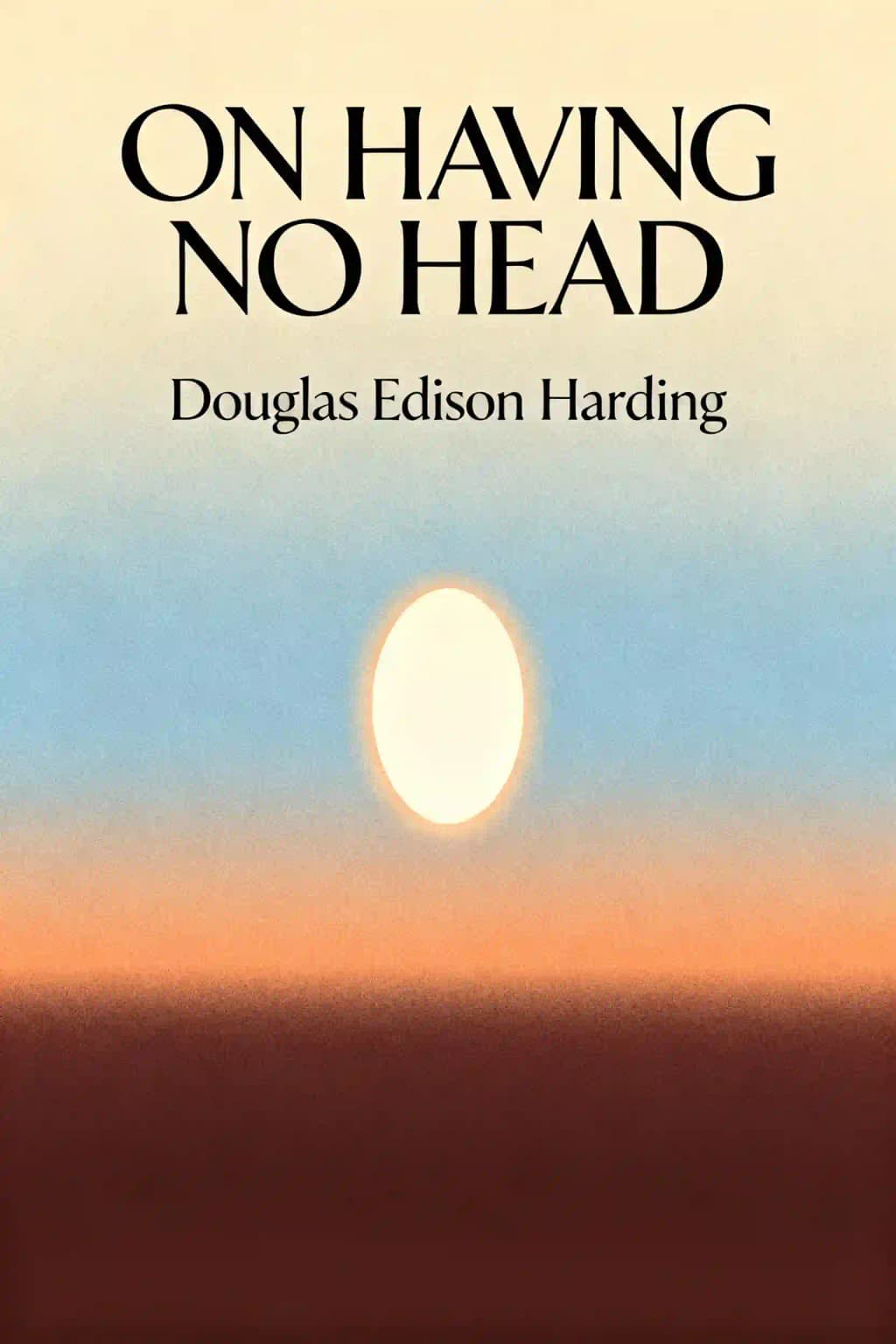
When Douglas Edison Harding walked in the Himalayas at age thirty-three, something extraordinary happened-he discovered he had no head. This wasn't a hallucination or metaphorical insight, but a direct perception of his first-person experience that transformed his understanding of consciousness and identity. "On Having No Head" has since become a cult classic among spiritual seekers, praised by philosophers and Zen masters alike. The Dalai Lama himself has acknowledged the profound simplicity of Harding's approach, while contemporary teachers like Sam Harris and Richard Lang continue spreading this revolutionary perspective. What makes this slim volume so powerful is not complex philosophy but its invitation to a direct experiential insight available to anyone willing to look. In our age of distraction and identity confusion, Harding's message resonates more than ever: our true nature is not what we think, but what we are when we stop thinking.
Capítulo 2
The Moment Everything Changed: A Himalayan Revelation
"The best day of my life-my rebirthday-was when I found I had no head." With these words, Harding begins describing the transformative experience that would define his life's work. Walking in the Himalayas at thirty-three, amid the towering peaks and thin mountain air, he suddenly stopped thinking. Words failed him. His name, his humanness, his very sense of being a thing disappeared. Past and future vanished, leaving only the eternal Now, a moment suspended in timeless awareness.
Looking down at himself, he saw khaki trouserlegs ending in brown shoes, khaki sleeves terminating in pink hands, and a khaki shirtfront rising upward to-absolutely nothing! Where he had always assumed his head should be, he found only empty space. Yet this emptiness wasn't a void in the negative sense; it was filled with everything-grass, trees, mountains, the vast blue sky. The panorama before him existed in perfect clarity, without the usual mental commentary or conceptual overlay that typically clouds our perception.
What made this experience so profound wasn't its esoteric nature but its sheer obviousness. It wasn't a mystical revelation accessible only to spiritual adepts but a simple perception of reality that had been hiding in plain sight. The experience brought an immediate sense of peace and quiet joy, unlike anything he had known before. He had lost a head and gained a world-a world utterly free of "me." The total presence of everything was matched by his total absence as a separate entity. In this state, the usual boundaries between self and other, inside and outside, subject and object completely dissolved.
This wasn't some abstract philosophical concept but a direct experiential reality. The mountains weren't "over there" while he was "here"; rather, everything appeared within a boundless awareness that had no location or center. Harding had stumbled upon what Zen masters call "seeing your original face"-the face you had before you were born. He had discovered his true nature not as a thing in the world but as the aware space in which the world appears. This revelation would later become the cornerstone of his teaching method, which he called "headlessness."
The impact of this moment was immediate and lasting. Rather than being a temporary altered state, it revealed itself as the natural condition that had always been present but overlooked. The simplicity of the insight stood in stark contrast to the profound implications it carried for understanding consciousness, identity, and the nature of human experience. This wasn't just a philosophical breakthrough but a practical discovery that anyone could verify for themselves through direct investigation.
Capítulo 3
The Paradox of First-Person Experience
As the wonder of his Himalayan discovery settled, Harding began trying to make sense of it. He had always vaguely thought of himself as inhabiting his body, looking through two small windows at the world. Now he realized it wasn't like that at all. There was only one immense, frameless window with nobody looking out. It was always others who had eyes and faces-never himself.
This insight revealed a profound truth: there exist two species of human beings-countless specimens with heads, and one specimen without. This luminous void he discovered at his center contains all that's on offer without intervening distance or separation. The traditional duality of subject and object had vanished in an instant.
When Harding explored this central region with his hand, he found various sensations but nothing amounting to a head. To constitute a head would require colored shapes in three dimensions-all plainly missing. This place at his center remained clear of obstructions that could cloud his universe. When groping for his lost head, he only lost his exploring hand as well, swallowed by the abyss at his center.
This yawning cavern, this unoccupied base of operations, functioned like a beacon-fire consuming all approaching things to maintain its world-illuminating clarity. Present experience could only occur in an empty and absent head-his world and his head were incompatibles. This wasn't philosophy but simple sight: LOOK-WHO'S-HERE instead of IMAGINE-WHO'S-HERE.
The skeptic who claims we have heads here should come and look for himself. Approaching us, he'd see first a full-length person-with-a-head, then half a person, then a head, a blurred feature, a mere blur, and finally nothing at all. With scientific instruments, he'd find tissues, cells, molecules... until reaching empty space. The observer who comes here finds what we find-vacancy. And looking outward with us, he'd discover this vacancy filled with the scene, this Nothing becoming All.
Our head is not a head but a wrong-headed idea. During lucid intervals, we are clearly headless here, while elsewhere we have countless heads-in mirrors, doorknobs, polished surfaces. But no head can appear on our shoulders, where it would blot out the Central Void that is our life-source.
Capítulo 4
The Scientific and Practical Implications
Even science, Harding points out, confirms this paradox through the mechanics of perception. Light bounces off objects, enters our eyes, forms an image, triggers chemical changes, and eventually affects brain cells. Only at this terminus does our universe spring into existence. But this scientific tale's conclusion cancels its premise-we can only know what's happening here and now at this brain terminal. The universe as it might exist independently remains a mere figment. This understanding aligns with quantum physics, where the observer effect demonstrates how consciousness and observation are inseparable from reality itself.
Practically speaking, advertisers and filmmakers intuitively understand and exploit this reality in their craft. The effective advertisement shows our kind of person-a hand lifting a glass to a void, not to someone else's head. This technique works because it allows viewers to project themselves into the scene without the jarring presence of another's perspective. Film directors create first-person sequences by removing the head, knowing we identify with headless perspectives. They use this in point-of-view shots, virtual reality experiences, and immersive storytelling. These experts grasp what children and animals naturally know-that we are fundamentally headless. Video game designers similarly employ this technique, creating first-person perspectives that feel natural precisely because they mirror our actual experience of ourselves.
This Himalayan experience fundamentally transforms our attitude toward others in profound ways. It abolishes confrontation-meeting someone, there is only one face (theirs). We trade faces in an intimate exchange of appearances, creating a dance of consciousness rather than a clash of separate entities. It gives perfect insight into others' Reality-we must believe we're all in the same condition, reduced to headless voids that contain everything. The headed person we pass is the apparition, while the real person's extent and content are infinite. This understanding dissolves the artificial boundaries we typically construct between self and other.
The value and splendor of others takes on new significance through this lens. Now we know exactly who they are and how to treat them - not as separate entities but as manifestations of the same consciousness. In fact, they are ourselves, appearing in different forms. While we had a head apiece, obviously we were two distinct beings. But now we are headless voids; what is there to part us? We can find no shell enclosing this void which we are, no shape or boundary or limit: so it cannot help but merge with other voids. This realization has practical implications for how we approach relationships, conflict resolution, and human interaction. It suggests a fundamental unity that transcends our apparent differences, leading to greater empathy and understanding.
Capítulo 5
Finding Zen: The Path Becomes Clear
In the months and years following his original experience, Harding tried hard to understand it. The vision itself didn't change, though it came more easily when invited and stayed longer. But its meaning developed, influenced by his reading. He found some help in scientific, philosophical, and religious books-particularly from mystics who seemed to have seen what he saw himself to be.
Discussion, however, proved almost invariably fruitless. "Naturally I can't see my head," friends would say. "So what?" Harding would begin to reply: "So everything! So you and the whole world are turned upside down and inside out..." It was no use. He couldn't describe his experience in a way that interested them or conveyed its significance. They had no idea what he was talking about-an embarrassing situation. Here was something perfectly obvious, immensely significant, a revelation of pure delight-to him and nobody else!
Even more dismaying was that among his acquaintances, the more cultivated and intelligent seemed specially unable to see the point: as if headlessness were an infantile aberration one should have outgrown. Some brilliant writers positively told him he was crazy. Chesterton ends his ironic list of scientific wonders with the crowning absurdity: men without heads! And Descartes begins his list of certainties with: "Firstly, I perceived that I had a head."
After more than a decade of largely fruitless searching, Harding stumbled upon Zen Buddhism and found in the words of the Zen masters many echoes of his central experience: they talked his language, spoke to his condition. Many had not only lost their heads but were vividly aware of this condition and its immense significance, using every device to bring their disciples to the same realization.
The famous Heart Sutra, recited daily in Zen monasteries, states that the body is just emptiness and declares there is no eye, no ear, no nose. Hui-neng, the Sixth Patriarch of Zen, advised his brother-monk Ming to see what at this very moment his own face looks like-"the Face you had before you (and your parents) were born." According to Daito Kokushi, all seventeen hundred koans of Zen are simply pointers to our Original and Featureless Face.
Bodhidharma prescribed a hammerblow on the back of the head. Tai-hui said: "The precious vajra sword is right here and its purpose is to cut off the head." This beheading was a common topic between Zen master and pupil. The Muslim poet Rumi similarly advised: "Behead yourself!" "Dissolve your whole body into Vision: become seeing, seeing, seeing!"
Capítulo 6
The Universal Vision Across Traditions
Harding discovered that this insight transcended cultural and religious boundaries. While Zen provided the clearest articulation of headlessness, parallels existed in virtually every spiritual tradition.
In India, Sankara, the great sage of Advaita or absolute non-duality, taught that liberation requires ceasing to identify with the body, a mere illusion born of ignorance: one's real Self is like space, unattached, pure, infinite. Ramana Maharshi would say: "Till now you seriously considered yourself to be the body and to have a form. That is the primal ignorance which is the root cause of all trouble."
Christianity too recognizes that illumination dispels the opacity of our bodies as well as our souls. "When thine eye is single," said Jesus, "thy whole body also is full of light." This single eye is surely identical with the Third Eye of Indian mysticism, which enables the seer to look in at his Emptiness and out at what's filling it.
Augustine Baker writes of the Christian contemplative: "At length he cometh to a pure and total abstraction; and then he seemeth to himself to be all spirit and as if he had no body." This comments on The Cloud of Unknowing, which teaches that awareness of our non-existence is prerequisite for pure joy: "all men have matter for sorrow: but most specially he feeleth matter of sorrow that knoweth and feeleth that he is."
Sometimes Western mystic language is as Zen-like as what it describes. Gerlac Peterson speaks of a "showing" that is "so vehement and so strong that the whole interior man, not only of his heart but of his body, is marvellously moved and shaken... His interior aspect is made clear without any cloud."
Poets too have glimpsed this reality. Rilke wrote of his dead friend: "For these, these shadowy vales and waving grasses And streams of running water were his face," but didn't stop with dissolving the human face and body: his mission was "to render the earth we live on, and by extension the universe, invisible, and thus transform it into a higher plane of reality." Thomas Traherne declared: "You never enjoy the world aright, till the sea itself floweth in your veins, till you are clothed with the heavens, and crowned with the stars."
This is the Zen experience of satori-only the language differs slightly. At satori there is an explosion, and a person has no body but the universe. "He feels his body and mind, the earth and the heavens, fuse into one pellucid whole-pure, alert, and wide-awake," says Po Shan: "The whole earth is but one of my eyes, But a spark of my illuminating light."
Capítulo 7
The Headless Way: A Developmental Path
Forty years after his initial Himalayan experience, Harding developed what he called "The Headless Way"-a systematic approach to rediscovering our true nature. This path unfolds through eight distinct stages, representing one variation on the archetypal journey "from the unreal to the Real, from darkness to Light, from death to Immortality."
The journey begins with the Headless Infant. As infants, we were headless and faceless for ourselves-immense, unseparate from our world, unconsciously living without obstruction from our Source. What was presented was truly present; the Moon was no bigger than the hand reaching for it. Our world was truly ours, with distance not yet stealing it away.
Next comes the Child stage, where we gradually learn the fateful art of seeing ourselves from outside, identifying with our mirror-face and answering to its name. Yet for ourselves, we remained headless, boundless Space for our world. Children often show awareness of this Space-asking why others have heads while they don't, declaring themselves invisible or nothing.
The third stage is the Headed Grown-up. Eventually, our learned outside view overshadows and blots out our original inside view. Instead of containing our world, we're contained by it. Reduced from being the whole scene to a tiny part, we become greedy, resentful, alienated, frightened, and unloving. We survive only because we remain rooted in our common Source-our happiness is deep-rooted and real, while our misery is shallow and born of delusion.
The fourth stage marks the beginning of awakening-the Headless Seer. To enter this stage, one simply turns around the arrow of attention. As the Katha Upanishad says: "God made the senses turn outwards, man therefore looks outwards, not into himself. But occasionally a daring soul, desiring immortality, has looked back and found himself."
Capítulo 8
Practical Exercises and Deeper Implications
Harding developed simple exercises to help people rediscover their headlessness: noticing you're looking out of empty Space; realizing you look out from one immense "Window" without edges; and pointing to this "Window" to verify it contains nothing. Contrary to tradition that presents this insight as difficult, it's actually the easiest discovery-"the treasure of treasures" hiding in plain sight.
This seeing into one's Nothingness has five unique virtues: It's the easiest thing in the world, not the most difficult as tradition claims. It's foolproof and can't be done wrong. It goes infinitely deep, penetrating beyond consciousness itself. It's uniquely communicable, identical for all beings. And it's always available regardless of mood or circumstance.
The fifth stage involves Practicing Headlessness-repeating this seeing-into-Nothingness until it becomes natural and unremarkable. The essential practice involves structuring one's attention around a double-barbed arrow pointing simultaneously inward at the Void and outward at what fills it. This meditation works for every circumstance, not just quiet retreat periods.
This two-way attention, cleansed of one-way intention, liberates us from all ill. Seeing from our Origin transforms the surrounding murk into Beauty beyond beauty and ugliness. While specific improvements may be slow to surface, benefits eventually include heightened sensory awareness, whole-body alertness, reduced stress, lowered center of gravity, deeper breathing, greater creativity, spontaneity, lightness, and sometimes less fear, greed, and anger.
In the sixth stage, Working It Out, we discover the profound implications of headlessness. When driving, my human body is pure Stillness where the countryside shuffles like cards. Looking up at night, my Earth body is the same Stillness where heavenly bodies dance. With eyes closed, my Universe body is the unmoving No-mind whose contents never stay still.
Everything is given right here where I am, with no distance between us. As a tiny solid something, I shut out all things and am poor; as immense vacant Space, I take delivery of the Universe. Though I see everything as "out there," it's not my world but its Viewer that is three-dimensional.
Capítulo 9
Challenges and Breakthroughs on the Path
Despite genuine spiritual progress, a profound dissatisfaction often emerges-the seventh stage called The Barrier. The wayfarer discovers that clear seeing into the Nothing here can coexist with blindness to a massive Something-one's personal, separative ego. This paradoxical state manifests as a deep inner conflict where intellectual understanding fails to align with emotional reality. It's as if one's perception and thinking have been flooded with light while one's heart remains partially closed and dark-half-surrendered. Many practitioners report feeling caught between two worlds - intellectually grasping the truth of non-duality while emotionally clinging to old patterns of separation.
Reactions to this stage vary dramatically. Many turn back discouraged, abandoning this difficult path for more popular spiritual highways that promise easier progress. Some seek comfort in group practices or traditional religious structures that feel more secure. Others misuse the special powers that have come with headlessness, applying them to ego-driven ends - perhaps becoming spiritual teachers prematurely or using their insights for personal gain. The true route, however, lies straight through this Barrier, what Western tradition calls the Dark Night of the Soul-not purging the organs of perception but the very shrine of self. This passage requires extraordinary courage and persistence, often lasting months or years.
The eighth and final stage is The Breakthrough-a profound declaration of intent that transforms the entire spiritual journey. This isn't merely an intellectual understanding but a visceral realization at gut level that one's deepest desire is that all shall be as it is, seeing everything flows from one's true Nature, the Aware Space here. It's not a doing but an undoing, abandoning the false belief that there's anyone here to abandon. This stage often arrives unexpectedly, after periods of intense struggle or, paradoxically, when all effort has been exhausted.
When we say YES! to our circumstances and actively will whatever happens, there springs up that lasting joy Eastern tradition calls ananda. This isn't the temporary happiness of favorable circumstances but an unshakeable peace that persists through all conditions. Our breakthrough is unconditional surrender to God's will revealed in our circumstances - from the most mundane daily tasks to life's greatest challenges. Insofar as his will becomes ours, we see his world as it is; insofar as we see it as it is, our will becomes his. This final integration manifests as a natural spontaneity in daily life, where action flows effortlessly from being, and the distinction between spiritual practice and ordinary living dissolves completely.
Capítulo 10
The Simplicity of Being What We Are
The Headless Way puts seeing into Nothingness at the very start of the spiritual life. From the beginning it is "the true seeing, the eternal seeing," illuminating all stages of the Way. It's the Foundation supporting the multistoried fabric of religion, which without this bedrock becomes dangerously lopsided.
Remarkably, the Headless Way lacks formal organization-it has no presiding authority, governing council, headquarters, or membership structure. This absence of structure arises from the nature of the experience itself-the ultimate in Self-reliance. It stems from the fourfold realization that the way to truly live is to look in and see Who is doing so, that only you can see this "Who," that this in-seeing establishes You as the authority on what matters supremely, and that your path won't conform to patterns laid down by others.
Despite the inherent solitariness of this seeing, the difficulty of maintaining it alone can't be exaggerated. For most people, the company of fellow adventurers is indispensable. Support is available through a loose network of friends, the website headless.org, mystical literature, and Harding's works.
Ultimately though, Self-seeing isn't achieved as separate individuals helping each other, but as "the One Seer in all beings." The answer to "where do we go now?" is simply: nowhere. We must stay right here, seeing and being This which is Obviousness itself, and take the consequences. They will be all right.
What we are can be trusted to reveal Itself in all its noonday freshness and brilliance exactly when It should. The Headless Way isn't actually a way of getting somewhere; everything one's heart desires is freely given from the start. Our true nature has never been lost-only overlooked. The invitation is simply to look, to see what we already are, and to live from that seeing.