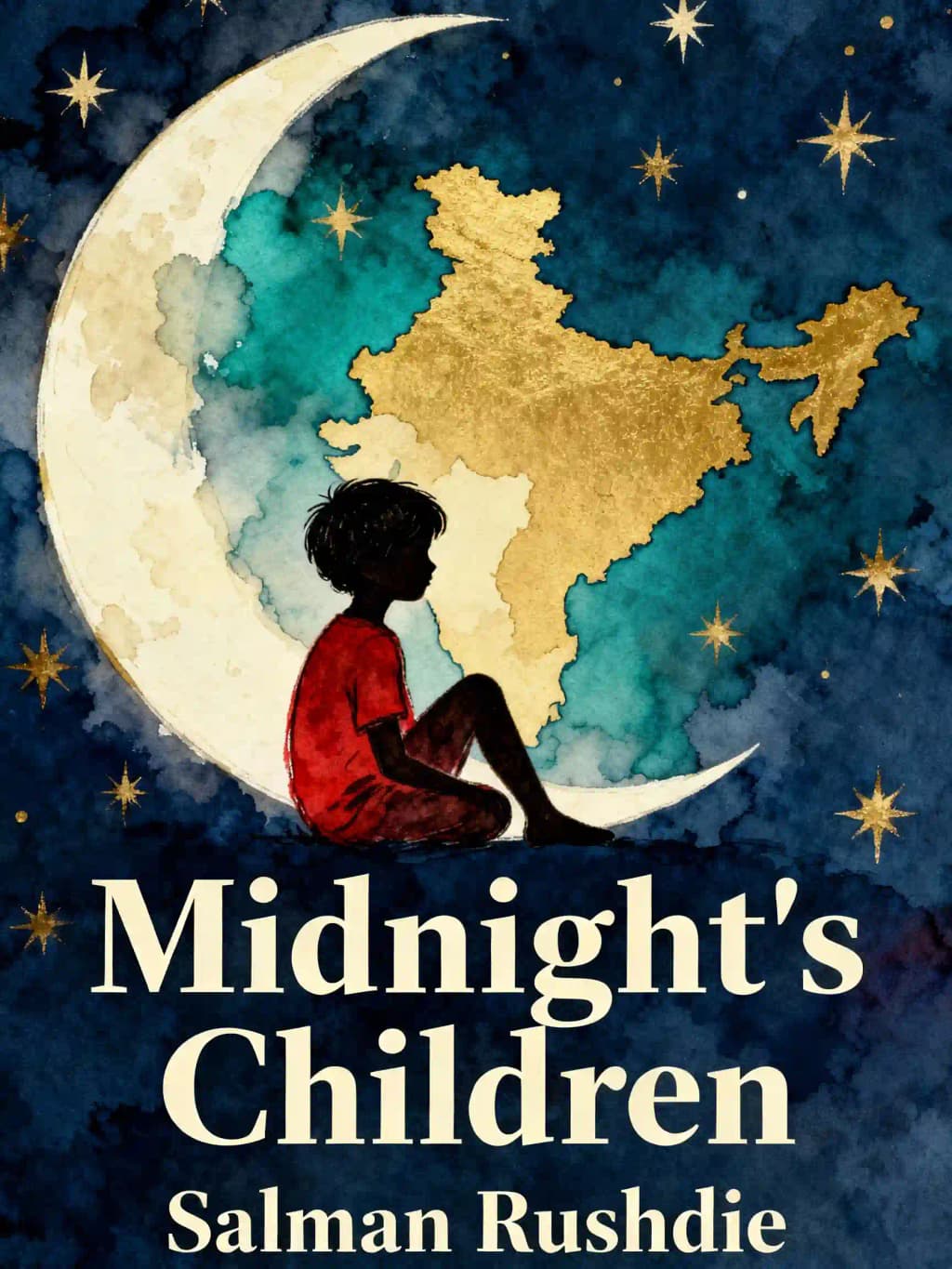
Midnight's Children
Resumen de Midnight's Children
Salman Rushdie's "Midnight's Children" - where magical realism meets India's independence. This three-time Booker Prize winner sparked controversy with its portrayal of Indira Gandhi, yet influenced Garcia Marquez and Murakami. How can one child's telepathic powers reshape a nation's destiny?

Temas clave en Midnight's Children
- magical realism
- postcolonial identity
- national allegory
- partition of india
- fragmented memory
Citas de Midnight's Children
a place of frequent and devastating warfare.
a very Indian lust for allegory.
Reality is a question of perspective.
I had been mysteriously handcuffed to history.
We, the children of Independence, rushed wildly and too fast into our future.
Personajes en Midnight's Children
- Saleem SinaiThe narrator born at the moment of independence
- Aadam AzizSaleem's grandfather and a doctor in Kashmir
- NaseemAadam’s wife, first seen through a sheet
- Mary PereiraA midwife who swaps two babies at birth
- William MethwoldAn Englishman who sells his estate in Bombay
Sobre el Autor
Sobre el autor de Midnight's Children
Salman Rushdie, the Indian-born British-American novelist and Booker Prize-winning author of Midnight’s Children, is celebrated for blending magical realism with historical fiction to explore identity, cultural clash, and postcolonial narratives.
Born in Bombay in 1947, Rushdie draws on his bicultural upbringing—educated at Cambridge after a childhood in India—to craft layered stories like Midnight’s Children, which reimagines India’s independence through protagonist Saleem Sinai.
A polarizing figure after his controversial novel The Satanic Verses (1988) sparked global debates on censorship and religion, Rushdie has authored over 15 acclaimed works, including Shame, Haroun and the Sea of Stories, and The Golden House.
Knighted in 2007 for literary contributions, he has won the Booker Prize twice, including the “Booker of Bookers” for Midnight’s Children. The novel, adapted into a 2012 film, has been translated into over 40 languages and remains a cornerstone of modern literature.
Descargar resumen de Midnight's Children
Obtén el resumen de Midnight's Children como PDF o EPUB gratis. Imprímelo o léelo sin conexión en cualquier momento.
Preguntas Frecuentes Sobre Este Libro
Midnight's Children follows Saleem Sinai, born at India’s 1947 independence, whose life mirrors the nation’s tumultuous history. Gifted with telepathy, he connects with other "midnight's children" endowed with magical abilities. The novel intertwines Saleem’s personal struggles—including a baby-switch at birth—with India’s post-colonial identity, Partition, and political upheavals like the Emergency era, blending magical realism with historical fiction.
This book appeals to readers of post-colonial literature, magical realism, and intricate historical narratives. Fans of Salman Rushdie’s layered storytelling, those interested in India’s independence era, and scholars exploring themes of identity, memory, and nationalism will find it compelling. Its dense prose suits patient readers seeking richly symbolic, politically charged fiction.
Yes—it’s a landmark novel that won the Booker Prize and the "Booker of Bookers." Rushdie’s innovative fusion of history, mythology, and magical realism offers a vivid portrait of India’s post-independence journey. While complex, its exploration of identity, destiny, and collective memory rewards readers with a profound, multi-layered narrative.
Key themes include identity (personal vs. national), fate versus free will, and memory as history. Saleem’s life parallels India’s evolution, questioning whether individuals control their destinies or are bound to historical forces. The novel also critiques post-colonial nationalism and the erasure of cultural diversity during political crises like the 1975 Emergency.
A nurse swaps Saleem (born to poverty) and Shiva (heir to wealth) at birth, reversing their social trajectories. This act symbolizes post-colonial India’s fractured identity and class divides. Saleem’s privileged upbringing contrasts with Shiva’s violent path, highlighting how chance and power shape lives—a metaphor for the nation’s uneven progress.
Magical elements—telepathy, symbolic powers, and mythical events—anchor the novel’s critique of history and politics. Saleem’s ability to hear others’ thoughts reflects India’s collective consciousness, while the children’s powers (e.g., time-travel, shape-shifting) mirror the nation’s potential and chaos. Rushdie uses surrealism to blur reality and allegory.
The 1975 Emergency, led by Indira Gandhi, becomes a dystopian backdrop where dissent is crushed. Saleem and other midnight’s children are sterilized, symbolizing state control over individual freedom. Rushdie critiques authoritarianism and the suppression of diverse voices, paralleling the erosion of democracy with the protagonist’s fractured identity.
Shiva, Saleem’s rival and biological brother, embodies violence and militarism. His “killer knees” and later role as a war hero critique hypermasculine nationalism. As Saleem’s opposite, Shiva represents the destructive forces competing with India’s idealistic vision, underscoring the tension between unity and fragmentation.
Saleem’s large, sensitive nose symbolizes his connection to history and ability to “smell” truth. It reflects his role as a storyteller navigating India’s contradictions—both a physical deformity and a source of power. The nose ties him to his grandfather, Aadam Aziz, linking generations of identity crises.
Through characters like Parvati-the-witch (representing Hindu mysticism) and the diverse midnight’s children, Rushdie portrays India as a hybrid, pluralistic society. The novel challenges monolithic nationalism, advocating for a mosaic of traditions while lamenting cultural erasure during political homogenization.
Some critique its dense prose, nonlinear structure, and overwhelming symbolism as challenging for casual readers. Others argue its male-centric narrative sidelines female perspectives. Despite this, the novel is widely celebrated for its ambition, blending personal and political historiography.
Like The Satanic Verses, it uses magical realism and historical allegory, but Midnight's Children is more tightly tied to national identity. While Shame explores Pakistan’s politics, this novel focuses on India’s birth pangs, offering broader scope and deeper mythological resonance.
It remains a seminal post-colonial text, reflecting ongoing debates about identity, democracy, and historical memory. Its critique of authoritarianism and celebration of diversity resonate in global discussions about nationalism, making it a timeless exploration of how individuals and nations narrate their past.