Capítulo 1
The Architect of Modern Diplomacy: Kissinger's Strategic Masterclass
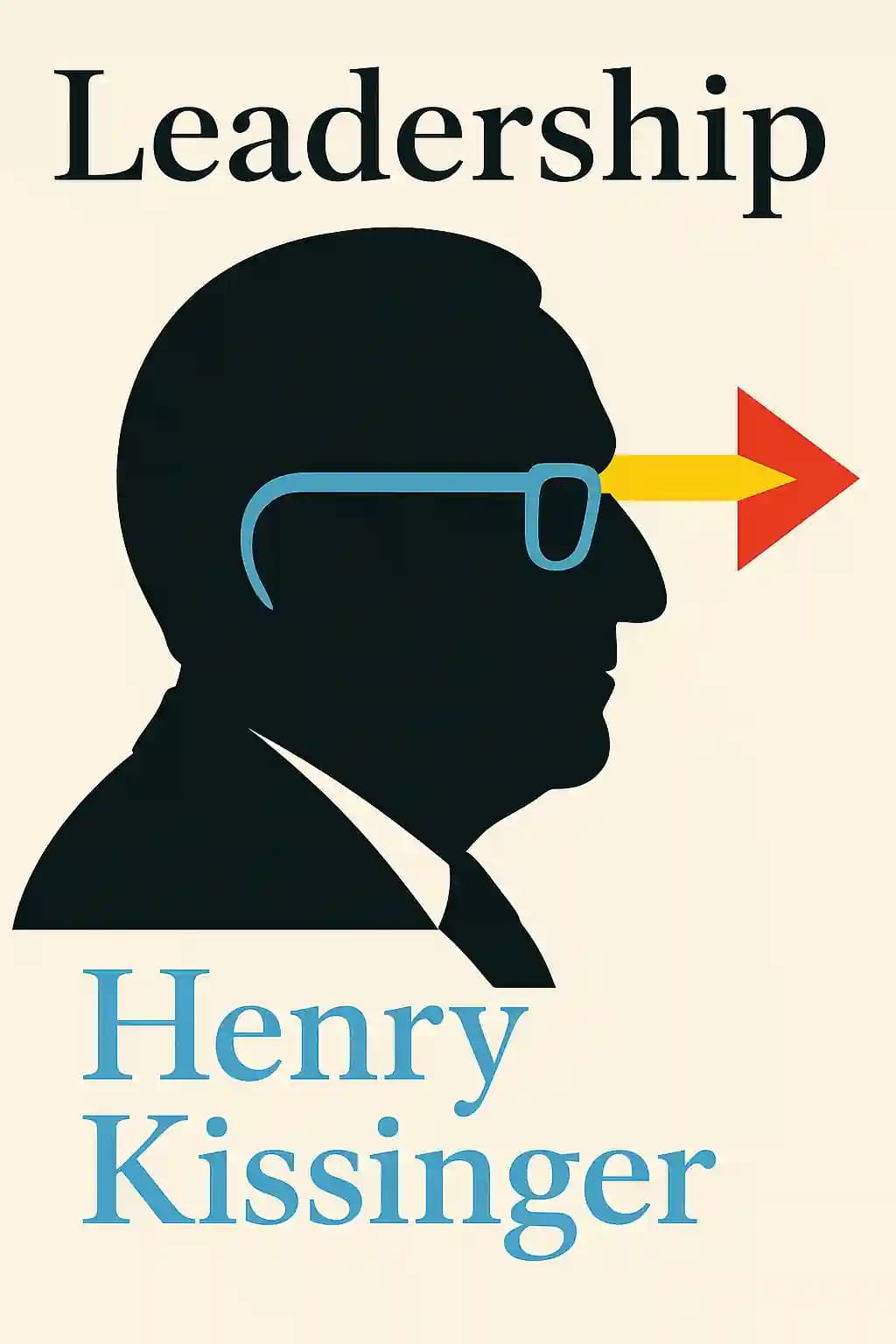
In a world of shifting alliances and precarious peace, Henry Kissinger's "Leadership" arrives as both historical analysis and urgent prescription. The 99-year-old statesman, having witnessed firsthand the tumultuous transformation of global order across nearly a century, distills wisdom from six extraordinary leaders who rebuilt their nations from the ashes of catastrophe. This isn't merely a collection of biographies but a masterclass in strategic thinking from a man who has counseled thirteen presidents and whose controversial brilliance continues to shape international relations. As we navigate today's multipolar uncertainty, Kissinger's insights on leadership couldn't be more timely-or more contested.
Capítulo 2
The Crucible of Crisis: Leadership's Ultimate Test
Leadership emerges most clearly during transitions when institutions lose relevance and the path forward becomes contested. The six leaders Kissinger profiles-Adenauer, de Gaulle, Nixon, Sadat, Lee Kuan Yew, and Thatcher-all inherited societies shattered by the "Second Thirty Years' War" (1914-1945) that consumed Europe's substance and transformed global power structures. Each faced unique challenges: Adenauer rebuilding a morally and physically devastated Germany, de Gaulle restoring French pride after occupation, Nixon navigating Cold War complexities, Sadat transforming Egypt's orientation, Lee creating a nation from a trading post, and Thatcher reversing British economic decline.
These leaders operated at the intersection of past and future, balancing their societies' values and aspirations while making difficult choices with incomplete information. Their decisions often contradicted conventional wisdom - like Sadat's unprecedented peace with Israel or Lee's rejection of socialist economic models prevalent among newly independent nations. They demonstrated an exceptional ability to read both the immediate crisis and its broader historical context, understanding how present actions would echo through time.
What distinguishes these figures is their ability to analyze their society's history and capabilities while simultaneously intuiting an uncertain future. They showed remarkable capacity for strategic patience - Adenauer's gradual reintegration of Germany into Europe, Lee's decades-long vision for Singapore's transformation, de Gaulle's careful restoration of French sovereignty. They demonstrated courage to transcend routine and choose among difficult options, and character to sustain commitment to values over time. As Churchill noted about "world-saving decisions," proportions are often "veiled in mist" when leaders must act.
Unlike scientists who can verify results through repeated experiments, strategists usually get only one test, making decisions that are typically irrevocable. This requires what Isaiah Berlin called wisdom-"the perception of unique flavors of each situation as it is," those aspects that make it "insusceptible to scientific treatment." Each leader developed this wisdom through different paths - Thatcher through her scientific training, Nixon through years of diplomatic observation, Sadat through military command and imprisonment.
Leadership divides into two ideal types: the statesman and the prophet. Statesmen preserve their society by manipulating circumstances rather than being overwhelmed by them. They embrace change while maintaining their society's basic identity, and temper vision with wariness of limits. De Gaulle exemplified this approach, modernizing France while preserving its essential character. The prophet, by contrast, invokes transcendent visions as proof of righteousness and seeks to erase the past to create an empty canvas - a pattern seen in revolutionary leaders who followed these figures. Each approach has its nemesis-for statesmen, equilibrium provides stability but not momentum; for prophets, ecstatic visions risk submerging individual humanity in their vastness. The most successful leaders, like those profiled, often combined elements of both approaches, knowing when to preserve and when to transform.
Capítulo 3
Konrad Adenauer: Rebuilding Through Humility
When Adenauer became chancellor in 1949, Germany had reached its least secure position since unification. The once-efficient German state had completely disintegrated, with ultimate authority exercised by American, British, French, and Soviet occupation forces. Food shortages caused widespread starvation, with daily caloric intake dropping below 1,000 calories for many citizens. Markets had collapsed, currency was virtually worthless, and basic services like electricity and water became unreliable. The country was divided into four occupation zones, with nearly a quarter of its prewar territory lost to Poland and the Soviet Union, forcing millions of ethnic Germans to flee westward.
Adenauer's "strategy of humility" consisted of four carefully calculated elements: accepting defeat's consequences without reservation, methodically regaining the victors' confidence through transparent cooperation, building a genuine democratic society from the ground up, and creating a European federation that would transcend historic divisions. Rather than pursuing a nationalist approach demanding immediate equality, Adenauer insisted that temporary inequality was the precondition for eventual equality of status - a position that drew fierce criticism from German nationalists but earned respect from Allied powers.
His reconciliation with France, particularly through cooperation with French Foreign Minister Robert Schuman, became the cornerstone of postwar European integration. Their partnership led to Germany's participation in the European Coal and Steel Community, which merged the heavy industries that had previously fueled continental warfare. Within just two years as chancellor, Adenauer had achieved Germany's participation in European integration by strategically overcoming Germany's past through practical cooperation rather than empty rhetoric. His approach to Nazi crimes against Jews was equally principled - while limiting denazification to a politically manageable scale to prevent social upheaval, he never wavered from affirming Germany's moral obligations to Holocaust victims, establishing comprehensive reparation programs and diplomatic relations with Israel.
By the time Adenauer resigned in 1963 after fourteen years as chancellor, he had transformed Germany from a pariah state into a trusted European partner, anchored in NATO and the European Economic Community. The "economic miracle" (Wirtschaftswunder) he oversaw with his finance minister Ludwig Erhard had restored German prosperity while integrating millions of refugees. When asked how he wanted to be remembered, he replied simply: "He has done his duty." His successors, even those from opposing parties like Social Democrat Helmut Schmidt, found his formative principles of Western integration, Franco-German reconciliation, and democratic consolidation essential for Germany's future. Helmut Kohl ultimately fulfilled Adenauer's vision of a unified Germany within a unifying Europe when Soviet rule collapsed, implementing reunification based on the institutional framework Adenauer had established.
Capítulo 4
Charles de Gaulle: The Power of Will
De Gaulle's extraordinary career began with his audacious BBC broadcast on June 18, 1940, announcing a resistance movement and inviting all French officers, soldiers, and skilled workers on British soil to join him: "Whatever happens, the flame of French resistance must not and shall not die." This extraordinary declaration came from France's lowest-ranking general, brazenly soliciting opposition to the government he had joined less than two weeks earlier. The broadcast, though barely heard in France at the time, would later become a defining moment in French history, symbolizing the birth of the resistance movement.
Unlike other exiled leaders in London, de Gaulle claimed an autonomous strategy from the start. While Britain and later America fought simply to defeat Germany, de Gaulle's ultimate goal was the renewal of France's soul. He presented himself as destiny's emissary, tasked with reclaiming France's grandeur-that mystical quality combining material success with moral and cultural preeminence. This vision extended beyond military victory to encompass a complete restoration of French civilization and its place in world affairs.
De Gaulle conducted himself as if Free France were reality rather than aspiration. Starting with just 7,000 fighters by late 1940, he focused on creating a geographical base for legitimacy by rallying French colonial forces, particularly in Africa. His strategic brilliance showed in how he leveraged these limited resources, transforming a small band of followers into the nucleus of a legitimate alternative French government. His main enemy was not Germany but Vichy; his objective was not merely winning the war but creating conditions for France's renewal afterward. He meticulously built diplomatic relationships, established administrative structures, and maintained a careful balance between resistance groups inside France and his external organization.
His challenging behavior stemmed from his concept of grandeur, which he sought to restore to France. Though Churchill once quipped that "de Gaulle thinks he's Joan of Arc, but my bloody bishops won't let me burn him," the British leader protected him from Roosevelt's hostility. De Gaulle's seemingly difficult personality masked a calculated strategy to establish France's independence and equality with its allies, often frustrating American and British leaders with his insistence on French participation in major military and political decisions.
After the war, de Gaulle's leadership of the provisional government centered on reconstructing a legitimate French state that would restore order and deal with Allies as equals. He portrayed the state as a "generational compact" connecting past, present and future, effectively casting Vichy as merely an erroneous interregnum. This myth of continuity helped salvage France's self-respect despite limited wartime support for the Free French. He implemented sweeping reforms, including women's suffrage, nationalization of key industries, and the creation of a comprehensive social security system.
De Gaulle's abrupt resignation in January 1946, like his flight to London years earlier, demonstrated his willingness to break with official France when his convictions demanded it. His dramatic exit reflected his carefully cultivated image as a man of destiny standing above ordinary politics. This decision, though shocking at the time, reinforced his reputation as a leader who acted on principle rather than political expediency, setting the stage for his eventual return to power in 1958 during another national crisis.
Capítulo 5
Richard Nixon: The Strategy of Equilibrium
When Nixon took office in January 1969, the Cold War had reached full maturity amid a dramatically shifting global landscape. America's extensive postwar commitments, spanning from Western Europe to Southeast Asia, were proving increasingly difficult to sustain both financially and militarily. Domestic conflict over Vietnam approached its apex, with unprecedented protests sweeping across college campuses and major cities. Meanwhile, both superpowers were deploying increasingly sophisticated nuclear missiles, including Multiple Independently Targetable Reentry Vehicles (MIRVs) that could deliver multiple warheads from a single missile.
The Soviet Union's approach to nuclear parity with the US in long-range strategic weapons marked a crucial turning point. By 1969, Soviet ICBMs numbered over 1,000, compared to just 39 a decade earlier. This rapid advancement raised serious concerns about the possibility of surprise attacks and political blackmail, fundamentally altering the strategic calculus that had governed US foreign policy since World War II.
Nixon revolutionized American foreign policy through his concept of "linkage," a sophisticated approach that rejected the previous administration's tendency to compartmentalize diplomatic issues. In a pivotal February 1969 memo to his Secretaries of State and Defense, he insisted that "on the crucial issues of our day, I believe we must seek to advance on a front at least broad enough to make clear that we see some relationship between political and military issues." This approach meant that progress in one area, such as arms control, would be explicitly tied to Soviet behavior in other areas, like support for North Vietnam or Middle East politics.
Nixon's statesmanship was fundamentally geostrategic, focusing on power relationships rather than ideological confrontation. He appointed Melvin Laird as Defense Secretary, who proved instrumental in navigating congressional appropriations and implementing the "Nixon Doctrine" of increased self-reliance among allies. Laird enhanced American strategic flexibility through development of missile defense systems, cruise missiles, and mobile land-based weapons, determined to prevent any aggressor from developing superior nuclear capacity. This included the development of the Safeguard ABM system and the modernization of the Minuteman missile force.
Nixon's opening to China stands as perhaps his most significant diplomatic achievement, dramatically reshaping the global strategic landscape. He had signaled his interest in engaging China as early as 1967, writing in Foreign Affairs that China couldn't be left "forever outside the family of nations." The February 1972 visit to Beijing represented more than just diplomatic theater; it fundamentally altered the triangular relationship between the US, USSR, and China. Rather than focusing on technical issues like Taiwan claims or financial matters during his historic visit, Nixon emphasized geopolitical alignment against Soviet expansion.
For twenty years following Nixon's visit, the US and China conducted collaborative policy to contain Soviet power, creating what Nixon termed a "structure of peace." He had presciently anticipated China's potential to become "an economic force in the world of enormous potential." This prediction has been borne out as China has evolved into a formidable economic and technological competitor, presenting challenges that require the same kind of strategic dialogue and balanced approach that characterized Nixon's original engagement. His policy of equilibrium continues to influence modern approaches to managing great power relations in an increasingly multipolar world.
Capítulo 6
Anwar Sadat: The Visionary Peacemaker
Sadat stands apart from the other leaders in this volume. While all sought to secure new purpose for their societies rooted in meaningful tradition, Sadat's triumphs were primarily conceptual, his implementation cut short by assassination. His greatest achievement-peace with Israel-is remembered by few, his deeper moral purpose largely ignored despite forming the foundation for subsequent peace agreements in the region.
Unlike his predecessor Nasser who saw Egypt at the center of Arab, Islamic and African circles with a "shared destiny" with the Arab world, Sadat felt "the pull of the Mediterranean" and desired Egypt's integration into the global system. Where 1948 was Nasser's formative conflict, 1967 shaped Sadat's worldview, demonstrating the danger of prioritizing pan-Arab solidarity over national interest.
By 1971, Sadat had declared he would not accept the "state of no war and no peace" with Israel, but needed to improve his negotiating position. After exploratory conversations with the US confirmed American willingness to engage-but also its limits-Sadat decided war was necessary. As his wife Jehan recalled, he needed "one more war in order to win and enter into negotiations from a position of equality."
The October 6, 1973 offensive initially succeeded brilliantly, with Egyptian forces crossing the Suez Canal and retaking territory in the Sinai. Though the military tide eventually turned against him, Sadat claimed a psychological victory: "The wounded nation has restored its honor, and the political map of the Middle East has been changed."
Sadat's boldest move came on November 19, 1977, when his plane landed in Israel to global astonishment. The next day, after praying at Al-Aqsa Mosque and visiting the Church of the Holy Sepulchre and Yad Vashem Holocaust memorial, Sadat addressed the Knesset. His speech, delivered in classical Arabic, abandoned decades of entrenched enmity. He declared he hadn't come for a separate agreement, a partial peace, or another disengagement agreement, but to build "a durable peace based on justice to avoid the shedding of one single drop of blood by both sides."
On October 6, 1981, during a military parade celebrating the eighth anniversary of the October War, fundamentalists within the Egyptian military opened fire on the reviewing stand, killing Sadat and ten others. The assassination came after months of growing opposition and Sadat's crackdown on religious extremists. Forty years later, Sadat's vision stands vindicated through the Egypt-Israel peace agreement, Israeli-Jordanian peace, and the Abraham Accords.
Capítulo 7
Lee Kuan Yew: Excellence as Strategy
Unlike other leaders in this volume who guided established nations with centuries of history, Lee faced the unique challenge of leading a country that had never before existed independently. When he became Singapore's leader in August 1965, his task was to establish a distinct national identity from divergent ethnic groups and transform a poverty-stricken city into a world-class economy.
Despite crippling disadvantages-Singapore's tiny territory of just 224 square miles, lack of basic natural resources including sufficient drinking water, a small population of 1.9 million divided among Chinese, Malay and Indian ethnic groups, and powerful neighboring states envious of its strategic location-Lee transformed this malarial island into Asia's wealthiest country per capita within a single generation.
Lee's leadership philosophy was built on the understanding that Singapore's survival was never guaranteed. "We're not a natural country but man-made," he would remind his people. With no margin for error, Lee demanded excellence across all sectors of society-government, business, education-with zero tolerance for mediocrity or corruption.
When Singapore gained self-government from Britain in May 1959 (except in foreign policy and defense), Lee became prime minister, a position he would hold for over three decades. The new Housing and Development Board constructed high-rise residential projects at unprecedented speed, building more housing in three years than the British had in thirty-two. This initiative transformed Singapore into a society of homeowners, giving families a stake in the nation's future while ensuring political stability.
Lee moved just as aggressively against corruption, passing the Prevention of Corruption Act within a year of taking office. The law imposed severe penalties and limited due process for suspected bribe-takers. Singapore's success against corruption became the "moral basis of PAP rule."
Lee's most innovative initiative was his language policy-addressing a population where 75 percent spoke various Chinese dialects, 14 percent Malay, and 8 percent Tamil. Rather than imposing a single national language, Lee implemented bilingual education, requiring English-language schools to teach Mandarin, Malay, and Tamil while mandating English classes in all other schools.
Lee positioned Singapore as part of America's strategic framework while maintaining his independence. He viewed America as essential for Asian stability following Britain's withdrawal, yet he worried about America's oscillation between idealistic foreign policy and neo-isolationism. His counsel to American leaders was delivered in his characteristic style: historical analysis stripped of small talk, awareness of his interlocutor's interests, and no hint of supplication.
Capítulo 8
Margaret Thatcher: The Power of Conviction
Few leaders define their era, yet Margaret Thatcher achieved this singular feat as UK Prime Minister from 1979-1990. She transformed Britain from a nation mired in nostalgia for lost imperial glory into a newly confident country and valued American partner in the late Cold War. As Britain's first female prime minister and a rare Conservative from the middle class, she was a complete outsider. Thatcher's greatest resource was her unique leadership approach centered on personal fortitude.
When Thatcher took office in May 1979, Britain faced severe economic crisis. Productivity was stifled, inflation soared (reaching 24.2% in 1975), and labor relations had deteriorated to the point where a three-day workweek was imposed in January 1974 to conserve coal during miners' strikes. The winter of 1979 brought freezing temperatures and widespread strikes that paralyzed the country-truck drivers blocked roads and ports, rail services ceased, garbage piled up in Leicester Square, emergency calls went unanswered, and in some areas the dead went unburied.
Thatcher's approach was decisive and experimental, raising interest rates to an unprecedented 17 percent to combat inflation despite triggering a recession. When GDP contracted and unemployment soared, she maintained her resolve, famously declaring "The lady's not for turning." Her reforms transformed Britain irrevocably-ending foreign-exchange controls, privatizing major industries, and establishing a "right to buy" program that enabled over a million council-house tenants to become homeowners.
Thatcher's defense of British sovereignty was tested in April 1982 when Argentina invaded the Falkland Islands. She viewed this as "a crisis of Britain's honour" requiring decisive action, despite skepticism from advisors. When Defense Secretary John Nott insisted retaking islands 7,000 miles away was impossible, she simply replied, "You'll have to."
Thatcher's approach to the Cold War masterfully synthesized realist and idealist perspectives. She maintained unwavering commitment to national defense, nuclear deterrence, and allied cohesion while evolving toward the conviction that peace required exploring coexistence with the USSR. Central to her foreign policy was reinvigorating the Anglo-American relationship. When visiting the US in 1975, she emphasized shared ideals of individual freedom and rejected the pessimism paralyzing the West.
Capítulo 9
Leadership for Our Time: Lessons from History's Masters
As these six leaders came of age, Western political and social structures were transforming from hereditary aristocratic models to middle-class meritocratic ones. None came from upper-class backgrounds: Adenauer's father was a clerk, de Gaulle's a teacher, Nixon had a lower-middle-class upbringing, Sadat was a clerk's son, Lee relied on scholarships, and Thatcher was a grocer's daughter. Their humble origins allowed them to defy conventional political categories, articulate national interests, and transcend conventional wisdom.
These six leaders shared a directness in communication, never relying on focus-grouped rhetoric but instead speaking plainly about difficult realities. They possessed both penetrating insight into current conditions and powerful vision for the future, distinguishing between elements of reality that needed promotion and those requiring management. All demonstrated boldness, acting decisively on matters of national importance even when conditions seemed unfavorable.
In the West today, the conditions that produced these six leaders appear to be deteriorating. The civic patriotism that once elevated public service has been replaced by identity-based factionalism and competing cosmopolitanism. Western educational institutions excel at producing activists and technicians but have abandoned their mission of forming citizens and potential statesmen.
Contemporary society is experiencing a profound transformation in human consciousness driven by new technologies that mediate our experience and information acquisition. Reading complex books carefully has become counter-cultural in this environment, as we shift from print to visual culture. What risks being lost is "deep literacy"-the ability to engage with extended writing in ways that anticipate an author's direction and meaning.
Today's narrow understanding of merit as intellect plus effort falls short of Thomas Jefferson's more sustainable conception of a "natural aristocracy" that merged "virtue and talents." For political elites to render meaningful public service, both education and character are essential.
The six leaders will be remembered for their defining qualities: Adenauer's integrity and persistence, de Gaulle's determination and historical vision, Nixon's strategic comprehension and decisiveness, Sadat's spiritual elevation, Lee's imagination in founding a multiethnic society, and Thatcher's principled leadership and tenacity. All demonstrated extraordinary courage, combining these virtues in different proportions.
As Epictetus wrote, "We cannot choose our external circumstances, but we can always choose how we respond to them." Leaders must guide that choice and inspire their people in its execution.