Capítulo 1
The Corporate Ladder and the Spiritual Staircase
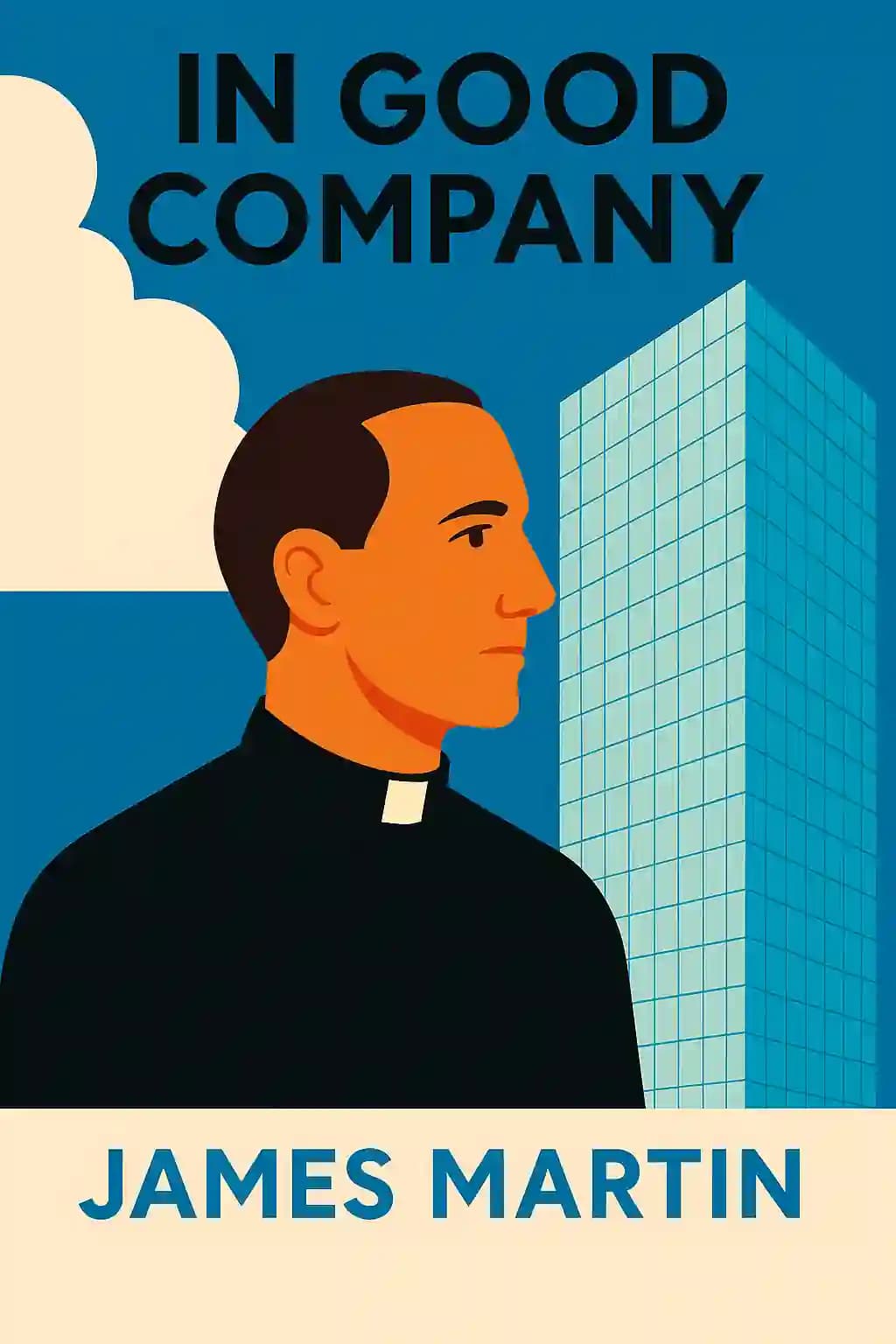
When James Martin knelt on the urine-soaked floor of a Kingston hospice, struggling to dress an elderly man who had insisted on wearing shoes in the shower, a friend appeared in the doorway and remarked, "Boy, if your friends from Wharton could see you now." This moment perfectly encapsulates the extraordinary journey from corporate finance to Jesuit novice that Martin undertakes in "In Good Company." The book has become a modern spiritual classic since its publication, resonating with seekers across religious traditions. Oprah Winfrey once featured it in her "What I'm Reading" column, calling it "a profound testament to following your authentic path." The memoir's enduring appeal lies in its honest portrayal of corporate disillusionment and spiritual awakening-themes that have only grown more relevant in our achievement-obsessed culture. As one of the most recognizable Jesuit voices in America today through his books and media appearances, Martin offers readers a rare glimpse into the radical transformation that occurs when one trades spreadsheets for spiritual exercises.
Capítulo 2
The Pressure Cooker of Corporate America
The Wharton School of Business was Martin's first taste of the cutthroat competition that would define his early career. As a seventeen-year-old freshman, he found himself surrounded by preternaturally competitive students who refused to share study materials to maintain their edge. When Martin expressed interest in taking a poetry course, his adviser actively discouraged him, warning that it would distract from "important courses" and wouldn't matter during interviews. Though he took the poetry class anyway and received an A, the business-focused environment steadily narrowed his intellectual horizons.
This competitive atmosphere perfectly prepared Martin for General Electric in the early 1980s, when CEO Jack Welch (nicknamed "Neutron Jack") was transforming the company through his ruthless "Move up or Move out" philosophy. Martin's first position in Income Margin involved reporting profits from global projects on twelve-column green spreadsheets, while simultaneously taking two years of in-house accounting courses. Despite an interviewer's warning about working too much overtime, Martin's boss laughed when he mentioned it.
What's particularly fascinating about Martin's corporate experience is how quickly he discovered accounting practices that contradicted his education. When he reported low numbers from Saudi Arabian contracts, an executive simply instructed him to "reverse a few journal entries." The company maintained reserve accounts specifically to manipulate monthly reports, ensuring they always "made their numbers" for corporate headquarters. These accounts even had telling names like "Plug," "Excess," and "Reserve." When Martin questioned this practice, suggesting they could prepare twelve months of reports at once if the numbers were predetermined, the executive stormed out. A colleague laughed, saying he was taking his accounting courses "way too seriously."
The human cost of corporate culture became evident when Martin witnessed G.E.'s downsizing firsthand. The company decided to shift the International Division's finance work to other divisions, reducing staff from 400 to just 50 people. While executives claimed economic necessity, many longtime employees had made significant personal sacrifices expecting company loyalty in return. Adding insult to injury, during these layoffs, Jack Welch renovated his rarely-used Manhattan office with marble floors, teak walls, and expensive carpeting while dismissed employees carried out boxes of personal belongings.
Capítulo 3
The Empty Promise of Success
Despite the ethical compromises and cutthroat atmosphere, Martin initially thrived at G.E. His bank account swelled with frequent trainee raises, bringing the novel experience of treating friends to expensive meals and buying armfuls of silk ties at Brooks Brothers. The twenty-something trainees socialized constantly-dancing at Manhattan clubs, throwing apartment parties, catching movies, and frequenting bars with free happy hour food. As John Updike observed, New Yorkers think people living elsewhere are "kidding," and Martin fully embraced this mindset.
After completing G.E.'s Financial Management Program, Martin secured a position at the highly profitable G.E. Credit Corporation in Connecticut, managing the same program he had recently completed. This role gave him his first taste of real authority, with his own office complete with a door and twelve ceiling lights (considered quite an accomplishment in corporate hierarchy). Though taking a human resources role might hurt his finance career prospects, he welcomed the chance for more creative work.
Yet despite achieving everything he'd dreamed of in college-great salary, independence, career advancement-Martin found no satisfaction. The fundamental question haunted him: "Is this life?" The corporate values he witnessed daily conflicted with his growing sense that something essential was missing. His promotion to "Specialist-Corporate Financial Management Development" brought more responsibility but also exposed him to disturbing practices like classifying employees with numbers (ones were highly promotable, fours were on their way out).
The moment that crystallized Martin's disillusionment came when he witnessed a manager attempt to fire a 15-year employee who had recently received a performance award. When Martin questioned this decision, the manager responded, "Fuck compassion." The stress manifested physically as irritable bowel syndrome, with doctors ironically advising him to "avoid stress" while working at GE. This physical breakdown became the first sign that Martin's body was rejecting the corporate world before his mind fully understood what was happening.
Capítulo 4
The Awakening of Spiritual Hunger
In the midst of corporate success and physical distress, Martin began experiencing a spiritual awakening. During his daily subway commute from Queens, he filled the time by reading classics he'd missed in college: Joyce's Portrait of the Artist, Homer's epics, Tolstoy, Flaubert, and Dostoevsky. This literary immersion opened new worlds beyond financial statements and corporate strategy.
A pivotal moment came during Sunday Mass, when the Gospel story of the rich young man who couldn't give up his wealth to follow Jesus resonated deeply with Martin. By chance, he discovered a PBS documentary about Thomas Merton, a Trappist monk whose autobiography "The Seven Storey Mountain" captivated him. Merton's story of abandoning worldly ambition for monastic life spoke directly to Martin's growing spiritual hunger. His question-"Why do we waste our time doing things which are just the opposite of what we were made for?"-perfectly articulated Martin's feelings.
Martin began secretly reading religious books, embarrassed yet unable to shake the thought of becoming a priest, monk or brother. Despite knowing little about religious orders or what priests actually did beyond celebrating Mass, he finally approached his parish priest after Mass and confessed, "I think I'd like to be a priest." This tentative step toward a radically different life path reveals how spiritual calling often begins not with certainty but with a humble admission of desire.
When Martin visited a psychiatrist for his ongoing physical symptoms, a breakthrough moment occurred. Dr. Tchachke asked what Martin would do if he could do anything, and Martin immediately answered: "I'd be a priest." The doctor's simple response-"Well, why don't you?"-triggered an epiphany. Despite mixed motivations, Martin recognized his genuine desire to serve God and others. He retrieved the Jesuit information he'd hidden away and called their vocations director, finally embracing what he truly wanted.
Capítulo 5
Trading Spreadsheets for Service
Martin's transition from corporate life to religious vocation required him to confront his fears and take concrete steps into uncertainty. When he gave notice at GE, his boss Karen asked, "You're kidding, right?" After six years at GE, Martin found leaving surprisingly easy due to his intense desire to join the Jesuits. Friends reacted with universal disbelief-"You're kidding!" was the standard response. At a dinner where Martin revealed his plans to Penn friends, they sat in shocked silence until a waiter asked if they needed more time, prompting one friend to reply, "We need a LOT more time."
The application process for the Jesuits proved surprisingly challenging in different ways than corporate interviews. Rather than the standard questions about career goals and strengths, Father Kane asked profound questions like "Who is God for you?" and "Who is Jesus for you?" that left Martin fumbling. Kane even inquired about Martin's sex life, including masturbation habits-questions that shocked Martin but reflected the Jesuits' honesty about sexuality.
What struck Martin most during the interview process was how different Jesuit leadership was from corporate executives. The Jesuits he met were accomplished yet humble-they had advanced degrees, wrote books, and worked globally, yet remained approachable and kind. The higher he went in the Jesuit hierarchy, the nicer they seemed-quite contrary to the "Jackass Theory" he'd developed at GE, where executives became more insufferable as they rose in rank.
After being accepted to the Society of Jesus, Martin faced the practical challenge of divesting his possessions-a process more complicated than St. Francis's dramatic burning of his belongings. He needed to dispose of his car, stereo, music collection, suits, books, and apartment. His roommates and he struggled to find takers for their furniture-even Goodwill and the Salvation Army rejected most items. They eventually paid someone $75 to take the remaining pieces. This process of letting go physically mirrored the deeper spiritual detachment Martin was embracing.
Capítulo 6
The Novitiate: Learning to Be Rather Than Do
On August 28, Martin headed to Arrupe House in Boston to begin his Jesuit training. The former convent offered modest accommodations-rooms large enough for only a twin bed, chair, and desk, with armoires in the hallway instead of closets. After his family departed around 3:00, Martin felt a sudden stab of fear about his decision. That night, after crawling into bed worried and uncertain, he wept-a poignant reminder that even the most meaningful life choices can begin with vulnerability and doubt.
The novitiate's rhythm was markedly slower than life at GE, with the first two weeks-called "postulancy"-feeling almost like a vacation. This period served as a low-key introduction to novice life, covering daily schedules, Society governance, and instruction on using the breviary (prayer book). Life quickly settled into a structured routine-the ordo. Morning prayer began at 7:15, followed by simple breakfast. Each day included an 8:00 AM conference covering Jesuit history and spirituality, with late mornings and afternoons dedicated to ministries outside the house, Mass at 5:00 PM and dinner at 6:00.
One of Martin's greatest challenges was adapting to a life focused on being rather than doing. His fall ministry at Youville Hospital in Cambridge required working with seriously ill and dying patients. Initially, he felt compelled to "perform" or accomplish something tangible, but quickly realized his role was simply to be present-visiting patients, listening to them, or sitting quietly with those who couldn't communicate. This felt awkward and useless, yet his supervisor Ernie reminded him that presence itself was the ministry.
This work contrasted sharply with Martin's GE experience-no deadlines, no competition, no performance metrics. The staff weren't concerned with whether you were a "high pot" or had "made your monthly numbers"-they focused instead on finding God in their work. Martin's patients became individuals and friends rather than mere patients: Rita, hospitalized for twenty years, had decorated her room like a home; Gladys, dying of cancer, sometimes confused Martin with her navy sweetheart; Gene, a 25-year-old with severe brain damage, communicated through a letter board with a surprisingly dry sense of humor.
Capítulo 7
The Jamaica Experience: Confronting Poverty and Privilege
Martin's "Third World Experiment" in Jamaica pushed him far beyond his comfort zone. Arriving in Kingston was jarring-from the tropical beauty of the airport to the shocking poverty beyond. Martin was assigned to a concrete annex at St. George's College, a Jesuit high school surrounded by nine-foot stone walls topped with razor wire. His room featured unwelcome wildlife including a bees' nest that the superior suggested he "wait until it gets bigger" before removing. That first night, lying on an ancient metal bed listening to reggae music, barking dogs, gunshots and mosquitoes, Martin wondered what he'd gotten himself into compared to his air-conditioned GE office.
Martin split his time between tutoring at Alpha Boys' School, an orphanage for "bad boys" run by Sisters of Mercy, and working at a hospice for the dying run by Mother Teresa's Missionaries of Charity. At Alpha, he helped struggling students with reading and math. His favorites were six-year-old Duane, who painted his fingernails red "because it's pretty!" and eighteen-year-old Ricaldo, nearly illiterate but enthusiastic about pirate stories. It was sobering to realize many boys would struggle after "graduating" into Kingston's unemployment and poverty.
Each morning Martin walked through Kingston's slums to Our Lady Queen of Peace hospice, overwhelmed by powerful smells-excrement, disinfectant, garbage, bleach, and cooking. His job was straightforward but challenging: bathing elderly men, many incontinent or disabled. He struggled with physical revulsion while the Missionaries of Charity maintained preternatural cheerfulness. To cope, he sang religious songs while working, which patients eventually hummed along with. When asked to baptize a dying man he had cared for, Martin named him Joseph, pouring water over his fragile frame in a sad yet peaceful moment.
These experiences repeatedly taught Martin the danger of stereotyping. Just as at Youville Hospital, he learned in Jamaica that he wasn't serving abstract categories like "The Poor" or "The Dying," but individuals with unique personalities, preferences, and dignity. He also discovered his tendency to romanticize those he served and overestimate his contribution, when in reality, the people he encountered sometimes included difficult personalities who challenged his idealized notions of service.
Capítulo 8
The Spiritual Journey: From Concepts to Relationship
Throughout the novitiate, Martin's understanding of prayer underwent a profound transformation. His spiritual director David introduced him to a revolutionary concept of prayer as "a long, loving look at the real" - finding God not just in formal meditation, but in everyday moments, from morning coffee to evening walks. Martin found particular resonance in William Barry's book "God and You," which illuminated how our relationship with God parallels human relationships in striking ways. Just as friendships require regular contact, vulnerability, and genuine interest, developing intimacy with God demands dedicated time, openness to learning, and most crucially, the ability to listen rather than dominate the conversation with requests and monologues.
This relationship-based framework helped Martin understand prayer's natural rhythms and seasons. Like human relationships, there's often an initial "honeymoon phase" marked by intense feelings and desire for constant connection. This eventually gives way to deeper, more mature phases that might feel less emotionally charged but are ultimately more substantial. Some days brought profound consolation, while others felt dry and difficult - all normal parts of the spiritual journey. The ultimate goal shifted from intellectual understanding about God to developing genuine intimacy with the Divine.
The Long Retreat, a cornerstone of Jesuit formation involving thirty days of silence and contemplation based on St. Ignatius's Spiritual Exercises, became transformative for Martin. During this intensive period, he confronted his deep-seated psychological patterns - his constant seeking of others' approval, his tendency to make harsh judgments, and his sometimes-desperate need for recognition and praise. Through this psychological and spiritual excavation, he experienced both crushing awareness of his own brokenness and the healing balm of divine forgiveness. Despite the emotional intensity of this work, life at the retreat house in Gloucester provided a gentle container for transformation. Following David's guidance, Martin established a rhythm of three to four hours of daily prayer, gradually building spiritual stamina despite occasional restlessness and resistance.
The second and third weeks of the retreat focused intensively on Christ's life through Ignatian contemplation - a method involving detailed imagination of Gospel scenes. Martin would place himself within stories like the Annunciation, observing Mary's reactions, imagining the angel's presence, and reflecting deeply on themes of faith, surrender, and courage. He found himself particularly moved by Mary's immediate "yes" to God's unexpected plan, contrasting with his own tendency to hesitate and analyze. Throughout these meditations, patterns of pride and impatience kept surfacing, but alongside these insights came a deeper appreciation of God's unwavering faithfulness despite human imperfection. The retreat concluded with Martin experiencing unprecedented closeness to God and renewed conviction about his Jesuit vocation, though he recognized this as just one milestone in an ongoing journey of relationship and discovery.
Capítulo 9
Embracing the Vows: Poverty, Chastity, and Obedience
As Martin approached his vow day, he reflected deeply on the three vows he would take: poverty, chastity, and obedience. Reflecting on poverty, he found giving up material possessions relatively easy after his GE days, where he'd saved most of his earnings anyway. The freedom from financial worries was liberating, though living on seventy dollars monthly presented real challenges. Working in impoverished settings-Boston's homeless shelters, Kingston slums, New York's Lower East Side-made it impossible to complain about minor discomforts.
Yet Martin sometimes struggled with reconciling his legalistic notion of absolute poverty against the comfortable lifestyle in some Jesuit communities. He realized there's a deeper spiritual poverty we all face-the poverty of human limitations, of being unable to solve every problem we encounter. Accepting this limitation paradoxically frees us from despair by allowing God to work through us more effectively.
Chastity proved more challenging. Beyond abstaining from physical intimacy, the hardest part was not having one exclusive person for emotional support. Yet this vow creates freedom to love many people deeply. As his spiritual director David reminded him, falling in love is natural and healthy-the question is how to integrate those feelings into celibate life. When lived well, chastity provides more energy and time to be present for others.
Obedience initially seemed easiest after Martin's corporate experience at GE. He was amused that people who would work fifteen-hour days and relocate their families for corporations couldn't understand religious obedience. One older Jesuit told him how he was once assigned to teach chemistry despite never having studied it-he simply learned and taught it for three years. This vow means Jesuits must be ready to shift between assignments based on the Society's needs. Yet the daily obedience of showing up for assigned work-whether teaching, studying, or praying-often proved the most challenging, requiring faith that this truly represented God's will.
Capítulo 10
Finding Home in Unexpected Places
On August 18, Martin pronounced his vows in the Church of the Immaculate Conception, surrounded by a gathering that represented the full spectrum of his life's journey. His once-estranged parents sat together in the front pew, their reconciliation a testament to healing that paralleled his own spiritual transformation. His sister, newly engaged and beaming, joined relatives who had traveled from Philadelphia, while college friends from Boston College and beyond filled the pews alongside his former GE colleagues and the dedicated teachers from Nativity School. The ceremony itself became memorable for unexpected reasons when the presiding priest, overcome by the August heat, fainted mid-service. The dramatic entrance of EMTs pushing a gurney up the center aisle during Communion added an unscripted moment that would later become a story told with both humor and reverence. Yet when Martin finally knelt to pronounce his vows, the chaos melted away. In that crystalline moment, speaking his promises to God before this tapestry of witnesses, he experienced a clarity and peace he had never known before.
Later that night, after the guests departed and the celebration debris was cleared away, Martin sought solitude in the novitiate chapel. The space was intimate and sacred, illuminated only by the gentle dance of candlelight before the hand-carved wooden tabernacle. As shadows played across the walls, he contemplated the remarkable path that had led him there. His former life at GE had been meticulously planned - the corporate ladder clearly defined, his financial future secure with growing investments, a company car, and the promise of executive benefits. The idea of becoming a Jesuit would have seemed absurd to his younger self, who saw success purely in terms of quarterly bonuses and stock options. The transformation seemed even more profound when he recalled his earlier attitudes toward service and faith. He had been the archetypal Manhattan professional, averting his eyes from the homeless people he passed on his way to client meetings. Spirituality had seemed like a crutch for others, something unnecessary for a successful young executive.
The past two years had utterly upended these assumptions. His experiences had taken him from the sterile corridors of corporate America to the raw humanity of hospital wards, where he ministered to the dying. He had worked alongside Mother Teresa's Missionaries of Charity in some of the world's poorest communities, witnessing a joy that defied material circumstances. In the classrooms of Nativity School, teaching seventh-graders had taught him more about patience, humility, and authentic connection than any business seminar ever had. Each step, though uncertain at the time, had led him closer to his true calling.
Sitting in the chapel's embrace, Martin felt overwhelmed by the profound grace that had guided his journey. The transformation hadn't happened through his own careful planning - rather, it had unfolded through surrender to a deeper wisdom. His story echoed the angel Gabriel's words to Mary: "Nothing is impossible with God." The mystery of vocation, he realized, often lies not in achieving what we think we want, but in discovering what we were created to become.
Martin's journey stands as a powerful reminder that authentic fulfillment rarely conforms to society's prescribed formulas of success. The courage to listen to one's inner calling - that persistent question that asks "Is this all there is?" - often requires abandoning the safe harbors of conventional achievement. True transformation demands the willingness to step into uncertainty, trusting that the path will reveal itself one step at a time, leading us not to where we thought we should go, but to where we were always meant to be.