Capítulo 1
A Land of Wonders and Contradictions
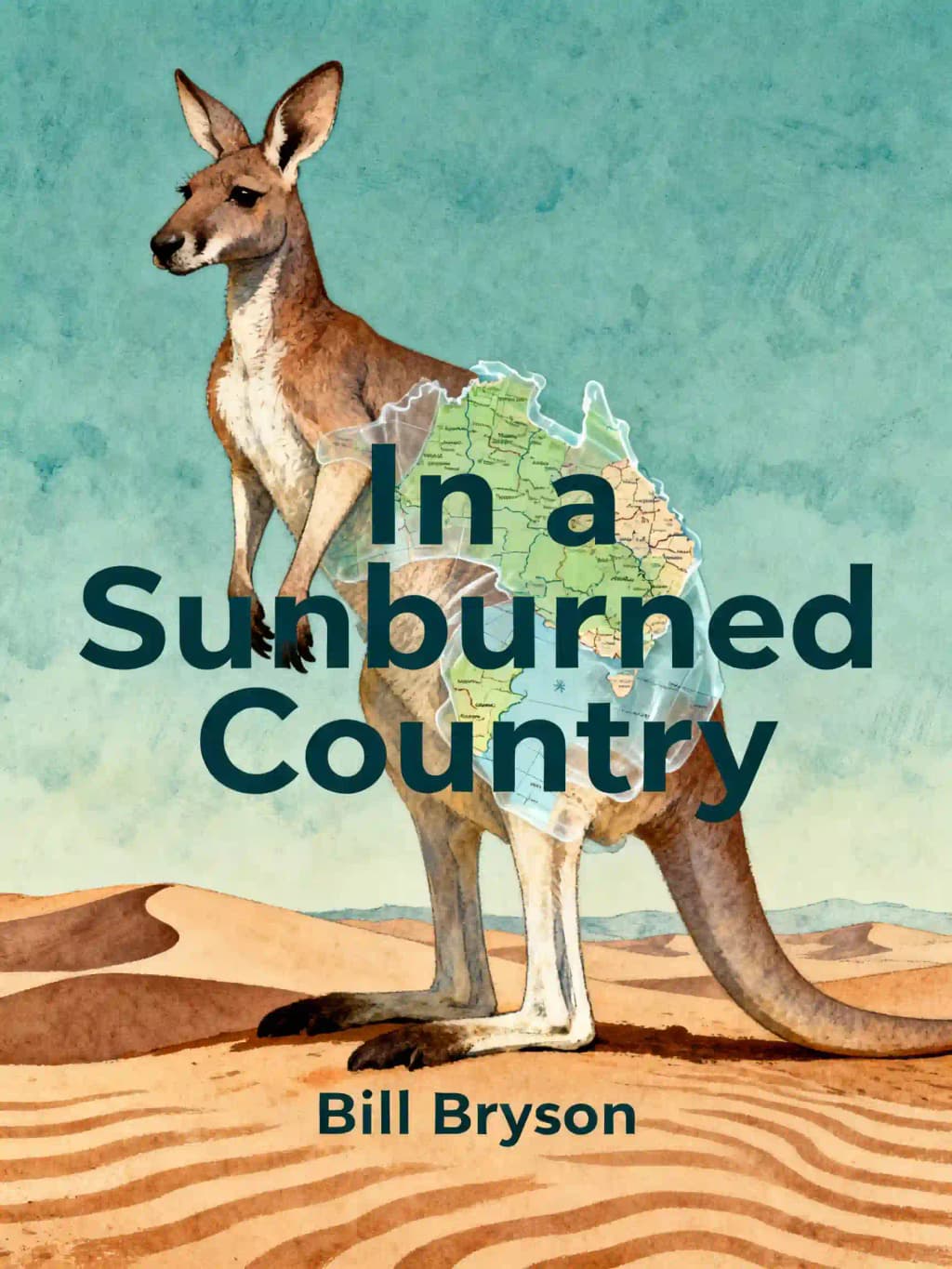
Australia is a place that defies expectations at every turn. Bill Bryson's journey through this sunburned country reveals a nation that somehow manages to be simultaneously familiar and utterly foreign, mundane yet extraordinary. It's a continent that houses the world's most venomous creatures, prehistoric plants thought extinct for 100 million years, and rock formations that stir something primordial in the human soul. Yet despite its remarkable qualities, Australia remains curiously overlooked on the world stage. As Bryson demonstrates through his analysis of the New York Times Index, this massive country receives less coverage than minor nations or trivial subjects. Even when Australia's Prime Minister Harold Holt disappeared while swimming in 1967 (imagine a U.S. President vanishing without trace), it barely registered internationally. This paradox - a country teeming with wonders yet perpetually off the radar - forms the heart of Bryson's exploration. The book has become a cultural touchstone for travelers and armchair adventurers alike, with Stephen Fry naming it among his favorite travel books and Barack Obama reportedly packing it for his Australian visit. Through Bryson's eyes, we discover a land that, as he puts it, "is mostly empty and a long way away, and thus doesn't need watching... but it is actually quite interesting, and entirely worthy of attention."
Capítulo 2
The Great Southern Land: A Continent Like No Other
Australia exists as a geographical anomaly - an island continent isolated for 45 million years, allowing evolution to run wild in spectacular ways. The result is a land where 80% of the flora and fauna exist nowhere else on Earth. Bryson captures this uniqueness through encounters with creatures like the platypus, which so confounded British scientists when first discovered in 1799 that they thought it was a hoax. With its duck bill, beaver tail, webbed feet, and egg-laying capability, the platypus exists "in a kind of anatomical netherworld halfway between mammal and reptile," defying conventional classification for a century.
The continent's botanical diversity proves equally astonishing - an estimated 25,000 plant species compared to Britain's mere 1,600, with at least a third still unnamed. New discoveries happen regularly, like the wollemi pines found in 1994 - 130-foot-tall "living fossils" that somehow escaped notice despite their size. Southwestern Australia alone contains twelve thousand plant species, 87% found nowhere else. This extraordinary diversity stems from poor soil forcing plants to specialize, and Australia's profound isolation - both from other continents and within its internal "life zones."
Australia's paradoxical nature - a harsh, infertile continent teeming with uncounted life forms - is perfectly illustrated through the tale of Nothomyrmecia macrops, a "proto-ant" thought extinct for 100 million years. After failed expeditions to find it at its original discovery site, entomologist Bob Taylor spotted a colony on a eucalyptus tree when his vehicle broke down in the remote outback - an extraordinary coincidence highlighting Australia's mysterious, packed-yet-empty character.
The land itself contains geographical wonders that would be world-famous anywhere else. The Devils Marbles - enormous granite boulders impossibly balanced in the middle of nowhere - sit completely deserted, a "lost wonder" that receives barely a mention in guidebooks. The Tree Top Walk in Western Australia's Valley of the Giants provides access to rare tingle trees, another outsized eucalypt found nowhere else. As Bryson notes, these forests represent "an apt metaphor for Australia" - filled with unappreciated wonders that hardly anyone outside the country has heard of.
Capítulo 3
Sydney to the Outback: The Journey Begins
Bryson's affection for Australia is evident from the start - a surprisingly familiar place despite its distance, with likable people, safe cities, excellent food, cold beer, and perpetual sunshine. His exploration begins in Sydney, a city that gives no hint of its desperate convict origins. The transformation is so complete that the city's penal colony beginnings are somewhat fudged, if not suppressed entirely.
The iconic Sydney Opera House, famously likened by Clive James to "a portable typewriter full of oyster shells," exists by small miracle. Construction dragged on for fourteen years, costing fourteen times the original estimate. Yet while the Opera House is splendid, Bryson's heart belongs to the Harbour Bridge - visible from every corner of the city, majestic from a distance but all might up close. Everything about it is enormous - stone blocks, girders, metal plates, and 6 million rivets "with heads like halved apples."
The harbor itself is Sydney's defining feature - more fjord than harbor, sixteen miles long with 152 miles of shoreline that wanders into serene coves and scalloped bays. From Hunter's Hill to the various suburbs, Sydney rewards exploration, though not without its dangers - including the funnel web spider, "the most poisonous insect in the world," whose bite can cause seizures, turn victims blue, and kill if not promptly treated.
Venturing beyond Sydney, Bryson boards the Indian Pacific train for a journey across the continent. The train's first-class accommodations prove hilariously compact - "not much larger than a standard wardrobe" but ingeniously designed. As they depart through Sydney's western suburbs into the Blue Mountains, Bryson explores the train's social hierarchy: plush first class with its brothel-like dining car, slightly less fancy holiday class with plastic tables, and the mysterious coach class behind a permanently locked door.
The quintessential Australian landscape soon appears - red soil, scrubby vegetation, and boundless horizons punctuated by skeletal gum trees. At Menindee, they meet Steve Garland, a former Sydney photographer now promoting tourism across 26,000 square miles of sparsely populated outback. The emptiness of Australia's interior strikes Bryson as they travel through semi-desert landscapes where lonely mailboxes appear every twenty kilometers, marking unseen stations.
Capítulo 4
The Deadly Paradise: Australia's Beautiful Dangers
Australia's reputation for deadly creatures is well-earned, though Bryson notes the curious pattern among Australians who "spend half of any conversation insisting that the country's dangers are vastly overrated" and the other half recounting terrifying encounters. This contradiction becomes evident when his friend Alan Howe casually mentions a recent close encounter with a shark while boogie boarding, then shares a story about narrowly escaping a crocodile in Queensland.
The continent's dangers are real and numerous. Box jellyfish render tropical beaches unusable during their breeding season from October to May. When Bryson asks marine biologist Dr. Alderslade what being stung by yards of jellyfish tentacles would feel like, he shudders and replies, "If you tried to imagine the worst pain possible, it would be beyond that."
Even more terrifying is the estuarine crocodile, "the one animal that has the capacity to frighten even Australians." What makes crocodile attacks so horrifying is their sudden, unexpected nature - victims are often simply standing in shallow water or sitting on a bank when "the water splits and, before they can even cry out, much less enter into negotiations, they are carried away for leisurely devouring."
The funnel web spider, "the most poisonous insect in the world," lurks in Sydney's leafy suburbs. Its bite can cause seizures, turn victims blue, and kill within hours if not treated. Australia also hosts the world's most venomous snakes, including the taipan whose venom can kill within minutes.
Yet these dangers pale in comparison to the outback itself - a place that, as Bryson puts it, "wants you dead." The punishing nature of the Australian interior defies exaggeration. Nineteenth-century explorers endured stinging ants, native attacks, thorny spinifex that caused infections, scurvy, impossible hygiene, and animals driven mad by thirst. Ernest Giles watched his horse plunge its nose into fire seeking water. Even camels struggled, with blowflies laying eggs in their wounds that produced maggots "scooped out daily with a pint pot."
The outback's emptiness creates its own peril. A wrong turn, a mechanical breakdown, or running out of fuel can quickly become life-threatening. Bryson recounts the tragedy of an Austrian couple whose four-wheel drive became stuck in the Simpson Desert, leading to the woman's death while attempting to hike to safety in 140F heat. Even today, with modern vehicles and communications, the vastness and harshness of the interior remain formidable challenges.
Capítulo 5
A People Shaped by Distance and Isolation
Australia's profound isolation has shaped its national character in fascinating and often peculiar ways. Newspapers regularly run obituaries weeks or even months after deaths, creating an odd temporal disconnect. The venerable Bulletin magazine once considered the birth of minor American actor Bill Bixby significant enough to mention six years after his death - a delay that would be unthinkable in most other developed nations. Most bizarrely, Manning Clark's standard one-volume history of Australia simply ended in 1935 until its revision in 1995, omitting World War II and everything since - a striking example of the country's strange disconnection from global events and time itself.
The sheer vastness of the continent has profoundly influenced Australian society and infrastructure. With 180,000 miles of paved highway, most clustered in the eastern corridor, vast stretches of the country remain untouched by roads - like the nearly 2,000 miles of pristine coastline between Darwin and Cairns. Queensland alone could fit most of Western Europe within its borders, yet has just three paved roads venturing into its interior. This limited infrastructure has created unique patterns of settlement and travel, with many communities relying on small aircraft or seasonal dirt tracks for connection to the outside world.
This geographical isolation has fostered a distinctive social dynamic marked by extraordinary community spirit. In Kalbarri, a small coastal town, Bryson witnesses a remarkable scene where nearly the entire population of 1,500 gathers spontaneously to watch a stricken fishing boat being slowly towed into harbor after being holed on a reef. The three-hour spectacle culminates with the townspeople clapping warmly and calling encouragement as the boat finally navigates the treacherous sandbars to safety. This display of communal concern and support deeply impresses him as emblematic of Australian values.
The Australian character emerges as distinctively practical, unpretentious, and good-humored, shaped by the necessity of adapting to harsh conditions and distant horizons. Bryson particularly delights in Australian voices and their "effortlessly dry, direct way of viewing the world." When discussing the constant threat of bushfires, his friend Alan exemplifies this attitude, acknowledging they're "totally at the mercy of nature" but philosophically noting that this very risk makes him appreciate their paradise all the more. This acceptance of danger and uncertainty runs deep through the Australian psyche, manifesting as a kind of cheerful fatalism.
Perth stands as the ultimate expression of Australian isolation, being "far and away the most remote big city on earth." With 1.3 million residents living between 1,700 miles of emptiness to Adelaide and 5,000 miles of ocean to Africa, the city has developed unique coping mechanisms. It compensates for its extreme isolation with glorious weather, sharp radiant light, and a vibrant local culture. Though architecturally unremarkable (earning it the nickname "Minneapolis Down Under"), Perth has developed its own distinctive character, with residents embracing their splendid isolation through outdoor living, beach culture, and strong community bonds. The city's remoteness has paradoxically become a source of pride and identity, exemplifying how Australians have turned geographical challenges into cultural strengths.
Capítulo 6
The Forgotten People: Aboriginal Australia
The peopling of Australia represents one of history's most momentous yet mysterious human migrations. Aboriginal Australians arrived at least 45,000 years ago, possibly 60,000 years ago, crossing at least sixty miles of open sea from what is now Indonesia. This remarkable achievement required watercraft and navigation skills that predated similar developments elsewhere by tens of thousands of years.
Even more impressively, they mastered every extreme environment on the continent, developing the world's oldest continuously maintained culture. Despite these extraordinary accomplishments, Aboriginal history and achievements have been largely invisible in global historical accounts.
When Cook's Endeavour arrived at Botany Bay, the Europeans were astonished that many Aborigines barely acknowledged their presence. Aboriginal culture defied European understanding - they had no words for "yesterday" or "tomorrow," no chiefs, permanent structures, agriculture, or pottery. Yet they undertook enormous projects like building shell mounds up to thirty feet high for reasons no one understands.
The Aboriginal population, estimated between 300,000 and a million at European settlement, collapsed catastrophically in the first century of colonization. While most deaths resulted from European diseases to which they had no resistance, many Aborigines were treated with unconscionable cruelty. William Lines documents horrific examples: Aborigines butchered for dog food, a woman forced to wear her decapitated husband's head, another shot repeatedly while desperately stuffing leaves into her wounds.
The Myall Creek Massacre of 1838 marked a turning point. When twelve men rounded up and slaughtered twenty-eight peaceful Aborigines, Australia's increasingly urban society grew disgusted with such casual slaughter. After journalist Edward Smith Hall publicized the story, seven men were eventually hanged - the first time whites were executed for murdering Aborigines.
Yet in modern Australia, Bryson observes a strange social dynamic - white Australians and Aborigines inhabiting "separate but parallel universes," never acknowledging each other. Many Aborigines looked beaten up, with puffy faces and bandages. Despite Aboriginal people comprising nearly 3% of Australia's population, he never once saw them participating in mainstream economic life - working in banks, delivering mail, or fixing telephone lines.
Watching the mixed crowds in Alice Springs' Todd Street Mall - "happy white shoppers with Saturday smiles" contrasted with "shadowy Aborigines with their curious bandages and slow, swaying, knocked-about gait" - Bryson feels helpless to suggest solutions. If asked to advise on Aboriginal issues, all he could write would be: "Do more. Try harder. Start now."
Capítulo 7
Ecological Catastrophe and Resilience
Australia's ecological fragility becomes starkly evident through Bryson's exploration of introduced species. The catalyst for one of the continent's most devastating ecological disasters came in 1859 when Thomas Austin released twenty-four rabbits for sport hunting. This seemingly innocuous act would transform Australia's landscape forever. Without natural predators and blessed with ideal breeding conditions, rabbits multiplied at an astronomical rate, reaching millions within a decade. Their voracious appetite destroyed native vegetation, particularly devastating the delicate eremophila shrub and countless other indigenous plants that had evolved over millions of years to survive in Australia's unique conditions.
The rabbit plague coincided with a catastrophic decade-long drought in the 1890s, creating a perfect storm that stripped away Australia's already precarious topsoil. The combination permanently altered vast tracts of the continent's interior. Even the introduction of the myxomatosis virus in the 1950s, which initially proved devastatingly effective by killing 99.9% of rabbits, ultimately demonstrated nature's resilience - the few resistant survivors quickly repopulated the continent, with numbers rebounding to approximately 300 million.
Perhaps most perplexing was Australia's persistent determination to introduce foreign species despite mounting evidence of ecological disaster. "Acclimatization societies" emerged across the country, operating under the misguided colonial belief that Australia was "biologically deficient" and needed European flora and fauna to achieve its full potential. These well-intentioned but disastrous groups systematically introduced foxes, camels, donkeys, horses, buffaloes, and numerous other animals. Many of these species established massive feral populations that continue to wreak havoc today. The scale is staggering: Australia now hosts 5 million wild donkeys, a million wild horses (known as brumbies), and such an abundance of introduced megafauna that "the once-mighty red kangaroo is now only the thirteenth largest animal in the country."
The toll on native wildlife has been catastrophic and continues to mount. Approximately 130 Australian mammals face extinction threats, with sixteen species already lost forever - the highest rate of mammalian extinction on any continent. The common cat has emerged as perhaps the most devastating predator; an estimated 12 million feral cats now inhabit every ecological niche across the continent. These skilled hunters, along with introduced foxes, have pushed numerous unique native animals to the brink of extinction, including the bilby, numbat, and various species of wallaby.
The plant kingdom has not been spared this biological invasion. The case of prickly pear cactus from America illustrates the potential scale of botanical invasions - by 1925, it had overrun 30 million acres in Queensland alone, requiring extensive and expensive control measures including both chemical pesticides and biological controls. Modern Australia grapples with more than 2,700 foreign weed species, with botanical gardens - originally established to cultivate and showcase exotic plants - ironically serving as major sources of invasive species.
Yet amid this ecological disruption, Australia's ancient natural wonders demonstrate remarkable resilience. The stromatolites at Shark Bay - unremarkable-looking gray blobs that represent Earth's oldest living organisms - have survived for an astounding 3.5 billion years. These primitive life forms gradually transformed Earth's atmosphere, raising oxygen levels to 20 percent and making complex life possible. The Great Barrier Reef stands as another testament to nature's endurance, covering between 280,000 and 344,000 square kilometers and stretching 1,200 to 1,600 miles along the Queensland coast. This living wonder hosts an incredible biodiversity: at least 1,500 fish species, 400 types of coral, and 4,000 varieties of mollusks, representing one of the planet's most complex and vital ecosystems.
Capítulo 8
A Nation Reinvented: From Outpost to Modern Marvel
Australia's transformation from remote British outpost to multicultural nation represents one of modern history's most remarkable social evolutions. The Immigration Museum in Melbourne brilliantly chronicles this journey, documenting how a sparsely populated colonial backwater became a vibrant, prosperous nation. The catalyst for this transformation came after World War II, when the Japanese bombing of Darwin and submarine attacks in Sydney Harbor delivered a stark wake-up call. After realizing Britain couldn't be counted on for protection, Australia adopted an ambitious "populate or perish" policy, opening its doors to millions of European immigrants, particularly from Italy, Greece, Yugoslavia, and later Vietnam.
This massive demographic shift fundamentally changed Australian society. New arrivals brought their cuisines, traditions, and cultural practices, transforming Australian cities from places where restaurants closed at 6 PM and pubs shut at 10 PM into cosmopolitan centers with vibrant nightlife, diverse dining scenes, and rich cultural festivals. Within a single generation, meat pies and fish and chips gave way to souvlaki, pho, and pasta. What's particularly striking is how Australia, despite some initial tensions, welcomed immigrants with genuine warmth. Bryson is moved by the story of a Hungarian refugee who, when registering at a police station, was surprised when the sergeant warmly shook his hand and said, "Welcome to Australia, son" - a memory that brought tears to the man's eyes decades later. Similar stories abound of European migrants finding acceptance in working-class neighborhoods and country towns.
The nation's economic development followed an equally dramatic trajectory. Before the 1950s, Australia was considered resource-poor, with an economy heavily dependent on wool and agriculture. Then came mineral discoveries "in dizzying succession" - massive iron ore deposits in the Pilbara, bauxite in Weipa, nickel in Western Australia, uranium in the Northern Territory, and diamonds in the Kimberley. Australia became "a mining colossus," with Perth transforming from a sleepy western capital into a boom town of gleaming skyscrapers and millionaire miners. Yet geologist Harvey Henley explains that Australia isn't necessarily overendowed with minerals per square meter - it simply has vast unexplored territory. The maps he showed Bryson, each covering 60 by 40 kilometers and requiring 10-15 man-years to produce, revealed that less than 20% of Australia's terrain has been properly surveyed for minerals.
Modern Australia presents a fascinating paradox of confidence and insecurity. The country has never experienced a civil war, never imprisoned political dissidents, and maintained stable democratic institutions for over a century. Its cities consistently rank among the world's most livable, its passport among the most powerful, and its healthcare system among the most efficient. Yet some Australians seem haunted by an existential uncertainty, convinced that their nation's continuation "is by no means assured." Bryson notes that Australians often lack perspective about their prosperity, fretting about slipping to 21st in global GDP rankings while ignoring their exceptional quality-of-life indicators (7th on the UN's Human Development Index) and overlooking their remarkable achievement in building one of the world's most successful multicultural societies in just a few generations.
Capítulo 9
The Enduring Mystery of the Sunburned Country
As Bryson's journey concludes, he reflects on Australia's persistent ability to surprise and captivate. Despite weeks of exploration, he's barely scratched the surface of this enormous country. Looking at his maps, he's tempted to continue to the Bungle Bungles, extraordinary sandstone formations near the Northern Territory border that remarkably weren't widely known until the 1980s. Measuring the distance, he discovers it's still 1,600 miles away - in the same state! This epitomizes Australia's vastness - so much to see in such an enormous space.
The continent's mysteries extend beyond its geography. In April 1860, John McDouall Stuart reached the desolate center of Australia after months of hardship, only to discover he wasn't the first white person there. Stuart encountered three Aboriginal men making Freemason signs, found horse tracks, and witnessed a Warramunga tribesman who knew how to tie shoelaces. Who these mysterious predecessors were remains unknown - just one of the outback's many unfathomable mysteries.
Even Australia's wildlife remains partially unknown. Species lists contain qualifiers like "possibly extinct" or "thought to be endangered." The oolacunta (desert rat kangaroo) exemplifies this mystery - discovered in 1843, not seen again until Hedley Finlayson's 1931 expedition found them thriving, only to vanish completely by 1935. Similarly, Rheobatrachus silus, a frog that uniquely gave birth through its mouth, was discovered in 1973 but disappeared by 1981.
As Bryson reluctantly accepts his journey's end, he begins the long drive back to Perth, already feeling the melancholy that comes when experiences begin fading into memory. He realizes that once he leaves Australia, news of it will cease to reach him - he'll never learn what happened with the Hancock millions or that stranded American couple. Australia will continue without him, its fires and crocodiles and political scandals unfolding beyond his awareness.
This is perhaps the most profound truth about Australia - it exists in splendid isolation, carrying on with its extraordinary natural drama regardless of whether the world pays attention. Australia is mostly empty and far away, with a small population and peripheral global role. It doesn't cause trouble or need watching. But Australia is genuinely interesting, and overlooking it is entirely our loss. In Bryson's affectionate portrait, we discover a land that defies easy categorization - at once familiar and utterly foreign, mundane yet extraordinary - a sunburned country that rewards those willing to look beyond the obvious with endless wonders.