Capítulo 1
Proust's Prescription for a Better Life
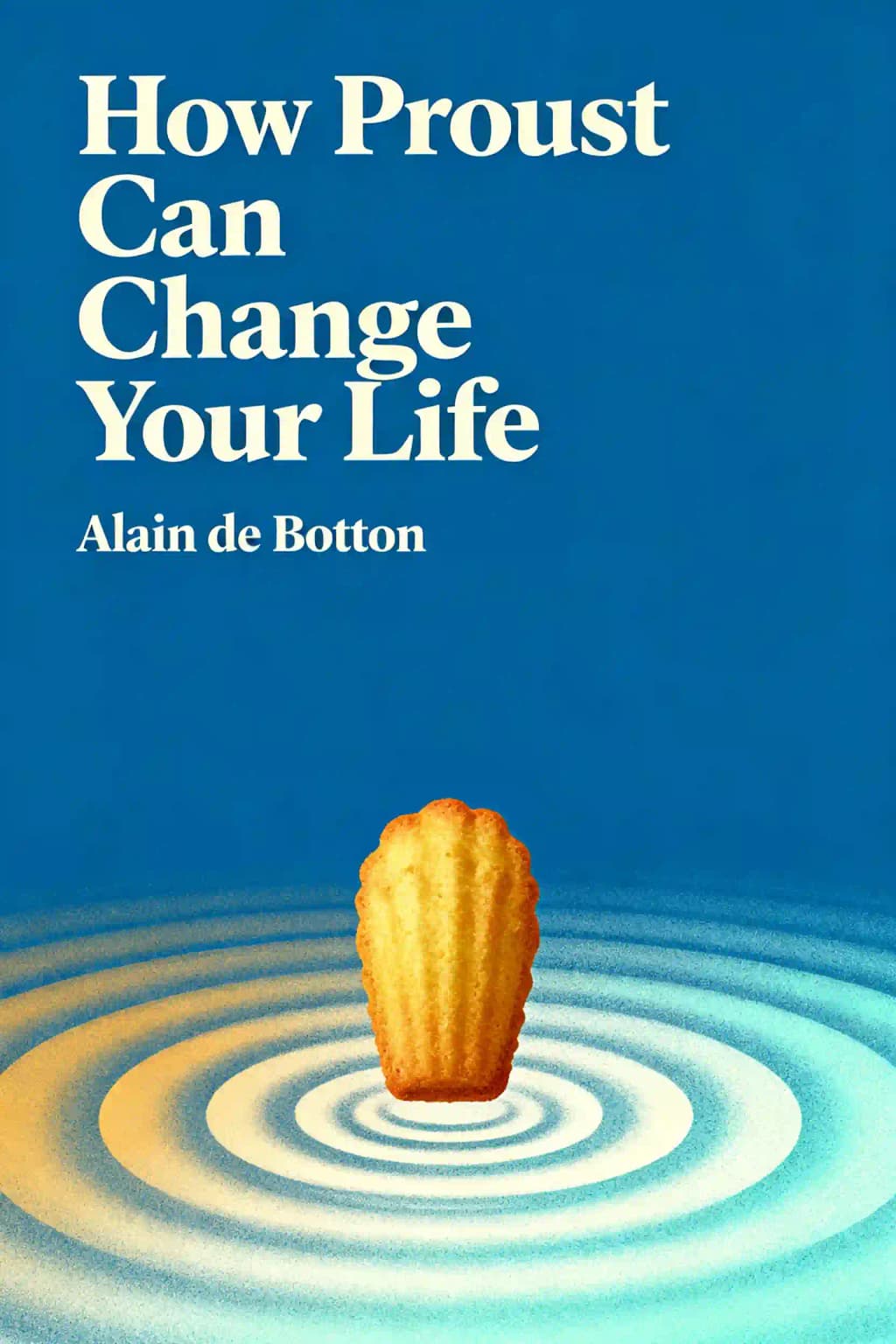
Marcel Proust once offered a striking answer when asked what he would do if the world were ending. While others suggested climbing mountains or seeking religious comfort, Proust declared life would suddenly seem wonderful if death threatened. This profound insight came just four months before his own death from pneumonia at fifty-one. His masterwork, "In Search of Lost Time," serves as a practical guide to stop wasting time and start appreciating life before personal or global destruction arrives. Though Proust lived as a recluse with chronic health problems, his work has influenced generations of readers, including celebrities from Susan Sontag to Alain de Botton. His novel revolutionized literature with its psychological depth and remains culturally significant a century later, teaching us to find meaning in everyday experiences that we typically overlook.
Capítulo 2
Reading as Self-Discovery
Marcel Proust came from a family where healing was taken seriously. His father, Dr. Adrien Proust, was an internationally respected physician specializing in public health, decorated with the Legion d'honneur. While his father healed bodies through medicine, Marcel aspired to heal souls through literature. This fundamental difference in approach revealed their contrasting worldviews.
Dr. Proust was a practical man who wrote straightforward health manuals with clear utility. His 1888 book "Elements of Hygiene" offered teenage girls specific advice on everything from proper posture (never lean forward or cross legs) to the dangers of corsets ("self-destructive and perverse") and the benefits of simple exercises like jumping off walls and swinging one's arms. His approach was direct, prescriptive, and focused on physical wellbeing.
Marcel, by contrast, believed literature's healing power came through recognition-seeing ourselves reflected in what we read. He called this the "Marquis de Lau phenomenon" (MLP) after his habit of connecting paintings to people he knew, like recognizing a Parisian acquaintance in Ghirlandaio's "Old Man and Boy" at the Louvre. This approach to art and literature wasn't mere association but a profound form of self-discovery.
The MLP offers several therapeutic benefits. First, it helps us feel at home everywhere. When we recognize our own emotions in characters from different eras-whether Homeric heroes or Parisian aristocrats-the seemingly alien becomes familiar. We "open the zoo gates" and release creatures from distant times and places whom we had previously viewed with provincial suspicion.
Second, it cures loneliness. Great literature confirms the normality of thoughts or feelings unmentioned in our immediate environment. After childishly fighting with a lover, there's relief in hearing Proust's narrator admit, "as soon as I found Albertine not being nice to me, instead of telling her I was sad, I became nasty." We find solace in fictional characters suffering as we do-and importantly, surviving.
Finally, literature articulates what we sense but cannot express. The value of a novel extends beyond depicting familiar emotions to describing them far better than we could ourselves. After reading attentive prose, we become sensitized to notice what the author would have noticed-our minds become radars newly attuned to certain frequencies. Great books teach us to value reflections, joys, and sorrows we had previously repressed or scorned, expanding our emotional vocabulary and deepening our experience of life.
Capítulo 3
The Art of Slowness
Proust's work presents readers with an extraordinary challenge: its sheer length. His brother Robert noted that people "have to be very ill or have broken a leg" to find time to read "In Search of Lost Time." Beyond the novel's overall size (over 3,000 pages), individual sentences pose their own challenge-the longest would stretch nearly four meters if arranged in a single line.
Publishers initially rejected his manuscript for its verbosity. Alfred Humblot of Ollendorf couldn't understand why "a chap needs thirty pages to describe how he tosses and turns in bed." Jacques Madeleine reported that after 712 pages, it remained impossible to know what the book was about. Even after publication and acclaim, readers complained about Proust's digressions-one American woman wrote that after three years of reading, she still understood "absolutely nothing" and begged him to "stop being a poseur" and explain himself "in two lines."
This perception inspired Monty Python's "All-England Summarise Proust Competition," challenging contestants to condense seven volumes into fifteen seconds. The joke works because it highlights the fundamental incompatibility between Proust's project and our modern desire for brevity and efficiency.
Proust believed that compression strips human experience of significance. When Henri van Blarenberghe killed his mother, Proust wrote a five-page article linking the matricide to Ajax, Oedipus, and King Lear, arguing that we all share guilt in our relationships with our mothers: "as we grow older, we kill all those who love us by the cares we give them." Through such efforts, he elevated what deserved only a "gruesome few lines" into complex tragedy worthy of literary treatment.
Even great literature would seem unremarkable as news-in-brief items. Romeo and Juliet: "Verona youth commits suicide following girlfriend's death." Anna Karenina: "Moscow woman throws herself under train." Great art comes not from inherently significant subjects but from their treatment-even soap advertisements could inspire thoughts as profound as Pascal's Pensees.
This philosophy extended to Proust's reading habits. He found delight in train timetables and questioned diplomats about minute details of their day. His motto might be "n'allez pas trop vite"-don't go too fast-allowing the world to reveal its hidden richness and complexity. By slowing down, we discover dimensions of experience that rushed living obscures, transforming the mundane into the meaningful through careful attention.
Capítulo 4
Suffering's Hidden Wisdom
When evaluating wisdom, should we examine the author's own life and health? Nineteenth-century critic Sainte-Beuve believed we must understand an author's personal details to truly grasp their work. Yet Proust forcefully rejected this approach, arguing that books, not lives, matter-Balzac might be ill-mannered and Baudelaire obsessive, but their works transcend these personal failings.
Proust had personal reasons for this position: while his writing was logical and serene, his life was marked by appalling physical and psychological suffering. His health problems were legion: debilitating asthma that began at age ten and caused severe attacks up to ten times daily; chronic digestive issues including constipation and painful urination; extreme sensitivity to cold requiring four jumpers even in midsummer; and such noise sensitivity that a neighbor's toilet installation drove him to compare the months-long construction to building "the Pyramid of Cheops."
His psychological struggles were equally severe. His relationship with his mother was defined by mutual dependence-she wanted to prepare him for life without her, while he remained childlike, writing notes when he couldn't sleep and considering separation from her the epitome of unhappiness. His homosexuality brought further complications in unenlightened France, leading to a series of unrequited crushes and romantic pessimism. He defined his principal character trait as "the need to be loved" yet concluded that love was inseparable from suffering, declaring it "an incurable disease."
For the last sixteen years of his life, Proust regularly announced his imminent death. When his stockbroker accused him of hypochondria, suggesting his health issues were self-inflicted, Proust nevertheless succeeded in dying the following year, proving his point.
Yet from this suffering emerged profound wisdom. Proust argued that suffering is essential to acquiring insight: "Happiness is good for the body, but it is grief which develops the strengths of the mind." Pain forces us to analyze processes we would otherwise ignore. The truly wise must pass through suffering, as "we cannot be taught wisdom, we have to discover it for ourselves." Yet suffering alone isn't enough-one must transform grief into ideas, as "griefs, at the moment when they change into ideas, lose some of their power to injure our heart."
Proust's characters demonstrate how not to handle suffering. Madame Verdurin, pained by social exclusion, dismisses elite gatherings as "boring" rather than acknowledging her disappointment. Francoise, insecure about her lack of education, pretends to know everything rather than asking questions. Alfred Bloch, making social gaffes, transforms his failures into deliberate choices rather than simply apologizing.
Unlike these unfortunate sufferers, Proust himself handled suffering admirably. Despite life-threatening asthma triggered by flowers, he didn't claim nature was boring. When lacking knowledge, he sought to fill the gaps. And unlike those who redirected disappointments onto staff, when his driver married his future maid, Proust sent congratulations with only minimal self-pity.
The moral: our best chance at contentment lies in learning from our ailments, social gaffes, and betrayals rather than blaming external factors. Suffering becomes valuable when we transform it into understanding rather than bitterness.
Capítulo 5
Speaking Your Truth
There may be significant things to learn about people by looking at what annoys them most. Proust was particularly irritated by poor expression-people who used English phrases when speaking French, referred to the Mediterranean as "the Big Blue," or relied on exhausted stock phrases. These weren't merely grammatical complaints but psychological ones, reflecting Proust's defense of honest and accurate expression.
When his friend Lucien Daudet responded to Beethoven's Choral Symphony with vague humming and "That's a wonderful bit!", Proust laughed and suggested he try to explain the wonderfulness instead. This exemplified Proust's concern with finding the right words rather than settling for superficial articulations. The problem with cliches isn't that they contain false ideas, but that they merely graze the surface of experience while making us believe they've adequately described it.
Proust believed cliches were detrimental because they inspire us to believe they adequately describe situations while merely grazing their surfaces. When his friend Gabriel de La Rochefoucauld sent him a manuscript filled with tired phrases about "moons shining discreetly" and skies "on fire at sunset," Proust gently criticized these overused expressions. In his own writing, he avoided such conventions, describing the moon as "like an actress who does not have to 'come on' for a while," creating fresh metaphors that better captured genuine impressions.
Against literary editor Louis Ganderax's belief that good writing meant following precedent, Proust argued passionately: "Every writer is obliged to create his own language, as every violinist is obliged to create his own 'tone'." He insisted that correctness and perfection exist only "on the other side of originality," after going through all the faults. True defenders of language must attack it, as every good writer in history had broken rules to ensure adequate expression.
The need for personal language is particularly evident in how we name those closest to us. Though Proust's official name was Valentin Louis Georges Eugene Marcel Proust, those who knew him intimately molded it into forms that reflected his particularities. His mother called him "mon petit jaunet" (my little yellow one) or "mon pauvre loup" (my poor wolf); to his friend Reynaldo Hahn he was "Buncht"; and he wanted his maid to call him "Missou."
Using stock expressions fails to capture the world's true diversity. Proust's novel reveals characters behaving in non-stereotypical ways: Aunt Leonie loves her family yet fantasizes about their deaths in a fire from which only she escapes; Albertine feels intense love for the narrator not because of his intellect but because of his smooth-shaven skin. These aren't perversions but demonstrations that human behavior is more complex than cliched accounts suggest. Like the Impressionists who painted what they actually saw rather than what they knew they were seeing, Proust sought to restore distorted or neglected aspects of reality, showing that life is stranger than cliches would have us believe.
Capítulo 6
The Paradox of Friendship
What did Proust's friends think of him? After his death, they described him as a paragon of friendship-generous with extravagant meals and enormous tips, an excellent listener who showed genuine interest in others, modest, and a dazzling conversationalist who never bored his guests. Yet paradoxically, Proust himself held caustic views about friendship, believing it was a superficial activity that prevented access to one's true self.
This contradiction reveals Proust's complex understanding of human relationships. He recognized that friendship demands some insincerity-not out of malevolence but to confirm affection. We can privately think someone both pompous and charming, but expressing negative thoughts often jeopardizes relationships. Proust compared friendship to reading, noting that with books "there is no false amiability"-we can be honest about boredom or disinterest without fear of hurting feelings.
Proust's solution to this dilemma was separation: be kind in person, honest in private. When his former classmate Fernand Gregh wrote a scathing review of Proust's work but later sent his own mediocre poetry collection for review, Proust responded with generous praise. Yet among Proust's papers was found an unsent letter containing his true, harsher assessment. This private space for unshared analysis became Proust's solution-with his novel serving as "an unusually long unsent letter," where he could finally express what couldn't be said in person.
Unlike books, which distill our sporadic minds into records of inspired moments, conversation makes no allowance for dead periods. It demands continuous responses, leaving us to regret both what we've said and what we've missed saying. Writing accommodates rewriting, where original bare thoughts can be enriched over time according to their own logic, rather than suffering the distortions of conversation's limits on corrections.
Proust recognized that friendship rarely involves effortless coincidence of interests. Instead, he always asked questions and addressed what was on others' minds rather than risking boring them with his concerns. "When we chat, it is no longer we who speak... we are fashioning ourselves in the likeness of other people." This explains why his friend Georges de Lauris could report discussing sport and motorcars with Proust, who cared for neither.
Proust proposed that "the scorners of friendship can be the finest friends in the world" because they approach relationships with realistic expectations. Rather than militantly pursuing both truth and affection, they recognize the incompatibilities and divide their projects-making a wise separation between public kindness and private honesty. They feel no resentment about asking rather than answering questions, seeing friendship as a domain for learning about others rather than lecturing them, while accepting the need for some false amiability to maintain social bonds.
Capítulo 7
Seeing the World Anew
Proust proposed leading a dissatisfied young man not to paintings of palaces and harbors but to Chardin's works depicting ordinary objects-bowls of fruit, kitchen utensils, and people engaged in everyday activities. Despite their mundane subjects, Chardin's paintings were extraordinarily evocative: a peach "as pink and chubby as a cherubim," a skate with insides "like the naves of a polychrome cathedral." Proust hoped this encounter would transform the young man, showing him that humble rooms could delight him: "When you walk around a kitchen, you will say to yourself, this is interesting, this is grand, this is beautiful like a Chardin."
Proust's essay suggested that great painters "open our eyes" to the world, teaching us to see beauty in the ordinary. Rather than placing equal value on all things, Proust encouraged ascribing correct value to them, revising notions of beauty that cause us to neglect some settings while misplacing enthusiasm for others. Our aesthetic judgments aren't immutable-they can be sensitized by artists who show us previously overlooked qualities in everyday objects.
The narrator of "In Search of Lost Time" experiences this revelation when tasting a madeleine dipped in lime-blossom tea, triggering an "exquisite pleasure" that transported him back to his childhood in Combray. This involuntary memory revealed not just facts but sensory details-the old gray house, country roads, flowers in the garden-making him realize "it wasn't his life that had been mediocre so much as the image of it he possessed in memory." Proust distinguishes between voluntary memory ("imprecise facsimiles of the past") and involuntary memory, which captures life's essential qualities.
What separates good paintings from bad ones is often subtle but crucial-the ability to capture "elusive elements" like the pinkish border of blossoms or the play of storm and sunshine across a field. The narrator's disappointment at Balbec illustrates "the critical importance of images in our appreciation of our surroundings"-having medieval Gothic expectations of stormy seas and wailing seabirds, he couldn't appreciate the sunny modern beach resort.
Fortunately, the painter Elstir helps him see beauty in the present: women in cotton dresses, yachts with gleaming surfaces, and jockeys at the racecourse. True beauty, Proust suggests, is often modest and understated-saltcellars and jugs in Chardin's paintings, cotton dresses and harbors in Elstir's work-rather than ostentatious.
Yet ironically, Proust himself frequented aristocratic circles and dined at the Ritz, though he eventually recognized the hollowness of glamour. His narrator similarly discovers the Guermantes aristocrats to be disappointingly ordinary, teaching us that refinement isn't tied to social class-a valet might speak lovelier French than a duke. We must learn to see beyond simple images and preconceptions to find genuine beauty and intelligence.
Capítulo 8
Love's Delicate Balance
Despite his own romantic struggles, Proust claimed a talent for helping others with their love lives. In a letter to Andre Gide, he asserted his "power to procure, very often, the happiness of others," including reconciling lovers. Though incapable of "obtaining anything for myself," he possessed "a certain diplomacy, a capacity for self-forgetfulness and an exclusive concentration on my friends' welfare"-qualities he believed could have helped even Swann win back Odette.
Proust observed that our appreciation for things and people diminishes with familiarity. Like the telephone, once a "supernatural instrument" but quickly taken for granted, human relationships suffer from habituation. After only fifteen minutes of friendship with the long-desired Gilberte, the narrator begins forgetting what life was like without her, thereby losing his capacity to appreciate her presence. We are "creatures of habit," Proust explains, who "only really know what is new" and grow contemptuous of the familiar.
Proust likens appreciation to Noah's experience in the Ark-only when deprived of seeing the world could Noah truly begin to notice it. Physical presence often prevents genuine appreciation, as we mistake visual contact for true understanding. Proper seeing requires re-creating objects in our mind's eye, identifying their salient features. This suggests that constant availability diminishes our capacity to notice and value what we have, while absence enhances appreciation through internal recreation.
For Proust, delayed gratification intensifies appreciation. He compares Albertine, who has little money and must contemplate clothes before buying them, with the wealthy Duchesse de Guermantes, who acquires whatever she wants instantly. Though Albertine owns far fewer clothes, her "desire creates a genuine, detailed, thorough knowledge of them." Similarly, in relationships, those who are "to some extent resistant, whom one cannot possess at once" become "the only interesting ones"-not for moral reasons, but because the interval between desire and gratification allows for deeper appreciation.
Proust believed humans lack "an organ for kissing" that would enable true possession of another. Physical contact ultimately disappoints because we merely touch "the sealed envelope of a far more elusive beloved person." We mistakenly blame the tedium on the person rather than the inherent limitations of physical connection. Jealousy becomes the only remedy for relationships ruined by habit-"an injection of jealousy is the only thing capable of rescuing a relationship." This creates a vicious cycle: desire, physical intimacy, boredom, jealousy, renewed appreciation, then boredom again. As Proust writes: "Afraid of losing her, we forget all the others. Sure of keeping her, we compare her with those others whom at once we prefer to her."
Capítulo 9
The Wisdom of Closing Books
Proust maintained a nuanced view of literature, believing one could simultaneously hold "a very lofty idea of literature, and at the same time have a good-natured laugh at it." While deeply valuing books, he recognized the dangers of excessive reverence toward them, understanding that a healthy relationship with literature requires appreciating both its benefits and limitations.
Reading transformed Proust's life, particularly his encounter with John Ruskin in 1899. "The universe suddenly regained infinite value in my eyes," Proust explained, as Ruskin articulated experiences he had only been semiconscious of before. Ruskin sensitized him to architecture, art and nature, helping him discover the beauty of French cathedrals. Great writers perform a kind of resurrection, bringing back to life "valuable yet neglected aspects of experience" deadened by habit and inattention.
Despite his scholarly aptitude, Proust rejected an academic career because he recognized reading's inherent limitations. While valuing books immensely, he believed they inevitably fall short because "the author wasn't us." Books should be "Incitements" rather than "Conclusions"-"We feel very strongly that our own wisdom begins where that of the author leaves off." Reading serves best as a threshold to spiritual life, not its entirety: "Reading is on the threshold of the spiritual life; it can introduce us to it: it does not constitute it."
Proust identified several symptoms of unhealthy reading. First, mistaking writers for oracles-as a boy, he so revered Theophile Gautier that he wished to consult him on all significant problems, from what to think of Shakespeare to whether he should become a diplomat. Second, being unable to write after reading a good book-Virginia Woolf nearly stopped writing after reading Proust, crying, "Oh if I could write like that!" and feeling momentarily that she could, only to discover she couldn't.
Third, becoming an artistic idolater-focusing on objects depicted rather than the spirit of art. Proust accused his friend Robert de Montesquiou of this sin for gushing over objects in real life that resembled those described by Balzac. Fourth, fixating on recreating specific elements from books-like buying La Cuisine retrouvee, a cookbook containing recipes for every dish in Proust's novels, rather than applying his spirit to any food.
Finally, making pilgrimages to literary sites-southwest of Chartres lies Illiers-Combray, a town that embraces its Proustian fame with competing bakeries selling "the madeleine of Marcel Proust" and signs marking literary landmarks. While local promoters insist visitors must experience Illiers-Combray to understand Proust, this misses his point entirely. The true homage to Proust isn't visiting where he lived but learning to see our own world through his attentive eyes.
As Proust himself wrote about Ruskin, even the finest works "must eventually prove silly, maniacal, constraining, false and ridiculous to those who spend too long on them." Reading should be an incitement to the spiritual life, not the spiritual life itself. Even the finest books deserve to be thrown aside-not out of disrespect, but because their ultimate purpose is to return us to life with renewed vision.