Capítulo 1
A World Divided: The Battle Between Truth and Power
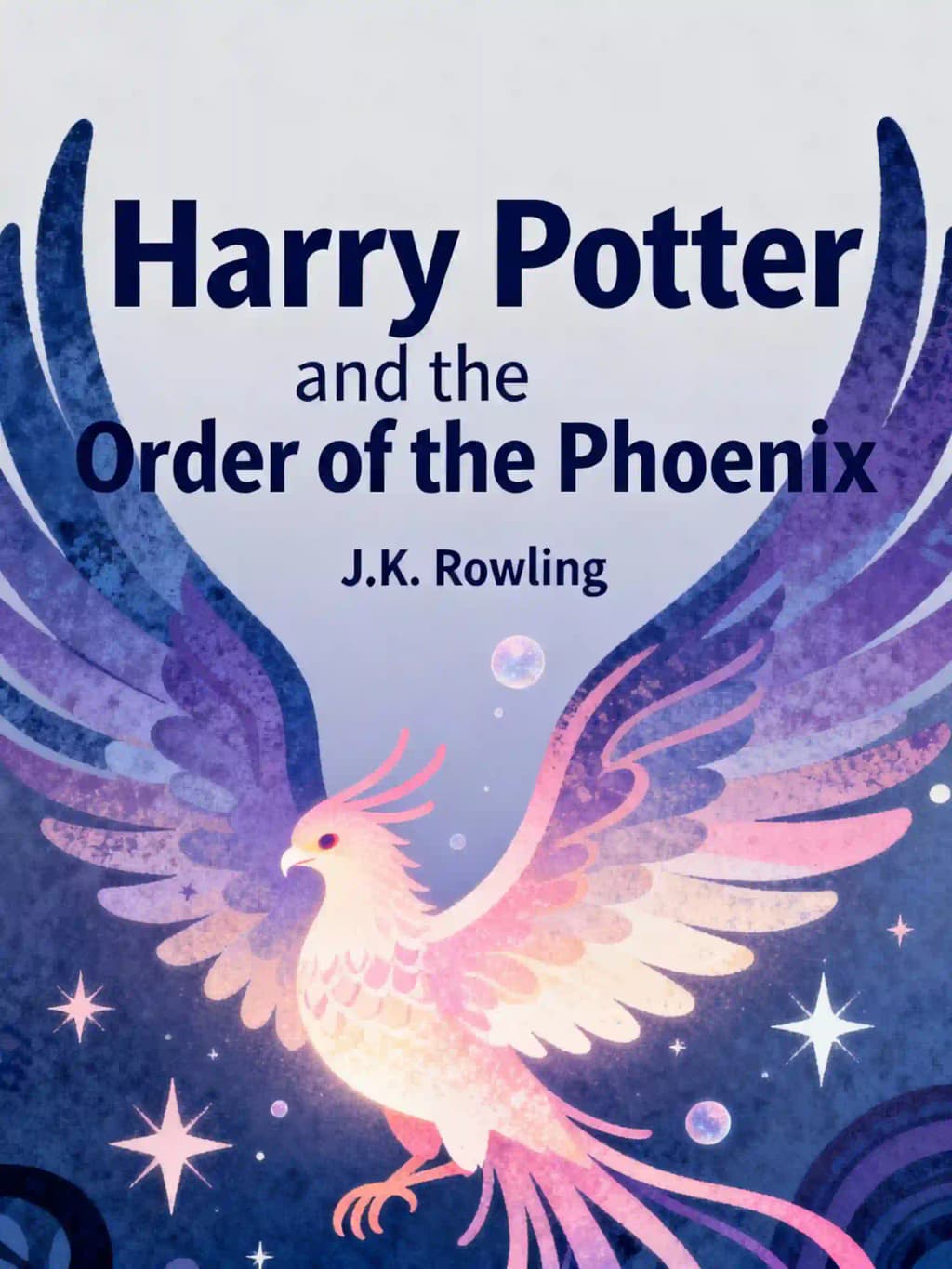
Harry Potter and the Order of the Phoenix marks a pivotal turning point in J.K. Rowling's beloved series. Published in 2003, this fifth installment became an instant cultural phenomenon, selling five million copies in its first 24 hours-a record at that time. The darker, more politically charged narrative resonated deeply with readers who found parallels to real-world struggles against propaganda and government overreach. Celebrities from Daniel Radcliffe to Emma Watson have cited it as their favorite in the series, with Watson noting how it captures "that moment when teenagers begin to question authority." The book's exploration of grief, resistance, and institutional corruption continues to influence young adult literature decades later, while phrases like "I must not tell lies" have become rallying cries for truth-seekers everywhere. As we follow Harry's most challenging year yet, we witness not just his battle against Voldemort, but his fight against something equally insidious-the manipulation of truth itself.
Capítulo 2
Darkness Falls: Dementors in Little Whinging
The sweltering summer in Little Whinging feels particularly oppressive to Harry Potter. Isolated from the wizarding world and haunted by nightmares of Cedric Diggory's death, Harry's frustration reaches a breaking point during an argument with his cousin Dudley. When Dudley cruelly mocks Harry about his nightmares, Harry threatens him with his wand-only for the situation to escalate beyond imagination when dementors suddenly appear in the suburban neighborhood.
The unnatural darkness that descends feels like more than absence of light-it's absence of hope itself. As the soul-sucking creatures approach, Harry struggles against their power, momentarily losing his wand when Dudley panics and punches him. The moment captures the terrifying vulnerability of being wandless against such creatures-like having your only lifeline ripped away when drowning.
What makes this encounter particularly significant is Harry's struggle to produce his Patronus. Unlike previous times, Voldemort's voice invades his mind, nearly paralyzing him with doubt. It's only by summoning memories of Ron and Hermione that Harry finally produces his silver stag, driving away the dementors-including one about to perform the soul-destroying Kiss on Dudley.
The aftermath brings another shock when Mrs. Figg, Harry's seemingly ordinary elderly neighbor, reveals herself as a Squib who has been secretly watching over him on Dumbledore's orders. Her presence suggests layers of protection Harry never realized existed, while her anger at Mundungus Fletcher for abandoning his post indicates a larger, organized effort to keep Harry safe.
This opening sequence brilliantly establishes the book's central tensions: Harry's isolation from both magical and Muggle worlds, the increasing reach of dark forces into supposedly safe spaces, and the realization that nothing-not even a quiet suburban street-remains untouched by the coming conflict. The dementors' appearance in Little Whinging represents the collapse of boundaries between Harry's school life and summer existence, foreshadowing how the coming war will eventually breach all protective walls.
Capítulo 3
Ministry Machinations: Politics and Persecution
The Ministry of Magic's response to the dementor attack reveals a disturbing shift in the wizarding government. Rather than investigating why dementors were in a Muggle suburb, they immediately target Harry with expulsion, treating him as the problem rather than the victim. This knee-jerk reaction exposes how deeply Minister Fudge's administration has committed to denying Voldemort's return-they'd rather punish a teenager than acknowledge the implications of rogue dementors.
Harry's emotional state deteriorates rapidly as he waits for his hearing. The isolation feels deliberate and cruel-four days with minimal communication, food slid through a cat flap, and cryptic messages warning him to "stay put." This treatment mirrors classic authoritarian tactics: isolate dissidents, control information flow, and create uncertainty about their fate.
When rescue finally arrives in the form of the "Advanced Guard," the contrast between these Order members and Ministry officials couldn't be starker. Tonks with her vibrant hair and casual demeanor, Lupin with his shabby but dignified presence, and Mad-Eye Moody with his paranoid but thorough security measures represent a different kind of authority-one based on mutual respect rather than intimidation.
The journey to the Ministry hearing itself becomes a metaphor for the labyrinthine bureaucracy Harry must navigate. Mr. Weasley guides him through underground passages, security checkpoints, and a maze of departments before descending to the courtrooms below-symbolically taking Harry deeper into the belly of an institution that has turned against him.
The hearing itself is a masterclass in power dynamics. The full Wizengamot assembled for a simple case of underage magic signals this is no ordinary proceeding but a political show trial. Fudge's repeated interruptions, his purple-faced rage, and determination to rush through evidence reveal a man more concerned with maintaining his narrative than discovering truth. When Dumbledore calmly dismantles each accusation with precise legal arguments, we see how thin the Ministry's case actually is-built on prejudice rather than facts.
Most telling is Umbridge's suggestion that perhaps the Ministry sent the dementors, which Dumbledore quickly turns into a logical trap: either the Ministry has lost control of its creatures or someone within the Ministry ordered an attack on Harry-both damning possibilities. This exchange foreshadows Umbridge's true nature and the Ministry's willingness to use violence to maintain control.
Harry's acquittal feels less like justice served and more like a temporary reprieve in an escalating conflict. The machinery of government persecution has been revealed, and though Harry escapes its gears this time, the apparatus remains in place, ready to grind down other victims.
Capítulo 4
Grimmauld Place: Headquarters and Heritage
Number Twelve, Grimmauld Place emerges from between buildings eleven and thirteen like a physical manifestation of the wizarding world's hidden conflicts. The headquarters of the Order of the Phoenix is no gleaming fortress but a decaying aristocratic home filled with dark artifacts and darker memories. Its very existence, concealed by powerful magic, represents how the resistance must operate-in shadows, between spaces, invisible to those who don't know exactly where to look.
The house itself becomes a character-hostile, resistant to cleaning, fighting against those who would purge its pure-blood legacy. The group battles doxies in the curtains, a murderous music box that induces drowsiness, and a grandfather clock that shoots bolts at passersby. These aren't random magical nuisances but manifestations of generations of Black family prejudice, literally embedded in the walls and furnishings.
At the center of this ancestral darkness stands Sirius Black, trapped in his childhood home, a place he despises. "The noble and most ancient House of Black" with its motto "Toujours Pur" (Always Pure) represents everything Sirius rejected, yet now he's confined there-a cruel irony that the man who escaped Azkaban finds himself imprisoned again, this time by circumstances and Dumbledore's orders. His frustration simmers throughout these scenes, occasionally boiling over in reckless suggestions and sharp remarks.
The Black family tapestry becomes a visual history of pure-blood ideology, with burn marks where "blood traitors" were blasted off-including Sirius himself. Through this tapestry, we see how intertwined all wizarding families are, how the Blacks connect to the Malfoys, the Weasleys, the Tonkses, and even Harry's own godfather. The wizarding world is revealed as a small, interconnected community where family politics and blood status have created deep, generational divisions.
Kreacher, the ancient house-elf, embodies the lingering poison of these ideologies. His muttered insults about "Mudbloods" and "blood traitors" while pretending to clean reflect how prejudice can become so ingrained it's almost unconscious. His devotion to the "noble" Black family traditions, even as he serves a master he despises, shows how systems of oppression create victims who perpetuate their own subjugation.
The cleaning of Grimmauld Place becomes more than household chores-it's symbolic warfare against entrenched bigotry. Each decontaminated room, each disposed dark artifact represents small victories against pure-blood supremacy. Yet some things resist removal, like the portrait of Sirius's mother permanently stuck to the wall with her Permanent Sticking Charm, screaming slurs at visitors-a reminder that some hatreds remain fixed, outliving even those who held them.
This gloomy setting perfectly captures the book's themes of inheritance and choice-what parts of our legacy we accept, what we reject, and how much freedom we truly have to escape the houses that shaped us.
Capítulo 5
Hogwarts Under Siege: Educational Decree by Educational Decree
Hogwarts, once Harry's sanctuary, transforms into contested territory as Ministry influence creeps into every corner. Dolores Umbridge's arrival signals this shift-her fluffy pink cardigan and girlish voice masking a ruthless determination to reshape the school according to Ministry dictates. Her first speech during the welcoming feast, though ignored by most students, contains the chilling promise to "prune practices that ought to be prohibited"-bureaucratic language concealing authoritarian intent.
The Educational Decrees become the weapons in this bloodless coup. Each new proclamation further restricts student freedoms and faculty autonomy: banning unauthorized student organizations, controlling teacher communications, forbidding The Quibbler, regulating Quidditch teams. These incremental changes demonstrate how institutions fall not through dramatic takeovers but through gradual normalization of control. By the time students realize how much freedom they've lost, the machinery of oppression is already firmly established.
Umbridge's classroom becomes ground zero for this ideological battle. Her theory-only approach to Defense Against the Dark Arts-with its emphasis on "Ministry-approved" textbooks and prohibition of practical magic-reveals the true agenda: creating a generation unable to defend themselves. When Hermione directly challenges this approach by asking how they'll protect themselves in the real world, Umbridge's response is telling: "Who do you imagine wants to attack children like yourselves?" This willful denial of danger outside classroom walls mirrors the Ministry's broader denial of Voldemort's return.
The inspection of teachers adds another layer of control, as Umbridge systematically undermines faculty authority. Her clipboard becomes a symbol of bureaucratic power, reducing experienced educators to nervous performers seeking approval. Her questions during Hagrid's evaluation, delivered in an insulting slow, loud voice, expose her prejudice against "half-breeds." Professor Trelawney's public humiliation and attempted expulsion demonstrate that Umbridge's campaign targets not just incompetence but difference itself-anyone who doesn't fit her narrow vision of magical propriety.
Most disturbing is Umbridge's detention system, where students write lines with a blood quill that carves words into their own flesh. "I must not tell lies" etched into Harry's hand represents the ultimate goal of authoritarian education-forcing students to inscribe the official narrative onto their very bodies. This physical manifestation of thought control shows how totalitarian systems seek not just obedience in action but conformity in belief.
The resistance that forms in response-Dumbledore's Army-represents education in its purest form: voluntary, practical, collaborative, and empowering. Meeting in the Room of Requirement, a space that literally becomes what students need, they create an alternative model of learning based on mutual support rather than hierarchical control. When Harry teaches the Patronus Charm, helping students defend themselves against the darkest creatures, it's a direct challenge to Umbridge's theory-only approach and the Ministry's denial of threats.
This educational battleground reveals the book's central conflict isn't just about who controls magic, but who controls knowledge itself-and by extension, the future of the wizarding world.
Capítulo 6
The Weapon of Truth: Media, Propaganda, and Resistance
In a world increasingly shaped by propaganda, truth itself becomes the most powerful weapon. The Daily Prophet's systematic campaign against Harry and Dumbledore demonstrates how easily media can be weaponized-subtle word choices like "the boy who lies" and "Dumbledore's growing senility" plant seeds of doubt without making direct accusations. This sophisticated approach to character assassination mirrors real-world propaganda techniques, where outright censorship is replaced by more insidious manipulation.
The Ministry's control extends beyond traditional media to interpersonal communication. When Umbridge inspects Harry's mail and monitors the Floo Network, we see how authoritarian systems maintain power by isolating dissidents and preventing the free exchange of information. Even Hogwarts itself, traditionally a place of learning, becomes an information battleground when Educational Decree Number Twenty-six forbids teachers from discussing anything unrelated to their subjects with students.
Against this backdrop, Harry's interview in The Quibbler represents a radical act of resistance. By sharing his unfiltered account of Voldemort's return, Harry bypasses official channels to speak directly to the wizarding public. The Ministry's panicked response-banning the magazine at Hogwarts-only increases its appeal, demonstrating the Streisand effect decades before the internet would name it. Students charm the magazine to appear as schoolwork, hide copies inside textbooks, and memorize passages to recite to friends-showing how censorship often amplifies the very messages it attempts to suppress.
The flood of supportive letters Harry receives afterward reveals a crucial truth: many wizards were waiting for an alternative to the official narrative. Some write that they believe him, others that they've always supported him, and still others apologize for doubting him. These varied responses show how propaganda works most effectively when it aligns with what people already want to believe-and how a single counter-narrative can crack that facade.
Hermione's brilliance shines in this information war. Her creation of the enchanted D.A. membership list with its jinx against informers shows her understanding that security requires consequences. When Marietta Edgecombe betrays the group and finds "SNEAK" written across her face in purple pustules, it's a harsh but effective reminder that betrayal leaves visible marks. Similarly, Hermione's fake Galleons for communicating meeting times represent resistance innovation-using ordinary objects to transmit forbidden information right under the oppressor's nose.
Even Harry's Occlumency lessons, though unsuccessful, highlight the battle for mental sovereignty. Voldemort's ability to plant false visions in Harry's mind-culminating in the tragic trap at the Department of Mysteries-shows how vulnerable we are when our sources of information can be corrupted. The mind itself becomes contested territory, requiring constant vigilance against manipulation.
By the book's conclusion, when the Ministry finally admits Voldemort's return after witnessing him firsthand, we see the ultimate limitation of propaganda: reality eventually asserts itself. No amount of newspaper articles or educational decrees can permanently suppress truth-they can only delay its recognition, often at terrible cost.
Capítulo 7
The Department of Mysteries: Prophecy and Consequence
The Department of Mysteries stands as both literal and metaphorical heart of the wizarding government-a labyrinth of rooms exploring the deepest questions of existence: time, thought, death, love, and prophecy. Harry's recurring dreams of its corridors throughout the book create a sense of inexorable movement toward this confrontation, as if the Department itself were calling to him.
When Harry and his friends finally enter this forbidden space, each room they encounter represents different aspects of magical understanding. The room of time with its endlessly aging and de-aging hummingbird suggests the fluidity of temporal experience. The chamber of brains with their ribbon-like thoughts demonstrates how consciousness can exist beyond its original vessel. Most haunting is the death chamber with its stone archway and fluttering veil-a literal threshold between worlds where voices whisper from beyond, audible only to those who've witnessed death.
The Hall of Prophecy, with its thousands of glass orbs collecting dust on endless shelves, reveals how much of wizarding history has been shaped by these mysterious predictions. The specific prophecy about Harry and Voldemort-that "neither can live while the other survives"-has driven the plot since before the series began, though neither Harry nor readers understood its full significance until now. This revelation transforms our understanding of the entire saga: Voldemort's obsession with killing Harry stems not just from vengeance but from existential self-preservation.
The battle that unfolds in these chambers demonstrates the practical consequences of theoretical magic. When prophecy orbs shatter, ghostly figures emerge reciting fragments of predictions. When Ron encounters the tank of brains, their thoughts wrap around him like physical tentacles. The veil between life and death becomes the literal instrument of Sirius's demise. These moments collapse the distinction between abstract magical concepts and their tangible, often devastating effects.
Sirius's death through the veil creates the book's emotional climax-a loss made more painful by its abruptness and ambiguity. Unlike a body that can be mourned, Sirius simply vanishes beyond the veil, leaving Harry (and readers) without closure. His final expression of "mingled fear and surprise" captures the fundamental injustice of death-how it often comes without warning or dignity, taking even the bravest mid-laugh.
The subsequent possession scene, where Voldemort briefly inhabits Harry's body, represents the ultimate violation of boundaries. Yet Harry's grief for Sirius becomes his salvation-the emotion is so powerful, so raw, that Voldemort cannot bear to remain within him. This moment reveals the book's most profound truth: that love and grief, our most human qualities, are not weaknesses but sources of strength that dark magic cannot tolerate or understand.
In the Department's circular room where all doors look identical, Harry and his friends face the fundamental challenge of navigation without clear markers-a metaphor for adolescence itself. Each choice of door leads to different dangers, and when the walls spin, they lose all sense of where they've been. This disorientation mirrors Harry's larger journey through a world where trusted institutions prove corrupt, mentors keep secrets, and certainties dissolve into questions.
Capítulo 8
The Weight of Prophecy: Destiny vs. Choice
The revelation of the prophecy that has shaped Harry's life since infancy forces him to confront profound questions about fate and free will. "Neither can live while the other survives" suggests an inescapable destiny-that Harry's life has always been moving toward a final confrontation with Voldemort. This knowledge transforms his understanding of his own identity and purpose, adding enormous weight to his already burdened shoulders.
Dumbledore's explanation of the prophecy contains a crucial insight: prophecies only gain power when people choose to believe in them. Had Voldemort ignored Trelawney's prediction, it would have become merely "words of interest, perhaps, but no more." Instead, by acting on the prophecy-by marking Harry "as his equal"-Voldemort himself created the very enemy destined to defeat him. This self-fulfilling aspect suggests that our choices, not predetermined fate, ultimately shape our destinies.
The ambiguity within the prophecy itself leaves room for agency. It could have applied to either Harry or Neville Longbottom-both boys born as July died to parents who had thrice defied Voldemort. Voldemort's choice to target Harry-the half-blood like himself rather than the pure-blood Neville-reveals his own prejudices and fears. Even within prophecy's constraints, choices determine outcomes.
This tension between fate and choice appears throughout the book. When the Sorting Hat sings of house divisions threatening Hogwarts, it warns students to "unite or we'll crumble from within"-predicting danger but leaving the response to individual choice. Similarly, when centaur Firenze teaches Divination, he emphasizes that even centaurs sometimes misread the stars: "We observe the heavens for great tides of evil or change that are sometimes marked there. It may take ten years to be sure of what we are seeing."
Harry's struggle with this knowledge manifests physically and emotionally. His scar burns more frequently, his dreams become more intense, and his temper flares unpredictably. These symptoms reflect not just his connection to Voldemort but the psychological burden of knowing one must either become a murderer or a victim. When he asks Dumbledore if he must kill Voldemort, the headmaster's affirmative answer confirms his worst fear-that his destiny includes an act fundamentally opposed to his nature.
Dumbledore's confession that he delayed sharing this information because he "cared more for your happiness than your knowing the truth" highlights the central ethical dilemma of the book: when does protection become harmful? By shielding Harry from knowledge vital to his survival, Dumbledore inadvertently endangered him. This revelation transforms our understanding of Dumbledore's character-his wisdom is profound but flawed by emotional attachments he claims to understand better than Voldemort but struggles to manage himself.
The prophecy's final line-"neither can live while the other survives"-takes on deeper meaning beyond physical existence. Throughout the book, Harry isn't truly living but surviving-isolated, persecuted, and haunted by trauma. The prophecy suggests that only by confronting Voldemort, the source of this suffering, can Harry ever truly live. This interpretation transforms the prophecy from death sentence to potential liberation-a path through suffering rather than an inevitable end.
Capítulo 9
Grief, Loss, and Moving Forward
Grief permeates the narrative, from Harry's nightmares about Cedric's death to the devastating loss of Sirius Black. The book captures grief's complexity-how it manifests not just as sadness but as anger, isolation, and sometimes emotional numbness. Harry's outbursts throughout the year reflect the volatility of unprocessed trauma, while his tendency to withdraw from friends demonstrates grief's isolating power.
Sirius's death represents a particularly cruel loss for Harry. Having finally found a parental figure who offered unconditional love and the promise of a real home, Harry loses him just as suddenly as he found him. The manner of Sirius's death-falling through the veil in the Department of Mysteries-denies Harry even the closure of a body to mourn. This ambiguous ending mirrors the disorienting nature of grief itself-the difficulty of accepting finality when there's no concrete evidence of death.
Harry's immediate reaction-denial, followed by desperate pursuit of Bellatrix-captures grief's first chaotic stages. His attempt to use the Cruciatus Curse shows how pain can temporarily transform even the most compassionate person. When Voldemort possesses him, it's Harry's grief for Sirius-his desire to die and join him-that ultimately forces Voldemort out, unable to bear such raw emotion. This moment reveals grief's paradoxical power: it can destroy us or save us, depending on how we channel it.
Different characters model various approaches to loss. Luna Lovegood, who lost her mother at nine, demonstrates resilience through radical acceptance. Her matter-of-fact statement about hearing voices beyond the veil-"They're just lurking out of sight, that's all"-offers Harry his first real comfort. Her perspective that loved ones are never truly gone challenges conventional boundaries between life and death.
Neville Longbottom carries a different kind of grief-for parents who are physically alive but mentally absent after being tortured into insanity by Death Eaters. The poignant scene where his mother gives him an empty gum wrapper, which he quietly pockets despite his grandmother dismissing it as trash, shows how even the smallest connection to lost loved ones becomes precious. Neville's transformation throughout the book, from timid follower to determined fighter, demonstrates how grief can ultimately strengthen rather than diminish us.
Dumbledore's approach to Harry after Sirius's death marks a significant change in their relationship. Rather than shielding Harry from painful truths as he had previously, Dumbledore finally shares everything-about the prophecy, about his own mistakes in distancing himself from Harry, about the power of love that saved Harry from Voldemort's possession. This transparency, though belated, offers a path forward through honesty rather than protective deception.
The book ends not with resolution but with continuation-Harry boarding the Hogwarts Express, still grieving but supported by friends who promise to bring him back to them soon. This open ending acknowledges that grief doesn't conclude neatly but becomes integrated into our ongoing lives. The final image of Harry leading the way out of the station into "the sunlit street" suggests that even after devastating loss, we can still move toward light, carrying our grief with us rather than being consumed by it.
Capítulo 10
The Power of Community: Resistance Through Unity
In a world increasingly divided by fear and propaganda, the formation of Dumbledore's Army represents the book's most hopeful counterpoint to rising darkness. What begins as practical necessity-learning defensive magic Umbridge refuses to teach-evolves into something more profound: a community bound by shared purpose and mutual support.
The D.A.'s first meeting at the Hog's Head brings together students across house boundaries-Gryffindors, Hufflepuffs, and Ravenclaws united despite traditional rivalries. Only Slytherin remains unrepresented, highlighting how house divisions mirror the larger wizarding world's fragmentation. When Zacharias Smith questions Harry's credibility, the group's defense of Harry demonstrates their growing recognition that unity requires trust, even without complete certainty.
The Room of Requirement itself symbolizes the perfect learning environment-responsive to students' needs, equipped with relevant resources, and hidden from oppressive authority. Unlike Umbridge's classroom with its rigid rows and silence, the D.A. space encourages movement, collaboration, and practical application. Students learn not just spells but confidence in their own abilities.
Harry's transformation from reluctant teacher to effective leader represents his growth beyond individual heroism toward community building. Initially uncomfortable with praise for his past achievements, he gradually embraces his ability to share knowledge and inspire others. His teaching method-demonstrating spells, offering individual guidance, celebrating small victories-contrasts sharply with both Umbridge's rigid textbook approach and Snape's intimidation tactics.
The impact extends beyond magical skills to personal growth. Neville Longbottom's dramatic improvement-from barely managing simple spells to mastering complex defensive magic-shows how supportive community can nurture potential that hierarchical education suppresses. Similarly, Luna Lovegood, often marginalized for her unusual perspectives, finds acceptance within the group. Even Hermione, typically defined by academic achievement, develops practical innovations like the enchanted coins and the jinxed membership list.
This community-building extends beyond Hogwarts to the Order of the Phoenix itself. The intergenerational alliance of Aurors, teachers, parents, and recent graduates models how diverse skills and perspectives strengthen resistance. Tonks's Metamorphmagus abilities, Kingsley's Ministry connections, Mrs. Weasley's fierce protectiveness, and Lupin's experience with dark creatures all contribute to a whole greater than its parts.
The contrast between these communities and Voldemort's followers is striking. Death Eaters operate through fear and domination-Bellatrix torturing Neville, Lucius threatening Harry, Voldemort possessing his followers. Their hierarchy depends on absolute obedience rather than mutual support. Even their escape from Azkaban, initially presented as evidence of their power, actually demonstrates their dependence on dementors-creatures that feed on human misery.
By the book's conclusion, when Harry faces Voldemort in the Ministry atrium, the difference in their power sources becomes explicit. Voldemort, attempting to possess Harry, cannot tolerate the emotional force of Harry's grief for Sirius. As Dumbledore later explains, "In the end, it mattered not that you could not close your mind. It was your heart that saved you." This fundamental distinction-between power based on domination versus power based on connection-suggests that community itself may be the ultimate weapon against darkness.